

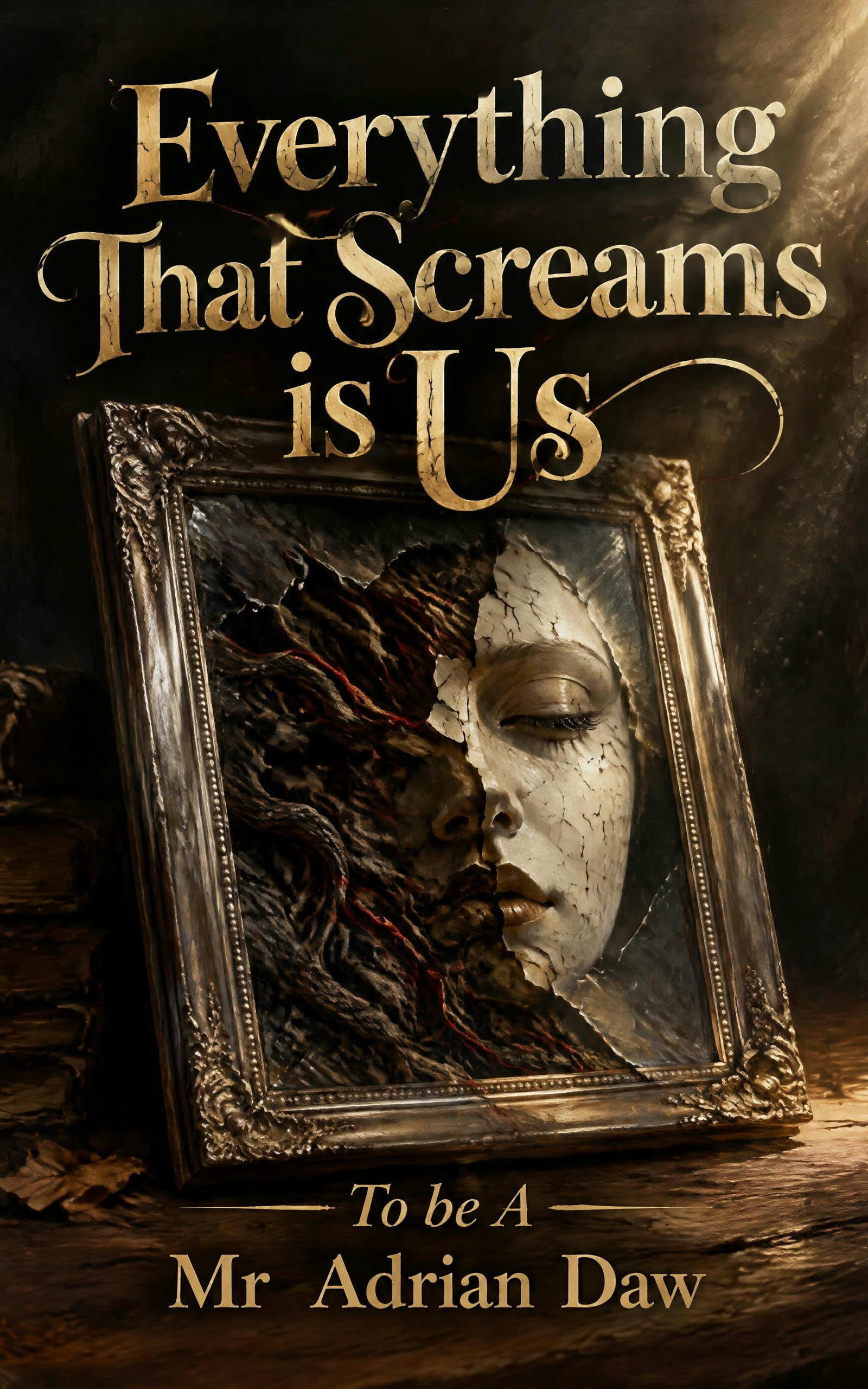
Everything That Screams is Us
To be A
by Mr Adrian Daw
Oakridge is not changing. It is remembering something else. When Liam Turner returns alongside the fractured survivors of the Dreamscape, home no longer offers sanctuary. Pavements lead nowhere, familiar houses warp overnight, and the faces in family photographs belong to utter strangers. The fragile barrier guarding waking reality is shattering completely. Victor Blackstone has returned, wielding a far crueller weapon than nightmare beasts: the systematic erasure of memory. He twists the past until childhood companions recall entirely different lives, tearing apart the collective trust keeping the group tethered to sanity. Max's frantic sketches leave physical scars upon the landscape, Zachary wrestles with a dark corruption beneath his skin, and Emma's gaze conceals an unbearable mystery. To save Oakridge from slipping permanently beyond recovery, Liam must confront the one truth he has spent a lifetime running from. The greatest terror was never annihilation—it was being forgotten whilst still breathing. In this heart-stopping conclusion to the Everything That Screams Is Us trilogy, survival demands remembering who you are, before reality itself is rewritten forever.
- Speculative Fiction
- Dark Fantasy
- Supernatural Thriller
- Horror
- Psychological Horror
The Wrong Colour of Morning
Through the thin glass of Dixon’s Diner, the morning light lay flat and colourless across the counter. Liam sat with both hands wrapped around a chipped mug, trying to count the seconds between the hiss of the espresso machine and the scrape of a spatula on the grill. The air smelled of burnt coffee and cheap detergent, a combination that should have been ordinary enough to hold him still. He focused on it, the way he always did when the edges of things began to loosen.
Steam lifted from the mug in slow, deliberate coils, moving against the quiet draught of the diner. The vapour twisted back on itself, gathering into dense knots that held their shape for seconds too long before collapsing into thin, violent whorls. He blinked hard. The steam broke apart into ordinary mist, then rose again, moving in rigid, mathematical angles that no smoke had ever followed.
The coffee was no longer brown. It had thickened into a viscous black that clung to the ceramic in slow, oily sheets. When he tilted the mug, the liquid did not pour; it stretched, a dark membrane that refused to break. A drop finally fell and struck the saucer with a sound like wet paper tearing. The stain spread in a perfect circle, glossy and wrong.
Outside, Oakridge High Street looked exactly as it had the day before: the same shop fronts, the same staggered parade of lampposts, the same wet blacktop still shining from overnight dew. Yet every person walking past the window moved with the same measured stride, left foot, right foot, arms swinging in precise unison. A woman in a blue coat turned her head at the exact second a man three paces behind her turned his. Their faces held no expression, only the blank readiness of something waiting for the next cue.
Liam pushed the mug away, watching the ink cling to the ceramic rim in a thin, dark line. He stood, left a few coins on the counter without counting them, and walked towards the door. The bell above it gave a flat, mechanical note.
Ethan was already there, one hand on the frame, as if he had been waiting. For a single heartbeat his face was nothing: a smooth slab of skin where eyes and mouth should have been, featureless as poured wax. Liam’s breath caught. Then the features returned—Ethan’s ordinary eyes, the slight crease of concern—and the moment might never have happened.
“You all right?” Ethan’s voice was steady, the same calm tone he used when everything else was not.
Liam nodded once. The lie sat between them like a heat haze, bending the light so that Ethan’s shoulders seemed to shift an inch to the left of where they actually were. They stood in the doorway while the street continued its perfect, synchronised traffic. Neither mentioned the blank face. Neither needed to.
The walk home took longer than two blocks should. Liam catalogued every sensory detail the way he always did when the world threatened to slide: the cratered pavement forcing him to adjust his stride, the chemical tang rising from a storm drain, a leaf blower starting up somewhere behind him and pushing him forward with sheer noise. The houses looked smaller than they should, each carrying its familiar cosmetic defect—a missing shutter, a porch step painted the wrong colour—but the defects felt rehearsed now, placed for his benefit.
Inside the kitchen, the light was yellow and too warm. Elena stood with her back to him, arms folded, staring at the longest wall. The wall was bare except for a neat band of rectangles lighter than the surrounding paint, scars left by photographs that had never hung there since they moved in.
“Mum?”
She did not turn. “I’m looking at the family portrait. The one from your father’s side. You remember it.”
There was no portrait. There had never been one in this house. Liam stepped closer. The air near the wall felt damp, slightly warmer than the rest of the room. He raised his hand and pressed his palm flat against the surface.
The wallpaper peeled back under his fingers with a soft, wet sound. Beneath it was not plaster or wood but a grey, pulsating membrane that contracted once, like a slow breath. A thin, clear fluid welled along the tear. The whole house seemed to inhale around him—floorboards flexing, ceiling beams creaking in a rhythm that matched a living chest.
Elena continued to stare at the place where the portrait was not. “It was always here,” she said, voice calm, almost fond. “We just forgot to look.”
Liam pulled his hand away. The grey muscle flexed again, sealing the tear with a seam that looked like scar tissue. He understood then, with the cold clarity that arrives after a long denial: the fresh start they had driven toward, the smaller house, the quiet street, the careful imperfections—all of it had been arranged. The Dreamscape had built them a cage that looked like safety and invited them to live inside it.
From the cellar stairs came a voice he had not heard in years, low and familiar and impossibly close.
“Liam. Come down here a minute.”
His father’s voice. Dead for years. Calling as if the man were simply waiting at the bottom of the steps with a toolbox or a question about homework.
Elena did not react. She kept watching the blank wall, smiling faintly at something only she could see. The house exhaled again, a long slow release of air that smelled of dust and old rain. Liam stood frozen between the kitchen table and the cellar door, the black stain of the diner coffee still faintly visible on his fingertips, while the voice rose once more, patient and inevitable.
“Liam. I know you’re there.”
He did not move. The walls breathed. The town outside kept perfect time. And somewhere beneath the linoleum the grey muscle waited for the next beat of whatever heart now lived inside the house.
Echo Architecture
The mill sits on the river like a tooth that never healed. Ethan leads them along the towpath without looking back, as if looking back would give the building permission to move. Liam keeps pace half a step behind, counting the gaps in the brickwork, the places where ivy has failed and left pale scars. Max’s sketchbook is open in his hands. The loa…