
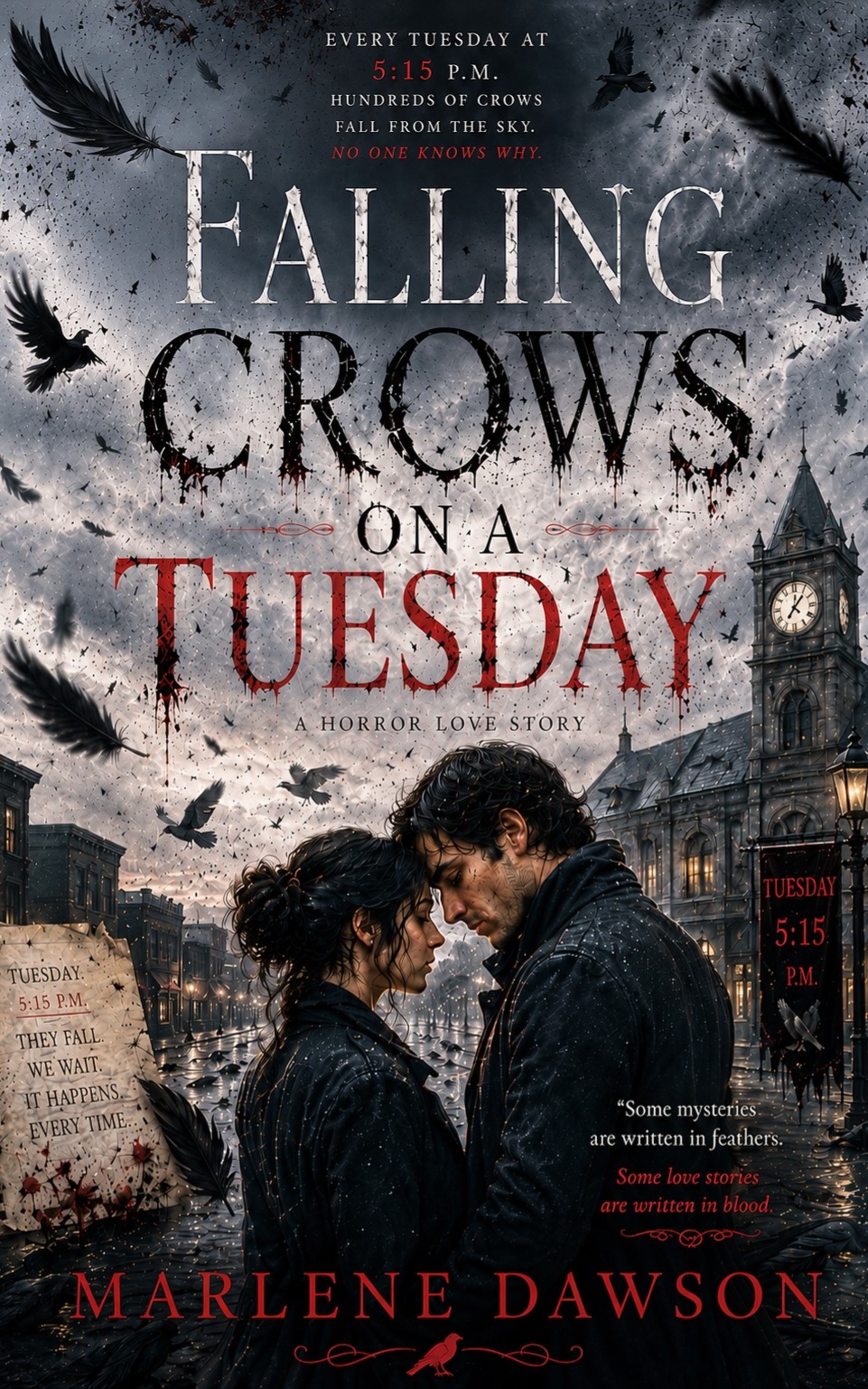
Falling Crow on a Tuesday
When the sky rains black feathers, the heart learns to fear the coming Tuesday
by Marlene Dawson "Mystic Ember"
Science cannot explain the rain of feathers and hollowed-out hearts in Oakhaven. Every Tuesday at exactly 5:15 PM, the sky goes dark as hundreds of crows drop dead, their bodies devoid of life but untouched by poison. For Dr. Evelyn Shaw, a clinical ornithologist, the phenomenon is a biological impossibility she is determined to solve. But when she arrives in the eerie town, her data-driven logic crumbles before the terrifying reality of the Blackwood Marsh. Nathan Cole, a reclusive biologist with a haunted past, has been tracking the shadows for years. Together, they unravel a dark tapestry of ancient family secrets and supernatural debt. The Vane family is preparing for an ascension, and the crows are merely the appetizer for an entity that has grown hungry for larger prey. As the 'Tuesday Event' begins to mark Evelyn herself, the investigation transforms into a desperate struggle for survival. Amidst the rot of the swamp and the rising tide of horror, an unlikely romance flickers into life—a fragile light in a town built on blood. To stop the cycle, Evelyn must choose between the cold facts of her training and the visceral, magical truth required to survive the final sacrifice. In Oakhaven, the silence is louder than the scream.
- Romance
- Horror
- Supernatural Horror
- Small Town Romance
The 5:15 Rain
The dashboard clock clicked to 5:14 PM. Outside the windshield of the rental sedan, the air in Oakhaven town square hung thick and greasy, smelling of stagnant river water and impending rain. Dr. Evelyn Shaw adjusted the focus on her high-speed digital camera, her fingers slick with sweat. A silver thermos, dented from years of field work and stained with stale espresso, rattled in the cup holder as the engine idled. She didn’t turn it off. The vibration was the only thing keeping her grounded in the stifling, humid silence of the late afternoon.
According to her notes, the viral videos she had spent the last three weeks analyzing weren’t the result of clever editing or digital manipulation. She had run the pixels through every forensic filter she owned. The trajectories were too perfect, the deceleration too uniform. It had to be a localized biological anomaly. A massive, coordinated chemical spill, perhaps, or a highly localized acoustic frequency that disrupted the inner ears of the local corvid population. She had her sensors active, a portable spectrum analyzer humming on the passenger seat, its green interface casting a sickly glow over her waxed canvas jacket.
“Five fourteen,” she muttered, her voice tight and clinical in the cramped cabin. “Barometric pressure is holding at one thousand twelve millibars. Winds are negligible. If this is a chemical event, the dispersal pattern should be circular.”
She checked her watch again. Her heart hammered a frantic rhythm against her ribs, a physical rejection of the cold logic she tried to cling to. She was a woman of data, of rigid migratory patterns and predictable avian pathology. This town, with its low-slung brick storefronts and dark, overhanging oaks, felt like a place where data went to die.
At exactly 5:15 PM, the bell in the central clock tower tolled once. The sound was flat, heavy, and devoid of resonance, like iron striking wet clay.
Then, the sky died.
A shadow fell over the square, but it wasn’t a cloud. The pale, humid gray of the afternoon was instantly swallowed by a swirling, chaotic vortex of black feathers. Hundreds of crows appeared from the upper atmosphere, not flying, but falling. They did not flap their wings. They did not cry out. They dropped like heavy, feathered stones, their bodies perfectly aligned in a synchronized, sickening plummet toward the earth.
Evelyn gasped, her finger freezing on the camera’s shutter button. The sky seemed to empty itself in a fraction of a second.
The impact was a chorus of wet, heavy thuds that vibrated through the chassis of her car. One crow slammed directly onto the hood of her rental, its breastbone shattering with a sharp crack that sounded like a dry branch snapping. Another hit the windshield directly in front of her face. A violent burst of dark, viscous blood erupted across the glass, thick and hot, leaving a jagged smear that slowly trickled down into the wiper well. The smell of copper and sudden, violent death seeped through the car’s ventilation system, rich and suffocating.
Evelyn stared through the blood-spattered glass. Across the square, the horror of the event was eclipsed by the horror of the reaction. Or rather, the lack of one. The local townspeople didn’t scream. They didn’t run for cover. As the birds continued to rain down around them, striking the brick sidewalks and the roofs of parked trucks, people simply reached into their bags. With practiced, synchronized movements, they opened black umbrellas. They kept walking, their boots stepping over and occasionally crushing the twitching, broken carcasses underfoot. A woman pushing a stroller adjusted her path slightly to avoid a particularly large specimen, her face as blank as a slate tablet.
“This isn’t happening,” Evelyn whispered, her hands shaking as she grabbed her camera. “It’s a collective hallucination. Or a neurotoxic agent.”
Driven by a desperate need to touch the reality of the situation, she threw open the car door. The thick, humid air hit her, carrying the heavy stench of raw iron and decay. Her heavy leather boots clicked on the asphalt as she stepped into the aftermath of the downpour. The square was covered in black bodies, a carpet of glossy feathers and broken wings. Many were still twitching, their legs jerking in silent, post-mortem spasms.
Evelyn knelt beside the bird that had struck her hood. It had slid off onto the gravel. Her fingers, pale and trembling, reached out to touch the sleek feathers of its neck. The body was still incredibly warm, almost feverish, radiating a heat that felt entirely unnatural for a dead animal. She gently turned its head toward the fading light.
Her breath hitched. The bird’s eyes weren’t the deep, intelligent black of a healthy corvid. They had turned into milky, white marble, completely opaque and devoid of pupils, as if the life had been instantly bleached out of them at the moment of impact.
“No corneal clouding happens this fast,” she muttered, her scientific vocabulary failing to mask the rising panic in her chest. “It’s pathologically impossible. The ocular fluid doesn’t just coagulate in seconds.”
“You’re trying to measure the wind with a net, Doctor.”
The voice was smooth, oily, and close. Evelyn flinched, dropping the bird’s head, and scrambled to her feet. A shadow fell over her, blocking out the dim light of the square.
Standing before her was Silas Vane. He was impeccably dressed in a dark, expensive wool suit that looked absurdly out of place in the muddy, isolated town. His salt-and-pepper hair was slicked back, and a heavy gold signet ring glinted on his finger as he checked a gold pocket watch. He closed it with a soft click and smiled down at her, a predatory, mocking expression that didn’t reach his sharp, gray eyes.
“Silas Vane,” she said, her voice rising to defend her. She wiped her bloody fingers on her trousers. “You’re the land developer who’s been buying up the properties near the marsh.”
“And you are the avian pathologist who thinks she can solve Oakhaven’s little quirk with a camera and a silver thermos,” Silas replied, stepping over a dead crow with effortless grace. He leaned slightly toward her, smelling of expensive cigars and cold, wet iron. “I assure you, Doctor, some things in this world aren’t meant to be measured by a ruler. The sky has its own ledger, and here, we simply pay the bill.”
“This is a biological disaster,” Evelyn said, her eyes flashing with a mix of anger and fear. “The townspeople are walking through this like it’s nothing but a light drizzle. You’re all poisoning these birds, or worse.”
Silas laughed, a dry, rattling sound. He took a step closer, his physical presence looming over her small frame. “We do what we must to survive, Dr. Shaw. But a smart woman like you should know when a habitat is no longer hospitable. I’d advise you to pack up your little sensors and leave. Before next week’s storm. It promises to be much, much heavier.”
The Hermit of Blackwood
The road to the Blackwood Marsh was less of a road and more of an open wound through the pines, choked with wet gravel and the bloated roots of ancient hemlocks. Evelyn pushed her rental sedan as far as the chassis could bear before the mud threatened to swallow the tires whole. When she stepped out, the air hit her throat like a wet wool blanket. …