
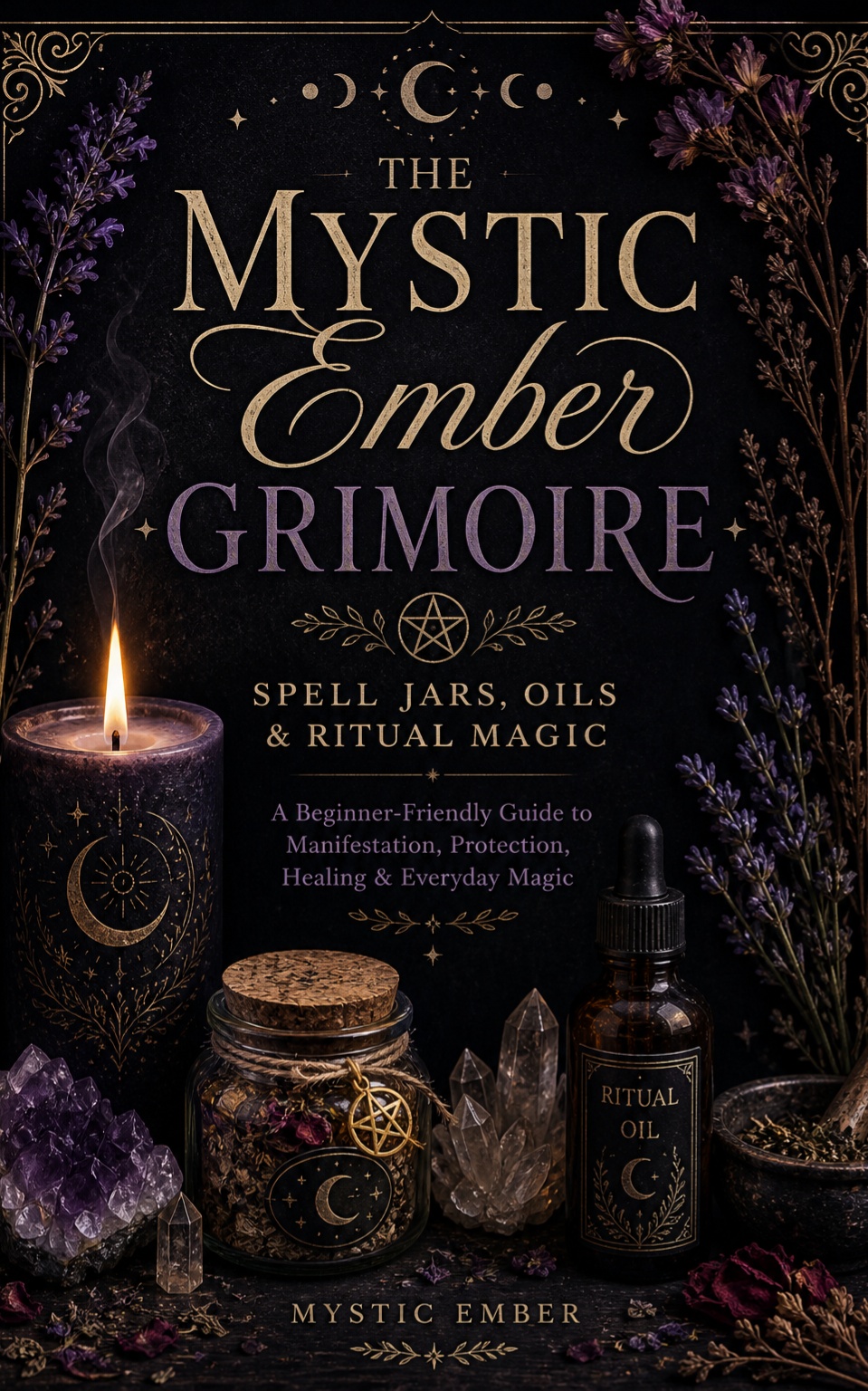
The Mystic Ember Grimoire
Awaken your inner spark through the transformative art of ritual oils and intentional magic
by Marlene Dawson "Mystic Ember"
Ignite the fire within and transform your daily life into a sacred journey of self-discovery. In The Mystic Ember Grimoire, seasoned practitioner Marlene Dawson invites you to bridge the gap between ancient wisdom and modern mindfulness. This isn't just a book of spells; it is a comprehensive guide to reclaiming your personal power through the tactile magic of the natural world. Whether you are a curious beginner or a seasoned seeker, you will learn to harness the 'Ember'—the internal spark of will that fuels all manifestation. Discover the art of crafting potent spell jars for protection, blending fragrant ritual oils for emotional healing, and mastering the focused intensity of candle magic. Dawson provides clear, step-by-step instructions that demystify esoteric practices, making them accessible and sustainable for a busy modern lifestyle. Inside, you will find: • The philosophy of intention-based magic and the history of folk traditions. • Detailed recipes for oils and jars tailored to personal growth and resilience. • Techniques for using color and light to focus your mind and manifest change. • Reflection exercises to help you trust your intuition and build a resilient inner landscape. Your path to empowerment begins with a single spark. Are you ready to tend your flame?
- Non-fiction
- Body, Mind & Spirit
- Witchcraft
- Magic
- Self-Help
- Mindfulness
The Inner Spark: Understanding Intention
Somewhere deep in human history, before written language, before organized religion, before the first city was ever built, a person sat by a fire and wished for something. Maybe they wished for rain, or for healing, or for the safe return of someone they loved. And in that wishing, they did something that felt too important to leave to chance. They acted. They arranged stones in a circle, or spoke words to the dark, or tied a knot in a piece of cord. They reached inward, grabbed hold of something real and burning, and pointed it at the world.
That is where magic begins. Not in a cauldron, not in a dusty book, not in any tool you can buy. It begins with you.
This chapter is about that starting point. Before you ever fill a spell jar or light a candle, you need to understand the force that makes any of those things work. That force is intention, and learning to work with it consciously is the single most important skill you will develop in this practice.
Where It All Started
Across nearly every ancient culture, magic operated on a principle anthropologists call sympathetic magic: the idea that like affects like, and that things which were once connected remain connected. A healer in ancient Egypt might press a carved image of a healthy body against a sick person, willing the image's wholeness into the patient's flesh. A farmer in medieval Europe might bury a handful of last year's grain at the edge of a field to encourage this year's crop to grow. Indigenous cultures across the Americas, Africa, and Asia used ritual objects, songs, and repeated actions to align human desire with the forces of the natural world.
What all of these traditions share is not a specific tool or deity. It is the deliberate, focused use of the human mind. The object was always secondary to the person holding it. The candle, the herb, the stone: these were anchors for attention, not sources of power themselves. They helped the practitioner hold a clear, unwavering picture of what they wanted. The magic was always the intention behind the act.
This is the lineage your practice belongs to. You are not starting something new. You are picking up a thread that humans have been weaving for tens of thousands of years.
Finding Your Ember
Before we go any further, let's do something practical. You don't need anything for this except a few quiet minutes.
Sit comfortably. Let your hands rest in your lap, close your eyes, and take three slow breaths. Don't count them or control them too tightly. Just breathe and let your body settle.
Now, with your eyes still closed, bring your attention to the center of your chest. Not your heart exactly, but that warm space just behind your sternum. Imagine there is a small ember there, the kind you'd find at the base of a fire after the flames have calmed down. It glows orange and deep red. It isn't blazing, but it is alive.
Take one slow, deliberate breath and imagine that breath feeding the ember. Watch it brighten slightly. Feel a faint warmth spread outward from that spot. Take another breath. The ember grows steadier. It isn't a roaring fire. It doesn't need to be. It is simply there, consistent, quiet, and yours.
Open your eyes when you're ready.
That sensation, even if it was subtle, even if you had to work to imagine it, is what this entire book is pointing toward. That is The Ember: your internal source of will, focus, and creative energy. Every ritual in this book is just a way of stoking it.
Why Intention Is the Steering Wheel
Here is a useful way to think about it. You could have the most beautiful, well-crafted spell jar in the world, filled with the right herbs, sealed with the right color wax, placed in the right spot in your home. Without intention behind it, it is a pretty object on a shelf. The jar holds the potential. You activate it.
Dion Fortune, one of the most influential magical philosophers of the twentieth century, wrote that "magic is the art of changing consciousness at will." Notice that she didn't say magic is the art of changing your circumstances, or changing other people, or changing the weather. She said consciousness. The inner shift comes first. The outer shift follows.
This lines up neatly with something psychologists call the observer effect in attention research. When you focus clearly on a specific goal, your brain's reticular activating system, the filter that decides what information reaches your conscious mind, starts tuning in to anything relevant. You've experienced this already. Think of the last time you learned a new word and then heard it three times in the same week. The word was always there. You just weren't listening for it. Focused intention works the same way. You're not creating opportunities out of nothing; you're training your mind to recognize the ones that were already there.
Magic is a partnership. You bring the intention; the universe provides the openings. Your job is to be clear about what you're asking for and present enough to see the response when it arrives.
Three Practices to Build the Habit
Knowing that intention matters is one thing. Making it a daily habit is another. Here are three small practices you can start using right now, before you own a single magical tool.
The Clarity Breath
This takes thirty seconds. Whenever you feel scattered or mentally foggy, before a meeting, before a difficult conversation, or just when your morning feels like it's already getting away from you, stop. Inhale slowly for four counts, hold for four counts, exhale for four counts, and hold the empty breath for four counts. This is sometimes called box breathing, and it works by activating your parasympathetic nervous system, pulling you out of reactive mode and back into a state where focused thought is possible. As you exhale, picture mental static clearing, like dust settling after a door slams shut. You don't need to be perfectly calm. You just need to be a little more present than you were a moment ago.
The Morning Spark
Every morning, before you look at your phone or start running through your to-do list, pour yourself a glass of water. While you drink it, choose one word for the day. Just one. It might be patience, or clarity, or courage, or ease. Say it quietly to yourself or just hold it in your mind. This is your intention for the next sixteen hours. You are not commanding the universe to deliver it. You are simply pointing your attention in a direction. Throughout the day, when something pulls you off course, come back to your word. This is the "I Am" method made as simple as possible: you are not describing who you currently are, you are naming who you are choosing to be today.
The Threshold Guard
Doorways have been treated as magical boundaries in cultures all over the world, and for good reason. Crossing a threshold is a natural transition point, a moment when your mental state can shift. Start using yours intentionally. When you leave your home in the morning, pause at the door for three seconds. Imagine a warm golden thread extending from that ember in your chest outward into the day ahead. You are carrying your intention with you. When you return home, pause again. Take one breath and consciously leave whatever you're carrying at the door. You are not bringing the noise of the day into your sanctuary. This visualization takes no time, but done consistently, it trains your mind to treat your home as a protected, intentional space.
Your First Grimoire Steps
A grimoire is your personal record of your magical practice, your experiments, your questions, and your results. You'll be building yours throughout this book. To start, you need one dedicated notebook. It doesn't have to be beautiful or expensive. What matters is that it's only for this.
Tonight, or whenever you next have five quiet minutes, open to the first page and write at the top: Why I am here. Then spend five minutes writing without stopping. Don't edit, don't second-guess, just write. What do you want to change? What do you want to feel more of? What are you tired of feeling? This is your first act of intention-setting, and it is more powerful than any herb or crystal you will ever use.
Also: choose a spot in your home where you'll practice. It can be a corner of a desk, a windowsill, or a small table. Somewhere you can return to consistently. Set a daily alarm on your phone for a one-minute mindfulness check-in, just sixty seconds to ask yourself how you're actually doing. These aren't decorative steps. They are the foundation.
The most important tool in your kit is already inside you. Everything else in this book is just a way of helping you remember that.
The Witch's Pantry: Essential Tools and Safety
Your kitchen already knows things you've forgotten. Long before witchcraft had an aesthetic, before there were spell kits on Etsy or crystals sold in boutique shops, the practice of magic lived in ordinary places. It lived in pantries and windowsills, in the salt crock by the stove and the bundles of herbs hanging from ceiling beams to dry. The peo…