

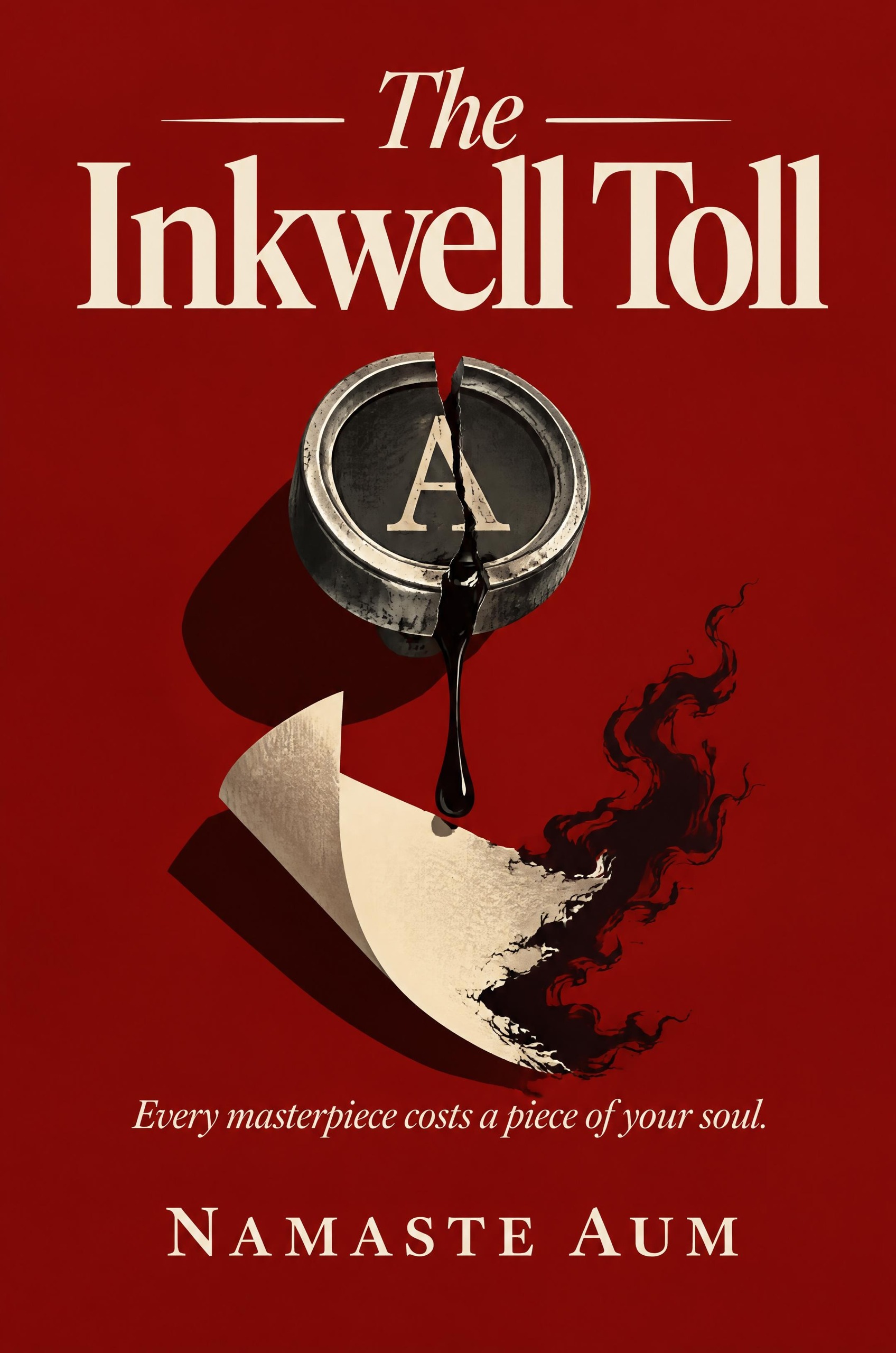
The Inkwell Toll
Every masterpiece costs a piece of your soul.
by Namaste Aum
Arthur Keene is a failed copywriter who can't finish a single story. His agent is done waiting. His bank account is empty. His dreams are dust. Then he finds the typewriter. It's an antique Underwood, tucked away in a dusty corner of a forgotten thrift shop. The moment his fingers touch the keys, the words start to flow. Bestselling prose. Perfect pacing. Characters so real they breathe on the page. But the typewriter doesn't work for free. For every finished manuscript, it takes something in return. A childhood memory. The face of his first love. The smell of his mother's kitchen. Arthur barely notices at first, but the toll is mounting. His past is fading. His present is unraveling. His wife no longer recognizes the hollow-eyed man sleeping beside her. Now his publisher wants the final chapter. The one that requires the ultimate sacrifice. Arthur has a choice: keep his soul and lose everything, or finish the book and disappear completely. The Inkwell Toll is a literary psychological thriller about ambition, identity, and the price of creative genius.
- Literary Fiction
- Thriller
- Psychological Thriller
- Character Study
The Final Ledger
The radiator clanked in the corner, spitting thin, dry steam that smelled of scorched dust and old iron. Philip Mason adjusted his wire-rimmed spectacles with the knuckle of his right middle finger, careful not to smear fresh ribbon ink across the glass. The clock on his desk had stopped ticking hours ago, its battery corroded inside the plastic casing, but the digital display on his microwave in the adjacent kitchen cast a cold, lime-green glow across the hallway floorboards: forty-eight hours left. Two days to deliver six hundred clean pages, or the publisher would cancel the contract, demand the advance back, and leave him to drown under the debts that had accumulated across a decade of failure.
He sat with his spine curved into an uncomfortable arch, his ribs pressing lightly against the edge of the mahogany desk. Around him lay the casualties of his earlier attempts. Piles of crumpled yellow copy paper were heaped beside the baseboards like miniature snowdrifts. Empty coffee mugs formed an erratic barricade near the window, their bottoms coated with dark, hardened rings of sediment. Between these ruins sat the antique machine itself, anchored to the center of the desk like a black cast-iron anvil. Its brass fittings caught the pale light of the desk lamp, muted and dark, while the silver typebars rested inside their semi-circular nest, sharp as teeth.
Philip rolled a fresh sheet of cotton bond into the platen. The rubber cylinder was stiff, clicking heavily with each rotation until the paper stood erect, waiting. His fingertips were stained an indelible violet-black, the pigment pressed so deep into the whorls of his skin that neither mineral spirits nor lye soap could touch it. He laid his hands upon the rounded glass keys. The letters were faintly yellowed under the glass caps, slightly worn in the centers where decades of frantic fingers had hammered out forgotten thoughts.
When he depressed the first key, the iron bar leaped forward with an authoritative crack. The letter T bit deep into the fibers of the paper, black and sharp, edged with an intensity of ink that no standard ribbon could produce. He struck the next key, and the next. Words formed with an uncanny fluency, assembling themselves into sentences that did not feel composed so much as unspooled from some deep, buried reservoir of absolute clarity.
"The porch boards smelled of wet cedar," he muttered aloud, his voice raspy from disuse and unfiltered cigarettes. His fingers moved faster, finding an effortless cadence. "The water in the bay was always cold enough to numb the instep within seconds, yet the boy stood there every August, waiting for the dinner bell to sound across the lawn."
The rhythm was intoxicating. The antique carriage slid smoothly to the left, its internal bell chiming with a pure, silver ring at the margin. Philip slammed the carriage return lever. The brass mechanism whirred softly, a low metallic purr vibrating up through his wrists, through his forearms, settling directly into the hollow of his chest. It was the prose he had spent fifteen years chasing through bad drafts, promotional flyers, and corporate newsletters. It possessed the weight of classical fiction, the terrifying precision of a master craftsman who understood human grief before he even learned to name it.
Yet as the final word of the paragraph struck the page, a sharp, physical cold gripped the nape of his neck. It was not a draft from the ill-fitting window sash. It was an internal freezing, a sudden withdrawal of warmth from the core of his skull that left his teeth aching. Philip lifted his hands from the keys, his chest heaving shallowly beneath his rumpled charcoal cardigan.
He leaned closer to the typed sheet. The scene he had just set down described the summer cottage with excruciating fidelity. The green paint flaking on the lower trim, the rusted padlock on the boathouse, the specific grey-blue hue of the lake under an overcast sky. He read the line about the woman calling from the kitchen window. She had worn an apron patterned with small yellow marigolds, her voice carrying over the damp lawn, distinct and clear.
Philip blinked. He reached up, pressing two blackened fingers against his temples. A peculiar emptiness hovered where a memory should have lived. He tried to picture the woman on the porch. He tried to picture his mother.
"She had... she wore that apron," he whispered into the empty study. The room offered no answer except the hum of the radiator.
He closed his eyes, searching backward through the filing cabinets of his mind. He reached for the sound of her laugh, the shape of her chin, the way she had comforted him when he broke his collarbone at nine years old. There was nothing. In the exact space where his mother's face had resided for thirty-six years, there was only a smooth, grey void, completely sterile, completely silent. When he looked down at the paper, the description was right there, rendered in crisp black pica: Her jaw was sharp, her voice carrying the thin, dry timbre of salt air. But that was prose. That was an artifact on paper. The woman herself was gone from him, erased as cleanly as pencil graphite beneath a soft rubber block.
A cold sweat broke out across Philip's forehead. His breath caught in his throat, hitching with sudden panic. "No," he muttered. "No, that's absurd. You haven't slept in thirty hours. It's exhaustion. It's sensory deprivation."
He stood up so quickly that his swivel chair squeaked in protest and rolled backward into the edge of a bookcase. His knees shook. He hurried around the desk, his frayed slippers dragging against the worn wool rug, and wrenched open the bottom drawer of his metal filing cabinet. The drawer groaned on its tracks. Papers rustled inside: tax forms from five years ago, utility notices stamped with past-due warnings, old college transcripts showing honors he had squandered.
At the very back of the drawer sat a thin cardboard shoebox. He pulled off the lid with trembling hands. Inside were a handful of brass keys, a watch with a broken crystal, and a small stack of matte-finish photographs curled at the edges. He drew out the top photo. It was taken in 1994, outside the cabin on Lake George. The sunlight in the image was bright, washing out the grass near the foreground.
Philip stared at the glossy rectangle. A boy stood in the center, eight or nine years old, grinning awkwardly with missing front teeth. Beside him stood a woman in her late thirties, her arm draped loosely over the boy's shoulder. Her hair was tucked beneath a canvas sun hat, her face turned three-quarters toward the lens.
He looked at her eyes. He looked at her mouth. He waited for the familiar ache of nostalgia, for the heavy, protective affection that had always defined his thoughts of her since her passing six years ago. Nothing happened. The emotional register remained entirely flat, like a dead telephone wire. She was a complete stranger to him. If someone had told him this woman was a schoolteacher from Nebraska or an extra in a catalog shoot, he would have believed them without hesitation. The personal connection had been amputated, its living tissue replaced entirely by the two paragraphs sitting in the typewriter carriage.
The machine had not simply drawn inspiration from his life. It had extracted the event itself, using the living memory as raw material to forge the literature. The brilliance on the page had not been granted; it had been purchased at cost.
Philip dropped the photograph back into the shoebox. His heart thumped violently against his ribs, rattling his frail frame. "My God," he whispered. "The lake. The house. All of it."
Before the horror could settle fully into his marrow, a sharp, piercing sound cut through the quiet of the apartment. His cellular phone, lying faceup on a pile of manuscript pages near the corner of the desk, began to vibrate against the wood. The screen flashed with the name Arthur Vance - Editor.
Philip did not touch the phone. He stood frozen, staring at the glowing rectangle as the vibration buzzed against the desk, rattling the brass carriage of the typewriter. The ringing stopped after five cycles, only to be replaced seconds later by the harsh chirp of a voicemail notification. Then the screen lit up again. The phone rang again, relentless and shrill.
Philip pressed the speaker button with an unsteady finger. He did not lift the receiver to his ear; he simply let the speaker project into the cramped, cold air of the room.
"Philip? Are you there? Pick up the goddamned phone, Philip." Vance's voice was tight, strained through the cheap microphone, carrying the rapid-fire aggression of a Manhattan office at mid-morning. Paper rustled in the background, accompanied by the muffled click of keyboards from the bullpen outside his office. "Look, I don't know what kind of artistic breakdown you're staging over there, but the board had a meeting at nine. The catalog is going to print on Friday. If I don't have the final chapters on my desk by tomorrow morning, nine o'clock sharp, we are pulling the title. Do you hear me? We're voiding the contract, clawing back the sixty-thousand advance, and releasing a statement. You'll never publish a single word in this town again. Not even a blurb on a paperback. Call me back immediately."
The call cut off with a sharp electronic click. The phone screen went dark, returning the room to the dim wash of the desk lamp.
Philip slowly lowered his hand onto the edge of the desk. Sixty thousand dollars. He had spent half of it paying down back rent and high-interest credit cards; the rest had vanished into groceries, utilities, and the purchase of the typewriter itself from that silent, dust-choked basement shop on the Lower East Side. If Vance pulled the contract, the collection agencies would move in within forty-eight hours. The bank would repossess what little he had left. He would be cast back into the gray, anonymous misery of writing pharmaceutical copy, churning out three-hundred-word blurbs about anti-inflammatory creams until his eyes failed him entirely.
He looked at his hands. The ink beneath his fingernails looked like dried blood in the yellow lamplight. He was mid-thirties, his hair already frosted with premature gray, his youth spent and discarded in dark rooms just like this one. He had sacrificed every romantic partnership, every friendship, every casual joy of adulthood to become a serious writer. He had told himself that the neglect was noble, that the solitude was the necessary price of a monumental work. If he failed now, he was not a tragic artist; he was simply a failure who had ruined his life for a delusion.
He turned back to the typewriter. The sheet of paper in the platen glowed under the lamp, the dark lines of prose waiting for continuation. He stepped forward and read the sentences again. They were magnificent. They possessed a cadence that sounded like Melville or Faulkner, sentences built from iron and bone, sentences that would compel critics to use words like revelation and triumph. If he delivered this manuscript, his name would be fixed in the firmament. He would be insulated from obscurity forever. No one would ever laugh at his ambitions again.
"It's just the past," Philip muttered, his voice dropping into a tense, rhythmic cadence. He began to pace the narrow path between his desk and the window, his cardigan swishing against his thighs. "The past is dead anyway. What is a memory? Synapses firing across a wet ditch of grey matter. Neurons decaying. You forget where you left your keys. You forget what you had for breakfast three weeks ago. People lose their memories every day to whiskey, to age, to disease. Why should it matter if it turns into something permanent? Something that outlives the rot?"
He stopped at the window. Outside, through the dirty glass, the rain had turned into a steady, freezing drizzle that slickened the asphalt of the alleyway below. Across the street, the yellow squares of neighboring windows showed the silhouettes of ordinary people: men watching televisions, women washing plates, lives lived in the safe, quiet margins of total mediocrity. They would live their seventy years, accumulate their small, forgotten memories, and vanish into the earth without leaving a single trace that they had ever drawn breath.
Philip pressed his forehead against the cold pane. "I won't be that," he whispered. "I refused that ten years ago."
He walked back to the desk. His hands were no longer shaking; they were rigid, his jaw set in a hard, stubborn line. He sat down in the swivel chair and pulled it close to the mahogany edge, feeling the familiar pressure against his sternum. He reached out to the shoebox, took the photograph of the boy and the unknown woman, and deliberately slid it beneath a stack of unpaid electric bills. Out of sight. It was gone now anyway. To grieve for something you could no longer remember was a pointless exercise in vanity.
He looked at the machine. The brass letters gleamed faintly in the lamplight. The mechanism seemed to sit with immense patience, indifferent to whether it took his mother, his first love, or the very town where he was born. It was simply an instrument of exchange, perfectly balanced, entirely impartial.
Philip raised his hands and placed his blackened fingertips on the home row: A, S, D, F; J, K, L. His spectacles reflected the pale glow of the blank paper waiting beneath the roller.
He thought of the next chapter. It required a scene of acute, unbearable loss. To make the protagonist's descent credible, the narrative needed the texture of true heartbreak. It needed the summer he was twenty-two, the tiny apartment in Providence, the girl who had played the cello until three in the morning, whose name he still carried like a sharp stone in his pocket.
For a brief second, a flicker of hesitation arrested his muscles. Her name was Clara. He remembered the smell of her lavender soap. He remembered the small scar above her eyebrow where she had fallen from a bicycle when she was twelve.
Philip drew a long, ragged breath through his nose. His eyes were wide, bloodshot, fixed upon the carriage roller. The apartment was dead silent except for the faint rattle of the window against the wind.
"Take it," he whispered to the iron keys. "Take the whole damn thing."
His fingers struck the keys. The typewriter exploded into furious motion, the typebars rising and falling in a blur of polished steel. The heavy rhythm hammered against the desk, filling the cramped study with a metallic thunder that drowned out the rain, drowned out the ticking of the dead clock, and drowned out the quiet, vanishing pieces of who he had been.
Formatting Test Chapter
Formatting validation fixtureThis synthetic chapter was added for layout and export testing. It is separate from the original story and exercises long pagination, running heads, headings, dialogue, lists, tables and typography.Layout exercise 11. The morning light crossed the quiet reading room while the librarian arranged a collection of letters o…