

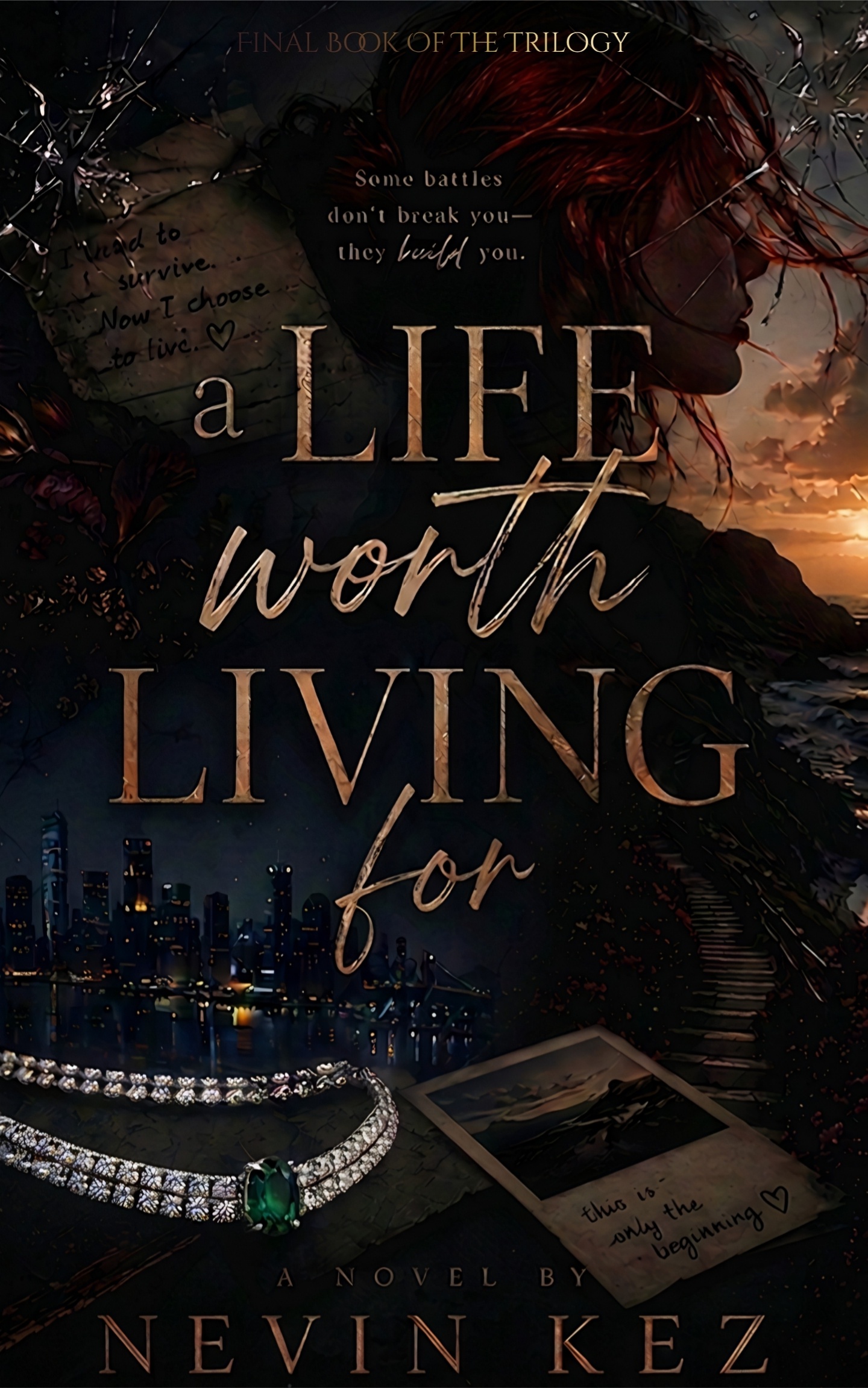
A Life Worth Living For
by Nevin Keszkowski
The past doesn't just haunt; it hunts. Mia Castellan thought she had finally found safety. After escaping the horrors of Project Siren, she and Sophia Bennett have spent two years building a quiet life under assumed identities at a secluded coastal beach house. But their hard-won peace is a fragile illusion. When the Phoenix Directive emerges from the ashes of the old program, it begins a silent coup, replacing the board of Castellan Industries with synthetic clones. Then the unthinkable happens: Mia is abducted. Held in a northern black site, she is subjected to brutal pharmacological reconditioning designed to erase her soul and restore the cold-blooded operative she once was. Desperate to save the woman she loves, Sophia assembles a defiant alliance of family, former partners, and rogue clones. Together, they must infiltrate a high-tech fortress and dismantle a conspiracy that reaches the highest levels of power. But in a world of mirrors and shadows, salvation comes with a devastating price. In this pulse-pounding conclusion to the saga, the line between human and machine blurs. How much would you sacrifice for a life worth living for?
- Thriller
- Romance
- Adventure
- Literary Fiction
- Women's Fiction
- WLW
The Pacific
The Pacific came in slow this morning.
Mia stood at the window with her coffee going cold in her hand and watched the water move the way water moves when it has nowhere to be — unhurried, a heavy slate-gray that broke into white foam against the jagged rocks before receding back into itself. Two years ago she would have read the horizon for threats. She did it now without deciding to — the eyes moving first to the distance, then the mid-ground, then the shadows where the light hadn't quite reached the rocks, checking for the wrong kind of stillness or the specific shimmer of a lens. The scan was automatic, built into the first seconds of consciousness every morning for so long it no longer registered as vigilance. It registered as breathing.
Clean. No vessels in range. No anomalous movement on the tree line to the north.
She let her eyes settle on the deck.
Sophia was in the chair she always chose — the one angled toward the water, not away from it — with her legs folded beneath her and a book open in her lap that she had not turned a page of in the last twenty minutes. Mia knew because she had been watching. The morning light was doing something specific to her hair — the platinum catching the early sun the way it always did, less like color and more like something that had decided to hold the light and keep it. Mia had never found a tactical reason to keep noticing that. She had stopped looking for one.
Ethan was at the far end of the deck with his laptop open on the railing, his fingers moving across the keys with the specific, unhurried precision of someone who understood exactly what he was looking at. He was eighteen now. The boy who had stood in her kitchen three years ago with too much awareness behind his eyes and not enough armor had grown into someone deliberate and composed, someone who had his mother’s quality of noticing and something of his own beneath that she was still learning to read. He was running a routine — she could tell by the way he checked the perimeter feed every few minutes without breaking his rhythm, a seamless integration of his technical capacity and the quiet responsibility he had taken for the safety of the household. He had his father’s height. He had nobody’s caution. That was entirely his own.
Lily was on the sand below the deck stairs.
This was the part Mia could not look away from.
Lily at twelve was a specific kind of force — contained enough to sit still for twenty minutes making a careful pile of stones by size, wild enough to abandon it at the first good wave and run at the water in her bare feet like she had a personal argument to settle with it. She was doing both, alternating, following whatever internal logic governed twelve-year-olds on Saturday mornings when no one had given them an agenda. She had Sophia’s mouth. She had a way of laughing that started in her shoulders before it reached her face, and every time Mia saw it she felt something that had no operational name.
The stones were arranged in a row now. Lily studied them with the expression she made when she was calculating something she hadn’t been asked to calculate. Then she picked up the smallest one, examined it, and threw it at the ocean with significant conviction.
Mia’s coffee was cold. She did not move.
This was the thing she still did not fully trust — not the peace, which she had stopped pretending to believe in, but this. The specific quality of a morning when no one needed anything from her except her presence. When the security grid was clean and Lily and Ethan were in eyeline and Sophia was on the deck not reading, and the worst thing happening was that her coffee had gone cold while she stood here cataloging it.
She had lived most of her life in rooms she was already planning to leave. Contingencies mapped before she sat down. Exits memorized before she crossed a threshold. She still did those things. They had not dissolved. They had simply gotten quieter, the way a scar gets quieter — still there, still part of the structure, just no longer the loudest thing in the room.
They lived under their own names now.
That had been the choice — hers, Sophia’s, made together at the kitchen table in the house in Virginia before everything that happened in Virginia, and reaffirmed six months later in this house, when the hearings were over and Jocelyn’s foundation was operational and the legal landscape had shifted enough that hiding felt more dangerous than not hiding. They had weighed it the way they weighed everything: methodically, honestly, without pretending either option was without cost.
The cost of being visible was exposure.
The cost of staying hidden was teaching Lily and Ethan that their family was something to be ashamed of.
They chose exposure.
There were security measures in place that would have made the beach house look like a military installation to anyone who knew what to look for. There were people with specific skill sets who checked in through specific channels at specific intervals. There were protocols. There would always be protocols. Mia was not naive enough to believe that the hearings had closed every door, or that two years of quiet meant the quiet was permanent.
But she had stopped waking up at three in the morning to check the grid.
Most mornings.
Below, Lily had relocated from the stones to a spot closer to the waterline and was now standing with her arms out at her sides, eyes closed, letting the incoming wash run over her feet. Testing something. Some private hypothesis about cold water and courage. When it hit she did not flinch. She opened her eyes and looked at the ocean like she had made her point.
Ethan glanced up from his laptop, watched his sister for a moment, and looked back down. Something in the set of his shoulders said he was smiling, though Mia was at the wrong angle to confirm it.
On the deck, Sophia turned a page.
The first page she had turned in twenty-three minutes. Mia noticed the change in the way she noticed everything — without meaning to, without being able to stop. It was the particular quality of attention that had nothing to do with threat assessment and everything to do with the fact that Sophia was the most important data point in any room she occupied — the single physical anchor that dictated Mia's own posture, the slight turn of her shoulders to keep Sophia within her peripheral field, the unconscious adjustment of her weight so that she was always ready to move toward her first. Mia had spent a long time pretending that was not true before she had stopped pretending.
The morning moved the way good mornings move — slowly, with no sense of needing to be anywhere else.
Lily ran back up the beach and threw herself onto the bottom step of the deck stairs, slightly out of breath, announcing something to Ethan in a tone that suggested it was obvious and he had somehow missed it. Ethan responded without looking up. Lily’s hands went to her hips with a precision that was entirely Sophia’s. Then she abandoned the argument and went for the door, sandy feet and all.
Mia heard her come through the kitchen.
“There’s coffee,” Mia said, without turning.
“I know,” Lily said, like she had invented coffee. The refrigerator opened.
The refrigerator closed. A glass filled. Lily moved through the kitchen with the ease of someone who had never been afraid in it, and Mia stood at the window and let that land where it always landed — somewhere behind her sternum, quiet and specific.
The door to the deck opened. Lily’s voice carried out, telling Sophia something about the water temperature that apparently required hand gestures. Sophia made a sound of genuine interest. Ethan closed his laptop.
On the deck, the three of them existed in the easy overlapping way of a family that had learned each other’s rhythms — Lily talking, Sophia listening with the full weight of her attention, Ethan contributing a single precise sentence that made Lily laugh. It was small. It was the smallest possible version of anything.
Mia watched it with her cold coffee and the clean horizon and the security grid running its quiet checks and the knowledge, sitting somewhere below language, that this was the thing she would burn the world down to protect.
A life worth dying for.
She had not said those words aloud in two years. She did not need to. They were in the architecture of every choice she had made since the first morning she had understood what she was choosing.
She must have moved, or stopped moving, or done something that shifted the air in the room. She could not have said what. But Sophia, mid-sentence, looked up.
Turned toward the window.
Found Mia’s eyes.
She did not say anything. Neither of them did. Sophia simply looked at her — across the deck, through the glass, across all the distance and all the years — and what was in her expression was not surprise. It was recognition. The look of someone who had known they were being watched and had been waiting, quietly, for the moment to be acknowledged.
Mia did not look away.
She did not need to protect this. She did not need to make it smaller or find a word for it or fold it into something more manageable. She was standing at her window, in her house, watching her family on a Saturday morning with cold coffee in her hand, and Sophia was looking at her like she was something Sophia had chosen and would choose again.
Lily said something. Sophia smiled — at Lily, at Mia, at the morning, at some combination of all three — and turned back to her daughter.
Mia looked out at the horizon.
Clean. No vessels. No movement in the tree line.
She drank her cold coffee and did not go anywhere.
Six O'Clock
The shower ran for exactly as long as it needed to.Mia heard it shut off and did not move. She was on her back with both arms behind her head and no intention of being anywhere else for the next however long this took, and she had made her peace with that before Sophia had even crossed to the bathroom. The morning light was coming through the curta…