

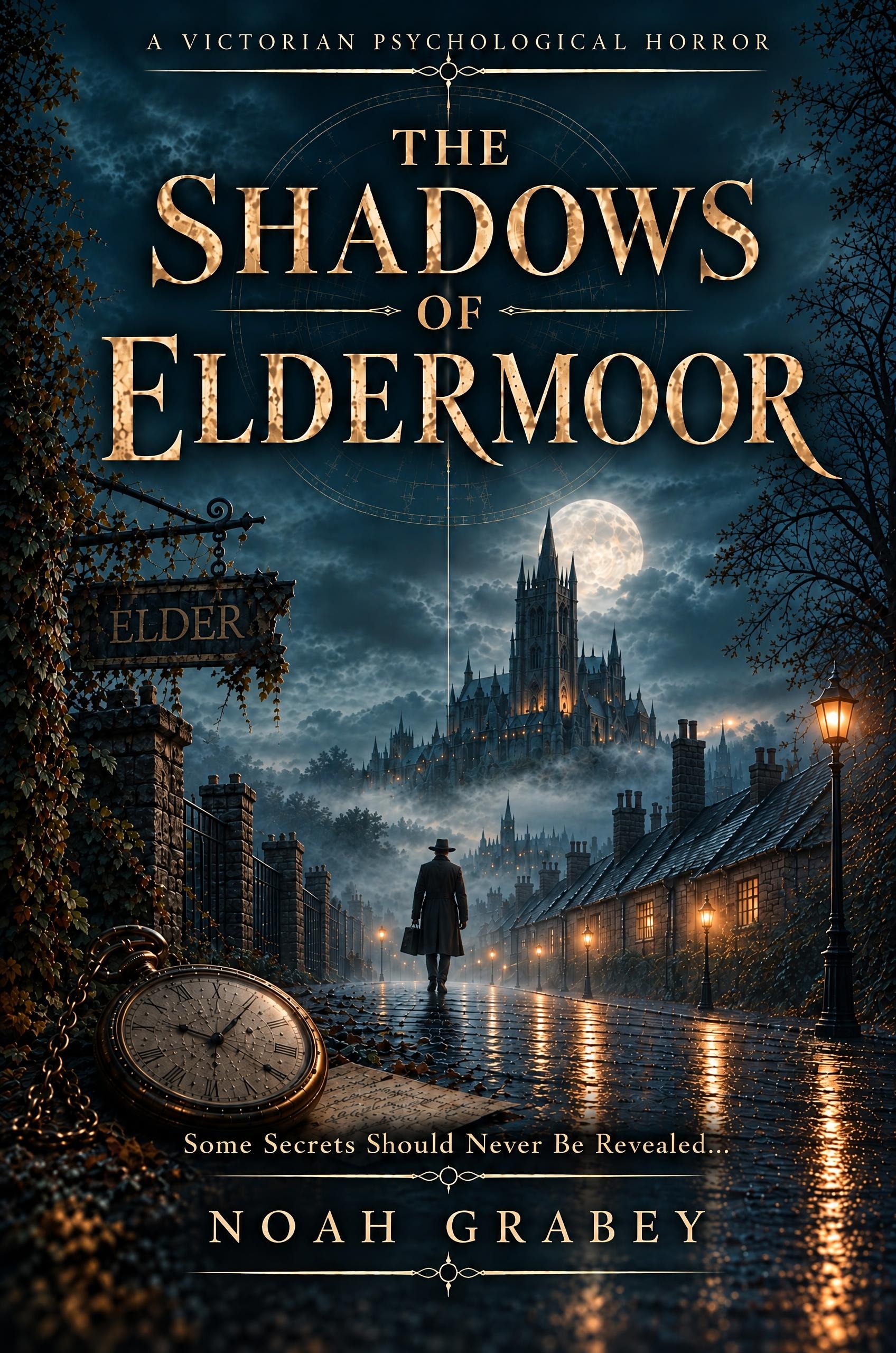
The Shadows of Eldermoor
by Noah Grabey
England, 1887. Some places are forgotten by the world. Others refuse to let the world forget them. When Detective Thomas Hawthorne receives a final note left behind by his father shortly before his death, he is drawn to the remote village of Eldermoor in search of answers. He expects to uncover the circumstances that led to his father's final days. What he finds instead is a place that seems to exist beyond the ordinary boundaries of the world. Eldermoor is a village of strange silences, unfamiliar faces, and old customs no outsider can quite explain. Its inhabitants speak as though they share a secret, yet none will admit to knowing what it is. The deeper Thomas ventures into the village, the less certain he becomes that anything around him is as it appears. Then there are the spirals. They surface in places they shouldn't, recurring with an unsettling persistence that suggests something far older than superstition. And Eldermoor itself begins to manifest in ways Thomas cannot account for, appearing where it should not be and leaving him questioning whether he has discovered a hidden truth or become trapped inside something he cannot comprehend. As the mystery surrounding his father's death deepens, Thomas finds his own memories, observations, and judgment turning against him. Streets seem to change. Familiar surroundings become strange. Moments he trusts begin to contradict one another. He is a detective by profession, a man accustomed to separating fact from deception. But in Eldermoor, even his own mind may be an unreliable witness. And if his father's final message led him here for a reason, Thomas must discover what lies at the heart of the village before he loses the ability to recognise the truth—or himself. Because some mysteries do not want to be solved. And some places never truly let you leave.
- Horror
- Mystery
- Historical Fiction
- Gothic Horror
- Cosmic Horror
- Psychological Horror
A New Arrival in Eldermoor
The train had left him in the dark, and the dark had kept the sound.
Detective Thomas Hawthorne walked away from the ruined platform, his boots striking the damp earth with the steady, measured cadence he had practiced through seven years in the Metropolitan Police. He did not quicken his stride. A man who ran in unfamiliar territory invited the very disorder he sought to master. Instead, he kept his shoulders square beneath the black wool of his overcoat, his gloved right hand resting near the seam where his revolver rested within its satchel.
The county line lay leagues behind him now, swallowed by the moors, but the low acoustic hum that had started beneath the carriage floorboards remained lodged in the base of his skull. It did not fade with distance. It seemed to come from the soil itself, faint and rhythmic, like water moving through lead pipes far beneath a city pavement.
March in northern England was an uncharitable season. The air carried a greasy damp that smelled of sodden turf, rusted metal, and old hearths. Thomas reached into his breast pocket and drew out the paper that had pulled him three hundred miles from his rooms in Bow Street. The parchment was folded into a tight square, dog-eared and smudged with dried ink along the creases. It was not a postmarked envelope; it had arrived via a solicitor’s clerk in Lincoln’s Inn, tucked into a bundle of deeds Malcolm Hawthorne had neglected for thirty years.
He held it up to the pale glow of his pocket lantern.
The script was his father’s, though it lacked the graceful, arching flourishes of the scholar who had once filled the British Museum’s annex with cataloged parchment. It was jagged, the iron-gall ink driven into the fiber by a shaking nib:
Thomas. You must not linger in the south. If my study is silent when you read this, take the night express. Come before the seventh toll strikes. The count is almost full, and what was fastened in fifty-two will not hold an empty tower. Forgive me. Do not look in the glass.
The coroner’s telegraph had preceded the solicitor by three days: Malcolm Hawthorne, scholar of antiquities, found dead March 12, 1887. Seated before the high altar of the ruined chapel, Eldermoor. Heart failure. No foul play detected. Interred by parish sexton.
Thomas folded the paper and slipped it back over his heart. A detective did not traffic in premonitions or filial hysterics. Heart failure was a common end for a recluse who ate dried mutton and breathed damp air. Yet a scholar did not die in the nave of an abandoned church thirty miles from the nearest turnpike while drafting frantic, unsent warnings to a son he had not embraced since his fifteenth year.
He adjusted the strap of his satchel. Through the coarse velvet pocket at the bottom, he felt the heavy silver disc of the watch Malcolm had handed him on that distant birthday. Its ticking was absent; the mainspring had bound itself tight the morning the telegram reached London, resisting every turn of the key.
The cart road narrowed, sinking between steep clay embankments covered in dead gorse. Then the lane turned, and Eldermoor rose before him.
It was not a large settlement. It clustered in a hollow between two barren fells, its slate roofs shining like wet scales under the overcast sky. Stone cottages lined the lane, their walls constructed of dark millstone grit, rough-hewn and packed with dark mortar. No dogs barked. No children called out from the side alleys. The village square was paved with worn, oval river cobbles that gleamed with moisture.
Thomas paused at the edge of the square, his detective’s eye automatically taking inventory. Four gas lamps stood at the intersections, but their mantles were dead, the glass green with moss. The only illumination came from oil lanterns hung from wrought-iron brackets beside front doors. The light was dull and amber, casting long shadows across the stones.
Then he saw the smoke.
From a dozen low stone chimneys, peat smoke rose into the twilight. A stiff north wind was blowing across the ridge, bending the bare branches of a row of ash trees until they creaked. By all laws of draft and current, the pale grey exhaust should have scattered toward the south fell. But it did not rise. It crept downward over the eaves, crawling over the wet slate and pouring into the street. It clung to the cobblestones like a heavy fluid, pooling around Thomas’s boots and drifting sluggishly northward, straight into the teeth of the gale.
Thomas took a single step forward, his boot parting the pale fog. The smoke did not smell of birch or seasoned ash. It had a sharp, mineral edge, resembling the copper slag left behind by blast furnaces.
He turned his head toward the nearest building, a low, double-fronted shop with a wooden tradesman’s board swinging above the entry. The lettering had faded to faint grey scars, but the shape of a cobbler’s last was still visible. Through the clouded windowpanes, a solitary candle flickered. A man stood behind the counter, motionless, his face turned toward the glass.
Thomas stopped.
The instant his boots ceased their rhythm against the cobbles, a dull wooden click cracked through the lane. Across the square, the heavy oak shutters of a tallow chandler slammed shut. Simultaneously, thirty yards to his left, the bolt of the cobbler’s entrance slid into its iron keeper with a dry, sharp snap. Farther down the lane, two more shutters dropped, falling together in absolute unison, as though operated by a single concealed lever.
The village was not asleep. It was sealing itself.
Thomas stood in the center of the lane, his hand resting once more against the rough wool covering his sidearm. He waited. Ten seconds passed. Fifteen. The wind groaned through the dead ashes, but behind the shuttered facades, not a voice murmured. No domestic clatter of tin pans or kettle irons filtered through the stone. Eldermoor did not possess the casual, bustling privacy of London or the rough curiosity of market towns; it held its breath like a suspect in an interrogation cell who understood that any word might serve as evidence.
He resumed his pace. His leather soles rang loud against the river stones. Behind him, as he passed each threshold, another bolt slipped home into the strike. A methodical, rhythmic closure followed his passage, shutting the lane behind him piece by piece.
At the highest point of the village square stood Greystone House.
It was a tall, four-story edifice built of the same dark stone as the church, but far more severe. Its windows were narrow, sash-hung apertures framed by lintels of pitted granite. A wrought-iron sign hung above the portico, displaying an unpainted oval plate that had rusted through the center, leaving a jagged void where an heraldic crest or name had once been painted. The porch steps were deeply cupped in their centers by decades of heavy boots.
Thomas climbed the four steps. The front door was heavy oak, bound with flat bands of blackened iron. Before he could raise his knuckles to the brass knocker, the latch lifted with a faint scrape.
The door swung inward on greased pivots, revealing a narrow, wood-paneled vestibule lit by a single brass oil lamp suspended from a ceiling beam. Behind the threshold stood a woman.
She was tall and gaunt, her body held with a stiff, unnatural rigidity beneath a high-collared dress of dull black bombazine that showed no decorative trim. Her silver hair was parted strictly down the center and gathered into a coil so tight it pulled the skin of her temples taut beneath a small cap of black lace. A heavy iron key, blackened with age, hung against her sternum from a linked silver chain. Her eyes were an extraordinarily pale hazel, almost devoid of color, and her lips remained pressed into a straight, dry seam that suggested an attempt at courtesy she did not feel.
Thomas removed his hat, holding it against his ribs. "Good evening. I am—"
"You have your mother's chin, Tom," she said.
The voice was thin and rasping, like dry corn husks rubbed together. It did not carry the rough vowels of the northern dales; it had the flat, clipped cadence of an older dialect.
Thomas felt his shoulder muscles tighten. He had not been called by that name since he was nine years old, when his father had packed two brass-bound trunks in the London terrace and told him he was never to set foot in Lancashire or Yorkshire again.
Thomas adjusted his stance, setting his feet apart and squaring his shoulders beneath his heavy coat. "I am Detective Hawthorne," he said, keeping his tone measured, formal, and authoritative. "From London. You are Ms. Willowby?"
"The rooms are aired," she replied, ignoring his title with the indifferent patience of someone who had watched many titles wash through the valley and vanish. "Or as aired as stone allows in the spring thaw. We do not keep fires in the parlor after sunset. It draws the flue ash down into the carpets."
"You knew I was coming," Thomas said. He stepped through the doorway, his boots striking a dark floor of oiled pine boards. "My telegram from Crewe could not have cleared the district post before noon."
"Telegrams are for the rail lines," Ms. Willowby said smoothly, turning her back to him to lead the way into the lobby. She moved without the rustle of skirts that usually accompanied heavy fabric, her slippers making no sound upon the timber. "The valley knows its own blood. We saw you crossing the embankment three miles back. You walk like Malcolm. Heavy in the heel. Always checking the ditch to see what might have fallen out of sight."
The lobby was high-ceilinged and cold. The walls were covered in faded, embossed paper depicting hunting scenes, though moisture had buckled the panels along the wainscoting, creating blistered ridges that resembled veins under skin. A grandfather clock stood against the east wall, its brass pendulum stationary, its blackened hands frozen at twenty minutes past four. Thomas noted the dust on the glass bezel; it had not turned in years.
Ms. Willowby stopped at a high mahogany counter. Without consulting a ledger or asking for a signature, she reached beneath the desk and produced a heavy brass key attached to a pear-shaped wooden tag. The numeral 3 was stamped into the timber, deep and darkened with graphite.
"Room Three," she said, laying it upon the counter between them. She did not release it immediately, her long, pale fingers resting on the metal. "The second-floor landing, to the front. The windows look down upon the square. Your father left his trunk there when he went up to the chapel. He was not one to scatter his papers across different houses."
Thomas reached out, his gloved fingers closing around the brass. The metal was surprisingly cold, colder than the air in the vestibule. "My father died at the altar, Ms. Willowby. The parish authorities listed heart failure. Yet his letters to me spoke of other things. Urgent things."
"Your father was a scholar," the woman said, her pale eyes fixing squarely on his brow, never quite dropping to meet his gaze. "Scholars spend forty years reading the dead until they forget the living have ears. When the heart gives out, it gives out. The ground here does not take kindly to men who listen for too long."
"Listen to what?"
For the first time, Ms. Willowby's lips twitched, the skin pulling tight over her cheekbones in what might have been a smile or a spasm of disgust. "The bells, Mr. Hawthorne. The ones you cannot hear until you've stayed a week, and the ones you cannot shut out once they find you."
Thomas maintained his composure, refusing to indulge her country superstitions. "There are no working parish bells within five miles of this valley. The railway guide noted that the chapel was de-consecrated after the fire of '61."
"Then you will sleep soundly," she whispered. Her fingers withdrew from the key. "Take the lamp from the table. Lock your door before the half-hour. Do not turn the handle for anyone who knocks after the church yard goes dark, even if they call you by your Christian name. The village does not wander at night, and what does wander has no business in Room Three."
"A warning?" Thomas asked.
"An economy," she said. "I have scrubbed the stairs three times this winter. I have no wish to do it a fourth."
She turned and walked down the darkened corridor toward the kitchen quarters, her black gown melting into the shadows until the white lace of her cap was the only visible object, then that too disappeared behind a baize-covered door. The latch dropped with the same sharp, decisive snap he had heard throughout the village square.
Thomas stood alone in the hall for a long moment, listening.
The low hum was louder here. In the dead quiet of the house, it had a physical presence, vibrating faintly against the soles of his boots through the oiled floorboards. It possessed an acoustic frequency that sat just below the range of normal hearing, like the sustained bass note of a vast organ pipe after the wind has been cut off.
He took the small brass lamp from the table, trimmed the wick, and struck a match. The flame flared yellow, driving the shadows back into the corners of the staircase.
The stairs were narrow and steep, the risers creaking under his weight. At the second landing, the air was colder still. Three doors faced the hall, their dark wood panels uniform and devoid of ornamentation save for small brass numerals. Room Three sat at the far end, directly overlooking the main entrance below.
Thomas inserted the key. The tumbler turned with a smooth, oiled resistance, and the door swung open without a sound.
The room was larger than he had anticipated, though sparsely appointed. A high four-poster bed of dark walnut was pushed against the north wall, its hangings removed, leaving only the bare frame. A washstand with an earthenware basin and pitcher occupied the corner, while a small writing desk of scarred mahogany sat beneath the tall sash window. Beside the wardrobe, an old leather traveling chest rested upon two blocks of wood, its brass buckles unfastened.
Thomas placed his satchel on the desk and hung his coat on the wooden peg behind the door. He turned the key in the inside lock, testing the bolt. It shot deep into the jamb. He turned the handle; the wood did not yield.
He sat down at the desk, opened his satchel, and withdrew his notebook and a steel nib pen. A London detective did not survive on impressions; he survived on tangible records. He dipped the pen into a small traveling inkwell and wrote:
March 15, 1887. Eldermoor. Greystone House, Room 3. Arrived 6:40 PM. Local population exhibits extreme insularity and signs of synchronized retreat at the arrival of strangers. Note behavior of chimney smoke: physical anomaly, likely related to sulfur deposits or unique valley barometric pressure, though movement against north wind warrants further observation. Caretaker Ms. Willowby: familiar with deceased, familiar with my family history. Displays evasive behavior regarding Malcolm’s death. Cause of death remains unverified by independent medical examination.
He set the pen down and rubbed his temples. The fatigue of sixteen hours in unheated third-class carriages was beginning to press behind his eyes, but his mind refused to settle. The acoustic hum was distinct here. It was not in his head; when he laid his palm flat against the mahogany surface of the desk, he felt the grain vibrating beneath his skin.
He rose and began a systematic inspection of the room.
The desk drawers contained only empty envelopes, yellowed scrap paper, and a dried block of blotting sand. The washstand was dry, its pitcher empty. He approached the leather chest by the wardrobe. The initials M. H. were burned into the hide near the lock.
Thomas knelt before it. The straps were unbuckled, but the lock itself had been forced; the brass latch was bent outward, and small splinters of ash wood clung to the screw holes. Inside, he found what remained of his father’s traveling library: several volumes on early Christian antiquities, a monograph on medieval foundry work by a Leeds metallurgy professor, and three bundles of hand-copied Latin manuscripts dealing with parish boundaries in the West Riding during the fourteenth century.
Between the pages of the foundry text, a single sheet of paper had been pressed like a dried leaf. It was covered in pencil sketches, drawn with an obsessive, heavy hand that had scored deep grooves into the paper.
They were spirals.
Not simple decorative scrolls, but tight, inward-turning lines that curved upon themselves with mathematical precision. In some sketches, the lines were interrupted by small tick marks, like the divisions of a surveyor's chain. At the bottom of the page, Malcolm had written three words in Greek, followed by an English translation in his deteriorating hand:
The throat does not close. It only listens.
Thomas lowered the paper. He could feel the cold of the floor penetrating through the cloth of his trousers. His knees ached against the bare boards.
As he rose, his boot caught the edge of the threadbare rug that lay between the bed and the large oak wardrobe. The fabric bunched back, exposing the floorboards beneath.
Thomas held the lamp down.
The timber here had been altered. While the rest of the room was floored with plain six-inch pine planks running north to south, a section beneath the wardrobe had been pieced together from three broad slabs of dark, dense timber that looked like bog oak. In the center of the threshold, carved directly into the surface of the wood, was a faint marking.
Thomas knelt again. He brushed away a layer of fine grey dust with his thumb.
It was a spiral, three inches across, cut into the timber with a narrow gouge. The cut was clean, but the edges were smoothed, as though many feet or fingers had passed over it for generations. Surrounding the symbol was a hairline seam in the flooring, defining a rectangle four feet long by two feet wide.
A trapdoor.
He pressed his hand against the carved spiral. The vibration was instantly clearer, running up the bones of his forearm like the stroke of a tuning fork. The bog oak was ice cold, carrying the damp chill of subterranean stone.
Thomas stood up, set the lamp upon the floor, and gripped the edge of the heavy wardrobe. It was solid country oak, eight feet high and packed with dry cedar shavings inside. Bracing his boots against the boards, he threw his weight against the corner. The furniture resisted for a second, then slid two feet along the wall with a dull groan, revealing the entirety of the trapdoor.
There was no iron ring, no visible latch. In its place, near the edge of the seam, was a circular hole half an inch wide, bored through the timber to serve as a finger pull.
Thomas hesitated. A sensible officer waited for daylight; a prudent man called the local sexton or constable before investigating structural anomalies in a rented room. But Malcolm had lived in this house for six months before his heart had stopped in the chapel ruins. If there were answers in Eldermoor, they were not to be found in Ms. Willowby's guarded parables or the closed shutters of the high street.
He reached into his satchel, drew out the .38 Webley, and checked the cylinder. Five rounds of lead ammunition sat in their chambers. He cocked the hammer halfway, slipped the weapon into his coat pocket where the grip remained within reach, and picked up the brass lamp.
Hooking his fingers into the hole, he pulled upward.
The trapdoor was balanced with a counterweight hidden in the wall; it rose with surprising ease, lifting without a creak. The air that surged from the opening did not smell of old cellars or coal bins. It was freezing, dry, and carried the alkaline tang of lime mortar, along with that same metallic, brassy taint he had detected in the lane.
He held the lantern over the void.
A narrow flight of steps descended into the foundation. They were not wooden cellar steps; they were carved from the living bedrock beneath the house, rough-hewn and slick with a film of dark mineral seepage. The walls of the shaft were narrow, scarcely wide enough for a man's shoulders, lined with blocks of unmortared river stone.
Thomas checked his pocket watch. The hands remained frozen at twenty past four, but the silence of the room was complete, save for that subterranean note that now resonated freely through the opening.
He lowered his boots onto the first step.
The stone was greasy beneath his leather soles, requiring him to brace his free hand against the rough wall as he descended. One step. Two. Three. The ceiling of Room Three disappeared above him, the rectangular square of lamp-lit pine growing small and distant. With every yard he descended, the air grew colder, biting through his wool trousers and chilling his knuckles where he held the lantern ring.
He counted twenty-four steps before his boot struck a level floor of beaten earth and river gravel.
He raised the lamp. The yellow beam cut through the darkness, illuminating a low, vaulted chamber cut directly into the gritstone shelf. The ceiling was supported by three low arches of rough masonry, their keystones bearing the same crude spiral marking he had found carved into the threshold above.
At the center of the chamber stood a table constructed of heavy baulks of timber, gray with age and rot. Upon it lay a brass bell, perhaps eight inches high, its surface green with verdigris. It lacked a handle, possessing only a heavy square lug at the crown, as though it were meant to be hung from an iron frame.
Beside the bell lay an open leather-bound ledger, its pages warped and bloated by the cellar damp.
Thomas approached the table, his footsteps deadened by the earth. He held the lamp above the parchment. The ink was faded, written in multiple hands spanning decades, each line recording a date and a surname:
1821, Oct. 4 — C. Vance. Sealed.
1836, Nov. 12 — H. Garrow. Sealed.
1852, March 24 — M. H. Seventh.
Thomas stared at the initials. 1852. M. H. His mother’s name had been Miriam. She had died in London when he was five years old, but her family had originated in these hills; Malcolm had never spoken of her people, burying her miniature portrait in the bottom of his desk drawer after her funeral.
Beneath the 1852 entry, a fresh line had been ruled in red ink, still glossy despite the dampness of the room. The hand was Malcolm’s, written with that same desperate, jagged slant:
1887, March 18 — The cycle calls. Six are gathered. The seventh must come to the frame or the valley wakes. Thomas, turn back.
March 18th was three days away.
As Thomas stared at his father’s handwriting, the acoustic hum suddenly ceased.
The silence that took its place was absolute, sudden, and heavy, like the drop in pressure before an artillery discharge. In the sudden quiet, the flame in his brass lamp guttered, shrinking to a blue bead before flaring up with a sharp hiss.
From the stone shaft behind him, up in the bedroom he had left locked, came the dry, distinct sound of a floorboard groaning under a heavy, deliberate heel.
Thomas did not move. He kept his left hand flat upon the damp ledger, his right sliding into his coat pocket until his fingers found the checkered walnut stock of the revolver. Above him, through the open trapdoor, the sound came again: a single, slow step, moving from the door of Room Three toward the wardrobe.
Then, sharp and clear through the floorboards, the brass handle of the bedroom door rattled against its plate.
Someone was testing the lock from the hall.
Thomas raised the lantern, turned toward the stairs, and began to climb back up into the house, his boots making no sound upon the cold stone.
Faces Beneath The Fog
The dawn brought no warmth to the valley, only a slow, gray thinning of the dark. When Thomas extinguished the oil lamp and drew back the heavy curtains of Room Three, Eldermoor lay beneath a pale wash of fog that clung to the slate roofs and pooled in the gutters. The village below was utterly still. He washed his face with cold water from the pit…