

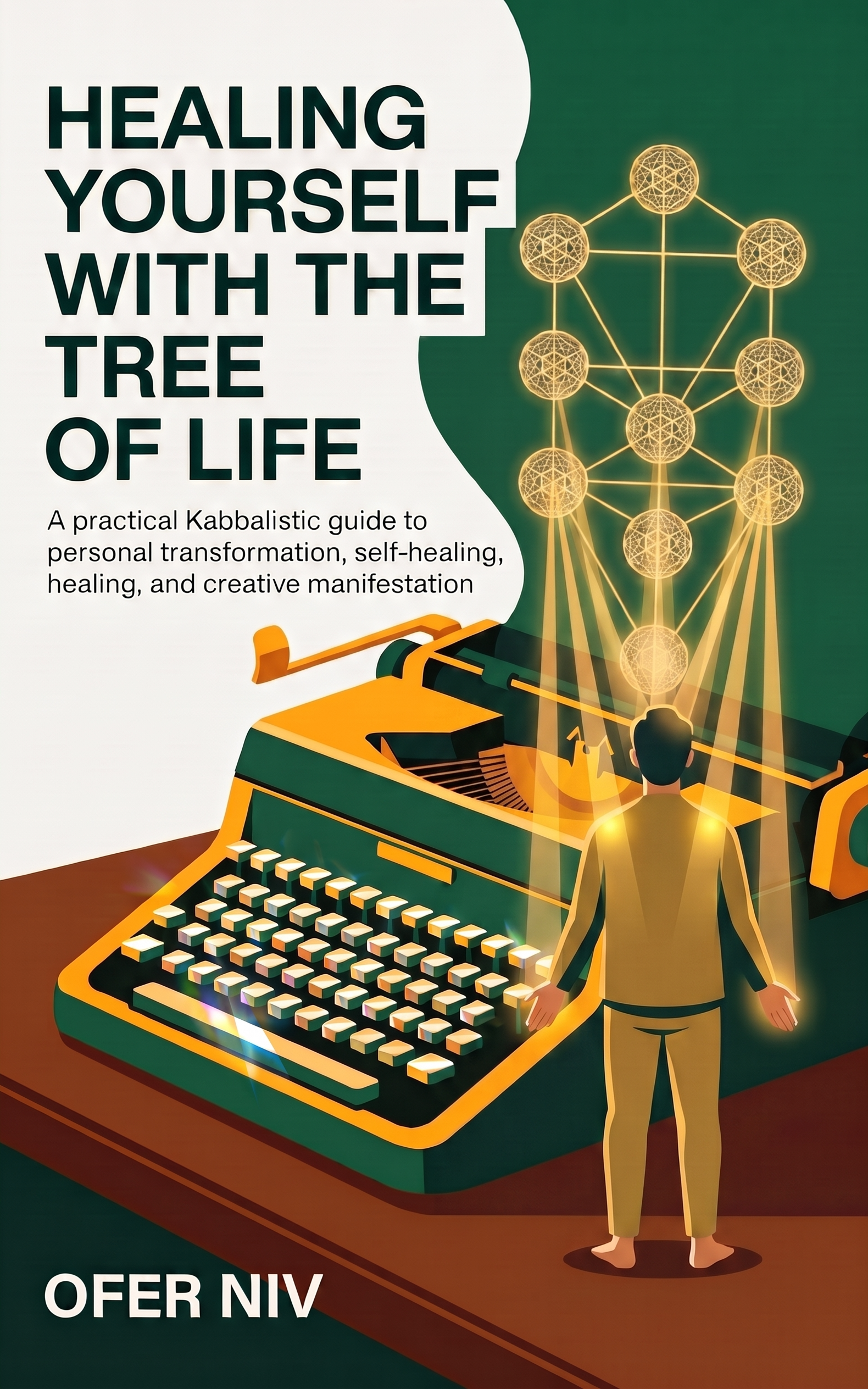
Healing Yourself With the Tree of Life
A practical Kabbalistic guide to personal transformation, self-healing, and creative manifestation
by Ofer Niv
Unlock the ancient wisdom of the Tree of Life and transform your inner world. In this groundbreaking guide, Ofer Niv demystifies the sacred structure of Kabbalah to present a practical blueprint for emotional and spiritual healing. By mapping the cosmic flow of creation, manifestation, and destruction across the ten sephiroth and three pillars, you will learn to navigate life's greatest challenges with profound balance and clarity. Using the intuitive process of writing a book as a real-world model, this practical system demonstrates how abstract spiritual forces apply directly to your daily experience. Whether you are seeking to release deep-seated trauma, quiet chronic anxiety, or align with your true purpose, the ancient blueprint offers a structured path toward wholeness. Discover how to harness the creative forces of the universe to reshape your personal narrative. Healing Yourself With the Tree of Life is an indispensable manual for seekers, mystics, and anyone ready to become the intentional author of their own destiny.
- Religion & Spirituality
- Self-Help
- Mysticism
- New Age & Spirituality
- Spiritual Growth
- Personal Growth & Habits
Mapping the Cosmic Blueprint: From Crown to Foundation
Life has a way of nudging us—sometimes gently, sometimes with a force that shakes us to the core. For me, it was the latter. When I received a diagnosis that turned my world upside down, the doctor's words were stark and clinical: "There's no cure." The standard medical protocols offered a measure of hope for managing symptoms, but they came with a heavy toll. The side effects left me feeling less alive, less like myself. I remember sitting in the parking lot after that appointment, staring at the steering wheel, thinking, This can't be it. At the time, I was deeply embedded in the corporate world. Numbers, deadlines, and efficiency had been my language for years. It was a world that rewarded logic and order, but slowly, it began to feel stifling. My body was rebelling, and my spirit felt trapped. Yet, in that struggle, I found a spark—a faint but undeniable sense that healing wasn't something external. It wasn't something I needed to search for in pills or rigid protocols alone. It was something I needed to rediscover within myself.
Deciding to step off the well-worn path of traditional approaches wasn't easy. It required me to challenge everything I thought I knew about health, energy, and human potential. The skepticism was loud, arising both from my own analytical mind and from the people closest to me. Convincing my loved ones that I wasn't grasping at blind hope, but taking a necessary step toward wholeness, was one of the hardest parts of the journey. Their fears echoed my own internal doubts: What if this doesn't work? But even in that deep uncertainty, I felt a pull stronger than my fears. As I began exploring energy architecture and ancient traditions, the shift was initially subtle—a new sense of awareness, a faint glimmer of something deeper. Over time, it became undeniable. Each practice and each moment of stillness peeled back layers of fear and limitation I didn't even realize I carried. I started to understand that my diagnosis wasn't the final word of my story. It was a doorway.
That doorway led directly to the Tree of Life—an ancient, profound map of consciousness that explains how abstract spirit condenses into physical reality. When we view our bodies, our emotions, and our life circumstances through this cosmic blueprint, we stop seeing ourselves as broken machines. Instead, we begin to see ourselves as authors holding the pen. Healing isn't just about managing physical symptoms; it's about reclaiming your sense of empowerment and rediscovering who you are beyond the labels and limitations imposed upon you. The Tree of Life provides the structural framework for this exact transformation. It reveals how every thought, emotion, and physical state originates in a pristine source and flows down through specific stages of creation. By understanding this map, you learn to step into your innate role as a creator, transforming the raw material of your past pain into the solid structure of a vibrant, healthy life.
The Esoteric Foundation: The Supernal Triad and the Three Pillars
To understand how healing occurs on a foundational level, we must look at the blueprint of creation itself as preserved in the Kabbalistic Tree of Life. The Tree consists of ten distinct spheres, known as sephiroth (plural of sephirah), connected by twenty-two paths. These spheres are not physical places in space; they are states of consciousness, energy channels, and operational stages through which unformed potential transforms into solid matter. At the very top of this map sits the Supernal Triad—the three highest spheres of pure consciousness that exist above the veil of manifest reality. These three spheres are Kether, Chokmah, and Binah. Together, they represent the ultimate blueprint of how an idea, a life, or a healing process comes into existence.
The journey begins at the crown, the highest sphere, known as Kether. Kether is the absolute beginning, the initial spark of pure, unmanifest awareness. It is the realm of pure potentiality, where nothing has taken shape yet, but everything is possible. In Kether, there is no separation, no disease, no narrative of suffering, and no conflict. It is the simple, quiet awareness that exists before a single thought forms. When you sit in absolute silence and drop the labels of your identity—your name, your job, your diagnosis, your past errors—you touch the energy of Kether. It is the unconditioned spark of divine life within you that remains entirely untouched by physical illness or emotional trauma.
From Kether, the raw divine energy flashes outward into the second sphere, Chokmah, which translates to Wisdom. Chokmah represents the dynamic expansion of pure creative force. It is the raw, unstructured flash of insight, the burst of vitality, and the father principle of kinetic movement. Chokmah is pure passion and infinite flow. It carries an enormous amount of power, but it has no boundaries, no direction, and no form. If energy stayed purely in Chokmah, it would burn out instantly or disperse endlessly into space without ever accomplishing anything concrete. It is wild, raw creative fire that needs a vessel to contain it.
That essential container is provided by the third sphere, Binah, which translates to Understanding. Binah represents the stabilizing form, the mother principle of structural containment, definition, and order. Where Chokmah expands outward endlessly, Binah draws a boundary around that expansion. Binah provides the walls, the outline, the vessel, and the discipline. It takes the wild, raw energy of Chokmah and gives it a clear shape, allowing abstract creative force to cool into a stable pattern. Without Binah, the creative energy of Chokmah remains a chaotic whirlwind. Without Chokmah, the structural discipline of Binah becomes a dry, rigid, and lifeless shell.
This dynamic interplay between expansion and contraction operates across the entire Tree through a geometric arrangement known as the Three Pillars. These pillars form the structural framework of human consciousness and physical health:
- The Pillar of Mercy (Right Pillar): Associated with Chokmah, this pillar embodies force, expansion, wild energy, passion, and unrestricted expression. It is the force that pushes life forward into new territory.
- The Pillar of Severity (Left Pillar): Associated with Binah, this pillar embodies form, restriction, boundaries, discipline, structure, and necessary critical evaluation. It is the force that establishes order and maintains limits.
- The Pillar of Mildness (Middle Pillar): Rooted in Kether, this central column represents balance, harmony, integration, and conscious synthesis. It balances the wild force of Mercy with the strict structure of Severity, allowing life force to flow cleanly down into physical reality without burning out or stalling.
Energy naturally descends down the Tree of Life in a pattern often called the Lightning Flash. Creative energy originates in the high stillness of Kether, expands dynamically through Chokmah, takes form and structure in Binah, and then continues downward through the lower spheres until it fully crystallizes into physical reality in the lowest sphere, Malkuth (the Kingdom). This means that every physical circumstance in your life—your physical vitality, your daily environment, your bodily health, and your emotional state—is the end result of an energetic process that began at the top of the Tree. Physical symptoms and environmental realities are not random occurrences; they are the final, tangible expression of abstract energetic blueprints.
When we attempt to fix a physical problem purely at the physical level without addressing the mental and energetic blueprint above it, we are trying to change a shadow on the wall without touching the object casting it. True, lasting self-healing requires us to climb up the Tree to the Supernal realm, clear the energetic blueprint at the level of Kether, balance wild passion (Chokmah) with clear boundary structures (Binah), and allow that restored harmony to flow naturally down into our daily lives.
The Writing Metaphor: Drafting the Book of Your Life
To make these profound esoteric principles completely clear and practical, we can use an accessible, powerful analogy: the process of writing a manuscript. Every single person is constantly writing the book of their own life. Whether you realize it or not, your subconscious mind is authoring chapters every single day. By examining how a book moves from a vague idea to a published manuscript, we gain an exact mirror for how human healing actually works.
Think of Kether as the very first, unformed impulse to write a book. It is that quiet, profound moment when an author senses a story wanting to be told. At this stage, there are no written words, no character names, no plot points, and no structural chapters. It is simply a strong, pure feeling of inspiration—a core intention waiting to manifest. In your personal healing journey, Kether is your core desire to be well. It is the unshakeable knowing that your illness or trauma is not the totality of who you are, but merely a narrative you are currently passing through.
Next comes Chokmah, which corresponds to the initial creative flood of drafting. This is the stage where the author sits down at the desk and lets the words pour out without any judgment, outline, or self-censorship. It is the messy first draft where raw emotion, wild ideas, dialogue fragments, and passionate scenes spill onto the page. During a Chokmah phase, you do not stop to correct spelling, trim scenes, or analyze logic. You simply let the creative energy stream freely. In self-healing, Chokmah represents the unfiltered release of stored emotions, memories, grief, and raw vitality. It is the moment you allow yourself to feel everything deeply without suppressing your inner experience.
However, a massive pile of raw, unfiltered writing does not make a readable book. If an author dumps five hundred pages of unedited inner streams of consciousness onto a printer and binds it, no reader will be able to navigate the story. It will be overwhelming, confusing, and chaotic. This is where Binah becomes completely indispensable. Binah is the architect, the outline, the chapter structure, and the rigorous editor. Binah comes into the creative process to organize the chaotic draft of Chokmah. It asks: What is the actual theme here? What needs to be removed? Where do we need strong chapter divisions? What is the logical timeline? Binah creates the structural container that allows the brilliant spark of Chokmah to be clearly communicated and experienced.
When we look at both creative writing and personal development through this lens, we instantly spot why so many people get stuck in chronic emotional distress or failed creative projects. The imbalance between these two supernal forces creates distinct, recognizable problems:
- Working Without Binah (Pure Chokmah Imbalance): When you operate entirely in Chokmah without Binah, you suffer from structural chaos and emotional overwhelm. In writing, this looks like hundreds of pages of disjointed ideas that never become a finished book. In personal life, this looks like endless emotional venting, persistent anxiety, chaotic relationships, and intense creative ideas that never turn into practical habits or completed projects. You feel constantly flooded by your emotions because you lack the mental boundaries and structural routines needed to contain them.
- Working Without Chokmah (Pure Binah Imbalance): Conversely, when you operate entirely in Binah without Chokmah, you build dry, rigid, and lifeless structures. In writing, this looks like an extremely detailed fifty-page outline for a book that has no heart, no passion, and no readable emotional depth. In personal life, this looks like rigid perfectionism, cold intellectualization, hyper-control, and obsessive adherence to schedules or diets that feel deadening. You have built a fortress of rules, but there is no living flame of joy or vitality inside it.
To write a masterwork—and to create a healthy, integrated life—you must master the interplay between both spheres. You must cultivate the courage to open the energetic taps and let the raw creative force of Chokmah flow, while simultaneously building the strong, compassionate boundaries of Binah to give that force form, clarity, and direction. When Chokmah's inspiration is successfully held within Binah's structure, the energy balances along the Middle Pillar, laying down a harmonious blueprint for the rest of your life to follow.
Psychological and Trauma Mapping
Understanding the Supernal Triad gives us a revolutionary lens for understanding mental health, nervous system regulation, and trauma recovery. Trauma, whether caused by a single catastrophic event or chronic environmental stress, fundamentally disrupts the natural balance of the Supernal spheres within our psychology. It sever our connection to Kether, floods us with unbalanced Chokmah energy, or traps us in hyper-defensive Binah structures.
At the highest level, trauma causes us to forget Kether—our primary, unblemished nature. When an individual suffers deeply from physical illness, childhood neglect, or severe emotional shock, the egoic mind begins to identify completely with the suffering. You stop viewing yourself as a whole person experiencing a temporary crisis; instead, you start viewing yourself as inherently damaged goods. Kether work in trauma recovery involves restoring the direct awareness of your essential, uncorrupted self. It is the deep psychological realization that beneath your triggers, beneath your anxiety, and beneath your bodily symptoms, there is a core awareness within you that was never broken. This is not toxic positivity or spiritual bypassing; it is an objective recognition of human awareness. Your pain is something you are experiencing, not who you fundamentally are.
When trauma is triggered, it often manifests as an overflow of unbalanced Chokmah energy. In psychological terms, this is sympathetic nervous system hyper-arousal—the classic fight-or-flight response. The emotional centers of the brain flood the body with overwhelming energy, traumatic memories, panic, rage, or grief. Because trauma carries such intense kinetic charge, it feels like an unbounded wave threatening to wash you away entirely. Individuals in this state often feel terrified of their own feelings. They suppress their emotions because they fear that if they open the door to their grief or anger, they will drown in it.
This fear occurs precisely because their internal Binah—their capacity for structural processing and emotional boundaries—has been compromised. Binah provides the psychological container, the cognitive clarity, and the executive functioning necessary to navigate deep emotional distress safely. In trauma processing, Binah acts as the gentle, objective observer who sits beside the overwhelming emotional storm and says: "I am here. I am safe in this room right now. This intense sensation is an old memory moving through my physical body, and it has a clear beginning, middle, and end." Binah provides the outline that transforms a terrifying emotional flood into a structured, digestible story.
To see how this works in real life, consider the case of Clara Morrow, a forty-two-year-old mid-level corporate executive who came to this work suffering from severe emotional burnout and autoimmune flare-ups. For over fifteen years, Clara had operated like a relentless machine. She managed complex logistics, worked fourteen-hour days, and constantly managed the demands of her family and colleagues. She prided herself on never complaining, never taking time off, and keeping every detail of her life meticulously ordered.
On the surface, Clara looked like a model of high-functioning success. But under the hood, her system was collapsing. She began experiencing sudden panic attacks, chronic body pain, severe digestive distress, and profound emotional numbness. Clara was trapped in a extreme, hyper-defensive Binah state. She had built a rigid fortress of overwork, micro-management, and intellectualization to suppress deep childhood feelings of instability and inadequacy. She had completely cut off her Chokmah energy—her capacity for wild creative play, spontaneous joy, soft rest, and emotional expression. Her physical body was ultimately forced to break down to stop her from pushing herself past human limits.
When Clara began mapping her experience onto the Tree of Life, her situation became crystal clear. Her recovery required a systematic rebalancing of the Supernal Triad through specific steps:
- Reconnecting with Kether: Clara started each morning with ten minutes of pure non-judgmental silence, learning to disidentify from her job title and her medical symptoms, anchoring herself in basic, unconditioned presence.
- Inviting Chokmah (Safe Emotional Release): She set aside intentional time to let her unstructured feelings surface. Through expressive journaling, intuitive movement, and crying without self-censorship, she allowed her trapped emotional energy to move out of her physical body.
- Restructuring Binah (Healthy Boundaries): Instead of using Binah as a rigid whip to drive overwork, she transformed Binah into a protective framework. She set non-negotiable boundaries at work, stopped answering emails after seven in the evening, and built daily thirty-minute blocks of quiet rest into her calendar.
By balancing the structural containment of Binah with the creative emotional release of Chokmah, Clara re-established balance along the Middle Pillar. Within four months, her panic attacks completely ceased, her inflammatory markers dropped significantly, and she recovered a vibrant sense of joy in her daily life.
Practical Alchemical Guide: Protocols for Supernal Alignment
Theory alone cannot transform your health or rewrite your life narrative. To experience the power of the Tree of Life, you must apply these principles through daily, actionable exercises. The following protocols are designed to clear your mental blueprint, harmonize your nervous system, and help you draft a structured life outline.
Exercise 1: The Three Supernal Breathwork Protocol
This targeted somatic breath technique uses the anatomy of the Supernal Triad to calm an overactive nervous system, clear mental confusion, and balance your subtle energy fields. Perform this breathwork once daily upon waking, or whenever you feel emotionally overwhelmed.
- Establish Your Posture: Sit comfortably in a chair with your feet flat on the floor and your spine long, upright, and relaxed. Rest your hands gently on your thighs, palms facing upward. Close your eyes gently.
- Anchor in Kether (The Inhale): Take a deep, slow breath in through your nose for a count of four. As you inhale, draw your focus to the very top of your head (the crown chakra). Visualize a brilliant, crystal-clear white light hovering at your crown, representing your pristine, unconditioned awareness. Feel this spark of stillness.
- Expand into Chokmah (The Hold): Hold your breath smoothly at the top for a count of four. Shift your awareness down to the right hemisphere of your brain and the right side of your upper body. Sense this region as a dynamic, warm, expansive field of pure creative fire and vital movement. Feel the raw power of your life force waiting to express itself.
- Contain in Binah (The Exhale): Exhale slowly and completely through your mouth for a count of six, making a soft "ha" sound. Shift your awareness to the left hemisphere of your brain and the left side of your upper body. Visualize a cool, calm, protective silver outline wrapping around your body, creating an absolute safe container that holds your energy securely.
- Rest in Synthesis: Pause at the bottom of the exhale for a count of two, resting in the peaceful center of your chest along the Middle Pillar. Repeat this four-part cycle for seven complete rounds.
Technique: Supernal Triad Visualization
When you feel mentally scattered, anxious, or unable to make a clear decision, use this brief three-minute mental visualization to clear your subtle channels:
Visualize a bright ray of crystal-clear white light touching the exact top of your head (Kether). See this light split naturally into two balanced streams. The right stream flows down into the right side of your head, illuminating your intuitive, creative brain center with golden light (Chokmah). The left stream flows down into the left side of your head, illuminating your analytical, structured brain center with calm indigo light (Binah). Watch these two streams cascade down to meet at the base of your throat and the center of your heart, blending into a brilliant, harmonious beam of white-gold energy that travels down your spine into your entire physical body.
Exercise 2: Deconstructing and Redrafting Your Narrative
This powerful journaling exercise applies the manuscript writing metaphor directly to past emotional hurts, traumatic experiences, or recurring life struggles. By processing your life story through Binah's objective outline, you strip old memories of their emotional reactivity and regain power over your life's narrative arc.
Step 1: The Raw Creative Dump (Chokmah Phase)
Take out a clean notepad and a pen. Set a timer for fifteen minutes. Write continuously about a specific personal challenge, illness, or past emotional hurt that currently troubles you. Write without stopping, without editing grammar, and without censoring any feelings. Let your raw pain, anger, confusion, and fear spill onto the paper completely unfiltered. Do not worry about being polite or logical. Let the wild, dynamic energy of Chokmah move out through your pen.
Step 2: Objective Outline Deconstruction (Binah Phase)
Take a ten-minute break, stretch your physical body, drink a glass of water, and return to your desk with a different colored pen or a fresh sheet of paper. Read back through your raw Chokmah draft with the cool, compassionate distance of a professional editor. On a new page, complete the following three structured exercises:
- Extract the Neutral Facts: Strip away all emotional adjectives, self-blame, and catastrophic predictions. Write down a simple, chronological three-to-five bullet point list of the objective facts of what actually occurred. (For example, change "My terrible illness ruined my career and made me completely helpless" to "I experienced a physical diagnosis in 2021, took six months of medical leave, and am now adjusting my daily workload.")
- Identify Core Themes: Look at your raw writing and name the underlying core themes at play (e.g., loss of control, fear of rejection, need for boundaries, transition of identity).
- Draft the Next Chapter Outline: Write down three concrete, practical actions you will take in your daily life to move this narrative forward toward health and empowerment. What clear boundary, daily habit, or new choice will define your next chapter?
Actionable Steps for Daily Integration
To ensure that the Supernal energy remains active in your life, implement these three daily action steps immediately:
- Formulate Your Core Intention Statement: Write down a single-sentence statement of core intent for your healing journey today. Keep it simple, clear, and focused in the present tense (e.g., "I am building a calm mind and a resilient body through clear daily boundaries."). Read this statement out loud twice daily.
- Establish a Dedicated Silence Block: Create a weekly schedule that blocks out thirty minutes daily for non-negotiable quiet reflection, breathwork, and structural journaling. Treat this time as a sacred appointment with your core self.
- Set One Firm Boundary: Identify one area in your work, family life, or social obligations where your energy is currently leaking due to overcommitment. Communicate one clear, firm, and polite boundary today to protect your time and quiet space.
Integration Checklist: Assessing Your Supernal Balance
Self-healing is an ongoing process of monitoring and fine-tuning your energetic blueprint. Use this comprehensive diagnostic assessment tool to evaluate your current alignment across the top of the Tree of Life. Read each prompt carefully and rate your current experience on a scale of 1 to 5 (1 = Severely Disbalanced, 3 = Moderate/Inconsistent, 5 = Deeply Aligned and Stable).
1. Clarity of Core Purpose (Kether Alignment)
- Self-Assessment Prompt: Do you regularly experience a calm, quiet sense of your true self that remains separate from your physical symptoms, medical labels, or current stress? Can you connect to a state of inner stillness at will?
- Score (1-5): _____
- Diagnostic Indicator: A low score indicates that you are completely over-identified with your physical illness, ego, or daily problems, forgetting your inherent underlying wholeness.
2. Dynamic Emotional Flow (Chokmah Alignment)
- Self-Assessment Prompt: Do you allow your raw emotions, grief, passion, and creative impulses to express themselves freely without instantly suppressing, judging, or rationalizing them away?
- Score (1-5): _____
- Diagnostic Indicator: A low score indicates emotional repression, perfectionist rigidity, loss of creative vitality, and chronic bodily tension.
3. Structural Boundaries and Clarity (Binah Alignment)
- Self-Assessment Prompt: Do you maintain clear, healthy personal boundaries with work, family, and yourself? Can you say "no" calmly without guilt, and do you maintain organized daily habits that support your well-being?
- Score (1-5): _____
- Diagnostic Indicator: A low score indicates emotional flooding, systemic overwhelm, burnout, lack of routine, and chaotic daily environments.
4. Daily Structural Organization (Middle Pillar Integration)
- Self-Assessment Prompt: Are your big creative ideas, spiritual insights, and personal goals turning into concrete, completed physical actions and steady habits, rather than staying as vague wishes?
- Score (1-5): _____
- Diagnostic Indicator: A low score points to a disconnect between abstract inspiration (upper spheres) and physical manifestation (lower spheres).
5. Physical and Somatic Grounding (Malkuth Realization)
- Self-Assessment Prompt: Do you feel safe, present, and fully grounded inside your physical body, paying respectful attention to its biological signals for rest, nourishment, and movement?
- Score (1-5): _____
- Diagnostic Indicator: A low score shows somatic dissociation, chronic exhaustion, and ignoring bodily pain signals until severe illness forces a stop.
Targeted Reflective Journaling Prompts
Review your scores from the integration checklist above. Identify your lowest scoring area, and use the following targeted reflective journaling prompts to pinpoint exact imbalances and begin restoring alignment immediately:
- Reflecting on Unstructured Ideas vs. Structure: Where in my current life am I experiencing wild creative ideas, intense emotional energy, or passionate intentions without the clear, disciplined structure needed to complete them? What specific daily routine or boundary would immediately help contain this energy?
- Reflecting on Personal Boundaries: What specific boundary do I urgently need to establish with my work, my family, or my own habits so that I can feel emotionally safe, secure, and quiet inside my own mind? What step will I take today to communicate this boundary?
- Reflecting on the Book Draft Analogy: How does viewing my past painful experiences as an unedited draft of a book—rather than an absolute, final decree—change my perspective on my current struggles? What new narrative chapter am I choosing to write starting today?
Moving Down the Tree
By mapping your consciousness through the Supernal Triad, you have begun the vital work of restoring your life at its ultimate source. You have reconnected with the untouched stillness of Kether, invited the dynamic emotional release of Chokmah, and built the strong protective outline of Binah. You are no longer merely reacting to physical symptoms or emotional storms as random catastrophes. You are stepping into the clear role of the author, holding the pen and organizing the manuscript of your life.
However, an outlined manuscript and a clear mental blueprint are only the beginning of creation. For an idea or a healing intention to alter your tangible world fully, it must step down out of the high realm of pure consciousness and move through the emotional and relational centers of the Tree of Life. In the next chapter, we will travel down the Lightning Flash into the realm of Chesed (Loving-Kindness) and Geburah (Disciplined Strength), exploring how to bridge your high spiritual blueprint with the powerful emotional architecture of your daily relationships and physical heart.