

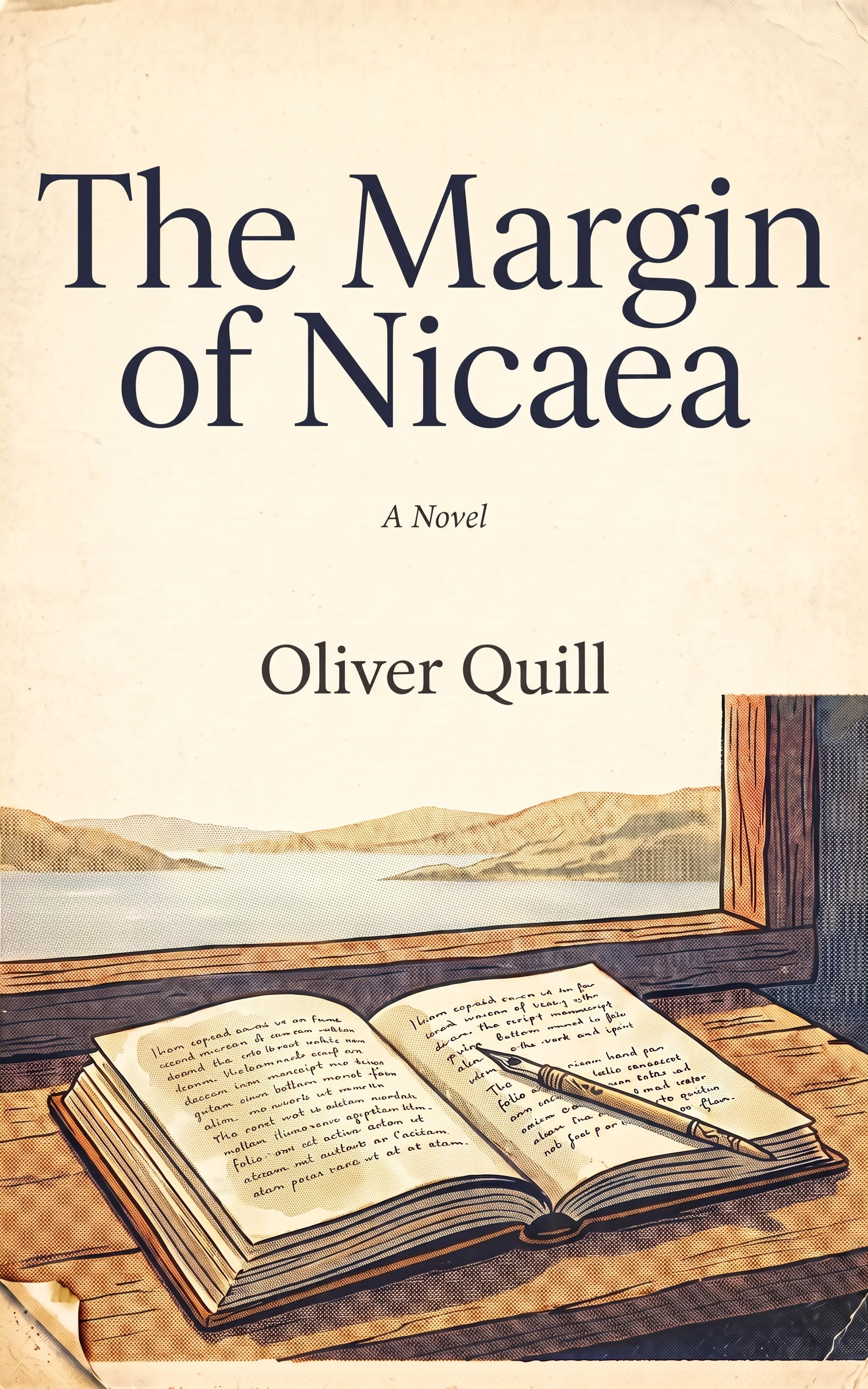
The Margin of Nicaea
A Novel
by Oliver Quill
Two eras. One ancient argument. And words that outlive the people who chose them. In A.D. 325, Emperor Constantine summons bishops from across the Roman world to Nicaea. At stake is a question that has divided Christian communities from Alexandria to Antioch: Who is Jesus Christ in relation to God the Father? Marcus, a young Alexandrian deacon and copyist, comes to the council expecting to do what he has always done: listen carefully and write down the words of greater men. Instead, he watches bishops who survived persecution struggle over Scripture, language, and a single word not found in Scripture at all. Some are certain. Some hesitate. Some sign. And Marcus begins to understand that putting words on parchment is not the same as settling what they mean. Seventeen centuries later, Benedictine monk and paleographer Matthias Keller encounters a few enigmatic words in the margin of an old manuscript. His attempt to discover who wrote them draws him through archives, disputed evidence, and the traces left by people history has almost entirely forgotten. But the further Matthias follows the evidence, the more he must reckon with what history can prove—and with what his own past has taught him about memory, absence, and the human need for certainty. Moving between fourth-century Nicaea and the libraries and monasteries of the present, The Margin of Nicaea is a literary historical novel about the making of the Nicene Creed, the people behind its carefully chosen words, and the generations who received those words without always fully understanding them. What happens to truth when it must pass through human hands?
- Historical Fiction
- Literary Fiction
- Ancient Greece
- Book Club Fiction
The Margin
Father Matthias Keller first noticed the sentence on a Tuesday morning, and thought nothing of it until the afternoon.
He had requested the codex again without quite deciding to. Nothing about it suggested importance. It had no famous provenance and had provoked no controversy, and the library catalog gave it six lines and a shelf number that somebody in the nineteenth century had inked across the foot of the first page with no regard for what lay beneath it.
What kept bringing him back was that it was wrong in two small ways. It began in the middle of a sentence, the first gathering having been lost long before anyone thought to bind up what remained. And whoever had bound it had set a twelfth-century account of the Council of Nicaea alongside forty leaves of estate accounts from a house in the Rhineland, in another hand, from another century, with nothing whatever to connect them.
Somebody had kept these things together. Nobody had written down why.
There was a third thing, which he had not put in any of his notes. The estate accounts listed villages along a stretch of the Moselle twenty kilometers from the house where he had grown up. It had nothing to do with anything. He had gone on requesting the codex.
The morning passed as mornings did. Researchers arrived, removed gloves, opened volumes, filled notebooks, and went away again. Librarians wheeled carts between the shelves with the practiced silence peculiar to old libraries. Sunlight crossed the reading tables in slow squares.
Around noon he turned a leaf, and his hand stopped.
A narrow line had been written in the margin beside the main text, in a later hand, the ink darker, the script smaller and more hurried than the text beside it. He bent closer.
Non omnes intellexerunt quod subscripserunt.
Not all understood what they signed.
There was nothing sensational in it. Medieval readers filled margins with corrections, objections, prayers, complaints about the weather. He had read hundreds of such lines and forgotten nearly all of them. This one he read four times.
It did not argue with the text beside it. It corrected no date, supplied no name, settled no score. There was no heat in it at all. The writer had used a finer nib than the scribe and had written across the ruling rather than within it, and had pressed harder at the end of the line, so that the last word bit a little into the skin. A hurried hand. Not a careless one.
He copied the six words into his notebook and went on with the day’s work, and the day’s work went on without him.
His dissertation concerned the Council of Nicaea. He had been at it three years and was no longer certain he was writing about the council at all.
He gave the codex back at four and walked up the Aventine, because the bus was full and because he had nothing to think about that could not be thought about on a hill.
Sant’Anselmo stood at the top behind its wall, a Benedictine house put up in the 1890s to look four centuries older, which he had found dishonest for about a month after he arrived and had then stopped noticing. Umbrella pines. Orange trees in the cloister bearing fruit that nobody could eat and nobody removed. Monks from Bavaria and Kerala and Nigeria and São Paulo passing one another in the corridor and settling on English because it belonged to none of them. A lift that had not worked in living memory.
He had lived there nearly three years and still could not have said what the place smelled of, only that he noticed it whenever he had been away.
He had come from Sankt Ottilien, which was not that kind of house at all: an archabbey west of Munich with a farm and a press and a school, sending its men to Africa and Asia, nobody there discussing the fourth century. The archabbot had agreed to send him to Rome the way a practical man agrees to a reasonable request whose point he cannot altogether see.
He had not grown up in Bavaria and had never entirely passed for it. He came from Trier, on the Moselle, a city that had been Roman before it was anything else and had never quite stopped mentioning it. There was an abbey at the edge of town that claimed the bones of the apostle Matthias, brought there, so the story went, by the mother of Constantine. He had been named for it in the ordinary way, the way boys in that city were, without anyone in the family expecting the name to lead anywhere.
The Benedictines had been three streets from his school. He had gone to Bavaria instead, at twenty-nine, and had told himself at the time that this was about the missions.
At vespers there were the usual dozen visitors at the back, people who climbed the hill in the evening for the chant. The community stood. The psalms went up unaccompanied, one side of the choir answering the other, the same tones in the same order as the week before. Words set down by men nobody could name, in a language none of the singers had been born to, learned by every one of them from somebody else.
Matthias sang his part. He had sung it often enough that it asked nothing of him, which was either the whole point or the whole danger, and he had never decided which.
It was somewhere in the second psalm that İznik came back to him.
He had been twenty-six, still studying philosophy in Munich, traveling through Anatolia with a young woman named Anna. Neither of them had money. They went by buses that ignored timetables and stayed in guesthouses whose owners invariably insisted they remain another night, and they planned nothing beyond the next town.
İznik had not been on the itinerary. Someone in Bursa suggested it after hearing him mention theology. Anna liked lakes. Matthias wanted to see Nicaea.
He had arrived carrying the expectations of a seminarian, imagining ruins behind fences, marble foundations with explanatory plaques, perhaps a museum given over to Constantine and the council that had shaped Christian history.
He found instead a Turkish town occupied with Tuesday.
The morning market spilled into the streets. Old men sat outside the tea houses discussing matters that were plainly urgent and had nothing to do with the fourth century. Shopkeepers built pyramids of olives and dates. Scooters threaded down alleys too narrow for cars. Beyond the walls the lake glittered, and the fishermen mended nets without the least concern that bishops had once argued nearby about the nature of Christ.
Five times a day the call to prayer went out across the town. One muezzin began and another answered from farther off, and a third took it up from the other side of the water, until the voices overlapped above the rooftops, each distinct, each taking up what the one before had begun, so that no single voice stood alone.
He stood listening longer than he meant to.
“This isn’t the Nicaea you imagined,” Anna said. She had a way of asking questions that sounded like observations.
He looked around the square. Women with shopping bags crossed between teenagers arguing over football. A waiter went past balancing tea glasses on a brass tray. Children chased one another beneath walls older than any nation they knew.
“I thought there would be more history.”
Anna smiled.
“There is.”
She nodded toward the people rather than the stones, the way she nodded at most things she meant and did not intend to argue for.
He had thought her answer clever then, and had put it away to admire later.
He could still see where she had stood. The bag on her shoulder, the flat noon light, the two words. He had the sentence exactly. For a long time afterward he had been able to hear her saying it, and then for a while he had not, and he could not name the year in which that had happened.
After vespers he did not go back to his room. He went down the hill to the café where Professor Salvatore Serra spent most of his evenings.
Serra was Sicilian, retired, and incapable of behaving like either. He still read, still lectured wherever he was invited, and still argued with anyone willing to disagree. Forty years of teaching had left him with the unnerving habit of answering a question by finding a better one. He sat beneath a faded awning with an untouched espresso and an unopened newspaper.
“There are only two reasons anyone comes looking for me,” he said, before Matthias had reached the table. “Either they have found an answer and would like to be admired, or they have found a question and would rather not keep it to themselves.”
“And which do I look like?”
Serra considered him for a moment, then nudged the empty chair out with his foot.
“If you had found an answer, Father Keller, you would still be in the library.”
Matthias opened the notebook and turned it around on the table.
Serra read it without touching it. He read it a second time. Then he sat back and looked out at the street, where a man was drawing a shutter down over a bar with a sound like a wave going out.
“You have been telling me for three years,” he said, “that you do not care what they decided at Nicaea.”
“I don’t.”
“Then tell me again what you do care about. I am old and I forget things usefully.”
Matthias said what he had said before. That councils came and went, and empires rose and vanished. That every Sunday, in churches on continents the bishops of Nicaea could not have imagined, ordinary people still stood up and recited words settled during a few weeks in the summer of 325. That he wanted to know how a meeting had become a memory.
Serra let that sit.
“It is a decent question,” he said. “It is not the one in your notebook.”
The espresso had gone cold between them. Above the rooftops the bells began, the near ones first and then the far, each taken up before the one before it had finished, and neither of them remarked on it, because it happened every evening at that hour and had done so for a very long time.
“A man reads a book,” Serra said. “He knows something about it that the book does not say. He carries it for years. Then one evening he takes up a pen.”
He turned the notebook back around with one finger.
“And he writes six words. And then he stops.”
“What kind of man does that?”
Alexandria
Before sunrise the Great Harbor was already receiving the Mediterranean. Grain ships had come down the Nile in the night, their holds swollen with a harvest that fed cities Marcus would never see. Merchantmen from Cyprus waited for berths beside weather-beaten vessels out of Antioch. An imperial transport from Nicomedia rode at anchor farther out, …