

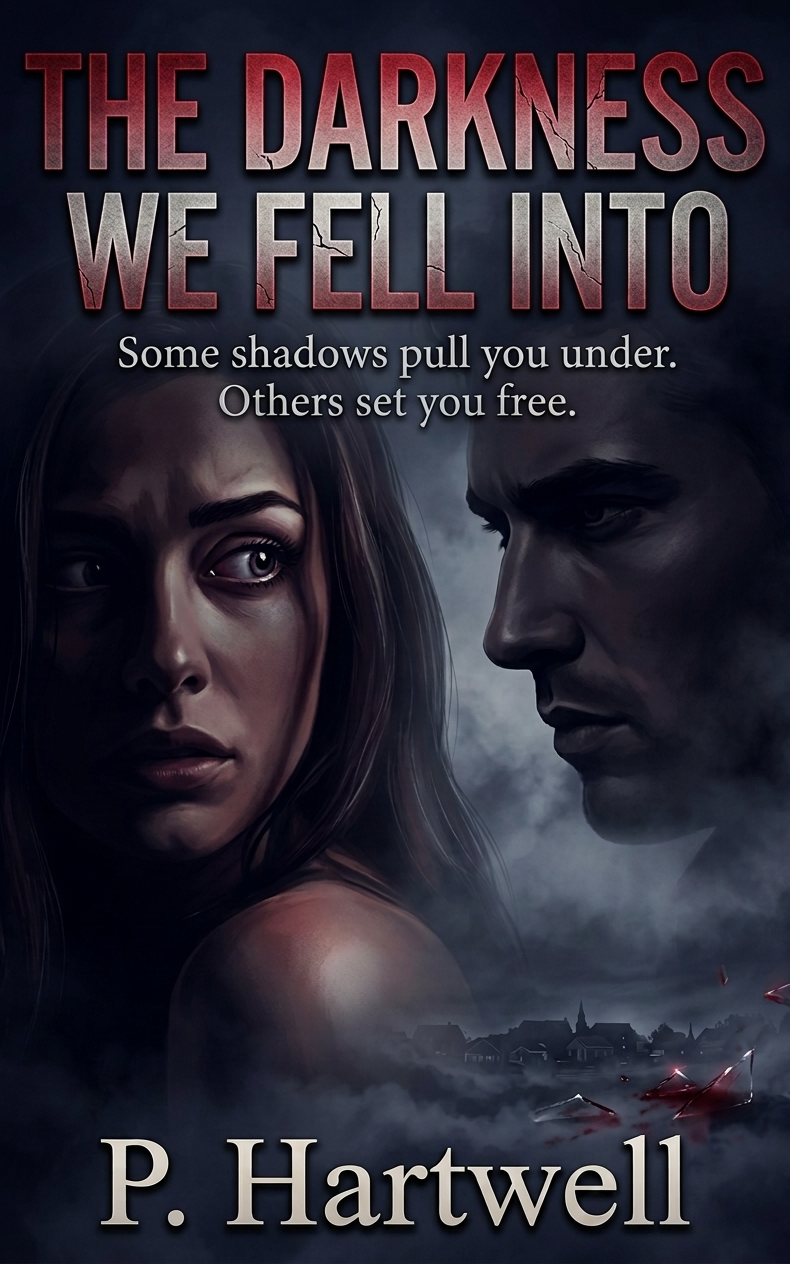
THE DARKNESS WE FELL INTO
Some shadows pull you under. Others set you free.
by P. Hartwell
Amber Rowan came to Cherry Creek to vanish. A brutal attack two years ago stole her memories, her boyfriend's life, and her sense of safety. The police called it unsolved. Her friends stopped calling. Now, in this sleepy New York town, she's rebuilding with flour-dusted aprons and quiet nights. Until the messages start. Intimate details. Sickly familiar threats. Only her attacker could know. Enter Dalton Vale. Ex-special forces. Mechanic with haunted eyes. He appears like a shadow—intense, protective, dangerously magnetic. Their connection ignites a slow, scorching fire that burns through her walls, leading to nights of raw surrender and whispered confessions. But Dalton knows too much. Shows up too often. And when a woman linked to Amber's past turns up dead, the truth fractures. He's not here by chance. Someone is hunting her. Someone who thinks Dalton stole their prize. As obsession collides with desire, Amber must unearth the memory she's buried—or lose herself forever. From P. Hartwell comes a dark romance where love is the deadliest obsession, and the past never truly dies.
- Romance
- Erotica
- Mystery
- Thriller
- Survival Thriller
- Friends to Lovers
The Scent of Cinnamon and Rain
Four in the morning is its own kind of quiet. Not peaceful — just empty, the way a room feels after someone's left it. Amber had learned to live inside that emptiness. She'd made it her whole personality, really.
She pressed the heel of her palm into the dough and felt it push back, warm and yielding, and for a fleeting second, the jagged knot of wire beneath her ribs uncoiled. Flour dusted her wrists, a fine pale coating that made her look like she was disappearing into the countertop. Which, honestly? Not the worst idea she'd had.
Six months in Cherry Creek. Six months of four AM starts and measured cups of flour and the soft, reliable smell of cinnamon filling the Roasted Bean's kitchen like a promise she could actually keep. She had a routine. She had a counter to lean on and an oven that didn't lie and a town small enough that nobody looked too hard at a girl who didn't want to be looked at. That was the whole plan, and it had been working just fine.
She shaped the cinnamon rolls in silence, listening to rain tap against the back window. It was early October, and Cherry Creek had decided to skip whatever gentle version of fall might exist and jump straight into cold, gray, relentless. The kind of weather that pressed down on your shoulders and dared you to try and feel optimistic.
Amber was not feeling optimistic. But she was feeling productive, which was close enough.
By six-thirty, the display case was stocked. Cinnamon rolls glistening with glaze, blueberry scones lined up in rows, a lemon loaf she'd made on a whim because she'd had extra zest and needed something to do with her hands at three in the morning when the nightmare woke her up again. She didn't think about the nightmare. She thought about the lemon loaf. She turned the sign on the door from CLOSED to OPEN and watched the rain streak down the glass in long, cold rivulets.
The first real customer of the morning came in just after seven.
She heard the bell above the door and glanced up from the espresso machine with the automatic smile she'd practiced until it felt nearly real. The man who stepped inside was tall enough that he had to duck slightly under the low wooden beam over the entrance, and he shook the rain off his jacket in one efficient motion, like he did everything with that same economy of effort. Broad-shouldered under a faded flannel shirt, dark blond hair damp and pushed back from his face, jaw carrying a couple days of stubble that was starting to lean toward actual beard territory. He had a scar through his left eyebrow — thin, pale, old — and eyes that were some particular shade of blue that made Amber think of winter lakes.
He was looking at her the way people look at something they recognize, and she had never seen him before in her life.
Okay.
She kept the smile in place, though her skin felt a size too small under that heavy blue gaze. "Morning. What can I get you?"
He stopped at the counter, his presence crowding the small space until the air seemed to hum with the scent of rain and cold machinery. He looked at the display case with an unnerving, flat intensity before those winter-lake eyes tracked back to hers. "Black coffee. And one of those." A nod toward the cinnamon rolls.
"Good choice." She meant it. Those were the best thing she made, and she wasn't modest about it. She poured the coffee, plated the roll, set it all on the counter and told him the total. He pulled a crumpled bill from his jacket pocket and laid it on the counter, and when she picked it up to make change, their fingers brushed — just barely, just for a second — and her whole nervous system had the audacity to short-circuit over that.
She dropped the coins into his palm. He didn't move immediately.
He didn't pull his hand away, his thumb brushing the edge of the counter. "These yours?"
Amber swallowed, her pulse thrumming against the base of her throat. "I made them, yeah."
Something shifted in his expression—not quite a smile, but a darkening of that blue stare that felt like a physical weight. "They're good." He spoke with a strange, quiet certainty, as if he’d already tasted them. As if he knew her work. He picked up the coffee and the plate, his movements slow and deliberate as he headed for a table by the window. Amber stood behind the register, her fingers still tingling where they'd nearly touched his, and very carefully did not watch him.
She watched him a little.
He ate the cinnamon roll slowly and drank his coffee and looked out at the rain, and there was something about the stillness of him that made her uneasy in a way she couldn't name. Most people fidgeted. Checked their phones, shifted in their seats, made small talk with whoever was nearby. He just sat there like he was completely comfortable taking up space, like the quiet didn't bother him at all. Like he was used to waiting.
She turned back to the espresso machine. Stop it.
Lila arrived at seven forty-five in a burst of wet caramel curls and polka-dot rain jacket and the particular energy of someone who had strong opinions about everything and was not planning to keep them to herself.
"Lord, it is disgusting out there," she announced, shaking her umbrella at the doormat. Her amber eyes swept the room, landed on the man by the window, and she got this look on her face — eyebrows up, lips curved, a silent well, well that she somehow broadcast without making a sound. She cut behind the counter and leaned close to Amber. "That's Dalton Vale."
"I don't know who that is." Amber kept her back to the room, obsessively wiping a spot on the counter that was already clean.
"He's got the garage on Route 9. Grew up here, left for the military, came back." Lila arranged this information with the practiced efficiency of someone who had cataloged every soul in a three-county radius. "Doesn't come in here much. Doesn't come most places much, honestly. Kind of a whole situation."
"A situation."
"A whole one." Lila glanced over again. "He's looking at you."
"He's looking out the window." Amber's voice was thin, even to her own ears.
"Same direction, honey."
Amber made a point of not checking. She restocked the napkin holder with great focus and purpose.
When she looked up a few minutes later, Dalton Vale was gone. The table was cleared. His coffee cup sat rinsed in the bus tub — he'd done that himself, which surprised her — and the plate held nothing but a faint smear of glaze. She hadn't heard him leave. Hadn't heard the bell over the door, hadn't heard his boots on the floor, nothing. He'd just stopped being there.
"See?" Lila said sagely. "A whole situation."
Amber's shift ended at two. The rain had softened to a fine, persistent mist by then, the kind that got into your collar and the back of your neck and made everything smell like wet pavement and leaves going to rot. She gathered her bag from the back room, said goodbye to Lila, who was already deep in conversation with a couple of regulars, and pushed out the side door into the alley.
Her car was parked around the corner on the narrow strip of lot the bakery shared with the hardware store next door. She'd been meaning to get the rattle in the front end checked. She'd been meaning to do a lot of things. There was a whole list of things she kept meaning to do, and she was getting to all of them slowly, in the order of least terrifying first.
She was fishing her keys out of her bag when she saw it.
The envelope was tucked under the windshield wiper on the driver's side. Small, white, slightly damp. The kind of plain, standard envelope you could buy anywhere, in any quantity, completely untraceable. She'd seen enough crime documentaries to know that.
She'd also seen enough of her own life to feel, before she even touched it, what this was.
Her hand didn't shake. She'd gotten good at that. She pulled the envelope free, turned it over. No name on it. No postmark. She slid her thumbnail under the seal and opened it.
Inside was a photograph.
Her front door. Her building, the blue-gray siding she'd memorized from the outside every night when she came home, the little potted plant she'd put on the step because she'd read somewhere that small acts of domesticity helped with anxiety. The photo was taken at night, from across the street or maybe from further down the block — close enough to be specific, far enough to be patient. And on the back, in thick charcoal strokes that pressed almost through the paper: I found you.
The mist kept falling. A car rolled past on the street without slowing. Somewhere down the block, a dog barked twice and stopped.
Amber stood very still and breathed through her nose and did not fall apart. She'd gotten good at that too.
Six months. Six months of careful, quiet, deliberate nothing. She'd changed her name on everything she could change it on. She'd told no one where she'd moved. She'd built this little careful life out of flour and routine and the particular mercy of a town that minded its own business, and somehow, somehow, it hadn't been enough.
She turned the photograph over again and looked at her front door in the dark and thought: they were standing right there.
Her stomach turned over, slow and cold. She put the photograph back in the envelope. She put the envelope in her bag. She unlocked her car and got in and sat there with the heat running and her hands flat on her thighs until her pulse came back down to something manageable.
She thought about calling someone. She thought about it the same way she'd thought about it for two years — seriously, briefly, and then she remembered the detective in Albany who'd looked at her across his desk and said, we just don't have enough to go on, and the thought passed.
She started the car and drove home through the mist and didn't cry, because crying was a thing she allowed herself between two and four in the morning when there was nothing else to do with it, and not in parking lots in broad daylight where anyone could see.
She made it back to her apartment, locked the deadbolt and the chain, and stood in her kitchen with her coat still on and made herself a cup of tea she didn't drink. The afternoon light was flat and gray through the window. She looked at the potted plant on her front step through the peephole — she'd drilled one in at knee height and one at normal height, because she was thorough like that — and the plant sat there exactly as she'd left it, small and stubborn and alive.
I found you.
She pressed her forehead against the door and closed her eyes. The wood was cool against her skin. She breathed in and out and thought about the cinnamon rolls and the rain and the particular quiet of four in the morning when the whole world was still asleep and nothing bad had happened yet. She tried to hold onto that. She was pretty good at holding onto things.
What she kept coming back to, though, when she was honest with herself, was the man at the table by the window. Dalton Vale, with his still, patient quality and his winter-lake eyes that had looked at her like he already knew her name before she said it. She didn't know what to do with that. She didn't know if it was comfort or warning or something in between — just that it had felt like both at once, which was not a combination she had any idea how to process.
She thought about the way he'd rinsed his own cup and left without making a sound, and the way his fingers had barely touched hers over the coins and how her whole body had registered it like a static shock. She thought about how, when she'd looked up and found him gone, her first feeling had been something she was not going to examine too closely because it had been awfully close to disappointment.
Pull yourself together, Rowan.
She went to her bedroom and sat on the edge of the bed and pulled the envelope out of her bag and looked at it one more time. The handwriting was the same as the one she'd gotten in Albany, two years ago, the one the detective had said they couldn't trace. Same pressure. Same charcoal. Same economy of words, like he'd thought about exactly what would land hardest and used only that.
He'd found her in six months.
She put the envelope in the shoebox in the top of her closet, behind the spare blanket, next to the two others she'd been hoping were the last. She pushed the closet door shut. She went back to the kitchen and picked up her tea and stood at the window and watched the rain start up again in earnest, coming down heavy and silver now against the street below, turning everything soft at the edges.
Out on Route 9, somewhere past the edge of town, a garage sat dark against the weather. She knew that now. She knew his name, and she knew he drove a truck, and she knew he took his coffee black and didn't leave crumbs.
She didn't know why that felt, at the end of a day that had cracked open beneath her, like the only solid thing she'd touched.
But it did. It absolutely did, and she hated herself a little for it, and she watched the rain and waited for morning the same way she always did — one breath at a time, hands wrapped around something warm, not looking too hard at what was coming next.
Broken Seals
The rattle in her front end had gone from mildly annoying to genuinely alarming somewhere between Tuesday and Thursday, and by Friday morning, Amber had run out of excuses to ignore it. She'd been putting off the garage the same way she put off everything that required interacting with a stranger in a confined space — methodically, creatively, and …
Want to read the rest?
Get the full book here: