

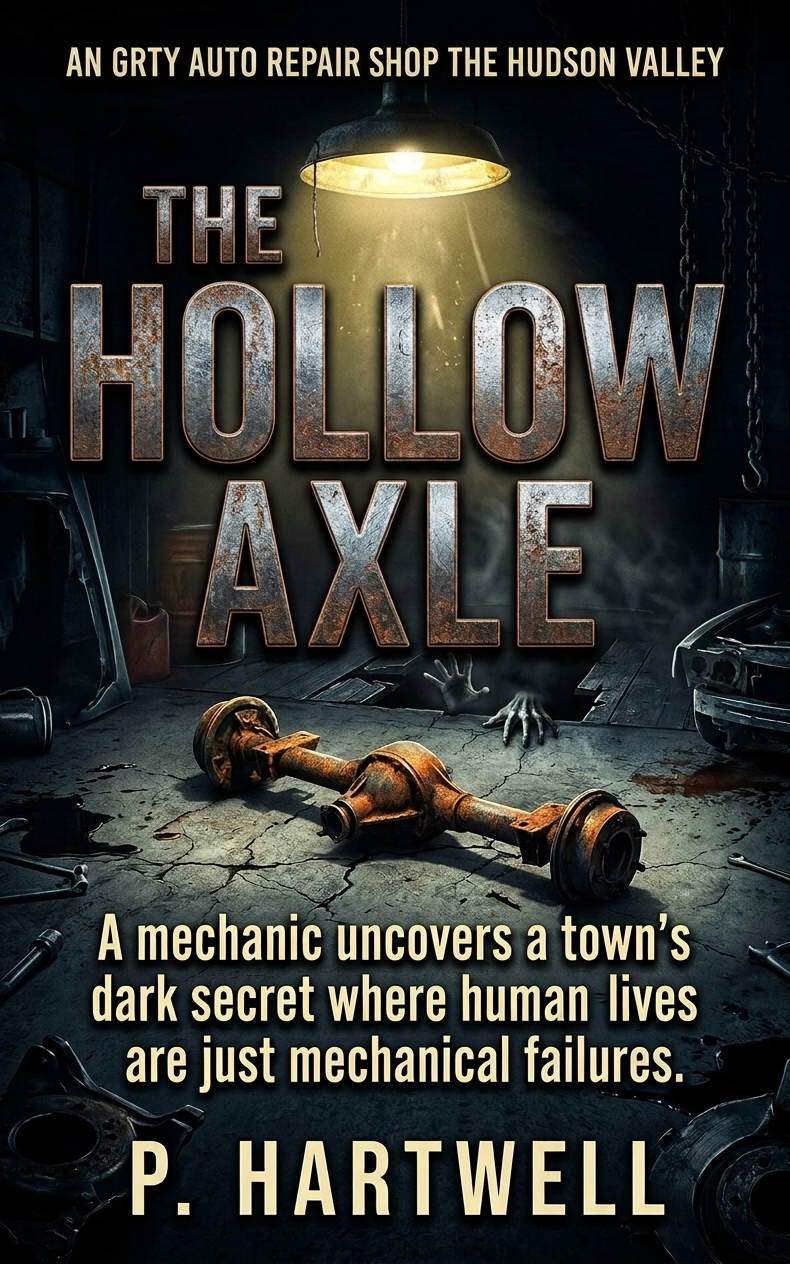
The Hollow Axle
A mechanic uncovers a town’s dark secret where human lives are just mechanical failures
by P. Hartwell
In the quiet Hudson Valley town of Hendricks, silence isn't just a virtue—it’s a survival tactic. Mike Hart is a young mechanic who knows the sound of a well-tuned engine, but when he finds a sedan with sabotaged subframe bolts in his uncle’s shop, he discovers a rhythm much more sinister. This isn't a simple mistake; it’s a blueprint for murder. For twelve years, Arthur Carver has run a sophisticated operation, staging vehicle accidents and processing human victims like line items in a ledger. Joined by Mara Ionescu, an ER nurse who has seen the grisly medical inconsistencies of these 'accidents,' Mike begins to peel back the layers of a conspiracy that spans from corrupt law enforcement to cold-blooded medical professionals. But when the concrete floor of the shop gives up its secrets—the remains of forty victims—the investigation turns into a fight for his own life. With the Sheriff in Carver’s pocket and Mike framed for the mechanical failures he tried to prevent, he must race to save a surviving victim from a remote farm before the system grinds them both to dust. The Hollow Axle is a chilling, atmospheric thriller that explores the high cost of silence and the brutal mechanics of evil.
- Thriller
- Horror
- Atmospheric
- Psychological Horror
- brutally physical
Cold Start
The shop had a smell Mike Hart had never been able to name. It wasn't just one thing. It was a weight.
Not oil, exactly. Not rubber or solvent or the sharp, metallic bite of brake dust. It was something older than any of those things, something that lived in the concrete itself—in the gray-black seams between the floor slabs and the low joists where decades of exhaust had left a residue the color of old skin. It was the smell of work accumulated past the point of memory. The building had absorbed it all. Now, it didn't release a thing.
He stood in the side doorway for a moment before going in, the way he always did. Right hand on the metal door frame, cold as a knife handle in November. Left hand holding the coffee he'd made in the dark of his apartment at five forty-five in the morning because he couldn't sleep again. Steam rose from the cup and flattened immediately against the wet air coming off the river. The sun was not yet up. The sky above the ridgeline to the east was a bruised greenish-gray, the color of something wrong with blood.
Mike stepped inside.
He found the light switches by muscle memory and threw them in sequence. The overhead fluorescent strobed on one by one down the length of the bay, buzzing slightly before settling into a flat, merciful working light. The shop materialized in sections. Lift one, empty. The tool wall with its masking-tape outlines. The steel shelving stacked with filters and belts in faded boxes. Ray's office. And the second lift.
Not empty.
Mike stopped.
There was a car on the second lift. A sedan—late model, dark, some shade between black and charcoal that occupied the space between the two without being either. He hadn't seen it when he'd left the night before. He'd locked the side door and the main bay doors himself, triple-checking the deadbolts the way he always did since the break-in two summers ago, though nothing had ever been stolen and Ray had never explained what he thought they were protecting. The car had not been there. Now it was.
He stood with his coffee in one hand and looked at it for a moment that stretched longer than it should have. Then he walked over.
It was a Ford Taurus. Dark gray, he decided. It was clean in a way that felt deliberate rather than cared-for—no road grime, no bird stains on the hood, no muddy spray in the wheel-wells. Wiped down. The windows were tinted dark, making the glass almost opaque in the shop light. He couldn't see what was inside without pressing his face to the window. He didn't want to do that.
He walked a slow circle around it first.
The body panels were unscratched. All four tires were the same brand—Michelin, road tires, relatively new—inflated to what looked like correct pressure just by the way the sidewalls sat. It was not a car that had been in an accident. It was not a car that had broken down. It had no oil or fluid pooling beneath it, no obvious damage, nothing that would explain why it was here.
He crouched at the passenger-side front wheel well and put his hand on the rotor out of habit, checking temperature even though it didn't matter. The rotor was cold. The car had been sitting for hours at minimum.
He stood up. Walked around to the rear. Looked at the license plate.
Ohio tags. A strip of electrical tape across the bottom corner of the plate, covering what might have been a registration sticker—or might have been a crack in the plate itself. Hard to tell.
He went to the driver's side and looked in through the window, cupping his hand against the glass. Nothing on the seats. A phone mount on the dash, empty. A fast-food cup in the center cupholder that looked weeks old. Nothing else. He tried the door handle. Locked.
Mike straightened up and drank some of his coffee. It had gone lukewarm.
He thought about calling Ray. Then he thought about what Ray would say, and decided it could wait five more minutes.
He went to the tool wall and got the drop light from its hook, clicked it on, and got down on his back on the creeper. Slid under the car.
The undercarriage was clean.
That was the first thing that struck him as wrong. Cleanliness in unexpected places usually is. No grease. No standard road debris packed into the frame channels. Someone had cleaned the underside of this car recently and thoroughly, and that wasn't a thing that happened to regular cars unless someone was getting them ready for a show. Mike ran the drop light along the frame. Slow. He let his eyes find what didn't belong.
He found the first one near the front subframe. A structural bolt—M12, shouldered, the kind that tied the subframe to the unibody—was visibly loose. Under any ordinary circumstances, it should have been torqued down tight for the life of the vehicle. He reached up and touched it. It moved. Not with the stiffness of a bolt that had vibrated loose over years of driving. It moved with the specific, awful ease of something that had been backed off on purpose.
He lay there for a moment with his hand on it.
Then he moved the light forward and found the second one. Same bolt, other side. Same deliberate loosening.
His breathing had changed without him noticing. He made himself slow it down.
He moved the light rearward. Checked the rear subframe mounts. Found one bolt turned nearly all the way out, still threaded but barely—a quarter turn from falling free. Found a second one he couldn't reach from this angle. Found a third near the differential mount that wasn't loose but had been marked, he realized: a thin scratch in the corrosion-protection coating, positioned exactly where a wrench would land. The scratch was made after manufacture. Someone had marked it and then stopped, or had been interrupted, or had decided three loose mounts were sufficient.
Mike slid out from under the car.
He sat up on the creeper and looked at his hands. They were clean. He hadn't touched anything that transferred grease or fluid. The whole undercarriage was clean. That was the problem. Everything here was clean and purposeful and that made the loose bolts mean something very specific.
This was not a car that had come in for repair.
This was a car that had been prepared.
He was still sitting there when he heard it.
A sound from outside—far enough away that it registered as ambient at first, the way sounds off the river did in the early morning when the water and the cold air conspired to carry noise across impossible distances. But this sound sharpened. Tires. Moving fast on the river road, the two-lane that ran along the east bank maybe three hundred yards north of the shop. The pitch of it rose—acceleration, not deceleration—and then there was a moment of something that wasn't quite sound, a quality of held breath in the air, and then the screech.
Tires locking up.
Long, high, sustained. The sound of a car doing something its driver had not intended.
Mike was on his feet before he understood he'd moved. He crossed the bay to the main doors, got his fingers under the bottom of the smaller service door inset in the left bay door, and hauled it up on its manual track. Cold air came in like a wall. He stepped out onto the gravel apron in front of the shop and looked north.
The river road was not visible from here—the shop sat back from it, set into a gradual slope that gave way to a screen of second-growth timber and then the road and then the river and then the far bank rising in the gray pre-dawn. But he could hear it. The screech had ended. There was a second of total silence in which the river itself seemed to stop.
Then a sound he felt more than heard: a flat, percussive impact. Metal and glass and inertia meeting an obstacle they could not negotiate.
Then nothing. The river fog took it. The morning continued, indifferent.
Mike stood on the gravel for a long moment.
He thought about the bolts. The clean undercarriage. The car that shouldn't be here. The Ohio plates. He thought about all of it arranged in a sequence, and the sequence had a very specific shape, and he understood its shape completely with the mechanical part of his mind—the part that didn't need to be taught how systems worked because it had always simply seen them—and what the shape described was not something he had words for yet.
He went back inside. Pulled the service door shut. Stood in the bay and looked at the dark sedan on the lift.
Then he went to the coffee maker on the shelf by Ray's office, poured what was left of his cup down the utility sink drain, and made a fresh pot. He did this methodically. He measured the grounds. He waited for the machine. He poured the result into his cup and wrapped both hands around it and stood at the sink and looked at the wall.
His hands were not shaking.
He thought about that.
Ray arrived at twenty past seven, same as always.
He came in through the side door. Mike heard the keys—the specific sequence, the slight sticking of the second deadbolt. Ray's truck was an '09 Silverado with a diesel engine Mike could identify from a quarter mile away. He'd heard it turn off the main road and crunch down the gravel while he was replacing brake pads on a Subaru. He'd heard it and he'd made a decision: he would not say a word about the sedan until Ray did.
It was a habit. Silence as information-gathering. You learned more by letting people decide when to speak than by asking. His mother used to say he'd come out of the womb waiting for someone else to go first. She'd meant it as a criticism. He took it as a rule.
Ray was fifty-three, built like a man who had spent thirty years doing physical work and hadn't stopped but wasn't twenty-five anymore either. Thick in the chest and arms, thicker now around the middle, with hands that were permanently stained dark in the creases of his knuckles despite whatever he used to clean them. He had a gray beard he kept short and a face that showed the weather more than his actual age, and he moved through the shop with the specific kind of authority that came from having built something from nothing and having watched it begin, slowly, to fail.
He came in and looked at the sedan and said nothing.
He went to the coffee maker. Poured a cup. Drank half of it standing at the counter with his back to the bay.
Mike torqued the last brake caliper bolt and set down the wrench.
"When'd that come in?" Ray asked. His voice was level, conversational. He stood by the counter, looking at the Subaru instead of the sedan.
Mike didn't look up from the wheel well. "It was here when I opened up."
Ray drank the rest of his coffee and refilled the cup, the machine gurgling in the silence. "I'll deal with it."
"Okay."
He picked up the wrench again. Selected the next bolt. Torqued it.
Ray leaned against the counter. "How's the Sub?"
"Fronts were metal-on-metal. Rotors are scored but not below spec." Mike wiped a smudge of grease from the caliper. "Replaced the pads, gave the rotors a quick resurface. She'll be fine."
"Good." Ray set his cup down on the counter and checked his watch. "I'm going to make a call."
He went into the office and shut the door.
Mike worked. He listened to the muffled low register of Ray's voice through the frosted glass—not words, just the cadence of speech, a short burst and then a pause and then a shorter burst and then silence. Two minutes, maybe three. Then Ray came out and walked to the sedan and stood beside it with his arms crossed and his coffee cup dangling from his right hand, looking at the car the way he sometimes looked at estimates he hadn't decided whether to take.
"I'll need you to move the Sub to the lot when you're done with her," Ray said. "Leave the second lift clear."
"Sure."
Ray nodded and went back to the office.
At nine forty-five, while Mike was looking up a part number on the computer at the front desk, a car passed on the river road at speed. He didn't look up. He heard it—the same road, same direction—and registered it as a vehicle moving at approximately twenty over the posted limit, which was nothing unusual for that stretch, especially on weekday mornings when the commuter traffic from the smaller towns upriver funneled down toward Poughkeepsie. He noted it the way he noted everything: filed without attachment.
At ten after ten, Ray's phone rang in the office. The conversation lasted less than a minute. When Ray came out his expression had not changed, which was the thing about Ray that had always disturbed Mike slightly without his being able to explain why: the consistency of his face across circumstances that should have distinguished themselves from each other. He looked the same when he was pricing jobs and when he was angry and when he was telling Mike that his father hadn't suffered, it had been quick, the way these things sometimes were.
"I'm running out to pick up hardware," Ray said. "Back by noon. You're good here?"
"Yeah. I'm good."
Ray left.
Mike sat at the front desk for a moment after the sound of the Silverado faded. Then he got up and went to the second lift and got back down on the creeper and slid under the sedan.
He checked all the bolts again. Counted them. Noted the locations, the specific degree of loosening on each one. He didn't write any of it down—there was nothing to write on that he would have left where it could be found—but he committed the geometry of it to memory with the same precision he applied to engine diagnostics. He could hold a complex mechanical picture in his head with accuracy that surprised people who didn't know him well. This was his gift, such as it was. He'd never thought of it as remarkable.
He lay under the car for a long time.
The structural bolts were loosened at three points on the subframe. Under ordinary driving conditions—city streets, light highway—the vehicle would perform normally. The looseness would not be detectable by feel and would produce no noise that a layperson would identify as dangerous. The car would drive well. It would accelerate normally. It would pass any casual inspection.
But under sudden stress—emergency braking or a hard swerve—the subframe would shift. The geometry of the suspension would change instantly. Steering control would just vanish. The car would stop behaving like a car.
The car would do whatever it wanted to do. And what it would want to do was crash.
Someone had built a crash. They had built it carefully, and they had built it here, in this shop, on this lift, and they had left it here in the dark and the locked building. And the screech of tires he'd heard this morning—the flat, percussive impact that had dissolved into the river fog—
Mike slid out from under the car.
He stood up. Looked at the dark sedan. Looked at the office door, dark behind its frosted glass.
He was twenty-two years old. He had worked in this shop for four years. He understood machines the way some people understood faces: intuitively, completely, without needing to learn the reasons. He had never been in trouble. He had never been inside a courtroom or the back of a police car or even, as best he could recall, a serious argument that hadn't resolved itself by one party walking away.
He understood what he was looking at. He understood it the way he understood a stripped thread or a cracked housing—not with alarm, exactly, but with the quiet, absolute certainty of a diagnosis that changed everything downstream.
He picked up his coffee cup, carried it to the sink, washed it out carefully, dried it with the shop rag hanging from the utility hook, and set it upside-down on the drain board. He said nothing and went back to work.
A Noise That Shouldn't Be There
The customer's name was Dennis Crough, and he arrived at eleven forty-three on a Tuesday with a 2017 Ram 1500 that had a noise he described as a clunking, maybe grinding, kind of like something loose but also kind of like something rubbing and which had been present, by his own admission, for approximately six weeks. Six weeks. Mike had learned ear…
Want to read the rest?
Get the full book here: