

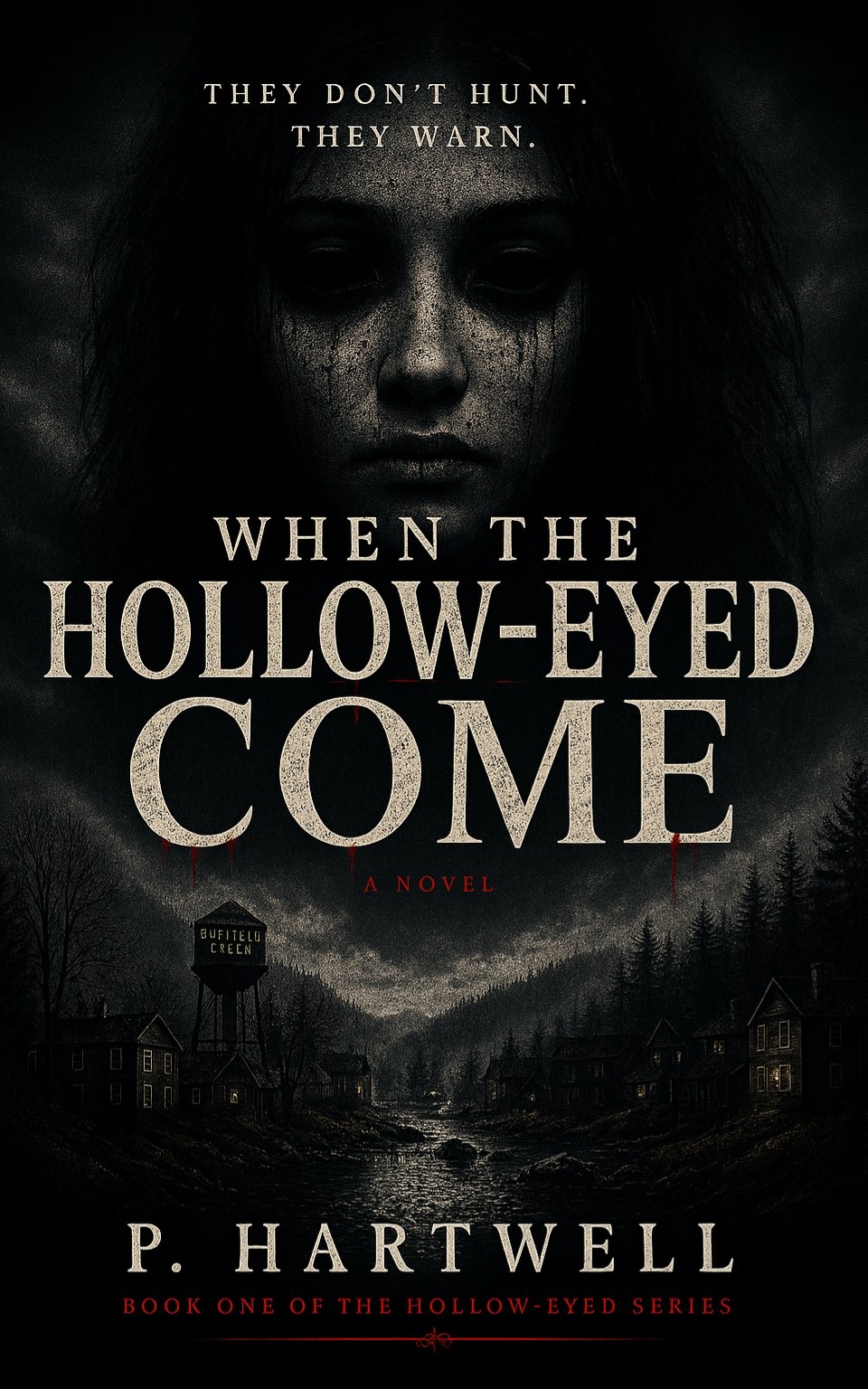
WHEN THE HOLLOW-EYED COME
When the silent watchers appear in the woods, something ancient and terrible follows
by P. Hartwell
The settlers along Buffalo Creek know the rules: avoid the deep trails after dark, ignore the shadows between the pines, and never speak of the figures with the hollow, lightless eyes. They don't hunt. They don't attack. They simply watch—and when they appear, death is never far behind. Jonas Farlow knows the frontier, but he doesn't know why a young man has turned up dead near the water with no wounds, no blood, and an unnatural emptiness where his eyes should be. While the town’s leaders look the other way to protect their interests, Jonas senses a rot spreading through the soil. Sera Redwillow, a Seneca woman who remembers the old warnings, knows the truth: the Hollow-Eyed Ones are not the threat. They are the heralds of a primordial consciousness awakening beneath the creek—something older than memory that views the living as nothing more than temporary sediment. As the creek turns oily and the weather defies the seasons, Jonas and Sera must confront a darkness that bridges the gap between folklore and cosmic dread. In a land defined by silence, the loudest screams are the ones that never reach the surface. The first installment of The Hollow-Eyed Trilogy is a grounded, atmospheric journey into the heart of wilderness horror.
- Horror
- Supernatural Horror
- Folk Horror
- Cosmic Horror
- Psychological Horror
The Eyeless Toll
The beaver traps had been empty for three days running, which should have been Jonas Farlow's first indication that something was wrong with the creek.
He worked his way south along the bank before dawn, lantern in one hand and the retrieval hook in the other, boots sinking into mud that sucked at each step like it didn't want to let him go. The sky overhead was still dark, that particular shade of deep blue that comes just before the light decides to commit. He could smell the water, cold and mineral, and beneath it something else he couldn't immediately name. Copper, maybe. Or old iron left out in the rain.
He told himself it was nothing, that the traps were empty because the beavers had moved upstream the way they sometimes did in late autumn when the sedge thinned out. He told himself that, and he almost believed it, right up until his boot caught on something solid in the reeds and he looked down.
At first he thought it was a deer. The way the shape lay half-submerged in the shallow water, one arm twisted under the body, it had that same boneless quality of something that had simply stopped. Then the lantern light caught the pale curve of a jaw, and Jonas stopped breathing for a moment.
He set the lantern on a flat stone and crouched down.
It was Thomas Biel. Seventeen years old, worked the cutting floor at Pricket's mill, had a habit of whistling badly through a gap in his front teeth. Jonas had spoken maybe thirty words total to the boy in the past year, but he knew his face well enough.
The boy's eyes were gone.
Not damaged, not torn out by an animal in any way Jonas had ever seen. Gone, like they had been removed with deliberate care. The sockets were clean and dry, the surrounding tissue undisturbed, no ragged edges, no bruising, no sign of any struggle at the orbital rim. They looked like two small, dark doorways set into an otherwise ordinary face. Jonas made himself look for a long moment because looking away felt like admitting something he wasn't ready to admit.
He checked the boy's shirt next. Pale linen, the kind the mill hands wore. Not a drop of blood on it. Not a smear, not a stain, not even the faint rust-colored shadow that would suggest it had been washed. The shirt was clean. Thomas's hands, folded loosely at his sides by the water's drift, were clean too. No torn fingernails, no scraped knuckles, nothing that suggested the boy had fought anyone or anything at all.
Jonas sat back on his heels and looked at the mud around the body. The bank was soft enough that a stepping cat left clear impressions. He searched for boot prints, drag marks, anything that showed how the boy had gotten here. There was nothing unusual. Just the shallow impression of Thomas's own body, and the water moving past it with complete indifference.
"Hell," Jonas said quietly, to no one.
He pulled the body out of the water carefully, getting his arms under the boy's shoulders and knees. That was when he noticed the weight. Thomas Biel had been a lean kid, maybe a hundred and fifty pounds at most. What Jonas lifted felt considerably heavier, the way a bag of wet sand feels heavier than it should. Not rigid, not stiff in the way a body gets with time. Just dense, as though something inside had changed composition overnight. He adjusted his grip and stood, mud releasing his boots with a reluctant sound.
The air smelled wrong. He noticed it more fully now that he was standing still, holding the weight of the boy against his chest. Ozone, sharp and electric, the kind of smell that comes before a lightning strike, but the sky above was clear and full of fading stars. And beneath the ozone, that metallic tang again, stronger now, wet iron or old blood, though there was no blood anywhere Jonas could see.
He started walking.
The settlement was three-quarters of a mile north along the creek bank, and Jonas made it maybe a hundred yards before the prickling started at the back of his neck. He knew the feeling well enough. Years in the woods teach a man to pay attention to that particular sensation, the one that comes when the forest is watching. Usually it meant a predator, something with patience and yellow eyes sitting in the dark beyond the lantern's reach, calculating whether you were worth the trouble.
He stopped walking. Shifted Thomas's weight and turned slowly toward the treeline.
The oaks on the eastern bank were old, older than the settlement by a long margin, their trunks thick enough that two men couldn't reach around them. Between two of the largest, something stood.
Jonas had seen tall men before. He was broad and six feet himself, and he'd known men who topped him by a few inches. What stood between the oaks was not a tall man. It was tall the way a dead tree is tall, all vertical lines and wrong proportions, the limbs too long, the torso too narrow, draped in something gray and ragged that moved in no wind Jonas could feel on his own skin. Eight feet, maybe more. It was difficult to judge distance in the pre-dawn dark.
It had a face. Or rather, it had the shape of a face, pale and smooth as a river stone worn flat. And where eyes should have been, there were only two round, perfectly black holes.
Jonas stood completely still. His arms tightened around Thomas's body without conscious decision, a reflex, the way you hold something precious when you feel the ground shift. The figure between the oaks did not move. Did not breathe. It simply stood there with the quality of something that had been standing there for a very long time and had no particular reason to stop.
Then, somewhere in Jonas's ears, a sound began that had no business being there. Running water. A full, rushing river sound, the kind the creek made during spring melt when the water ran high and fast and brown with snowmelt from the hills. He could hear it clearly, a roar of moving water, though the creek behind him was low and quiet and he was already thirty yards from its bank.
He blinked.
The figure was gone.
The two oaks stood the way they always had, thick and dark and indifferent. Nothing between them, no shadow, no shape, no evidence that anything had been there at all. The sound of rushing water faded slowly, like something draining away, until all Jonas could hear was the actual creek behind him and the distant call of a nightjar somewhere in the canopy.
He stood there for another few seconds, breathing carefully through his nose. Then he turned back north and kept walking, because the boy needed to be out of the mud and there was nothing else he could usefully do standing on the bank with his heart pounding in his ears.
His cabin sat on a shallow rise above the floodplain, a single-room structure built from squared timber with a stone chimney that drew well and a door that hung true. Jonas had built it himself four years ago, and it suited him. He went inside, laid Thomas on the workbench along the east wall, and covered him with a wool blanket. Then he stood by the cold hearth and tried to light his pipe.
His hands were shaking.
He noticed this with the same flat attention he gave most things. His hands did not generally shake. He had dressed wounds in the field, reset his own dislocated shoulder once without making much noise about it, pulled dead men out of collapsed mine shafts back east without his hands so much as trembling. He watched his fingers fumble with the tobacco and thought about that.
He eventually got the pipe lit. He sat on the edge of his cot and smoked and looked at the shape under the blanket and thought about the sockets where Thomas's eyes had been, that clean and deliberate absence, and he thought about the figure between the oaks.
He believed in what he could touch, what he could measure, what left tracks in the mud. The world was large and mostly indifferent to human opinion, but it was also legible if you paid attention. Animals left signs. Weather had patterns. Even death had logic to it, a cause you could trace back to something real if you looked hard enough.
The body on his workbench had no logic he could find.
He pulled on the pipe and let the smoke out slow. Somewhere outside, a branch cracked. He listened to the silence that followed, the particular quality of it, and realized the birds hadn't started yet. The nightjar had gone quiet. Even the creek sounded muffled, farther away than it should be, as though something had been placed between him and it.
He thought about the rushing water sound again. Clear and close and internal, the way a sound feels when it's coming from inside your skull rather than outside. He turned the pipe over in his hands.
You're not going soft, he told himself. You're not your father.
But his father had started with sounds too, hadn't he. Sounds that had no source, voices in empty rooms, the sensation of being watched in places where nothing watched. Jonas had been nineteen years old when they found the old man in the woods three miles from the house, sitting with his back against a pine and his face turned up to the sky, dead of a winter that hadn't been cold enough to kill him. No marks. No struggle. Just gone, like a candle someone had pinched out.
He set the pipe down on the hearthstone and rubbed both hands hard against his thighs until the shaking stopped.
The blanket over Thomas Biel lay perfectly still. The cabin was cold enough that Jonas could see his own breath. He sat there in the gray dark and listened to the silence where the birds should have been, and after a while he got up, pulled on his coat, and began stoking the fire. The body would need to be brought to the settlement come first light, and he'd need a clear head to deal with Pricket, who would have opinions about this that had nothing to do with the truth.
The fire caught slowly. Jonas fed it small splits of pine until it was breathing properly, then stood with his back to it and let the warmth work on the stiffness in his shoulders. Outside, the sky was beginning to pale at the eastern edge, that first weak light that doesn't quite commit. A jay called somewhere in the oaks. Then another. The birds were coming back, which meant whatever had been here was either gone or had learned to be still enough that they couldn't feel it anymore.
He wasn't sure which of those options he preferred.
He went back to the workbench. Lifted the corner of the blanket and looked at the boy's face one more time, not because he wanted to, but because he needed to be certain of what he'd seen. The sockets were exactly as he remembered them. Clean and empty and perfectly round, the orbital bones intact, no fracture, no prying, no tool marks he could identify. Whatever had removed Thomas Biel's eyes had done it without breaking anything else.
Jonas let the blanket fall back.
He thought about the ozone smell, still faintly present in his coat where he'd held the body against him. He thought about the dense, leaden weight of the boy. He thought about the figure standing motionless between the ancient oaks, its hollow face turned in his direction with no expression because it had no face left to make one with, and he thought about the sound of rushing water filling his ears from nowhere.
He had trapped this creek for four years. He knew every bend, every eddy, every place where the water ran shallow over gravel and every place where it dropped into dark, still pools that held their cold even in August. He knew the trees along its banks the way you know the walls of a room you sleep in. He knew the sounds it made at different water levels, the particular voice of each riffle and rapid.
He had never heard it sound like that. Not like a river. Not from inside his own head, clean and close and impossible.
The fire popped behind him. Outside, the jays were arguing about something in the canopy with their usual lack of dignity. The sky through the single window was going from dark blue to gray, and the shapes of the trees were becoming distinct again, individual things rather than a solid black wall.
Jonas picked up his coat and checked the hang of the knife at his belt. He looked at the blanket-covered shape on the workbench. He looked at the window, and the pale morning coming through it, and the dark line of the forest beyond the clearing.
Nothing moved out there. Nothing stood between the trees that he could see.
He reached for his rifle anyway, checked the load, and set it by the door where he could get to it quickly. Then he sat down to wait for enough light to make the walk to the settlement worth making, because stumbling through the dark with a dead boy in his arms and his hands still not entirely steady seemed like the kind of thing a man should only do once.
The fire burned low and even. The blanket lay still.
Somewhere far off, or maybe not far off at all, Jonas heard it again. Just for a moment, barely there, the soft rush of water moving fast over stone, filling the quiet cabin like a held breath. He sat up straight and looked around the room, at the walls and the ceiling and the cold corners where the firelight didn't reach.
Nothing. Just the fire, and the dead boy, and the pale morning pressing itself against the glass.
He picked up his pipe again. Found it had gone cold. Set it back down.
The woods had been home for a long time. Since before he'd packed up his life back east and moved west, leaving behind a house that smelled of damp plaster and the quiet, terrible weight of things left unsaid. This particular stretch of forest, with its deep oaks and its cold creek and its long winter silences, had been the closest thing to peace he'd managed in years.
He sat with the rifle across his knees and watched the morning come, and tried to remember the last time the woods had felt like that. Like something you belonged to rather than something that was watching you from every direction at once, patient and still and waiting for you to make a mistake.
He couldn't remember. And that, he decided, was the thing that frightened him most.
Copper and Crow
First light was fully committed by the time Jonas got Thomas Biel down from the rise and into the settlement. He carried the boy on his back, wrapped in the wool blanket, and he took the creek road because it was the most direct and because he didn't want to walk through the trees any more than he had to. The morning was cold and gray, the kind tha…
Want to read the rest?
Get the full book here: