

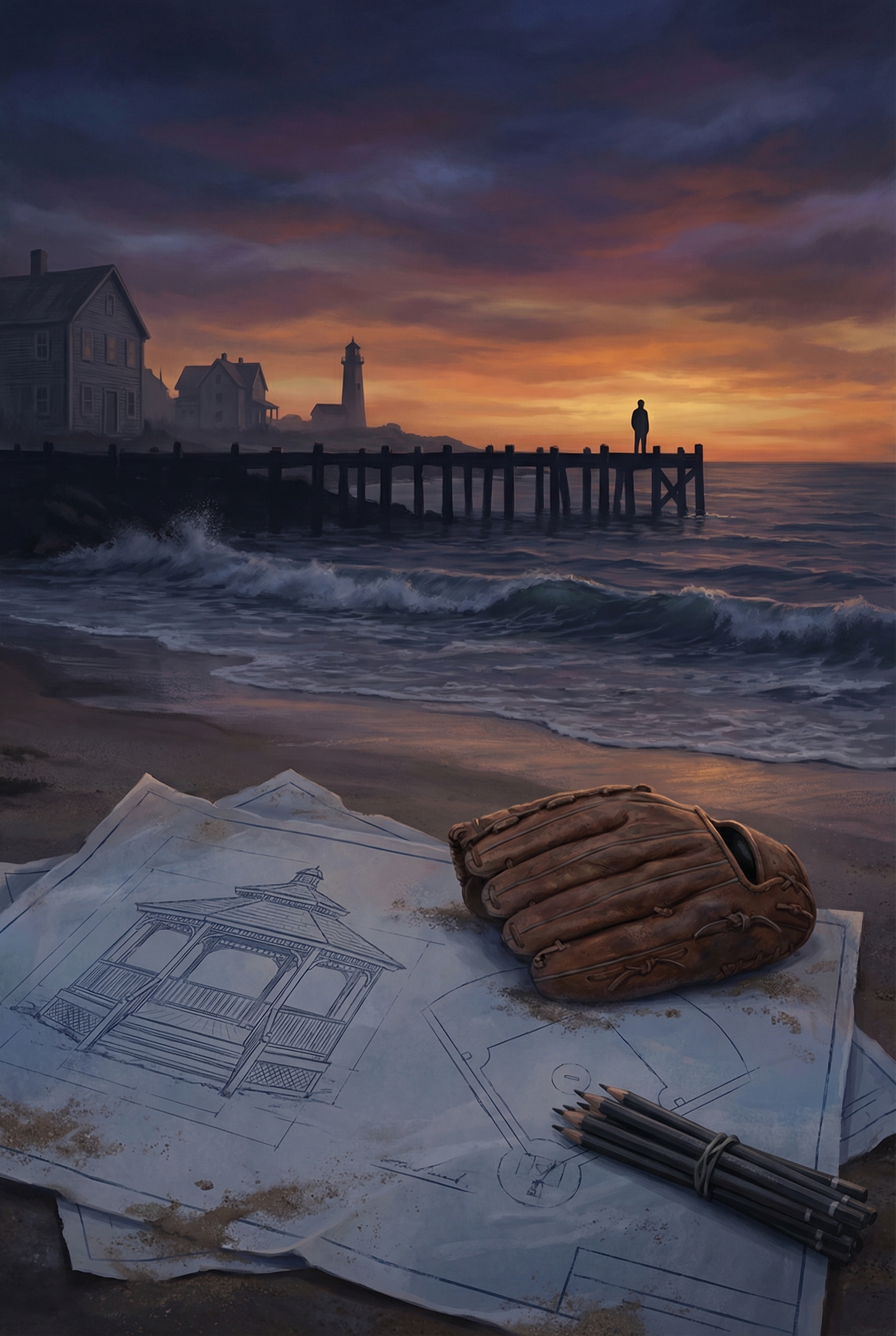
Five Kids, One Heart
A story of found family, summer dreams, and the shadows that haunt a seaside town
by Padraig Jack MacPhee
In the picturesque town of Duxbury, the Cameron siblings—triplets Mickey, Farland, and Pherson, and twins Jill and Rusty—share a bond that transcends their non-traditional upbringing. Supported by their two mothers, Meg and Denise, and their biological father Jack, the kids spend their fourteenth summer on the baseball diamond and dreaming of a secret sanctuary in Provincetown. But while the Camerons live in a world of light and laughter, their best friend Ike Riley is drowning in a dark reality. Living in a mobile park in nearby Kingston, Ike hides the bruises and the terror of his stepfather Stanley’s rage. He finds solace in his art, his music, and the unwavering loyalty of the Duxbury crew, but the walls are closing in. As the siblings plan a professional baseball diamond and a custom-built gazebo for their future, Pherson begins to sense the cracks in Ike’s armor. What starts as a coming-of-age story about friendship and first loves soon becomes a race against time. In a world where family is everything, the Camerons must discover if love is enough to save a friend from the ultimate tragedy. This emotional journey explores the strength of domestic bonds and the devastating cost of secrets kept in the shadows.
- Young Adult
- YA Coming of Age
Summer's First Swing
The alleyway between our houses smells like cut grass and Eileen Riley's peach pie, and that is how I know summer has really arrived in Duxbury. I am Mickey Cameron, and I have been calling meetings in this alleyway since I was six years old. Today is no different, except that the stakes feel bigger.
"Okay," I say, spreading a hand-drawn map across the top of an overturned milk crate. "Dad gave us the land. The question is what we do with it." I look around at my siblings. Rusty is cross-legged on the ground beside me, his curly strawberry blonde hair catching the afternoon light. Farland is leaning against the fence with his arms folded, and Pherson stands a little apart from everyone else, chewing his lip. Jill sits on the porch steps, her long strawberry blonde hair tucked behind both ears, looking like she would rather be anywhere with a flat, clean surface.
"We already know what we're doing with it," Rusty says. He is not impatient about it, just certain. "The gazebo. The baseball diamond. We talked about this."
"Talking isn't building," I say. "We need a real plan."
Jill tilts her head. "We need blueprints is what we need. And someone who can actually read them." She lets that hang in the air with a perfectly arched eyebrow, making it clear she knows exactly who that someone is.
I am about to answer when Ike Riley comes around the corner of the fence. He has walked over from his grandparents' house next door, and the first thing I notice is how pale he looks. It is July. He should be tan. He has his sketchbook tucked under one arm and his dark hair is falling across his forehead, and there is something in his face that is careful and quiet in a way that sets off a small alarm somewhere behind my ribs.
"You started without me," he says, but he is smiling when he says it, so I let it go.
"We saved you a seat," Rusty says, patting the ground beside him. That is Rusty. He always saves a seat.
We move the meeting to the Riley backyard, where Paddy is already sorting through a crate of baseball equipment on the porch. He is a big, barrel-chested man with silver hair and the kind of hands that look like they were carved out of something solid. He nods at us without breaking his rhythm, pulling out a bat, checking the grip, setting it aside.
"You kids staying for pie?" Eileen calls through the screen door. She does not wait for an answer, because she already knows it.
We spend the next hour on the back porch, eating slices of peach pie that are still warm from the oven and arguing in the best possible way about Provincetown. Farland wants the baseball diamond built first. Jill says the gazebo has to come first because it is the structure with the most load-bearing complexity, and she says it the way she says most things, like it is simply a fact and anyone who disagrees is working against physics. Jack Kennedy arrives around three o'clock in his truck with a load of lumber samples in the bed and a relaxed grin on his face, and the energy shifts the way it always does when he shows up. He is tall with salt-and-pepper hair and blue eyes that all three of my brothers got, and he has this quality of making everything feel more possible without actually promising anything.
"You've got good bones to work with out there," he says, leaning against the truck. "Two acres of flat land behind the house, solid soil. Jill, I brought a couple of architectural surveys. Thought you might like to look them over."
Jill lights up in a way she would never admit to and takes the rolled papers from him carefully, like they are something precious. Pherson watches her for a second, then looks back at Ike.
Ike has been quiet. Not rude-quiet, just his own kind of still. He is sitting at the edge of the porch steps with his sketchbook open on his knees, drawing something in quick, sure lines. I lean over and see the outline of a gazebo, small and hexagonal, with a fireplace sketched in at the center and a suggestion of windows on every wall. It is beautiful. It is also clearly somewhere he has been going in his head for a while.
"That's really good, Ike," Rusty says softly, and Ike closes the book a little too quickly.
Then his phone buzzes on the step beside him. He looks down at the screen, and I watch his face go somewhere I cannot follow. Whatever is on that screen is not good news. He sits with it for a moment, then stands up and tucks the sketchbook under his arm.
"I have to head back," he says.
No one argues, because we have learned not to. Paddy goes very still on the porch. Eileen appears at the screen door, and there is something in her expression that is careful, the same way Ike's face is careful.
"You just got here," Farland says, and it is not an accusation, just a true thing said out loud.
"I know." Ike looks at Rusty, and then he pulls one page from his sketchbook and holds it out. "That's for the project. The gazebo. Use it if you want."
Rusty takes it. "We'll use it," he says. "It's exactly right."
Ike says goodbye to his grandparents quietly, and Paddy puts a hand on his shoulder for a moment that lasts just long enough to mean something. Then Ike walks down the alley toward the bus stop, a slight figure in an oversized shirt, his sketchbook tucked close against his side like something worth protecting.
From the porch, I watch him go. Beside me, Rusty holds the drawing of the gazebo carefully with both hands. Mom and Ma are standing together at the edge of our yard, and I see them exchange a look, the kind that doesn't need any words and says everything anyway.
I want to call after him. I want to say something that would make him turn around and stay in Duxbury where the pie is warm and the air smells like summer. But the bus stop is already swallowing him up, and all I have is the alleyway and the drawing and the uneasy feeling that some distances are harder to cross than two towns on a map.
Blueprints and Beach Dreams
Jill has Ike's sketch of the gazebo pinned to the wall above the kitchen table by eight-thirty the next morning, and she is already talking about load-bearing walls like the rest of us have been awake for hours. "The hexagonal shape is actually smart," she says, smoothing a blueprint across the table with her palms. Her long strawberry blonde hair …