

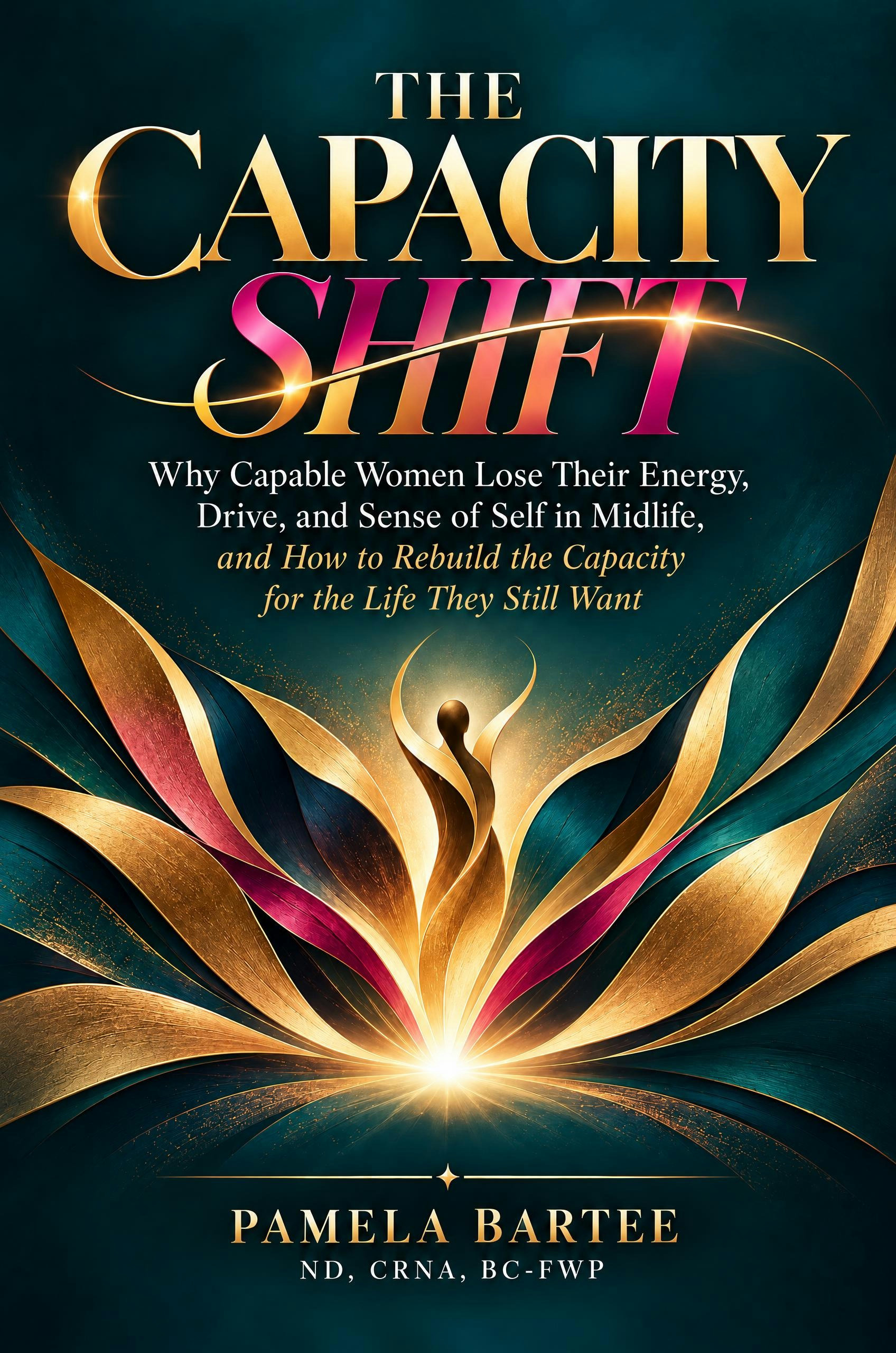
THE CAPACITY SHIFT
Why Capable Women Lose Their Energy, Drive, and Sense of Self in Midlife, and How to Rebuild the Capacity for the Life They Still Want
by Pamela Bartee
You haven't lost your ambition. You haven't lost your intelligence. And you haven't lost the desire for more. So why does everything feel so much harder?** You used to be the woman who could handle everything. The career. The family. The responsibilities. The endless demands. You were the strong one, the dependable one, the woman everyone counted on. But somewhere along the way, something changed. You're exhausted even after sleeping. Your mind feels foggy. Your body is changing in ways you don't understand. Your motivation isn't what it used to be. Your confidence has taken a hit. And the things you once handled with ease now require energy you simply don't seem to have. You keep asking yourself, *What happened to me?* Maybe you've blamed menopause. Maybe you've blamed aging. Or maybe you've quietly wondered whether you've lost the drive, discipline, and capability that once defined you. **But what if you haven't lost your capability? What if your capacity to sustain the life you've built needs to be restored?** In *The Capacity Shift*, Pamela Bartee, ND, CRNA, BC-FWP, draws on nearly four decades of healthcare experience and her own midlife transformation to introduce a different way of understanding the exhaustion, physical changes, emotional overwhelm, and loss of confidence so many high-achieving women experience. She explores how hormonal changes, physical health, accumulated stress, and long-standing patterns of pushing, pleasing, performing, proving, and pretending can influence the way women experience midlife. Through her signature **CAPACITY framework** and the four-part journey of **Release, Refill, Rebuild, and Reclaim**, you'll discover how to: - Recognize the physical, mental, and emotional demands that may be draining your capacity. - Understand why midlife changes can make your old ways of pushing through feel increasingly unsustainable. - Reconnect with your body's signals instead of continually overriding them. - Support your energy, sleep, nutrition, movement, digestive health, and recovery. - Identify the survival patterns, expectations, and boundaries that may be keeping you exhausted. - Begin making meaningful changes through a practical 30-day Capacity Reset. This isn't another book telling you to work harder, become more disciplined, or get the old you back. It's an invitation to stop measuring your worth by how much you can carry and begin building a life that supports the woman you're becoming. **Because you didn't work this hard, overcome this much, and come this far just to spend the next chapter of your life sitting on the sidelines.** There is still more life you want to live. And it's time to rebuild the capacity to live it. **The Capacity Shift begins here.**
- Self-Help
- Wellness & Fitness
- Women's Health
- Boundaries & Self-Care
- Stress & Anxiety Management
- Holistic Wellness
Introduction: The Tab My Body Could No Longer Pay
Something is happening to women in midlife.
And I don't believe we're talking about it deeply enough.
She has spent decades building a career, raising children, supporting a family, serving her community, caring for parents, building businesses, solving problems, meeting deadlines, managing households, and being the person everyone knows they can call.
But lately, getting things done costs her more.
She walks into a room and forgets why she's there.
She rereads the same email three times because her brain isn't processing information the way it used to.
She loses words in the middle of conversations, reaching for simple vocabulary that used to come instantly.
Her belly is changing even though she hasn't dramatically changed how she eats.
Her workouts take more out of her than they used to, leaving her drained for two days instead of energized.
She feels more anxious, irritable, overwhelmed, emotional, or sometimes strangely numb.
She looks in the mirror and wonders where the capable, clear-headed woman went, quietly asking herself if this is simply what getting older feels like, or if she has somehow failed at managing her own life.
The High-Functioning Hurdle
When I reached age 55, my body pulled the emergency brake. Within a matter of months, I gained thirty pounds. My hair began shedding in handfuls that clogged the shower drain. I had unpredictable cravings for sugar and refined carbohydrates that made no rational sense given my background in nutrition. Worst of all was the cognitive fog. It was thick, disorienting, and relentless. I lost the confidence to step on stage, a place where I had previously felt completely at home. My regular exercise routine, which had sustained me for thirty years, suddenly left me bedridden with deep, aching joint fatigue. My initial impulse was simple: blame menopause. It felt like the obvious culprit. Every headline, doctor visit, and wellness forum pointed to declining estrogen as the sole cause of my collapse.
The truth was far more uncomfortable. Menopause was not the origin of my breakdown; it was merely the event that exposed it. The actual rupture had occurred nearly a decade earlier, inside an operating room in 2015.
I was working long shifts in surgical environments, standing for ten or twelve hours at a stretch under glaring lights. One afternoon, during a simple patient transfer, I suffered a severe physical injury. A sharp, tearing pain ripped through my back and hip, and nausea washed over me from the sheer intensity of the sensation. Yet I never stepped away from the table, asked for help, or even sat down.
I adjusted my posture, locked my knees, and kept working for another four hours. I told myself that the patient mattered more than my comfort. I told myself that asking for a replacement would inconvenience my colleagues. I told myself that a true professional finishes what she starts, no matter what it takes. In reality, I was trapped in five survival patterns that had dictated my entire adult life: pushing, pleasing, performing, proving, and pretending.
I pushed past acute physical trauma. I pleased my team by not disrupting the schedule. I performed my duties with a steady hand while my nervous system was screaming in agony. I proved that I was indispensable, tough, and unfazed. And I pretended that I was perfectly fine.
That afternoon was not an isolated display of dedication. It was an act of systemic self-abandonment. When the surgery ended, I took high doses of anti-inflammatory medications, drove home with tears streaming down my face, slept for five hours, and returned to work the next morning. I treated my endurance as a badge of honor. For years afterward, I continued running businesses, managing clinical demands, mentoring others, and showing up for everyone who knocked on my door. I survived on black coffee, sheer willpower, and adrenaline. Every time my back ached, my sleep faltered, or my stomach cramped, I pushed harder.
High-functioning women do this every single day. We confuse our ability to function with genuine physical capacity. Functioning means you can drag yourself across the finish line of your daily checklist through muscle memory, grit, and stimulants. Capacity means your cells have the actual metabolic energy, hormonal balance, and nervous system reserves to do those things without bankrupting your future health. For decades, I had zero capacity, but my functioning was off the charts. Until age 55 arrived, and the illusion shattered completely.
Behind the Symptoms: The Biology
Every time you override an internal signal, your body does not simply forget the incident. It keeps a running tab. The human body is an exquisite accountant, and its ledgers always balance eventually.
When you choose to work through an illness, skip meals to hit a deadline, sleep four hours to prepare a presentation, or suppress your legitimate anger to keep peace in a relationship, you create biological debt. To keep you standing, your endocrine system must supply the energy your lifestyle fails to provide. It does this by leaning heavily on the sympathetic branch of your autonomic nervous system and the hypothalamic-pituitary-adrenal axis, commonly known as the HPA axis.
Under acute stress, your adrenal glands pump out cortisol and adrenaline. These hormones serve an evolutionary purpose: they mobilize stored glucose into your bloodstream, elevate your heart rate, sharpen your immediate focus, and shut down non-essential functions like digestion, cellular repair, and reproductive hormone production. This response is meant to last minutes or hours. In high-achieving women, this response stays active for twenty, thirty, or forty years.
So let's get a little technical for those who want a little more. Consider what happens when you spend decades in sustained sympathetic dominance:
- HPA Axis Dysregulation: Constant demands force your adrenal system into overdrive, eventually flattening your natural daily cortisol rhythm. Instead of waking up energized with high morning cortisol and winding down peacefully at night, your rhythm flips or crashes entirely, leaving you exhausted all morning and wired at 10:00 PM.
- Metabolic Shift to Storage: Sustained elevation of cortisol raises baseline blood sugar levels by triggering gluconeogenesis in the liver. Over time, your cells become less sensitive to insulin. Even if you maintain a pristine diet, your body begins storing visceral fat around the midsection as a protective survival mechanism against perceived chronic starvation or danger.
- Neurotransmitter Depletion: Chronic stress depletes the raw materials required to produce serotonin, dopamine, and GABA. This leads directly to low mood, sudden bouts of panic, lost motivation, and the inability to feel calm even during quiet weekends.
- Immune and Gut Suppression: Digestion requires parasympathetic activation, often called the rest-and-digest state. In chronic fight-or-flight, blood flow is diverted away from your digestive organs. Stomach acid drops, intestinal motility slows or becomes erratic, and the mucosal barrier of your gut breaks down, inviting systemic inflammation.
Scientists refer to the cumulative wear and tear of chronic stress on physiological systems as allostatic load. When you are thirty-five, you possess a deep cushion of estrogen, progesterone, and growth hormone that actively buffers this load. Estrogen is a potent neuroprotective and anti-inflammatory hormone. It supports insulin sensitivity, dilates blood vessels, and helps regulate serotonin receptors in the brain. Progesterone acts as nature's natural anti-anxiety agent, stimulating GABA receptors to calm nervous system firing.
Throughout your thirties and early forties, these ovarian hormones quietly subsidize your overwork. They clean up the biological mess left behind by missed sleep, poor boundaries, and chronic deadlines. You believe your lifestyle is sustainable because your body hasn't collapsed yet. But your body wasn't thriving; it was merely using its reproductive reserves to pay the tab you were running up.
Then comes perimenopause. Ovarian production of progesterone begins to decline, followed by erratic fluctuations and an eventual drop in estrogen. Suddenly, the biological subsidies vanish. The buffer is gone. The allostatic debt that accumulated over decades is suddenly due in full, with compound interest.
This is why midlife hits capable women like a freight train. You did not suddenly break because your ovaries changed their output. You experienced an allostatic crash because your nervous system, adrenals, and metabolism had been running on empty for twenty-five years. Menopause did not create the fire; it merely removed the sprinkler system that had been keeping the flames at bay. Menopause is not just a hormone problem; it's a capacity problem.
The CAPACITY Connection
When the crash occurs, the standard playbook of the modern achiever fails completely. What does an ambitious woman do when she feels out of control? She applies more discipline. She cuts carbohydrates, signs up for intensive interval workouts, buys twenty different supplements recommended by wellness influencers, and downloads meditation apps. She treats her exhaustion as a management problem that can be solved with tighter execution.
I watched myself do this, and I watch thousands of brilliant women do it every year. We try to out-discipline biological depletion. We purchase expensive adaptogens while continuing to work fourteen hours a day. We drink green juice while saying yes to board positions, family demands, and community committees we have no business taking on. We treat our bodies like recalcitrant employees that need a stricter performance review.
You cannot supplement, diet, or exercise your way out of sustained self-abandonment. If your foundational posture toward your body remains one of extraction—demanding that it perform, produce, and endure without adequate raw materials or rest—no pill or diet will restore you. True vitality requires a fundamental capacity shift.
To rebuild what has been drained, we must move through the eight pillars of the CAPACITY framework:
- Calm: Shifting your autonomic nervous system out of chronic survival mode and restoring parasympathetic tone so your organs can repair.
- Awareness: Learning to read signals, the quiet biological cues of hunger, fatigue, tension, and pain, before they escalate into full-blown crises.
- Plate Strategy: Fueling your physiology with the macronutrients, protein thresholds, and stable blood sugar required for hormonal balance, rather than punishing your metabolism with restriction.
- Anchored Sleep and Aligned Movement: Establishing non-negotiable circadian rhythms and shifting away from draining, high-cortisol workouts toward strength and movement patterns that build muscle without bankrupting your adrenal reserves.
- Cellular Health: Supporting mitochondrial energy production, reducing oxidative stress, and providing the micronutrient cofactors your cells need to produce actual ATP (Energy).
- Intestinal Health: Repairing the gut barrier, balancing the microbiome, and ensuring efficient nutrient absorption and systemic inflammation reduction.
- Toxicity Reduction: Lightening the biological burden by reducing exposure to endocrine disruptors, environmental pollutants, and metabolic waste products that slow liver clearance.
- Identity, Emotions, and Boundaries: Dismantling the psychological survival identities that equate your worth with your output, and installing firm boundaries that protect your physical energy.
Notice that boundaries and emotional patterns share equal weight with cellular and intestinal health. The biological and the psychological are fundamentally linked. If you do not change the internal belief that your value lies in never disappointing anyone, your nervous system will remain in a chronic threat response, your cortisol will remain elevated, and your gut will refuse to heal. Healing midlife exhaustion is not a matter of trying harder. It is a matter of learning how to stop the biological leak before trying to refill the tank.
Targeted Protocol: The 5P Audit
Before we can rebuild your physiological capacity, we have to identify where you are leaking it. High-functioning women rely on five distinct survival strategies to override their bodies. I call these the 5Ps. They served you well when you were building your early life and career, but in midlife, they become toxic.
| The Pattern | How It Looks in Daily Life | The Biological Cost |
|---|---|---|
| Pushing | Working through acute exhaustion, relying on caffeine to clear afternoon brain fog, ignoring pain signals to finish a project. | Sustained cortisol elevation, HPA axis strain, elevated resting heart rate, sleep disruption. |
| Pleasing | Saying yes to requests out of guilt, accommodating others at the expense of your schedule, avoiding healthy conflict. | Suppressed parasympathetic tone, chronic muscle tension in the jaw and neck, digestive upset. |
| Performing | Delivering perfection in public, curating an image of effortless mastery, keeping standards unrealistically high. | Adrenaline surges, shallow thoracic breathing, mental exhaustion, diminished HRV. |
| Proving | Taking on excessive workloads to prove your competence, needing to be the most reliable person in any room. | Glycogen depletion, chronic inflammation, systemic oxidative stress, joint stiffness. |
| Pretending | Smiling when you are overwhelmed, replying "I'm great!" when you feel hollow, hiding physical pain from colleagues. | Emotional blunting, social alienation, internal nervous system dysregulation, migraines. |
To break these cycles, you must make them visible. You cannot change a behavior you are performing on autopilot. Complete the following audit to map where your daily habits are creating physical debt.
The 5P Audit Exercise
- Set up your audit sheet: Take a clean sheet of paper and draw five vertical columns. Label them Push, Please, Perform, Prove, and Pretend.
- Review your last seven days: Look back across your work week, your weekend, and your interactions with family and colleagues. Write down specific instances where you used each behavior to override a clear physical need. Do not write generalizations like "I worked too hard." Write exact moments: "Answered client emails on Thursday at 10:30 PM while my eyes were burning from fatigue," or "Agreed to bake three dozen treats for the committee fundraiser when I had a throbbing backache."
- Identify the biological cost: Beside each entry, note the immediate physical symptom that followed. Did you experience an afternoon migraine? Did you wake up at 3:00 AM with a racing pulse? Did your neck lock up? Did your stomach bloat? Write it down plainly. Connect the behavior directly to the biological invoice.
- Execute one deliberate stop: Choose one non-essential activity from your list this week where you habitually push or please. Make a firm decision: you will stop pushing and choose rest instead. Cancel the non-essential meeting, decline the invitation, or step back from the voluntary project. Notice the discomfort that rises when you make this choice. Sit with that discomfort; it is the feeling of an old survival identity losing its grip.
Daily Implementation Plan
Awareness without a daily operational shift is merely intellectual entertainment. To begin moving your physiology out of chronic biological debt, you must install micro-practices that disrupt the automatic patterns of overfunctioning.
The average high-achieving woman wakes up with an immediate mental scan: What does everybody else need from me today? What does my boss need? What do my children need? What does my partner need? What does my team need? By starting your morning with this external orientation, your nervous system immediately gears up for defense and service before your feet even touch the floor.
Starting tomorrow, you are going to replace that external scan with a foundational capacity check. Your new default question is: "What does my body need right now?"
Here is your daily implementation plan for the coming week:
- The Morning Capacity Baseline: When your eyes open, do not reach for your smartphone. Do not check your inbox or look at your calendar. Keep your eyes closed for sixty seconds. Place one hand on your chest and one hand on your lower belly. Take two deep breaths into your hands. Ask yourself: What does my body need right now? The answer might be a glass of water, five minutes of quiet, a warm breakfast with thirty grams of protein, or simply permission to move ten minutes slower through your morning routine. Give your body that single thing before you open the door to the demands of the world.
- The Hourly Nervous System Pause: Set a gentle chime or silent vibration on your phone or watch to go off once every hour during your workday. When it sounds, do not stop what you are doing for long; this takes thirty seconds. Unclench your jaw. Drop your shoulders down away from your ears. Uncross your legs and place both feet flat on the floor. Take one long exhalation that lasts twice as long as your inhalation. Ask yourself: Am I pushing right now? If you are, soften your grip on the keyboard, drink some water, and drop the artificial urgency.
- The Pretending Inventory: Identify one task today where you are pretending you are fine when you are actually running on empty. It might be leading an optional working lunch, volunteering to proofread a colleague's report, or hosting dinner for extended family. Choose that single task and change the script. Either ask for direct help—"I don't have the bandwidth to handle the dinner preparations alone tonight, so I need you to take charge of it"—or decline the request outright with clear, polite language: "I cannot take that on this week."
These actions may feel unnerving at first. You may feel a wave of guilt or worry that people will judge you as less capable. Remember this: guilt is simply the emotion you experience when you choose self-preservation over pleasing someone else. It is not an indicator that you have done something wrong. It is proof that you are finally breaking an addiction to overperformance.
Progress Markers
How do you know when your capacity is actually shifting? In the old framework, you measured success by your output: how many projects you completed, how many people you accommodated, how many miles you ran, how little sleep you managed to survive on. In this work, your metrics look entirely different.
You must stop treating your physical symptoms as personal failures or obstacles to be crushed. A symptom is not an enemy. A migraine, a wave of deep fatigue, a sudden mood drop, or digestive distress is simply your body speaking to you. It is raw biological data telling you that your current inputs do not match your biological costs. When you stop fighting the data, you can finally use it to heal.
As you begin applying the 5P audit and the daily implementation plan, track these three early markers of physiological restoration:
- Noticing the Body's "No" in Real Time: In the past, you only realized you had overcommitted after you crashed, got sick, or snapped at someone you love. A true sign of early progress is feeling the physical contraction in your stomach, chest, or throat the exact moment someone asks you to do something you do not have the capacity for. You feel the boundary before your mouth agrees to the demand.
- Declining Non-Essential Demands Without Over-Explaining: Watch your communication. When you decline an obligation, do you offer a five-paragraph apology detailing every reason why you cannot attend? That is the 5P pattern trying to protect your image. Progress looks like saying, "Thank you for thinking of me, but I am unable to take that on right now," and stopping there. No excuses. No self-defense.
- Releasing the Urgency Addiction: High-functioning women use urgency as an energy source. When your adrenals are depleted, panic provides the adrenaline you need to keep moving. Progress looks like having an open hour on your schedule and sitting quietly on your porch with a cup of tea without reaching for your phone, folding laundry, or feeling like you are wasting valuable time.
The goal of this book is not to return you to the woman you were at thirty-five so you can continue running the same frantic race. That woman was running up a bill she expected you to pay today. Our goal is to build an entirely new, sustainable model of personal strength—one where your physical health, mental clarity, and nervous system resilience are protected at all costs.
Chapter Summary
Key Takeaways
- Menopause is rarely the sole cause of midlife crashes; it reveals decades of unpaid biological debt accumulated through chronic stress, overperformance, and self-abandonment.
- Survival strategies like pushing, pleasing, performing, proving, and pretending often look like success until physical capacity runs out.
- The body keeps a running tab of every ignored signal, missed hour of sleep, and suppressed boundary; eventually, that bill comes due.
- You cannot supplement, diet, or exercise your way out of sustained self-abandonment.
- Symptoms in midlife are not evidence of broken ambition or personal failure, but the body demanding that you rebuild sustainable capacity.
Action Steps
- Complete the 5P Audit to identify where you habitually override your body.
- Practice an hourly check-in: Pause for thirty seconds, unclench your jaw, drop your shoulders, and ask, "What does my body need right now?"
- Identify one task today where you are pretending you are fine, and ask for help or decline to take it on.
Discussion Questions
- In what ways have your survival strategies (such as being dependable or handling everything yourself) been rewarded throughout your life?
- Looking back over the last five to ten years, what charges have you consistently added to your body's tab?
- When your body began showing signs of fatigue or brain fog, did you respond with self-criticism or with curious investigation?
The Capacity Crisis
Something is happening to women in midlife. And I don't believe we're talking about it deeply enough.She is 45, 50, 55, maybe 60. She's accomplished and responsible. People depend on her. She has spent decades building a career, raising children, supporting a family, serving her community, caring for parents, building businesses, solving problems, …