

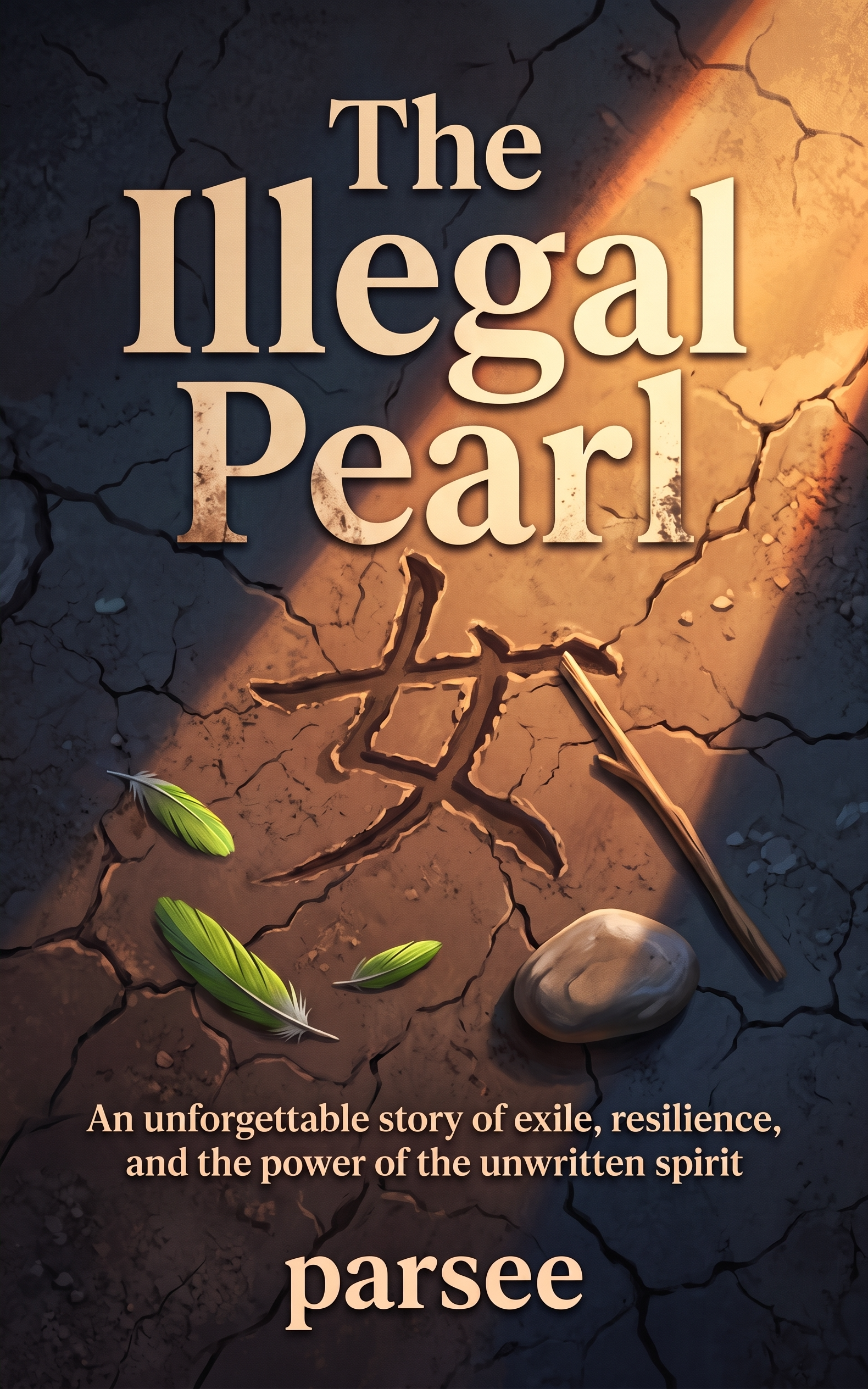
The Illegal Pearl
A story of sacrifice, silence, and ultimate forgiveness
by hadi Rezaei
Rural China, 1975. Seven-year-old Mei is exiled to her grandmother’s remote, mud-brick cottage after her family incurs a crushing government fine for having an illegal third child. Separated from everything she knows, Mei faces a quiet, secluded existence in a world shaped by scarcity and silence. Denied a formal education due to her legal status and poverty, Mei refuses to let her mind be constrained by physical walls. Armed only with twigs, charcoal, and an fierce curiosity, she transforms the dusty courtyard into her classroom. Through secret studies, deciphered newspaper scraps, and the quiet wisdom of her stoic grandmother, Mei cultivates an indomitable inner sanctuary. As the years pass, Mei untangles the complex sacrifice her parents made, transforming her bitterness into a profound understanding of love, resilience, and forgiveness. From author Hadi Rezaei comes an extraordinary literary masterpiece about the silent strength of the human spirit, the enduring bond of family, and the quiet triumph of self-discovery.
- Historical Fiction
- Literary Fiction
- Family Drama
- Coming of Age
- Generational Saga
Spring 1975
The spring of 1975 arrived on the North China Plain not with the gentle promise of renewal, but with a biting, persistent frost that clung to the dry furrows of the fields. Inside the small earthen home, the air was suffocating, thick with the scent of boiled water and hot iron, punctuated by the rhythmic, strained groans of Li Hua. Outside, seven-year-old Mei sat on the cold threshold, her small fingers tracing the ancient cracks in the hardened dirt, listening to the low, hurried whispers of the village midwife echoing through the papered window panes.
When the newborn’s cry finally broke the heavy silence, no chorus of joyous congratulations followed. It was a thin, frail sound, shivering against the mud-brick walls before dying away into the vast, indifferent stillness of the afternoon.
In the center of the courtyard, Zhang Wei stood motionless, his broad hands still coated in black hearth soot from the morning fire. He made no move to cross the threshold or hold his new son. Instead, his gaze remained fixed on the distant ridge, where the faded crimson propaganda banners of the local brigade fluttered against the gray sky like warning signals. A third child was not a blessing under the state's unyielding gaze; it was an illegal third bloom, a 'black' child whose very breath was an act of non-compliance.
The formal penalty attached to such a transgression was three hundred thousand yuan—an astronomical, unpayable figure so vast it belonged to the realm of urban officials and distant ministries, completely beyond the reach of a family that scraped out an existence handful of grain by handful of grain. To Zhang Wei and Li Hua, the sum was not a mere monetary fine; it was an existential debt, a judgment written on official paper that threatened to strip away their land, their home, and their very survival.
Trapped within the rigid machinery of official decree, the parents found themselves forced toward an unthinkable resolve. To preserve the household and shield the remaining children from total ruin, a sacrifice was conceived in the quiet hours of desperation. The burden fell upon seven-year-old Mei, whose departure was framed as a temporary visit to her grandmother’s cottage in the distant hills. Yet the hollow, grief-stricken stillness in her father's eyes betrayed the permanence of the exile. With quiet solemnity, Mei wrapped her meager belongings alongside a single wooden doll with faded painted eyes, preparing to step away from the only world she had ever known.
The birth of a third child, particularly in a rural brigade where state directives were enforced with unyielding rigor, was no longer a matter of private joy. In the Zhangs’ courtyard, the air thrummed with a silent, electric tension that crackled beneath the surface of daily tasks. The village elders, resting their calloused hands against the smoothed ash wood of their walking sticks, exchanged knowing glances—weary reckonings of the storm brewing down the road. The muted rasp of early cicadas was swallowed by a persistent, quiet dread, a communal anxiety seeping into every home from the loud-hailers in the square.
The Party's mandate had long cast an unyielding shadow over the North China Plain. It was a cold directive that sought to dictate the exact count of living souls permitted on the land. For families like the Zhangs, tied to small allotments of soil where ancestral expectations collided daily with state directives, an extra child was not merely another mouth; it was a catastrophic defiance. The familiar scent of damp earth and wood smoke seemed tainted by an underlying panic that stayed with them through every waking hour.
The brief comfort of holding the infant was swiftly cut short by the arrival of the formal notice. It came on coarse paper bearing the crisp ink of the commune office: three hundred thousand yuan. To a family measuring their survival in meager bushels of wheat, saved copper coins, and worn hoe blades, the figure was an impossible abstraction. It was not a debt to be managed over a lifetime, but an immediate death sentence for their household, threatening to pull the ground out from under their feet.
In a valley where continuity of bloodline had governed life for centuries, having a son was the traditional anchor of existence. Yet state decrees flipped that ancient logic into a crime. The Zhangs were trapped between the quiet expectations of elderly neighbors and the unyielding machinery of the county cadres. Every glance from a passing neighbor and every abrupt silence in the lane felt like an accusation, marking them as a family whose non-compliance threatened the whole brigade.
When the initial shock dulled into a constant, hollow ache, uncertainty settled over the earthen home. They questioned not only how they would ever produce such a fortune, but what punitive measures would follow. Would the cadres confiscate their tiny plot of arable land? Would Zhang Wei be taken away to a distant work crew? Every rustle of dry sorghum stalks outside and every stray boot step near the gate brought a sharp, cold spike of dread.
Out of this trap of impossible math, a harrowing resolution took shape. To reduce the household's official count and conceal the child from further inspection, a sacrifice had to be made. The choice fell upon seven-year-old Mei. Under the pretense of a temporary stay with her grandmother in the distant hills, she would be removed from the village registry rolls. The decision was not discussed in open light; it was settled in brief, choked exchanges over a dying hearth fire, born of total desperation.
A heavy stillness took hold of the room once the plan was set. Mei was told only that she would visit her grandmother’s cottage for a time. Her mother’s forced smile offered no comfort against the hollow look in her father’s eyes. Mei packed her single spare tunic and her wooden doll with its chipped, painted eyes, tying the bundle with a scrap of dyed cloth. She clutched the doll tightly, sensing that her familiar world was coming to an end.
The morning departure was marked by dusty roads and the dry axle-creak of an old wooden cart. Each jolt over the rutted tracks widened the distance between Mei and her family's courtyard. She watched the bare gray fields slip away, the familiar outline of her village dissolving into the haze of the North China Plain. Her mother’s parting embrace and her father’s hushed instructions faded, replaced by the empty expanse of an unfamiliar sky.
Grandmother Anya’s home was a solitary mud-brick cottage tucked against a stone slope, surrounded by thin stands of bamboo and dry terraced plots. Here, the silence was vast and absolute. Grandmother Anya was a stoic woman with hands gnarled like weathered wood and eyes that held decades of unsaid history. She greeted Mei with gentle efficiency, providing a bowl of warm water and a spot near the hearth, but her words were spare. Without playmates or a nearby school, Mei entered a quiet, solitary world governed entirely by the rhythms of survival.
In this quiet exile, Mei’s active mind turned inward. She became an intense observer of her grandmother’s routine—the deliberate way the old woman darned worn socks, swept the dirt floor with a bound twig broom, and rationed every spoonful of grain. Stripped of familiar distractions, Mei’s senses sharpened. The smell of burning dry leaves, the chill of mountain water, and the coarse texture of homespun cotton formed the boundaries of her daily life, fostering an early, quiet self-reliance.
During long evenings by the weak light of an oil lamp, Grandmother Anya would occasionally break the quiet with stories of the past. These were simple accounts of surviving harsh winters, long droughts, and past upheavals. The low cadence of her voice gave Mei a sense of grounding, offering a quiet record of endurance that helped ease the sting of her immediate isolation.
Food in the small cottage was simple and sparse. The main staple was the sweet potato, harvested from the stony plot behind the wall. Boiled in an iron pot, roasted in hearth ashes, or mashed into thin porridge, it appeared at nearly every meal. Its dense, sweet flesh satisfied basic hunger, but its dull repetition marked the narrow reality of their daily existence.
Though the sweet potatoes kept stomach cramps at bay, Mei felt an unspoken hunger for something more—for new sights, words, and connections. Watching village children pass along the lower trail with school satchels, she imagined the sound of recited lessons and the taste of meals served at bustling family tables, aching for a life beyond the quiet stone walls.
From the courtyard wall, Mei could see the dirt path leading to the brigade primary school. Every morning, children in patched blue tunics walked toward the mud-brick classroom with worn slates under their arms. Listening to the distant rise and fall of their reading recitations, Mei felt a sharp, lingering ache for the education denied to her by poverty and legal exclusion.
Printed words were almost nonexistent in the cottage, save for a yellowed agricultural almanac and discarded scraps of the People's Daily used to line shelves. Mei treated these scraps like precious artifacts. She would kneel on the dirt floor, tracing the complex black ideograms with a small thumb, memorizing their shapes long before she understood their full meaning.
Without formal instruction, the surrounding courtyard became her classroom. She studied the subtle shifts in clouds that signaled rain, watched how ants navigated dry earth furrows, and remembered every word spoken by visiting peddlers. Her sharp mind categorized these details, building a quiet understanding of the world from small, everyday clues.
When tasks were finished, Mei practiced writing in secret. Using a trimmed willow twig, she traced characters into the dust of the yard, repeating each stroke until the brushwork was precise before sweeping the ground clean. On chilly mornings, she used her finger to draw words in the window condensation, turning her isolation into a silent, disciplined study.
Grandmother Anya’s weathered features reflected a life lived through harsh historical tides. She had survived severe famines, war, and lean years on wild herbs and tree bark. Her presence provided Mei with an unshakable anchor, demonstrating how silent fortitude could withstand the hardest circumstances.
Grandmother emphasized, with a quiet but unwavering conviction, the virtue of self-sufficiency. "The land provides, but only if you tend it with care and respect," she would say, her voice raspy but firm, each word carrying the weight of experience. She imparted to Mei the practical skills necessary for subsistence, skills that were not taught in any school but learned through necessity and a deep understanding of the natural world. She taught Mei how to mend clothes until they were threadbare and yet still serviceable, how to coax life from the smallest plot of soil, transforming meager seeds into sustenance, and how to preserve food for the lean months when the harvest was a distant memory. This practical education, grounded in the fundamental need to survive, instilled in Mei a deep appreciation for resourcefulness and the remarkable ability to make do with what little they had, transforming scarcity into a testament to human ingenuity.
Though Grandmother Anya could read only a handful of common characters, she supported Mei’s curiosity. She would point to signs in the almanac or hold the lamp steady while Mei deciphered news scraps, quietly validating the child's drive to learn.
The high, stone wall enclosing the courtyard formed both a refuge and a boundary. Inside, the quiet was broken only by the wind through the bamboo and the scrape of Grandmother's spade. Through small gaps in the mortar, Mei caught glimpses of the outside world, learning to observe life from a protected distance.
Far across the hills, the fine remained an impossible, crippling weight on the Zhang family, a sum so astronomical it felt entirely out of reach. It dictated every thought and rationed every meal, hanging over their heads like an impending disaster that could strike at any moment.
In her grandmother's courtyard, Mei continued her silent studies, turning dirt into pages and twigs into brushes. With every character mastered, she fortified her inner sanctuary, building an unshakable resilience that would carry her into an uncertain future.
The air in the small house was thick with the scent of boiled water and iron. Outside, the spring of 1975 was waking up in the North China Plain, but inside, the atmosphere was suffocating. Mei sat on the threshold, her seven-year-old fingers tracing the cracks in the dry earth. Behind her, the muffled groans of her mother, Li Hua, were punctuated by the sharp, authoritative whispers of the village midwife.
When the cry finally came, it wasn't the joyous announcement a third child should have been. It was a thin, fragile sound that seemed to shiver against the mud-brick walls.
Mei’s father, Zhang Wei, stood in the center of the yard, his hands stained with the soot of the morning fire. He didn't move toward the door. He looked at the horizon, where the red banners of the local administrative office fluttered like warning signals in the wind. A third child. A 'black' child.
The midwife emerged, her face a mask of weary pity. "A boy," she said, but her voice held no celebration.
Mei looked at her father. She saw the way his shoulders slumped, not with the exhaustion of a new parent, but with the crushing weight of a man who had just seen a death sentence written in ink. The 'Third Bloom' was not a blessing in their village; it was a debt that would require a lifetime to pay, and a sacrifice that had not yet been named.
The Forbidden Bloom
The spring of 1975 arrived in the village with a deceptive gentleness. The plum trees were heavy with blossoms, and the air was thick with the scent of damp earth and new growth. But inside the Zhang household, behind closed doors and drawn curtains, the season brought a different kind of bloom—the quiet, hurried birth of a third child. No firecrac…