

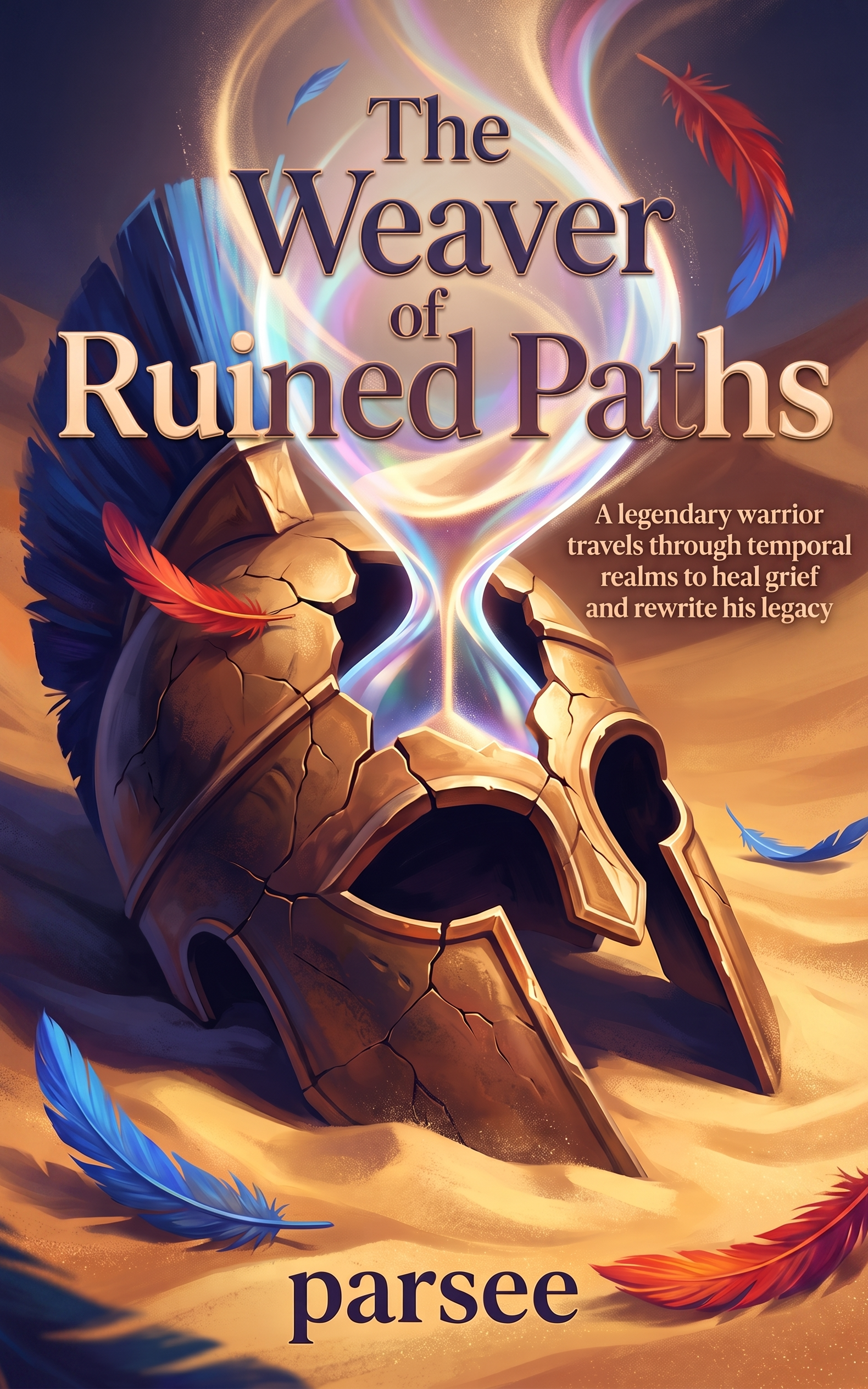
The Weaver of Ruined Paths
A legendary warrior travels through temporal realms to heal grief and rewrite his legacy
by hadi Rezaei
Grief can drive even the greatest hero to challenge time itself. After slaying his unknown son Sohrab on the battlefield, the legendary Persian warrior Rustam is shattered by remorse. Consumed by heartbreak, he retreats into the wilderness and calls upon the mythical Simorgh. The celestial entity offers him a perilous path to redemption: journey through seven temporal realms to retrieve the legendary Time Crystal, an artifact capable of reshaping destiny. From the harrowing Whispering Sands to the overwhelming River of Unmaking, Rustam must brave ancient sentinels, ethical paradoxes, and the phantoms of his own past. Each realm tests his physical strength and threatens to unravel his mind. Yet as he nears the ultimate power to alter history, Rustam faces his most profound trial: learning that undoing the past might destroy the fabric of reality itself. In this masterful epic blending Persian mythology with temporal fantasy, author parsee delivers a breathtaking tale of tragedy, spiritual endurance, and the true meaning of honor.
- Fantasy
- Adventure
- Science Fiction
- Epic Fantasy
- Mythological
- Time Travel
Grief on the Battlefield and the Call to the Simorgh
The battlefield lay quiet at last, though quiet was too gentle a word for what silence meant here. It was the hush that follows slaughter, when the crows have not yet found their courage and the wind alone dares to move among the dead. Rustam stood amid the wreckage of another victory, his massive frame still and dark against the smoke-streaked sky, and he understood that no man who had lived as long as he had should still feel his stomach turn at the sight of broken bodies. Yet it turned. It always turned.
Zhaghad hung heavy at his side, its blade dulled with blood that had long since dried to a rust-colored crust. His arms ached in the way they always did after a battle of this size, a deep animal ache that no amount of glory had ever managed to soften. Around him the plain stretched wide and torn, churned into mud by hooves and boots and the desperate scrambling of men who no longer had names, only allegiances, only the colors of the banners they had died beneath. Some of those banners still stood, snapped at odd angles, their cloth stiffened by blood and wind. Others had fallen entirely, trampled into the earth alongside the men who had carried them.
He walked the field the way he always did after a fight, though he could not say why he still bothered. Perhaps it was penance. Perhaps it was simply the old habit of a commander counting his losses, even when the losses were not his own to count. His boots sank into the softened ground with each step, and the smell rose up around him, iron and smoke and something sweeter beneath it that he had learned decades ago never to name.
It was near a shattered banner, half buried in the churned mud, that he saw the boy.
He was propped against the broken staff as though he had crawled there himself, seeking some small comfort in the last upright thing on the field. His armor had once gleamed, Rustam could tell, though now it was scored and dented, the polish long since lost beneath grime and blood. One hand pressed weakly against his side, where a wound had opened him nearly to the bone, a wound that Rustam recognized with a cold and sinking certainty as his own work.
He remembered the duel now, though the memory came to him slower than it should have, as if his mind resisted piecing it together. A young warrior of remarkable speed had broken through his line near midday, cutting down three of his best men before Rustam himself had turned to meet him. The boy had fought with a ferocity that had startled him, an economy of motion that spoke of skill far beyond his years, and for one strange moment in the clash of their blades Rustam had felt something he could not name, some flicker of recognition he had dismissed as battle-madness. He had ended the duel the way he ended all duels. Cleanly. Finally.
He had not thought of the boy again until now.
Rustam knelt beside him, the mud soaking through the leather at his knees, and for a long moment he only looked. The boy's face was pale and drawn, his lips cracked, but his eyes when they opened were a vivid, startling blue, so blue that Rustam felt something twist deep in his chest before he understood why.
"You fought well," Rustam said, and his voice came out rougher than he intended. It was the only thing he could think to offer a dying enemy, the old warrior's courtesy extended a thousand times before to men whose names he had never learned and never would.
The boy's eyes moved slowly, searching his face as though hunting for something buried there. His breath rattled in his chest, shallow and wet, and when he spoke his voice was barely more than air shaped into words.
"They said... you carried a mark. On your hand."
Rustam went very still.
"A warrior," the boy continued, each word costing him visibly more than the last, "who once loved a woman in Samengan. Who left before he knew..."
The world seemed to tilt beneath Rustam's knees. He knew the tale the boy was reaching for, knew it the way a man knows an old wound that has never fully closed, a night in a foreign city so many years past that it had become something closer to legend even in his own memory. He had told himself it meant nothing, that such things happened to soldiers far from home, that the woman's face had faded the way all such faces fade.
He had never once let himself wonder if he had left something behind.
"Show me your hand," the boy whispered.
Rustam's fingers trembled, actually trembled, for the first time in more years than he could count, as he drew back the edge of his gauntlet. There upon the back of his left hand, faint and coiled and nearly invisible unless the light struck it just so, was the mark shaped like a small dragon that had been with him since birth, the mark his mother had once called the seal of his fate.
The boy's eyes filled, and something in his ruined face broke open with a grief so raw and immediate that Rustam felt his throat tighten, the air catching in his chest until he could neither draw breath nor look away.
"Father," the boy said.
"Father," the boy said.
The single word landed in Rustam's chest with more force than any sword had ever managed. He felt his own breath leave him as he knelt in the mud, his hands hovering uselessly over a boy he had killed without ever knowing his name.
"No," Rustam said, and it came out broken, barbaric, nothing like the voice of the Shield of Iran that armies had trembled to hear across a thousand fields. "No. Tell me this is not true."
"Sohrab," the boy said, as though offering the only gift he had left to give. "My mother named me Sohrab. She said... she said you would know me by your mark, if ever we met. I searched for you. I searched the whole world for you, Father."
Rustam gathered the boy into his arms, careless of the wound, careless of the blood that soaked immediately into his own armor, and he held him the way he had never in his life held anything, as though sheer will alone might keep the boy's spirit tethered to his failing body. Sohrab's breath came shallower now, and his blue eyes, so like Rustam's own in shape though not in color, fixed on his father's face with an expression that held no anger at all. Only a terrible, aching relief, as if finding him had been worth the dying.
"I searched," Sohrab said again, softer now, "and I found you."
"You should never have had to search," Rustam said, and the words tore out of him like something physical, like a wound of their own. "I should have known you. I should have been there. I should have—"
But Sohrab was no longer listening, or perhaps he was listening to something else entirely, some distant sound only the dying can hear. His hand rose, trembling, and found Rustam's own, and for one moment his grip was strong, the grip of a warrior, before it loosened entirely and fell still.
The plain around them did not change. The wind still moved through the trampled grass. The banners still hung broken on their splintered staffs. But the world Rustam had known, the world in which he was the invincible Shield of Iran, the unmatched champion whose name alone could turn the tide of wars, that world had ended in the space between one breath and the next.
He knelt there a long while, Unmoving, the weight of his son's body settling into his arms like something that would never lift again. He did not weep, not then. The grief was too large for tears, too large for any sound a human throat could make. It simply sat inside him, vast and silent, filling every hollow space his pride had once occupied.
When at last he rose, he would not leave the boy for the crows.
He lifted Sohrab's body as gently as a man might lift a sleeping child, cradling him against his chest, and he began to walk. The battlefield fell away behind him, the shouts of surviving soldiers and the distant clatter of camp being struck growing fainter with each step, until there was only the sound of his own boots against stone and the whisper of wind rising as the ground began to climb.
The mountains had always called to him in times of trouble, though he could not have said why. Perhaps it was some memory buried deep from his own childhood, some inheritance from his father Zal, who had been raised among such heights by a creature of legend. Perhaps it was simply that the mountains offered what the world below could not: distance, and silence, and a place high enough that grief might have room to breathe.
He climbed for hours, though he could not afterward have said how many. His arms did not tire, though his heart grew heavier with every step. The air thinned and cooled around him, and the last stunted trees gave way to bare rock, gray and ancient, scored by winds that had blown across this height since long before men first raised swords against one another.
He came at last to a windswept plateau near the summit, a flat shelf of stone open to the sky on every side, where the wind moved unbroken and the clouds seemed close enough to touch. It was as good a place as any. It was, he thought, the only place worthy of what he had to do.
He laid Sohrab's body down upon the stone with a care that bordered on reverence, and then he began to dig.
He did not look for tools. Some part of him, the part that had not yet stopped feeling entirely, understood that this grave needed to be dug with his own hands, that no shovel or blade should stand between him and this last act for his son. He tore at the ground with his fingers, and the stone bit into his skin, and still he dug, until his hands bled and the blood mixed with the dark earth beneath the mountain's thin soil.
The wind screamed around him as he worked, tugging at his cloak, carrying the cold of the high peaks into his bones, but he did not stop, and he did not feel the cold, not truly. He felt only the boy's name, repeating itself in the hollow of his skull like a war drum that would not cease. Sohrab. Sohrab. My son.
When the grave was deep enough, he lowered the boy into it with the same terrible gentleness, arranging his ruined armor, folding his hands over the wound that had ended him. He knelt there a long while at the edge of the grave, looking down at the face of a son he had known for the length of a single dying conversation, and he tried to find something to say, some final word worthy of the moment, and found that he had none. All his life he had been given words to command armies, to inspire men to die willingly for causes not their own. He had no words for this.
He covered the grave with his hands as well, drawing the loose stone and earth back over the boy's body, and when it was done he sat back on his heels and looked at the small mound he had made, no larger than any common soldier's grave, though the boy beneath it had been the son of the Shield of Iran.
The silence that followed was the worst thing he had ever known.
He thought of every battle he had ever fought, every kingdom he had saved, every song the poets had composed in his honor, and none of it meant anything now. He had spent his whole life believing that strength was the answer to every question the world could ask, that a sword swung true and a heart unafraid could set right whatever wrong stood before him. He understood now, kneeling on that cold plateau with his hands buried in his own son's grave, that strength had been the very thing that killed the boy. His strength. His unmatched, celebrated, feared strength.
The cry that tore out of him shattered the high silence, a raw, ragged bellow that struck the sheer granite walls and split into jagged echoes. It reverberated through the narrow gullies and deep gorges below, multiplying until the entire mountain chain seemed to groan with the resonance, vibrating in the bedrock beneath his knees. He did not choose to make that sound; it simply tore free, carrying the acoustic weight of a lifetime's ruin into the empty air.
"Why?" he shouted at the clouds, at the wind, at whatever gods might still be listening to a man who had spent so little of his life in prayer. "Why did you let me raise my blade against my own blood? What use is all my strength if I cannot see the one thing that mattered most?"
The mountains gave him nothing. The wind only rose and fell, indifferent, as it always had.
He knelt there a long while more, until the sky above him began to shift toward the deep violet of evening, and something in him, some ember that had not yet gone entirely cold, refused to accept that this was the end of it. He had heard, as a child, the old stories his mother used to tell him in the dark hours before sleep, stories of a bird larger than any earthly creature, a bird who nested at the edge of the world and who had once, long ago, aided his own father in his hour of greatest need. He had never truly believed those stories were more than comfort offered to a frightened boy. He had spent his whole life relying on steel rather than legend.
But he had nothing left now except legend.
He rose to his feet at the edge of his son's grave, his whole body trembling with exhaustion and grief in equal measure, and he lifted his face to the darkening sky, and he called out the ancient name in a voice that cracked with everything he had lost that day.
"Simorgh," he called. "Queen of Birds. Hear a father who has slain his own son. Hear a fool who mistook glory for wisdom his whole life long. I have nothing left to offer you but my grief, and I offer it now, all of it, if only you will hear me."
The wind seemed to catch on something, to hesitate in its endless circling of the peaks, though he told himself later that this was only his own desperate mind inventing meaning where none existed.
"I do not ask for glory," he said, softer now, the fight gone out of his voice entirely. "I do not ask to be remembered as I once was. I ask only for understanding. I ask only to know if there is some path left to me that does not end in this grave, some way to carry what I have done without it destroying what remains of me."
Silence answered him, vast and complete, broken only by the low moan of the wind through distant crags.
He stood at the edge of the plateau, his hands stained with the blood and earth of his son's burial. He could not return down the mountain as the man who had climbed it; something in him had shattered past mending. If no answer came from the darkening sky, he would remain on this cold stone until the gale wore him to nothing.
The first stars had begun to prick through the deepening violet above him when he felt it, a change in the air so subtle that he might have missed it entirely had every nerve in his body not been raw and open to the world in a way they had never been before. The wind shifted. It did not merely blow. It gathered, somewhere far above him, into something with purpose and weight, something vast enough that the very stone beneath his feet seemed to hum in response.
Rustam lifted his eyes to the sky, his heart hammering in his chest for the first time that day with something other than grief, and he waited to see what, if anything, had answered his call.
The Simorgh's Manifestation and the Temporal Mandate
The shadow came first, a darkness that swallowed the last violet light of evening and spread across the plateau like a tide rolling in from some ocean far beyond the mountains. Rustam did not step back from it. He had spent his whole life meeting what came at him, and he was too hollowed out now to do anything but stand his ground and watch as the …