

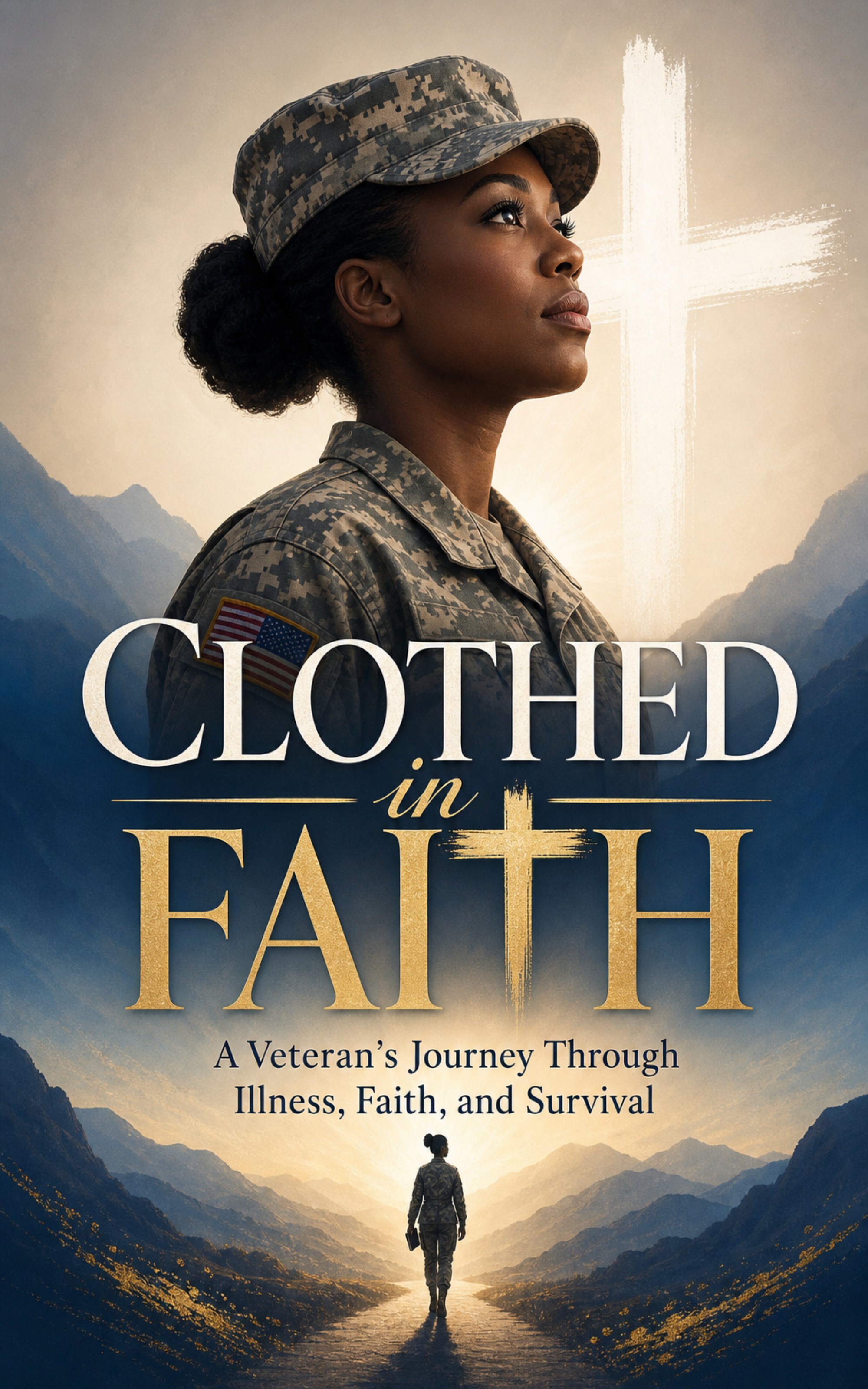
Clothed in Faith
A veteran’s journey from medical mystery and ICU survival to walking in God’s miraculous light
by Pat Smith
Twelve years of mystery. Twelve years of pain. Army veteran Pat Smith returned from Saudi Arabia with more than just memories; she brought back a silent killer. For over a decade, she navigated a labyrinth of hospital visits and unexplained symptoms, only to face a terrifying crisis that left her fighting for her life in the ICU. When a massive deep vein thrombosis and internal hemorrhaging pushed her to the brink, Pat found herself at a crossroads where medicine ended and miracles began. Bedridden and unable to care for her two young sons, she didn't just pray for a cure—she reached for her Bible and clothed herself in an unshakable faith. From the grueling steps of learning to walk again—transitioning from a walker to a cane to unassisted strength—to the bittersweet relief of a lifelong diagnosis, Clothed in Faith is an intimate portrait of resilience. It is a story for anyone who has been told their condition is incurable or their situation is hopeless. Discover how to find purpose in the pain, strength in the scriptures, and a future guided by the steady hand of God.
- Non-fiction
- inspirational
The Sand and the Silent Onset
The heat in Saudi Arabia is not like any heat you have ever felt standing in a parking lot in August or walking out of an air-conditioned building into a Southern summer afternoon. It is a heat that has weight to it. It presses down on your shoulders, climbs into your lungs, and sits behind your eyes. When I stepped off that plane and the desert air met my face for the first time, I understood immediately that this place was not going to ask permission to change me. It was simply going to do it.
I was proud to be there. I want to be clear about that. The pride of wearing that uniform, of having raised my right hand and meant every word of that oath, ran deeper than I had words for back then. I came from people who believed in hard work and service, and the Army had given me a structure that matched something already living inside me. I believed in the mission. I believed in my fellow soldiers. I stood at attention in that desert and I felt, despite the oppressive heat and the unfamiliar terrain, like I was exactly where I was supposed to be.
But the body does not always agree with where the spirit wants to stand.
It started quietly. That is the thing about a silent enemy. It does not announce itself with a dramatic moment you can point to later and say, that was when everything changed. There is no explosion, no visible wound, no clear line between before and after. It creeps in wearing the disguise of ordinary tiredness. It borrows the face of dehydration, of long shifts, of the kind of exhaustion that makes sense when you are deployed far from home and working in extreme conditions. I told myself it made sense to feel worn down. Every soldier around me looked worn down. The heat alone could drain a person in ways that took days to recover from.
But this was something else, and somewhere underneath all the logical explanations I was handing myself, I knew it.
There was a fatigue that did not lift after rest. A heaviness in my legs that had nothing to do with how far I had walked. Strange sensations that I could not name, little signals my body was sending up like flares that I kept choosing not to read. A tightness. A warmth in places that did not make sense. I was a soldier. I was trained to push through discomfort, to keep moving, to treat my body like a machine that could be willed forward regardless of what it was reporting back. Military discipline is a real and powerful thing. It gets people through situations that would break someone without it. But that same discipline, applied to your own health, can teach you to silence the very signals that are trying to save your life.
I kept moving. I kept working. I kept serving.
What I did not do was stop long enough to listen.
When the Desert Gets Inside You
There is a particular kind of loneliness that comes with being sick and not knowing you are sick. You cannot explain what is wrong because you do not have language for it yet. You just know that something feels off, and when everything around you is already so far from normal — a different country, a different climate, the constant low hum of military alertness — it becomes very easy to fold that wrongness into the larger category of this is just hard right now.
During long shifts, I found myself doing something I had always done in difficult moments. I prayed. Not long, elaborate prayers with my eyes closed and my hands folded. These were whispered prayers, the kind you send up in the middle of movement. Lord, give me strength. Lord, help me get through this shift. Short, urgent, honest conversations with God that I had been having since I was a girl. Faith was not something I put on for Sundays. It was woven into how I moved through the world, and in that desert, far from everyone I loved, it became the most consistent thing I had.
I did not know then that those whispered prayers were the beginning of a practice that would one day be the only thing standing between me and complete despair. I did not know that the discipline I was learning, the discipline of turning toward God even in the middle of exhaustion, even when the answer was not immediate, even when the relief I asked for did not come, was training me for something I could not yet see.
That is how faith works. It builds quietly, the same way the illness was building quietly, except that one was tearing something down and the other was constructing something that would outlast the damage.
I think about other people who have stood in their own version of that desert. Maybe yours was not sand and military uniforms. Maybe it was a demanding job that left you too tired to notice your body changing. Maybe it was the season of raising small children or caring for aging parents, when your own needs seemed like the least urgent thing on the list. Maybe it was simply the pace of modern life, moving so fast that slowing down felt like a luxury you could not afford. Whatever your desert looks like, the experience of not listening to your body until it forces you to is almost universal. We are remarkably good at explaining away what our bodies are trying to tell us.
The Lesson the Desert Teaches
True service, I learned in Saudi Arabia, requires more than physical strength. Anyone can show up when they feel strong. The real test is what you do when your strength is quietly being taken from you and you do not fully understand why. The real test is whether your spirit can hold steady in the unknown.
I had plans. Most people do. I had a vision for my military career, for what came after, for the life I was building. Deployment was part of that plan, a chapter in a story I was writing with intention. What I did not plan for was coming home changed in ways I could not explain. What I did not plan for was twelve years of my body behaving like a mystery I could not solve, doctors unable to connect the dots, and my own life becoming a series of interruptions I had not scheduled.
But I have come to believe, with everything in me, that the interruptions are often where the real story lives.
When I look back at that woman in the desert, young and proud and already quietly unwell, I want to reach back through time and tell her something. I want to tell her to pay attention. Not to panic, not to catastrophize, but to pay attention. To write things down. To notice the pattern. To be her own best advocate before she even knows she needs one. Because the body is always communicating, and the earlier you learn its language, the better equipped you are for what comes next.
This is not just personal wisdom. This is practical, actionable truth. One of the most important things anyone navigating a health challenge can do, especially in the early and confusing stages, is document everything. The date a symptom appeared. How long it lasted. What made it better or worse. What you were doing when you noticed it. This information becomes a medical history that you carry with you, and it can mean the difference between a doctor connecting the dots and a doctor sending you home with nothing. Nobody will advocate for your body the way you can. Nobody lives inside it but you.
Walking Out the Faith Before You Know the Road
One of the hardest things about the early stages of any health journey is that you are being asked to keep walking a road you cannot see clearly. You feel something is wrong. You may not have a name for it yet. The people around you may not believe you, or they may minimize what you are experiencing. The medical system may send you home with reassurances that do not reassure you at all. And still, you have to get up the next morning and keep going.
This is where mindset becomes not just helpful but necessary. I am not talking about toxic positivity, the kind that insists everything is fine when everything is clearly not fine. I am talking about the decision to keep your spirit from collapsing while your body is sending confusing signals. I am talking about the choice, made daily and sometimes hourly, to believe that what you are going through has a purpose even when that purpose is invisible to you.
For me, that choice was always anchored in God. When I whispered those prayers in the desert, I was not pretending I felt strong. I was asking for strength because I did not have it. That is what real faith looks like. It does not perform confidence it does not feel. It simply refuses to let fear have the final word.
Faith is not the absence of fear, but the decision to trust God in the midst of it.
I carried that truth with me out of Saudi Arabia, though I did not yet know how much I was going to need it. I came home to a life I was trying to build, carrying something invisible inside me that would spend the next twelve years demanding my attention in increasingly urgent ways. But the foundation had been laid in that desert. The practice of turning toward God in the middle of exhaustion, the discipline of whispered prayer, the decision to keep moving even when I did not understand what my body was doing. All of it was being built, brick by brick, in the heat of a place I never planned to be.
Before the Storm Knows Its Name
If you are reading this and you are in your own version of that early season, when something feels wrong but you cannot quite name it, when you are explaining away symptoms that deserve attention, when you are pushing through because stopping feels impossible, I want you to hear this clearly: your body is not your enemy. It is trying to talk to you. The fatigue, the strange sensations, the things that do not quite add up, those are not signs of weakness. They are information.
Start writing it down today. Not tomorrow, not when things get worse, not after you have seen another doctor. Today. Get a notebook or open a note on your phone and write down the first symptom you remember noticing. When was it? What did it feel like? What did you tell yourself about it? This simple act of documentation is an act of self-advocacy, and it is one of the most powerful tools you have.
Then make the appointment. The one you have been putting off. The one where you have been telling yourself it is probably nothing, or that you do not have time, or that you will wait and see if it gets better on its own. Make that call. Go in. Ask the questions. Push for answers if the first ones do not satisfy you. You deserve a doctor who takes you seriously, and if you do not get that the first time, you keep looking until you find one who does.
This is not being dramatic. This is being responsible for the one body you have been given.
A Prayer for the Desert You Are Standing In
Before we move forward, I want to pause here, because I believe in the power of bringing God into every chapter of our story, including the ones that are just beginning and whose ending we cannot see.
If you are in a desert right now, if life feels harsh and your body feels uncertain and the road ahead feels unclear, this prayer is for you as much as it is for the woman I was in Saudi Arabia all those years ago.
Lord, help me to trust You when my body feels like it is failing and the environment around me is harsh. Help me not to explain away what You are trying to show me. Give me the courage to pay attention, the wisdom to seek help, and the peace to trust that You already know the end of this story. Give me peace in the desert of my life. Amen.
That desert in Saudi Arabia was the beginning of a twelve-year journey I did not ask for. But it was also the beginning of a faith that grew stronger with every passing year, every hospital visit, every moment of uncertainty when I had nothing to hold onto but God's word and God's character. The sand got inside me in more ways than one. Some of what it left behind nearly broke me. But some of what it built in me, that quiet, stubborn, whispered-prayer kind of faith, that was the thing that would one day bring me all the way through.
Your Turn: Reflection and Action
Before you move to the next chapter, take a few moments with these questions. You do not have to have all the answers. Just sit with them honestly.
- When did you first notice that something was wrong with your health? What did that first signal feel like, and what did you tell yourself about it at the time?
- How did you react to that initial uncertainty? Did you lean into finding answers, or did you push it aside and keep moving?
- Is there someone in your life, a doctor, a specialist, a health advocate, you have been avoiding reaching out to? What is the real reason you have been waiting?
Now take this one step further. Get out a piece of paper or open a document on your phone or computer. Write down a timeline of your health journey starting from the very first symptom you can remember. Do not edit it. Do not minimize it. Just write it down as honestly and completely as you can. This document belongs to you. It is the beginning of your own story of advocacy, and it matters more than you know.
Then do one more thing this week. Schedule that appointment you have been putting off. One call. One step. That is all. The road ahead may be long, but every long road starts with a single step, and sometimes the bravest thing you can do is simply decide to begin.
Twelve Years in the Dark
Twelve years is a long time to live inside a question with no answer. I want you to sit with that for a moment before we go any further. Twelve years. That is not a rough patch. That is not a difficult season. That is a decade plus two years of walking into emergency rooms, of watching doctors frown at test results, of being poked and scanned and d…