

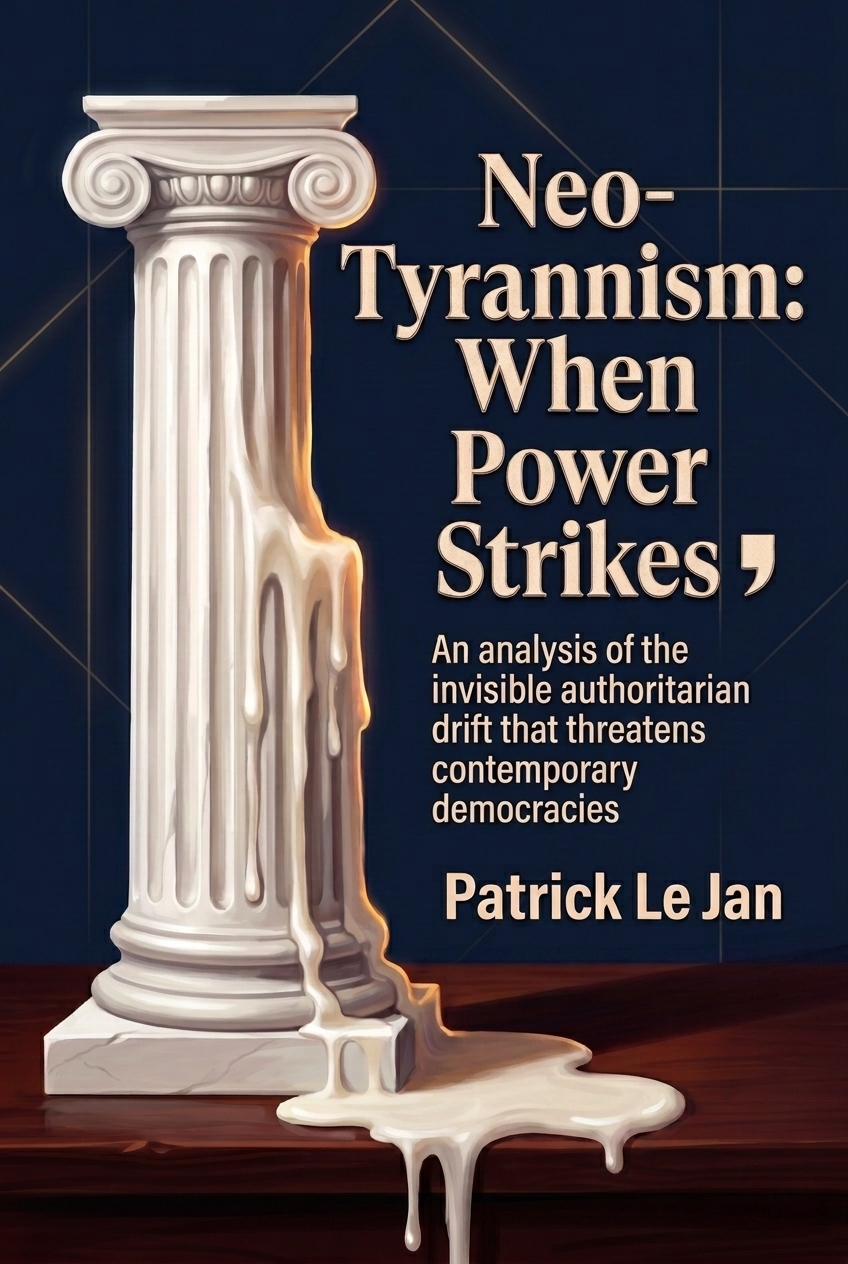
Neo-Tyrannism: When Power Strikes
An analysis of the invisible authoritarian drift that threatens contemporary democracies
by Patrick Le Jan
Can democracy collapse without any coup d'état being declared? Through a rigorous dissection of Donald Trump's term in office, Patrick Le Jan reveals the emergence of an unprecedented political phenomenon: neo-tyrannism. Far from the military dictatorships of the past, this new form of authoritarianism does not smash institutions from the outside; it corrodes them from within, in full apparent legality. Personalized power, clan logic, contempt for legal norms, and the methodical deconstruction of the post-Westphalian international order: the author dissects the workings of a patrimonial governance that silently neutralizes the judiciary, parliament, and the media. This compelling book offers an essential interpretive framework for identifying invisible attacks on the Republic. More than an alarming diagnosis, it is a call for civic rearmament and a practical guide for strengthening the resilience of our institutions. A major and indispensable political essay for anyone who wishes to understand and defend the future of our freedoms.
- Educational & Academic
- Political Science
State Capture: When the Leader Becomes the Law
A single man decides, acts, cuts through the noise, and the country finally moves forward. This was the promise that carried Donald Trump to power in 2016, and it is the promise his ideological heirs continue to peddle today, in Washington as in other Western capitals. The argument is simple, almost seductive in its brutality: modern democracies have supposedly become too slow, too bogged down in procedure, too encumbered by checks and balances to act effectively. What is needed, supposedly, is a man capable of making the hard calls, upending the rules, saying no to judges, bureaucrats, journalists, and anyone else slowing down the will of the people. This chapter takes direct aim at this idea, because it is false, and because it carries concrete consequences for every citizen. The personalization of power does not make the state more efficient. It makes it more arbitrary, more unstable, and ultimately less capable of protecting anyone.
The Mirage of the Strongman
Trumpist rhetoric rests on a deceptive equation: fewer rules equals more action, and more action equals more results for the people. The president is portrayed as the sole direct representative of the popular will, while Congress, the courts, and the federal bureaucracy are reduced to mere bureaucratic obstacles erected by out-of-touch elites. This worldview casts every executive order as an act of liberation, every bypass of Congress as a victory over gridlock, every firing of a recalcitrant civil servant as a gesture of political courage.
The problem is that this equation completely falls apart under serious scrutiny. A government that runs on the basis of a single man is not a swift government; it is a fragile government. It depends entirely on the mood, whims, and personal interests of one individual. It is stripped of institutional memory, administrative continuity, and safeguards against error. What propaganda advertises as speed is, in reality, chronic instability. What supporters call decisiveness is often dangerous improvisation, patched up through hasty backpedaling and public contradictions.
Here, a specific thesis championed by populist circles around Trump must be dismantled: the notion of a direct presidential mandate that takes precedence over congressional oversight. According to this view, the president, elected by indirect universal suffrage through the Electoral College, embodies the will of the people more faithfully than members of Congress, who are often re-elected in gerrymandered districts drawn to their benefit. This reasoning appeals to a segment of the public, but it rests on a flawed reading of the U.S. Constitution itself. The framers of the 1787 Constitution, wary from their own experience under the British monarchy, deliberately designed a system of separated powers and checks and balances. The president does not govern alone; he governs alongside Congress and under the watchful eye of the courts. It is precisely this architecture, rather than its circumvention, that ensures power remains accountable to the people over the long haul, and not just on election day.
The presidential mandate therefore does not erase the mandate of representatives and senators; it coexists with it. Claiming the opposite reduces democracy to a single ballot—the presidential election—wiping out all the rest. It is a manipulation of democratic language in service of a project that is anything but democratic: the concentration of power into a single set of hands.
Birth of a Narrative: 2016 and the Anti-Establishment Revolt
To understand the power of this narrative, one must trace its origins. The 2016 campaign took root in fertile soil of genuine frustration. Millions of Americans, especially in industrial regions hit hard by offshoring, felt abandoned by decades of bipartisan policies that had done nothing to improve their daily lives. They saw Washington as a talk shop, incapable of delivering results, riddled with lobbyists, and paralyzed by endless red tape. In this climate, the persona of the businessman outsider wielded a powerful appeal.
Donald Trump framed himself not as just another politician, but as the very antithesis of traditional politics. He had never held elective office. He flaunted his lack of institutional experience as an asset. His implicit slogan was straightforward: I've run businesses, I know how to make decisions, and I'm not entangled in the compromises and decorum of Washington politeness. This posture allowed every bent rule, every broken norm, and every provocative statement to be rebranded as proof of authenticity rather than a red flag.
The rhetorical brilliance of this campaign lay in turning a weakness into a strength. A candidate with zero government experience is not normally a selling point. Yet in an environment of widespread elite rejection, the absence of institutional experience became proof of independence from the system. In the same vein, the overt disdain for the norms of the office, the refusal to release tax returns, and the relentless attacks against journalists and judges were all presented not as democratic warning signs, but as badges of courage against a corrupt establishment.
This dynamic is not unique to the United States. Variations of it can be found across numerous Western democracies facing a crisis of confidence in their representative institutions. However, the American case features a distinct characteristic: the sheer power of the federal executive, combined with the extreme polarization of the political system, provided uniquely fertile ground for experimenting with personalized governance on a massive scale.
What the Facts Show: The Executive Order vs. The Law
This is where the theory of the effective strongman shatters against reality. The legal and administrative record documented since 2017 tells a radically different story from the one sold on the campaign trail. Far from producing a faster, more decisive government, the personalization of power generated immense institutional chaos, recurring gridlock across the federal bureaucracy, and systemic corruption that ultimately spilled into public view through several congressional and journalistic investigations.
Executive Orders as Weapons of Circumvention
The clearest example of this drift lies in the use of executive orders—presidential decrees that allow for action without a vote in Congress. In theory, an executive order is meant to clarify the enforcement of an existing statute or manage the internal operations of the executive branch. Under the Trump presidency, this mechanism was systematically transformed into a tool for outright bypassing the legislative branch.
In the very first week of his term, Executive Order 13769, known as the Muslim Ban, barred entry to the United States for nationals of seven Muslim-majority countries without prior consultation with Congress, without impact studies, and without coordination with the relevant agencies. Administrative chaos was instantaneous: travelers stranded at airports, federal judges staying the order within days, and successive versions hastily rewritten in a bid to survive judicial scrutiny. This was not a display of executive efficiency; it was a demonstration of a rushed, ill-prepared administration forced to appear before the courts three times before finally securing partial validation from the Supreme Court.
Two years later, in 2019, faced with Congress's refusal to fund the construction of the southern border wall, the administration declared a national emergency to divert military funds originally appropriated for other purposes. In a rare display of bipartisan unity, Congress passed a joint resolution to block the maneuver. The president vetoed it. The outcome was not a wall built faster, but a years-long legal battle, funds frozen by court injunctions, and a dangerous precedent: an executive willing to reallocate public funds without the consent of those who constitutionally hold the power of the purse.
Over the course of his term, Donald Trump signed more than two hundred executive orders—a pace outwardly comparable to his predecessors, but with one critical distinction: the proportion of these orders successfully challenged in court reached unprecedented levels. According to data compiled by multiple university legal clinics, federal agencies lost the majority of court challenges related to these orders, particularly in the areas of immigration, environmental regulation, and public health. A government that routinely loses in court is not an efficient government; it is a government that values optics over implementation.
The Department of Justice Brought to Heel
The second key illustration is the open politicization of the Department of Justice, an institution traditionally designed to maintain independence from the executive branch in law enforcement matters. Under several successive attorneys general, that independence was methodically eroded. The most thoroughly documented case remains that of Michael Flynn, the former national security advisor convicted of lying to the FBI, who was later pardoned by the president after direct intervention by the Department of Justice to drop the charges—despite the objections of the federal judge presiding over the case. Another striking example: the sentencing recommendation for Roger Stone, a personal friend and former campaign adviser to the president, was drastically reduced following DOJ intervention, prompting four federal prosecutors to resign from the case in protest.
These episodes were not isolated anecdotes. They formed a coherent pattern: the law ceased to apply equally; it became a tool used to protect the president's circle of loyalty. Those who served the president were shielded, regardless of the gravity of their conduct. Those who crossed him, on the other hand, remained exposed to the full weight of the judicial system. This was the exact opposite of what the propaganda promised. The public was sold a leader capable of enforcing the law with an iron fist; what they received was a leader capable of suspending it for his inner circle.
What the Academic Research Proves
This shift was not a fluke unique to one man or a single term. Harvard professors Steven Levitsky and Daniel Ziblatt documented it with remarkable rigor in their book How Democracies Die. Their central thesis is simple and unsettling: modern democracies almost never collapse through military coups or sudden seizures of power. Instead, they erode from within, piece by piece, through the slow accumulation of minor infractions against the unwritten norms that sustain the system. Two norms in particular anchor their analysis: mutual toleration between political rivals, and institutional forbearance—the willingness of leaders to refrain from fully exercising all the legal powers at their disposal.
Levitsky and Ziblatt demonstrate that the U.S. Constitution, like those of most democracies, leaves substantial room for executive interpretation. This ambiguity functions only so long as leaders voluntarily choose not to push their powers to the absolute limit. A president can, in theory, pardon anyone for any reason. A president can, in theory, declare a state of emergency for dubious reasons. A president can, in theory, fire inspectors general tasked with overseeing the administration. What the two scholars define as forbearance is precisely the self-restraint required to avoid exploiting these powers to the hilt, out of respect for the spirit of the system rather than just its literal text.
Their findings, applied to the American case since 2017, are chilling: this forbearance vanished systematically. Every legal boundary was tested, pushed, and frequently breached, with federal courts left as the sole barrier—themselves subjected to growing pressure from partisan appointments. This was not a sudden rupture with American democracy; it was a steady erosion, nearly invisible to many everyday citizens, yet entirely measurable for anyone tracking the number of institutional guardrails bypassed year after year.
Loyalty Over Competence: The State as a Fiefdom
Once this framework is established, the true nature of neo-tyrannical power comes into focus. This is not a government that is more effective because it is more centralized. It is a government whose fundamental operating criteria have changed. The question is no longer: Does this decision serve the public interest? The question becomes: Does this decision demonstrate loyalty to the leader?
This shift fundamentally altered the day-to-day operations of the federal bureaucracy. Key appointments were no longer awarded on the basis of expertise or seniority, but on personal loyalty. Civil servants deemed insufficiently devoted were sidelined, demoted, or publicly humiliated across the president's social media accounts. Multiple inspectors general—whose very mandate is to police internal misconduct within the executive branch—were dismissed during the administration, often immediately after releasing reports critical of executive actions. The inspector general of the State Department, the Department of Defense, and the Intelligence Community were all removed under similar circumstances within a matter of weeks in the spring of 2020.
This patrimonial management of the state relied on a deliberate blurring of the lines between the personal interests of the leader and the duties of the office. The president's hotels and properties hosted foreign official delegations, generating revenue directly tied to the exercise of the presidency. Members of the first family served as official advisers without Senate confirmation, blurring the boundary between a family enterprise and the apparatus of state. This was not an isolated excess; it was the core logic of the system: the state becomes an extension of the clan, its resources become family assets, and its appointments become rewards for fealty.
This clan-based logic—which the next chapter will examine in greater depth—produces an effect that is paradoxical yet entirely aligned with this book's thesis: the more power is personalized, the less the state operates on objective criteria, and the more vulnerable it becomes to arbitrariness, incompetence, and capture by private interests masquerading as the national interest.
What the Citizen Loses in the Bargain
It can be tempting to view these developments as purely political disputes, reserved for constitutional law debates. That is a mistake. Every circumvention of institutional norms carries a direct cost for everyday citizens, and that cost is often paid long before the courts ever hand down a ruling.
When an executive order abruptly suspends a category of visas, real families are separated overnight, without warning, and without immediate recourse. When the Department of Justice intervenes to shield an ally of the president, the principle of equality under the law—a cornerstone of the republican ideal—is reduced to an empty slogan. When an inspector general is fired for doing their job, an essential check against fraud and abuse of power disappears, leaving citizens in the dark until a full-blown scandal erupts for lack of oversight.
The legal instability bred by this personalized governance also strikes the real economy and everyday life. Businesses that invest on the basis of environmental regulations find themselves buffeted by abrupt reversals—imposed by decree, stayed by courts, and subsequently reinstated—in a cycle of uncertainty that chills long-term investment. Immigrant workers who arrived legally under programs established for decades suddenly find themselves in legal limbo, left at the mercy of a unilateral presidential decision.
This is where the myth of the effective strongman reveals its true face. A regime that claims to liberate the people from bureaucratic red tape ends up stripping those very people of their most fundamental protections: the predictability of the law, equal treatment, and shelter from executive overreach. These safeguards are not disposable administrative baggage. They form the bedrock of what we call the rule of law, and their steady erosion does not yield greater government efficiency; it breeds deeper precarity for every citizen, especially the most vulnerable.
The narrative of the strongman liberating the people from institutional shackles is, therefore, a complete inversion of reality. The people are not liberated by the personalization of power. Power itself is liberated from the people, from their elected representatives, and from the checks and balances that historically ensured authority remained in service of the common good. The following chapter will demonstrate how this personal logic naturally evolves into a clan logic, steadily transforming the Republic into a partisan family patrimony—governed no longer by shared rules, but by the bonds of loyalty that tie the leader to his inner circle.
Clan Logic: The Patrimonial State Against the Republic
In January 2025, a man who had never been elected to anything, nor confirmed by the Senate for any office whatsoever, was granted direct access to U.S. Treasury payment systems, federal personnel records, and the internal structure of several agencies responsible for distributing social assistance to millions of citizens. That man's name is Elon Mu…
Want to read the rest?
Get the full book here: