

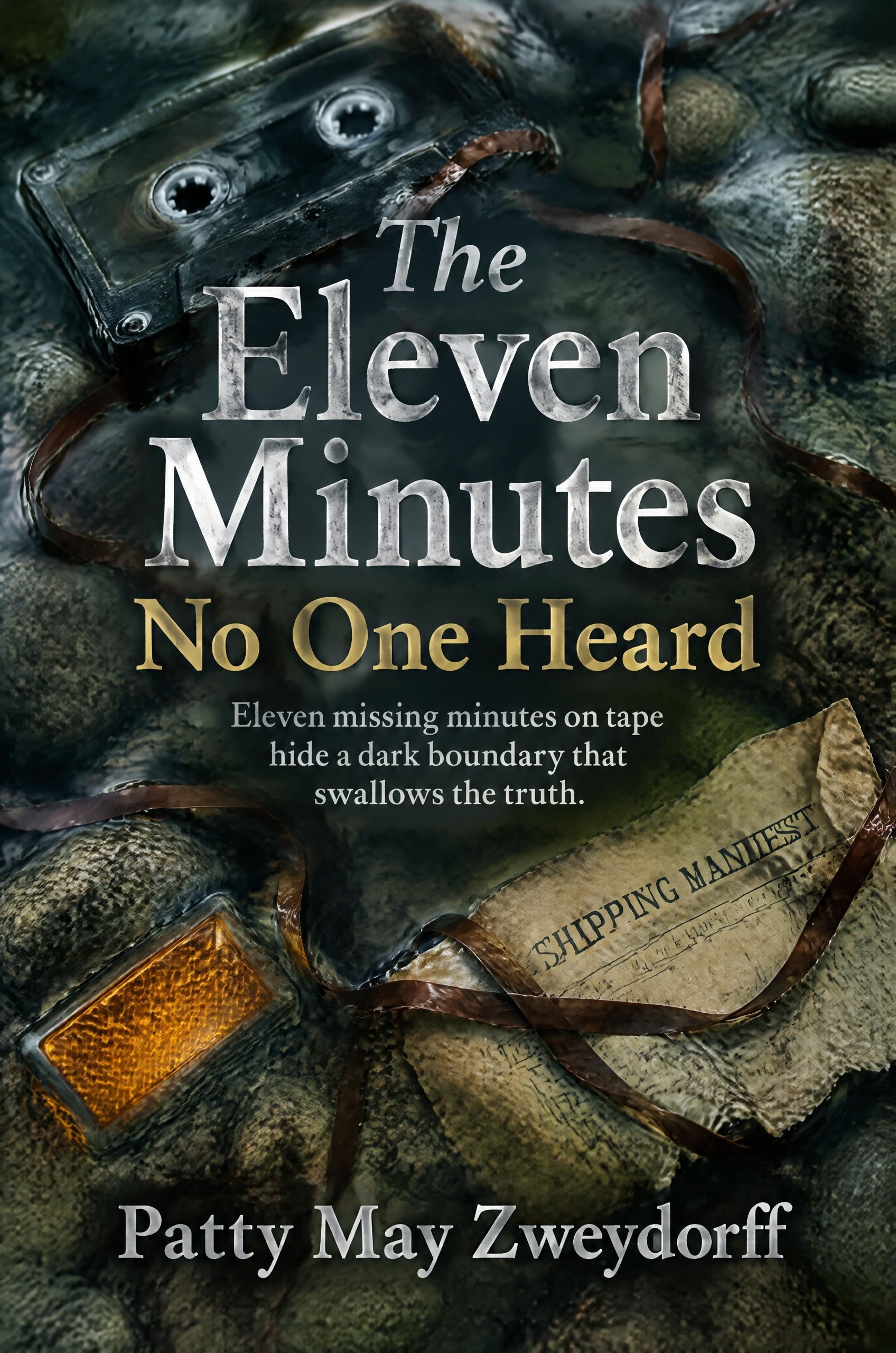
The Eleven Minutes No One Heard
Eleven missing minutes on tape hide a dark boundary that swallows the truth.
Freelance legal transcriber Clara Halloway knows how to listen to silence. But when she processes an official police interview with long-haul driver Vincent Yates, she encounters a dead zone like no other: an inexplicable gap of exactly eleven minutes. When the audio returns, Yates recants his entire testimony, denying he ever left the state highway. Refusing to let the erasure stand, Clara approaches Detective Gordon Ashby, a weary investigator sidelined for questioning flawed regional case files. Together, they trace Yates's unrecorded detour toward an abandoned ford where GPS signals dissolve and radios go dead. When a torn historical manifest links the forgotten route to a corrupt logistics empire running illicit cargo, human greed collides with a terrifying local reality. Something unnatural lurks along the misty crossing, a quiet threshold that claims travelers and conceals brutal crimes. As armed enforcers close in to destroy the surviving physical evidence, Clara and Ashby must navigate a suffocating expanse of dread to pull the truth from the riverbed before they vanish into the gap themselves.
- Mystery
- Horror
- Crime Fiction
- Police Procedural
- Supernatural Horror
- Small Town Mystery
The Dead Minute
Clara’s office took up the smaller bedroom of her rental, the one with the north window that never got direct sun. She liked it that way. Sun washed out the waveform display and made her squint. At nine in the morning, with her coffee gone lukewarm beside the keyboard, she had the room the way she wanted it: dim, quiet, the soundboard glowing blue.
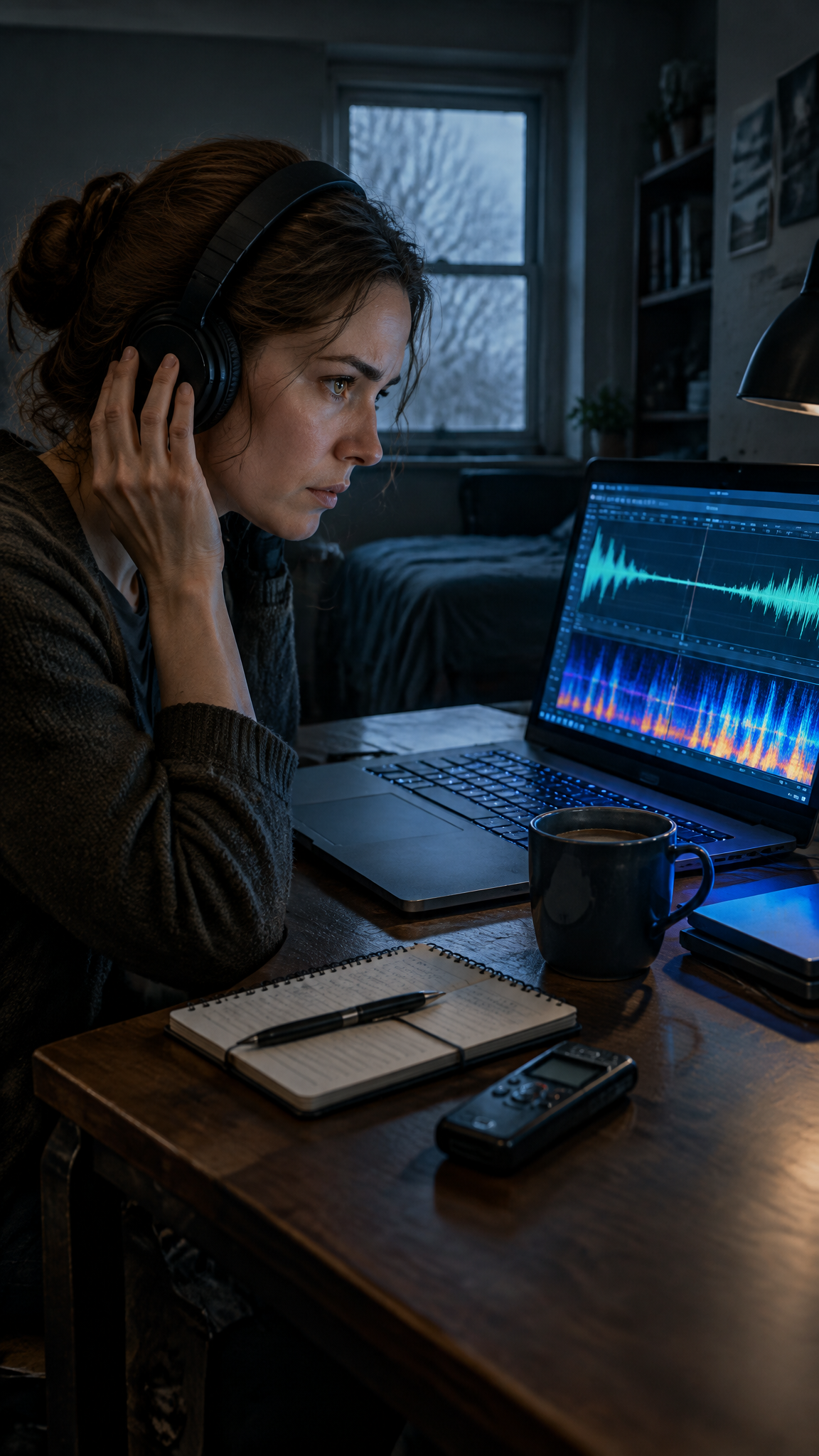
File 88-B sat in her queue with a case number and nothing else. County Prosecutor, Transcription Request, Priority Standard. She had done forty of these in the last year. Collision statements, property disputes, a shoplifting confession that ran six minutes and should have taken two. Routine work. She opened the file the way she opened all of them, headphones on, levels checked, cursor at zero.
The interview was Vincent Yates, a long-haul driver, questioned two nights before about an incident near the old Blackwood crossing. Clara didn’t know the details yet. She rarely did, going in. The prosecutor’s office sent her sound, not context, and she preferred it that way. Context made her hear things that weren’t there.
The first forty minutes were unremarkable. A detective she didn’t recognize asked Yates to state his route for the record. Yates answered in a thin, nervous voice, describing a run up Highway 9 with a stop at a weigh station, then a detour onto an unmarked dirt track he called, more than once, “the old spur.” He said the GPS had dropped out. He said he’d taken the track because another driver told him it cut forty minutes off the haul. He sounded tired. He sounded like a man who wanted the interview over so he could sleep.
Clara typed as she listened, fingers keeping pace with the recording at double speed, slowing when the dialogue overlapped or dropped low. It was easy work, the kind her hands did without her mind fully engaged. She was two cups of coffee into a job that would net her maybe sixty dollars by evening.
At timestamp forty-two minutes and ten seconds, the room went silent.
Not conversation-silent. Not a pause between question and answer. Clara had transcribed thousands of hours of interrogation audio, and she knew the particular texture of a room with people breathing in it, even when no one spoke. There was always something: the hum of fluorescent lights, the whisper of an HVAC vent, the faint creak of a chair when someone shifted weight. Ambient room tone, she called it in her own head, the sound a space made just by existing.
At forty-two ten, the ambient tone didn’t fade out. It stopped, the way a radio stops when you pull the plug instead of turning the dial.
Clara sat up straighter and pulled off one side of her headphones.
She scrubbed back ten seconds and listened again. Yates’s voice, mid-sentence, cut off clean at the end of a syllable. Then nothing. Not static, not white noise, not the low floor hum she’d expect from a cheap recorder left running in an empty room. True digital silence, flat as a held breath that never released.
She checked the waveform.
The visual display, usually a ragged green line full of small jagged mountains even during silence, between spoken lines, dropped to a perfectly straight band. No texture. No noise floor. It looked less like a quiet room and more like a wire that had been disconnected and then reconnected somewhere else entirely.
Clara reached for her notebook, the one with the elastic band, and wrote the timestamp in neat, small print. 42:10.
She let the dead space run.
It ran for a long time. She watched the counter climb, one minute, three minutes, six. She caught herself holding her breath somewhere around the eight-minute mark and made herself exhale, annoyed at her own nerves. Nothing was happening. That was the entire problem. Nothing was happening when something should have been.
At fifty-three minutes and ten seconds, the ambient tone returned, just as abruptly as it had vanished, and Yates was talking again.
His voice had changed.
Clara rewound to compare the two halves side by side, the pre-gap Yates and the post-gap Yates, the way she might compare two takes of the same scene. Before the silence, he’d spoken slowly, in the flat cadence of a man reciting facts he’d rehearsed on the drive over. After, his voice had climbed half an octave and gone breathy, the words tumbling out too fast, swallowing their own endings.
“I never left the highway,” Yates said. “I don’t know why I said that before. I was tired. I get confused when I’m tired. I was on Nine the whole time, start to finish, I never touched any spur road, there is no spur road that I know of.”
The detective’s voice, when it came, sounded almost bored, as though this reversal were the least surprising thing that had happened to him all week. “You told me twenty minutes ago you took a detour to save time.”
“I misspoke.”
“You misspoke for about four minutes, with mile markers.”
“I was tired,” Yates said again. “I want to go home.”
Clara stopped the playback.
She sat with her hands flat on the desk, feeling the small hum of the computer tower through the wood, and thought about the two voices. The first Yates had sounded exhausted but steady. The second Yates sounded like a man reading a hostage statement, the kind where you can hear someone standing just out of frame.
She went back to the gap itself, the eleven minutes of nothing, and opened the file in her spectral editor, the tool she used when a recording needed real scrutiny instead of a quick pass. She wanted to see the frequency content beneath the silence, the way a doctor might want an X-ray instead of trusting a bruise.
What she found made her pull her chair closer to the screen.
Beneath the flat silence, at a resolution most listeners would never notice, there were hard edges. Abrupt vertical lines in the spectral display, evenly spaced, each one marking a point where the signal had been sliced and rejoined. An amateur compression filter had been laid over the top to smooth the transitions, the kind of cheap audio tool that flattened loudness but couldn’t fully disguise a cut. Clara had seen plenty of edited recordings in her years of legal work, confessions trimmed for broadcast, depositions cleaned of cross-talk. She had never seen one dressed up to look like silence instead of an edit.
This wasn’t a dropout. Dropouts were ragged, inconsistent, full of digital artifacts that scattered unevenly across the frequency range. This was clean. Someone had taken eleven minutes out of the recording and replaced it with manufactured quiet, then smoothed the seams well enough to fool a casual listen.
Well enough to fool most people. Not well enough to fool her.
Clara sat back and pressed two fingers against her temple, the way she did when a problem refused to resolve into something simple. If the eleven minutes had been removed rather than lost, then whatever happened during them had been removed on purpose. And whatever Yates said during that gap, whatever he’d admitted or described, had been important enough for someone to carve it out and seal the wound.
She thought about the detour he’d described before the cut. The old spur. The dirt track near the Blackwood crossing he swore, after the silence, had never existed.
She copied the file to an external drive, her hands steadier than she expected them to be, and labeled it in block letters: 88-B ORIGINAL, DO NOT OVERWRITE.
Then she picked up her phone and called the records supervisor’s line at the municipal building, knowing before it rang through that she’d get voicemail. She did.
“This is Clara Halloway,” she said, keeping her voice level, the way she always did when she wanted to be taken seriously and not wanted to sound alarmed. “I’m transcribing file 88-B, the Yates interview, for the prosecutor’s office. There’s a corruption in the audio around the forty-two-minute mark, roughly eleven minutes of flat silence that doesn’t match the rest of the recording. I don’t think it’s equipment failure. I’d like someone to look at the original file before the transcript goes into the court record. Please call me back.”
She left her number twice, slowly, and hung up.
For a long moment she sat looking at the waveform frozen on her screen, the long flat scar running through the middle of it like a seam in bad stitching. She thought about how easy it would have been to miss, if she’d been transcribing at double speed the way she usually did, if she hadn’t happened to notice the absence of hum.
She closed the laptop, slid it and the external drive into her bag, and pulled her cardigan off the back of the chair. The municipal building was a fifteen-minute walk from her apartment, and she decided she would rather hand this to someone in person than leave it sitting in a queue where it might get filed, stamped, and forgotten before anyone thought to ask what eleven minutes of silence had cost a man his own story.
Badge and Eraser
The municipal building had done nothing with Clara’s voicemail. No one called back, not that morning and not by the time she gave up waiting and dialed Detective Gordon Ashby’s direct line instead, the number she kept in her contacts from a property dispute two years back where her transcript had actually mattered to someone. Ashby answered on the …