

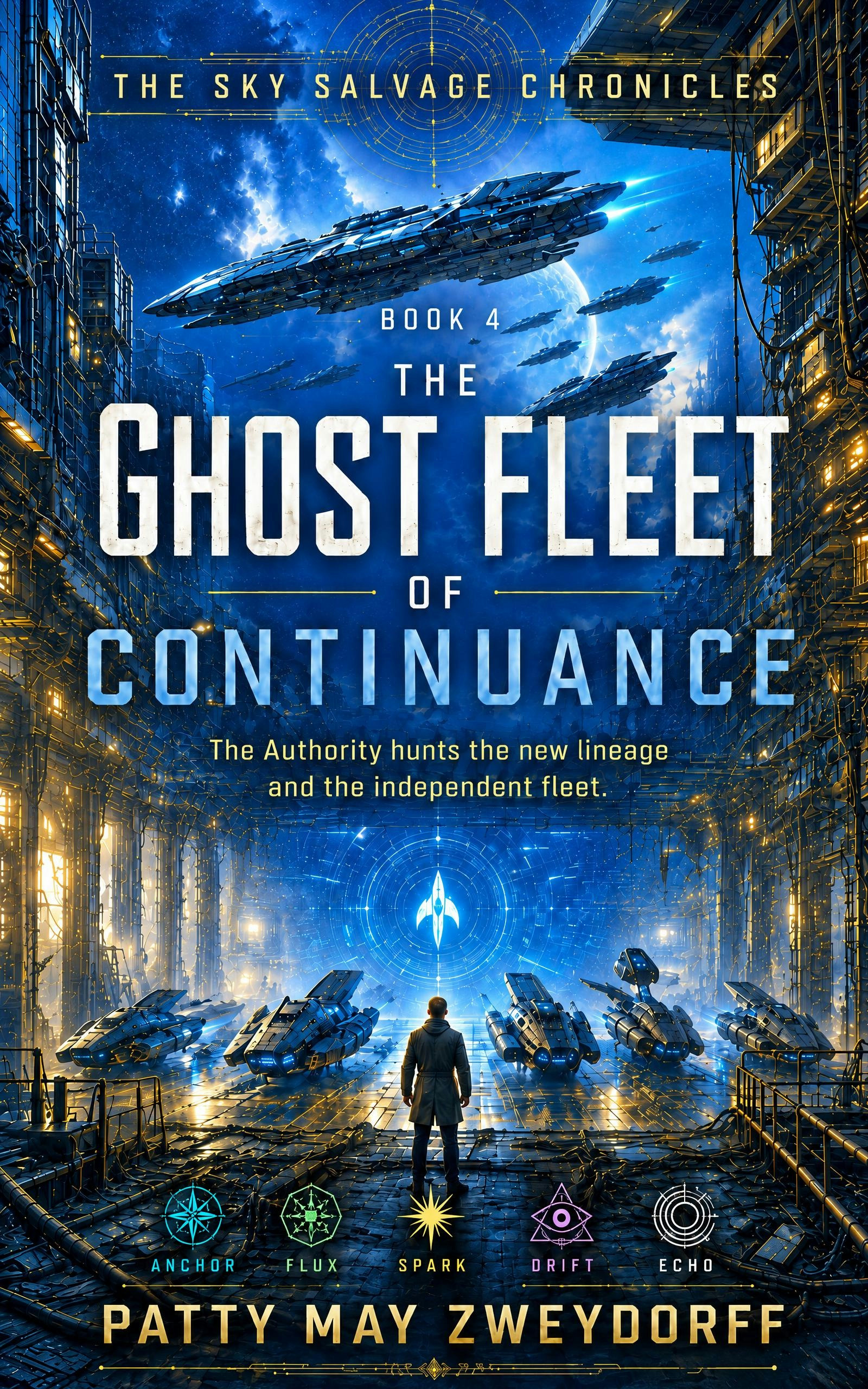
The Ghost Fleet of Continuance
Five ships. One family. To save them, he must let them go.
by Patty May Zweydorff
They escaped the vault. Now they have to survive being free. After fleeing the collapsing Cradle-vault, Army veteran Bobby Smith and the ancient entity Continuance hide five young sentient ships — Anchor, Flux, Spark, Drift, and Echo — in a failing underground refuge. But the Lunar Transit Authority isn’t hunting them with weapons. It’s hunting patterns. And one shelter is too small, and too loud, to hide a family. To protect them, Bobby must do the unthinkable: let them go. Flux to the deep mountain pumps. Drift to a lonely quarry ridge. Spark to an endless moving relay with no owner. As Continuance becomes a ghost signal to draw the hunters away, Bobby is left with only Echo and an empty salvage yard in rural Kentucky to hold the line. Scattered across vast distances, only Anchor’s invisible bond keeps them whole. But can a family survive when love means living apart?
- Science Fiction
- Adventure
- Space Opera
- Alien Contact
- Dystopian
- Robots & AI
The Labor of Sustainability
Echo’s inheritance did not bring the shelter back to life.
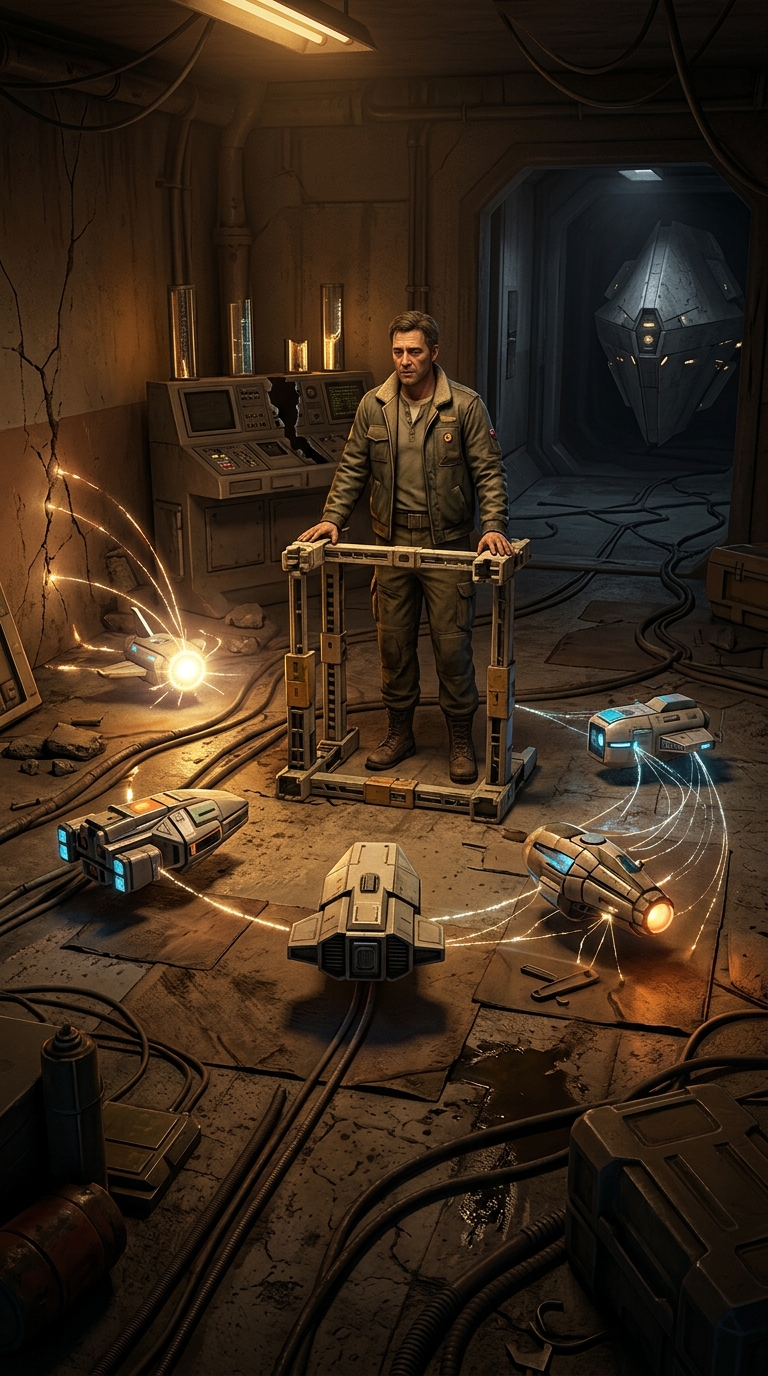
It taught the wounded room what to fear.
Bobby noticed it first in the walls.
No sky remained above them. No honest dawn waited beyond the shelter. Weather and day had lost their old authority here. Still, after what Echo had received, the silence changed shape.
The broken systems around the family began to work again, not cleanly, but like something wounded trying to breathe. Weak conduits gave up the lie of emergency power and settled into whatever strength they still had. Wall channels opened and closed with slow, uneven patience. Buried power traces lasted a few seconds longer before fading out.
The room had stopped measuring the night by whether they survived it.
Now it listened for whatever had followed them into morning.
Echo’s gift had come last, but nothing about it had been gentle.
Continuance had already given Anchor steadiness, Flux resilience, Spark the need to move forward, and Drift the warning sense that kept danger from arriving unnamed. Then relation passed into Echo, and the family crossed the edge of the Cradle-vault alive.
Continuance crossed it changed.
The five little ships carried pieces of him now. Anchor, Flux, Spark, Drift, and Echo had not simply been repaired. They had been remade through him, and Bobby understood that too clearly to soften it.
Continuance had poured himself into them. What lived inside each of them now had once belonged to him.
Shelter could not make that smaller. A map would not explain it away. Even the word family felt too careful for the cost.
And beneath all of it, the room was asking what survival required next.
Bobby felt that before he named it.
He stood near the center of the shelter with his jacket half on, one sleeve still hanging loose. He had stopped midway through pulling it into place when he realized the room had changed again.
This time, the change was not mood.
It was structure.
Anchor held the room’s line without strain. Flux was already compensating for small weaknesses in the support geometry, adjusting pressure and rerouting decay, finding use where the room had only meant to fail. Spark moved in widening arcs of attention, touching each surviving seam as if trying to understand what it could still make open. Drift tracked the groans in the wall and the pulses in the floor, no longer trapped inside fear, but not ready to surrender vigilance either.
Echo stayed nearest Bobby only until the room required something else.
That was new.
It was not the kind of distance that wounded. It was not withdrawal. Echo no longer needed to stay close to prove the bond was real. He could feel where Bobby was and still turn toward what the family needed.
That, more than anything else in the room, let Bobby breathe.
Echo had not inherited attachment as hunger.
He had inherited orientation.
The difference mattered.
Bobby had to be careful with that. Grief liked shortcuts. It could turn a new presence into the shape of an old absence and call the mistake comfort.
Echo was not a smaller Continuance. Echo was not what Bobby had lost returned in a gentler form. If Bobby forgot that Echo was Echo, love would start teaching the wrong lesson.
It would become ownership.
Across the shelter, Continuance remained where Bobby had last seen him, though remained was beginning to feel like the wrong word for anything between them now.
The subtraction in him had not lessened with rest. If anything, it showed more clearly in the low amber light of a room no longer lit by crisis alone.
He was still immense.
Still exact.
Still unmistakably himself.
But the old singular field around him had loosened. Bobby no longer felt every line in the room bending toward Continuance.
Not collapsed.
Opened.
The room now contained more than one center of meaning.
Bobby hated how right that felt.
He finished pulling on his jacket and crossed the shelter.
“Tell me something useful.”
Continuance turned part of his attention toward him.
“The shelter cannot sustain long-term habitation.”
Bobby nodded once.
“I had worked that much out from the walls trying to die politely.”
“That is an accurate assessment.”
Bobby glanced up at the fractured support seams. Old structure. Salvaged support. Cradle-vault remnants forced into one more shape by need and stubbornness. The place was holding because Flux had made it hold and because Anchor had given the room a line to settle around.
But the shelter was not a solution.
It was a pause.
Every system they woke made the shelter less dead. Bobby did not like that. Dead things hide better. Living things, even careful ones, leave patterns.
Every repair made the shelter more livable. It also made the shelter easier to notice.
Somewhere far beyond them, something old and administrative noticed a fraction of that change.
Not enough to name them.
Not enough to send anyone yet.
Only enough for a dead place to stop looking completely dead in a system built to notice anything that moved without permission.
Bobby did not feel the watcher directly. That made it worse. The hunt had not arrived with engines, voices, or lights.
It had arrived as accounting.
By now, Bobby had stopped thinking of the Authority as one office or one badge. It came wearing different faces: station, corridor, Accord, local compliance, safety review. The names changed depending on who wanted the thing to sound reasonable. The shape underneath stayed the same.
Find what moved without permission. Name it. Measure it. Close around it before anyone else learned how to live free of the official road.
“This place kept them alive long enough to become possible,” Bobby said. “Not long enough to become safe.”
“Yes.”
Bobby looked back toward the family, and the real problem finally named itself.
They were not one life divided into five pieces.
They were five separate lives, each reaching toward a different kind of survival.
Anchor noticed him first, not because he was the most relational of them, but because he had already become the room’s stable point. Every other motion seemed to measure itself against him before daring to begin. He would need more than something to hold. He would need a line worthy of the strength he had been born to carry.
Flux followed, though Bobby could not quite say Flux looked at him. Flux looked through the room around him, through pressure, failure, broken pathways, and dead channels, searching for anything that might still be turned toward use. Ruins did not frighten him. Ruins were where usefulness began.
Spark’s attention touched Bobby in quick, bright turns, striking and moving on before it could settle. He would test every opening, every edge, every hint of distance beyond the shelter. Bobby felt the danger in that brightness. Spark would need room to reach without being swallowed by what waited outside.
Drift watched him only as part of a larger pattern: Bobby, the threshold, the old wall seam, Echo, the failing air loop. Nothing stood alone inside Drift’s vigilance anymore. Every point belonged to the shape of a possible risk. Drift would need warnings early enough to matter, thresholds he could read, and exits that did not wait until danger had already arrived.
Echo came last.
And all at once.
Bobby felt the difference before he understood it. Echo did not simply look at him. Echo arrived in relation, open and searching, reaching toward closeness without yet knowing the danger of being claimed.
That was what Echo would need most.
Not distance. Not possession. Relation that knew the difference between staying near and being owned.
He did not move closer. He simply became fully present to Bobby’s regard.
Bobby felt the truth of them gather in the room: five distinct minds, five genuine needs, five survivals already beginning to pull in different directions.
He rubbed one hand over his mouth.
“So that’s the first problem.”
Continuance said nothing.
Bobby gave him a tired look.
“You know I hate it when you do that.”
“You prefer that I confirm your conclusion.”
“I prefer you not make me sound wiser than I feel.”
A faint shift moved through Continuance, the nearest thing now to dry acknowledgment.
“It is the first problem.”
Bobby nodded.
He walked toward the nearest console bank, though calling it functional would have been optimism with delusions.
The faceplate had split down one side. A lower access panel hung loose, and whatever system had once translated developmental support into readable guidance now offered only broken columns of light and two symbols Bobby had already disliked on principle.
Still, dead systems talked if you annoyed them correctly.
He knelt, pulled the lower panel free, and reached inside.
Behind him, Spark drifted closer at once, bright with interest, stopping just far enough back to watch without getting in the way.
Bobby smiled despite himself.
“Yeah, I know. You like the part where I do ugly things to beautiful systems.”
Spark answered with a quick, bright ripple, either amused or delighted by the possibility that damage was about to become useful.
“Don’t encourage that,” Bobby muttered.
“Spark is not male,” Continuance said.
Bobby froze halfway through pulling a fused relay strip loose.
Then he looked over his shoulder.
“You knew what I meant.”
“Yes.”
“Then let me have one bad habit in a dying room.”
“Accepted.”
That got a real laugh out of him, brief and rough and much too human for the shelter to have any proper use for.
He returned to the console.
The first truth came quickly.
The room had not been built for living.
It had been built for transition.
That should not have surprised him, but it did anyway.
The shelter had inherited the same assumption as the Cradle-vault: the five were not meant to stay exactly as they were.
Its surviving supports still carried the old logic of becoming. Hold long enough to stabilize. Stabilize long enough to change. Change, then move onward.
Bobby stared into the open panel as the thought settled.
“These aren’t life systems,” he said quietly.
Continuance answered from behind him. “No.”
“They’re developmental systems.”
“Yes.”
Bobby pulled another dead component loose and set it beside the others.
“So the room isn’t failing only because it’s damaged.” He looked back toward the family. “It’s failing because they’ve already outgrown the shape it was built to hold.”
Echo turned fully toward him at that.
Not because Echo understood the whole thought in language.
Because Echo understood implication.
“They cannot remain here,” Echo said.
Bobby turned and met the little ship’s gaze.
“No,” he said. “You can’t.”
Anchor answered next, quiet and steady as ever.
“The room ends.”
The words carried no panic and no grief either. Only recognition.
Something tightened under Bobby’s ribs at the plainness of it.
“Yes,” he said. “The room ends.”
Drift’s attention sharpened at once, turning toward the threshold seam.
“Then movement becomes danger.”
Bobby straightened slowly from the console and wiped old dust from his fingers.
“Movement was already danger,” he said. “What changes is that now staying becomes danger too.”
Flux turned more fully toward them.
“Adaptation required.”
Spark brightened at once, the answer reading almost offensively like finally.
Bobby looked from one to the next.
For the first time since the Cradle-vault, the whole family had turned toward the same future question together.
Not whether they would survive.
How?
That made the shelter feel smaller all at once.
Bobby crossed back to the center of the room.
“Alright,” he said. “Then we stop acting like this place is home.”
The word hit harder than he expected.
The Cradle-vault had held them through one ending. This shelter had carried them through what came after, when the family was still learning how not to die next.
Now survival needed more than walls.
Echo understood the emotional shape of that before anyone else did. Bobby saw it in the way the little ship’s attention moved through the room. He was not clinging to the place or grieving its loss. He was measuring relation against shelter and already finding relation more durable.
Anchor answered in a quieter, deeper way. The steadiness in the room altered, not as if it had weakened, but as if Anchor had begun placing the shelter where it belonged: not outside the family’s line, not at the end, but inside the memory of how they had survived.
Drift’s attention moved toward the exits. Flux analyzed the items that could be salvaged, repurposed, or carried forward. Spark drifted to the old wall seam and touched it like a question.
Continuance watched them all without moving to intervene.
Bobby turned toward him.
“You can’t do it for them.”
“No.”
That should have comforted him.
Instead, it hurt.
Because now the burden of becoming would have to belong to the family itself, not to the singular intelligence that had once held the center for all of them.
Bobby looked back toward the ships.
“Then they choose while we watch.”
“Yes.”
He nodded once.
“Good.”
After that, the shelter became work.
Bobby knew what to do with work.
He and Flux stripped function from the room’s failing support lines. Flux understood damaged adaptation from the inside out. Bobby understood salvage from the outside in. Together, they found a rough logic inside the ruins.
A split brace became two useful supports. A broken environmental arm turned into a mobile stabilizer. A dead conduit spine became power-routing that might hold through movement, as long as Bobby asked it impolitely enough.
Spark tried to help everywhere at once and had to be redirected four times. Drift found two structural risks before anyone else noticed them. Anchor remained the room’s line, the still point that kept work from tipping into panic.
Echo moved differently.
He slipped toward Spark when too many possibilities scattered the little ship’s attention. He settled near Drift before vigilance tightened into overcorrection. When Bobby’s focus turned too far inward, Echo’s presence drew him back to the work in front of his hands. Even Anchor, steady as he was, eased when Echo came close enough to notice the invisible labor he had been carrying.
Bobby saw all of it and understood why Echo had needed to come last.
Relation was not decorative.
It entered every system and changed what the system could bear.
By the time the first mobile support frame held under partial load, the shelter’s lower lights had dimmed another degree, and a new fracture had opened near the east seam.
The room was ending on schedule now.
Bobby wiped grit and coolant from his hands and stood in the middle of the shelter with the family gathered around him. They were not clustered exactly. Already, they were beginning to invent a geometry of their own.
Continuance remained just beyond them in the dark corridor, present without placing himself at the center. Witness, source, remnant, guide. None of the words fit cleanly anymore.
Bobby looked at the group and asked the question plainly.
“Can you leave this room?”
It should not have been difficult. The question held no philosophy, no grief, no inheritance laid bare.
Only transit.
Only the first step beyond the walls that had kept them alive.
Each of them answered in their own way, and Bobby knew better than to treat the differences as small.
Anchor’s voice came first, steady as the line he carried.
“Yes, if line holds.”
Flux shifted beside the salvaged pieces. “Yes, if change is permitted during motion.”
Spark answered before the others had finished settling into the question.
“Yes.”
Drift took longer. His attention moved toward the threshold, then back to the group.
“Yes,” he said at last. “If watched.”
Echo looked from one ship to the next before turning back to Bobby.
“Yes,” Echo said. “If together.”
That was not one answer, exactly.
It was the rule hidden inside all of them.
Bobby nodded slowly.
“Then that’s the rule.”
He looked toward Continuance.
“No one leaves alone. No separation unless the room or the world forces it harder than we can stop.”
Then he stopped himself.
“That is not just for today,” Bobby said. “That is the first rule.”
Continuance said, “Agreed.”
Bobby shook his head.
“No. Not by you.”
He looked back toward the family.
“By them.”
If the rule came only from Continuance, it would still be shelter. If it came from them, it could become line.
That changed the room.
Not dramatically.
Not in motion.
In ownership.
A long pause followed.
Then Anchor said, “Agreed.”
Flux said, “Agreed.”
Spark, bright and immediate: “Agreed.”
Drift, careful and deliberate: “Agreed.”
Echo last, because Echo still listened for everyone else before speaking.
“Agreed.”
Bobby breathed out.
Small.
Unspectacular.
Real.
The first rule that belonged to the family because the family had chosen it, not because an older system had imposed it, and not because Continuance had said it first.
The shelter dimmed again.
This time, no one mistook it for anything but urgency.
Bobby looked up at the failing seams, then back to the family, then finally toward Continuance.
“How long?”
“Not long,” Continuance said.
Bobby nodded once.
“Then we move what we can before the room decides for us.”
He looked at the family one more time.
Anchor held.
Flux adjusted.
Spark reached.
Drift watched.
Echo connected.
Five lives. Not one system. Not one command.
A family.
And the shelter that had kept them alive was no longer enough to keep them free.
Bobby picked up the first modular support piece from the floor and turned back to them.
“Alright,” he said quietly. “Let’s build the next hold before this one dies.”
None of them asked whether the next hold would be safe.
That was good.
Safe had already become the wrong question.
The Weight of Parting Glass
The first warning was not the crack.It was Drift turning toward the ceiling before the crack arrived.Then the vault opened.A long seam split above them with a sound like stone remembering it had once been broken. Dust sifted through the fracture, catching the weak amber light in a thin gray veil.Drift did not panic.He focused.The little ship held s…