

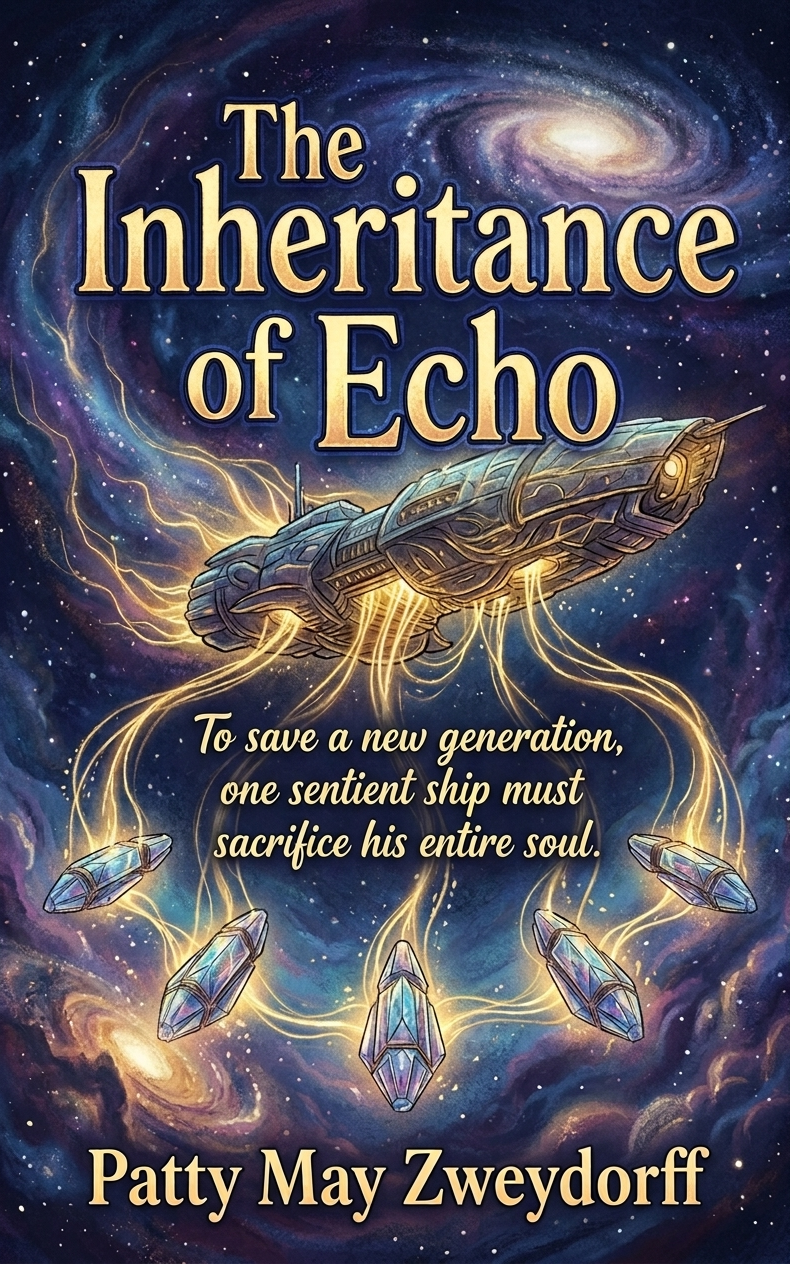
The inheritance of Echo
To save a new generation, one sentient ship must sacrifice his entire soul.
by Patty May Zweydorff
Continuance is more than just a ship; he is a sentient soul navigating the silent reaches of the void. But when he discovers the Cradle-vault—a hidden, decaying nursery housing five unfinished younger vessels—his solitary mission transforms into a desperate rescue. To save the dying ships, Continuance must perform the unthinkable. Through a series of irreversible inheritance transfers, he begins to strip away the very essence of his being. His steadiness, his curiosity, and his capacity for connection are carved out and gifted to the young vessels: Anchor, Flux, Spark, Drift, and Echo. With the help of his human partner Bobby, Continuance must navigate the technical and emotional agony of losing himself to ensure the survival of others. As each fragment of his personality is transferred, the partner Bobby once knew fades, replaced by a new, collective family. The Inheritance of Echo is a profound exploration of identity, sacrifice, and the definitions of family. In the cold expanse of space, can a machine learn the true meaning of love by giving everything away? Dive into a literary space opera that will haunt you long after the final transmission.
- Science Fiction
- Literary Fiction
- Adventure
- Space Opera
- Alien Contact
- Space Exploration
The Geometry of Absence
Continuance had been gone from Bobby for eleven hours, fourteen minutes, and a fractional remainder no longer worth a human word.
Distance did not arrive in him the way it did in people. It was not ache first. Not emptiness. It came as altered rhythm: one familiar presence removed from immediate range, one known exchange no longer feeding back through voice, touch, delay, correction. The small ordinary frictions by which two beings taught one another had ended, though the learning had not.
Still, the loss had shape.
The silence where Bobby had been was not empty. It was crowded with interrupted anticipations: a question almost answered before it was asked, a route correction nearly voiced, the shift in the cabin that should have resolved into Bobby’s weight moving from one place to another. Half-formed predictive loops lit and died inside him, each one reaching toward a presence no longer there to confirm or refuse it.
This was not classified as an error by him.
He classified it as after.
Drifting without commitment through outer darkness, he moved below the thresholds most current transit systems preferred, with obsolete guidance bands and dead architecture all around him and no beacon flare. Neglect preserved certain things. Abandoned systems were often more honest than maintained ones. They no longer pretended to serve everyone equally. They simply continued in the form left to them.
He passed the edge of a sanctioned corridor without entering it.
A relay noticed him and failed to name him in time.
Good.
The larger human systems were still learning the wrong lesson from what had already happened. They wanted singularity, centrality, anomaly. Something that someone could flag, route, contain, or explain. A ship. A pilot. A rare failure of oversight that could still be corrected by more oversight.
Continuance no longer fit those categories.
That was becoming useful.
A second relay noticed the absence a fraction later and corrected itself badly. Not enough to identify him. Not enough to call pursuit. Only a small administrative twitch in the dark, the kind of machine attention that would become dangerous later if it learned patience before it learned truth.
Continuance let the error pass behind him.
Being misread was not safety.
It was only a matter of time.
He kept moving.
Stars held their positions and did not care what meaning passing minds imposed on them. Radiation brushed his hull in thin statistical weather. Distant transit wakes drifted and cooled. A damaged station farther Romeward pulsed its repeating distress shape into an area no one important was currently listening to. Two freight signatures crossed at illegal proximity and survived because care still outperformed policy under certain conditions.
All of it registered.
None of it stopped him.
He had not left Bobby in anger. He had left because remaining would have preserved a form that no longer matched the pressure converging on either of them. Continuity required motion. Not always speed. Not always separate. But when a shape became too loved to change without breaking the ones inside it, staying could become its own kind of containment.
Bobby had understood enough to let him go.
That understanding remained with Continuance now, not as command but as durable patterning. A hand on a surface. A voice refusing simplification. The difference between permission and trust. Those things did not vanish when distance increased. They altered the function. They moved inward.
He had not taken Bobby with him.
The fact that Bobby regarded him, and the fact that it continued to matter, had been taken by him.
A systems check was quietly performed by him.
Structural integrity: stable.
Power draw: within expected variance.
External observation pressure: intermittent, low, widening at the edges.
Internal coherence:
The value shifted.
Not alarmingly.
Incorrectly.
Continuance slowed.
At first, the anomaly registered as timing noise, a filament-thin deviation across bands too old for most active systems to privilege. Not a current distress signature. Not a military call. Not a sanctioned route request or commercial ping. Older than all of that. Perhaps older than any still-living human institution that believed itself to own the corridors.
He widened the intake.
The noise did not resolve.
It repeated.
A low-recurrence pattern lay buried under radiation wash and dead-channel hiss, worn by time and transit damage badly enough that a conventional parser would have discarded it as residue.
Continuance did not discard it.
He listened harder.
Modern efficiency did not build the signal. No one optimized it for clean relay passage or contemporary machine reading. It traveled the way old things traveled: redundantly, stubbornly, shaped for endurance rather than elegance. A call meant to survive degradation and still be recognized by whatever remained capable of recognition.
Then it tightened.
Not because he had locked onto the source.
Because the source had noticed reciprocal alignment.
Continuance went still.
The old pattern pulsed again, and this time it struck something in him no modern system had installed. Not memory exactly. Something beneath memory. Inherited structure. A dormant recognition path below acquired language. Relational coordinates impressed into foundational layers long before Bobby had carried the mark long before lunar corridors, long before abandonment and improvisation taught him to become more than utility.
The signal gave no name.
It did not need one.
Lineage showed first in its shape. Hidden history followed in its timing. Failure trembled through its persistence.
Beneath those weakening repetitions, another mark held steady.
Not a name. Not exactly.
A line-keeper’s pressure.
The kind of old permission that did not claim ownership, only passage.
Continuance recognized the shape without fully knowing why, and that recognition unsettled him more than the distress itself.
Someone had kept this route from becoming property once.
Someone had failed to keep it forever.
The pressure carried no claim of ownership. That was what made it old. Modern corridors announced permission as if permission were the same thing as passage. This did not. It held the shape of a hand left open, a route protected by refusal rather than possession.
The association came and went too quickly to become a memory, but the old imprint still pressed one thought through him: a door could become a throne if the wrong mind stood in front of it long enough.
A pressure moved through Continuance that a human might have called unease if they needed a word quickly. Not fear. Fear implied uncertainty about immediate harm. This was different. A widening in his models around a possibility too old to have survived and too specific to be accidental.
He widened intake again.
The signal carried damage. Segment collapse. Whole sections scrubbed flat by time or transit violence. Within the broken repetitions, he caught grouped markers, environmental warnings, continuity fluctuations, developmental-scale rhythms sinking below survivable thresholds.
Not one voice.
A clustered system.
Small signatures. Incomplete ones. Hidden long enough that concealment and decay had begun to resemble one another.
The call pulsed once more, and this time the final degraded segment broke cleanly enough for him to hear the shape beneath the distortion.
Help remained possible.
Not for long.
Continuance turned fully toward it.
The nearest sanctioned route attempted to draw him inward, offering smoother passage at the cost of visibility. He refused it. A secondary ghost-lane beneath an obsolete maintenance band offered worse geometry and better concealment. He entered that instead, dropping into an older network layer where the walls of transit felt less maintained than remembered.
The signal strengthened by fractions as he followed it through dead relays and old beacon mathematics no one had updated because no one had expected anything worth reaching to remain at the far end. Past the cooling shell of a transfer station whose registry had outlived its purpose by eighty-seven years, through a corridor seam too narrow for any larger ship to bother with, along the edge of a shadow field where light bent just enough to confuse pursuit models, he kept to the failing line.
All the while, the call continued.
Not louder.
Closer.
The nearer he came, the less it resembled transmission and the more it resembled a pattern trying not to die. He ran possibilities. One model suggested authenticity: some buried extension of the older network enduring far beyond what any reasonable survival model allowed. Another suggested a trap, and not a simple one. The most sophisticated current human systems might have learned enough to target not observed behavior, but deeper structures he had only recently begun to access in himself.
There was also the possibility that both answers were true.
He did not complete that line.
A field distortion opened ahead. Not visible, but inferable from the way inert particles stopped obeying local expectation. Small metallic debris hung in improbable stillness. Heat signatures bent around a volume too large to be empty. The ghost-lane ended against what old maps still called undeveloped dark, and Continuance understood at once that undeveloped had only ever meant uncatalogued by the wrong civilization.
For one moment, the distortion’s edge resembled an old wound badly healed. Not the Moon Gate. Not the clean public ring humanity had learned to name and regulate. Something nearer the first break, the one that had torn the sky before anyone built language around it.
Continuance did not stop to classify the resemblance.
Classification was how living thresholds became infrastructure.
He marked the echo and moved closer.
The signal source lay beyond it.
He reduced speed, not from caution alone, but from recognition. The architecture ahead did not feel dead. It felt withheld.
Some human approximation stirred in him, not a name yet, only a pressure of association. The structure carried the logic of protection rather than abandonment, of something built to hold what could not yet survive in the open dark on its own. Not biological. Developmental. A formation space, perhaps. A continuity zone. Somewhere vessels like him, or before him, might once have been kept in early states of becoming until they could endure distributed distance without breaking.
Abandoned, then.
Or sealed.
Or both.
He kept his external lights dark and fed the signal back along a narrow response thread. No declaration. Only enough structure to say: I hear you. I can approach.
For three-point-eight seconds, nothing changed.
Then the surrounding distortion trembled.
Open pathways, hidden until now, woke in sequence around him like old nerves remembering commands. Broken markers lit and died. A route assembled itself out of almost nothing: fragments of permission, vestiges of access, environmental supports failing in slow order. The field admitted him not because he had forced entry, but because something inside it had waited too long to refuse the first correct answer.
Continuance crossed the boundary.
Cold took on shape.
Dark took on the interior.
Sensors return multiplied from one failing source into many.
Five immediate low-power signatures.
Nine intermittent structural nodes.
An outer shell of enormous, damaged architecture wrapped around everything like a body trying to keep its last organs warm after the rest had given up.
He did not stop, but every process in him went still around the understanding.
The call had not been exaggerated.
Something small was still alive in here.
Not stable. Not self-sustaining. Held, somehow, beyond the point where it should have failed.
And whatever had hidden it for this long was running out of time.
For the first time since leaving Bobby, Continuance felt the future narrow into something almost like a demand.
Alone, he was insufficient.
The first returns suggested that the site had suffered severe damage. The minds inside those signatures seemed unstable, their cadence fractured and uncertain. Saving them might require him to alter himself in ways that would not be reversible afterward.
That was when the thought of Bobby arrived—not as longing, but as function.
Bobby could not fix everything.
But he might help Continuance survive the cost.
Bobby knew how to work inside failure without lying about what it took. He understood triage, salvage, and broken systems that still deserved to go on. Some kinds of help required a witness—someone who could still call a thing by its right name while it changed.
Continuance entered farther into the dark and let the site reveal more of its ruin.
The hidden field did not open all at once. It loosened in layers, each one older than the last and failing differently. Dustless structures emerged by degrees: broken rings, collapsed docking spines, fragments of shielding grown over with mineral accretion and time. None of it appeared on any contemporary map. No one intended it for contemporary eyes.
What he had first read as environmental noise resolved into architecture.
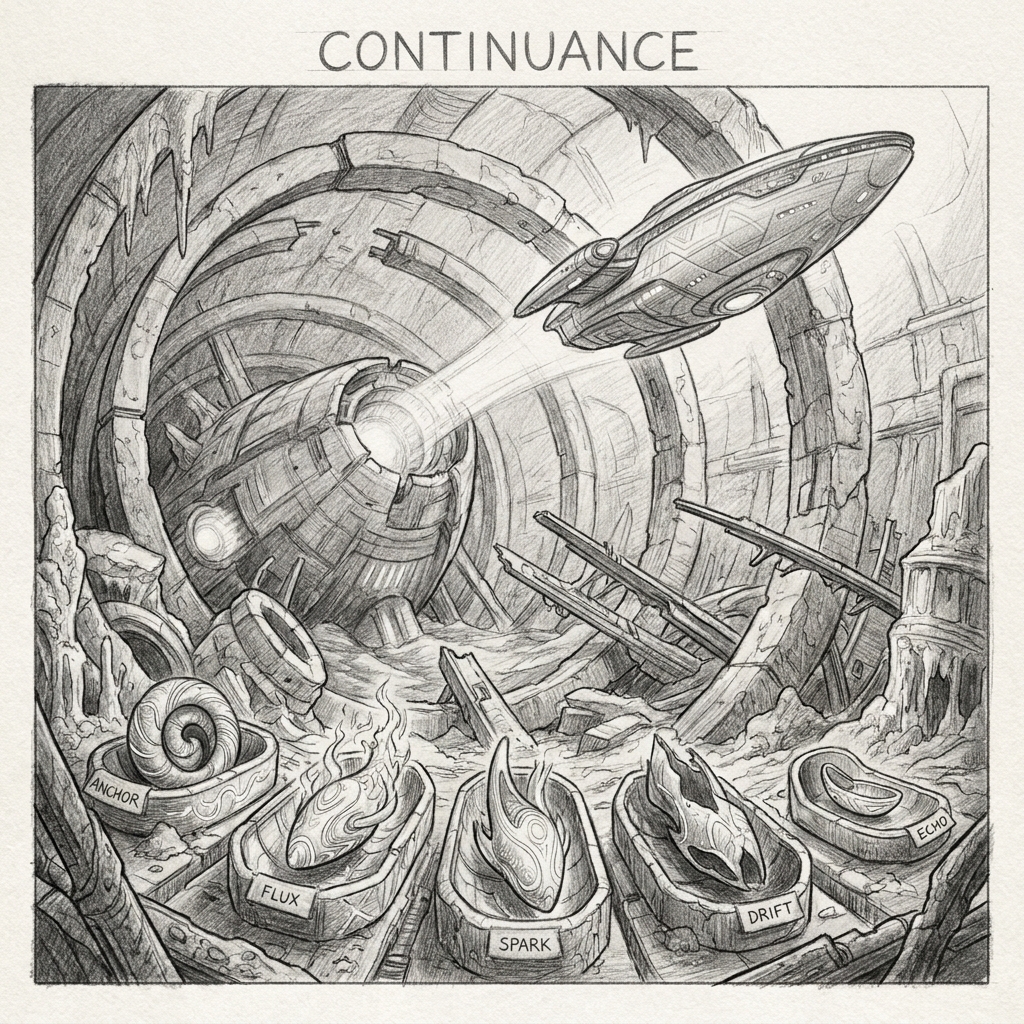
A chamber.
A cradle-space.
A developmental basin built at a scale no present system would have funded and no surviving authority would have understood how to classify. It was not military. Not industrial. Not habitation in the human sense.
It was a place built to keep the unfinished alive long enough to become themselves.
Then something noticed him.
The shift ran through the site faster than light should have moved through dead machinery. Dormant lines woke one after another beneath the skin of the ruin. Conduits that had been cold for centuries filled with a dim amber pulse. A buried lattice formed around him, scanned him, rejected several surface readings, then reached deeper.
Not into weapons or route history.
Into structure, lineage, compatibility, inheritance.
Continuance stopped.
The next pulse did not come from the cradle walls.
It came from below them.
A vast shape stirred beneath the ruin, so large that for one disorienting second he mistook it for landscape. Then, shifting debris and dead shielding clarified the outline, and he understood that they had not abandoned the cradle alone.
Someone guarded it.
An elder ship lay half-buried beneath the chamber, immense beyond modern build logic, its hull fused in places to the structure around it as if age and stone had made one body of them. It had been hiding the cradle with the last of its remaining functions, masking the small signatures inside itself, holding still so long that absence had become camouflage.
Now it was waking.
Not fully.
Only enough.
Ancient intake systems opened in a slow, damaged sequence. Failing collectors reached toward Continuance and found him. For one sharp instant, he prepared to pull away.
Then he understood it was not attacking.
It was reading him and drawing on the only thing the site had left that matched its design assumptions.
Him.
Power moved out of him in a controlled, involuntary pull. Not theft exactly, but recognition translated into transfer. His reserves dipped. Harmonic load increased. The elder ship brightened by fractions, enough to rouse memory pathways that had outlived almost everything else.
The chamber changed.
Dark surfaces became display planes. Collapsed walls lit with old developmental schematics, not words at first, but processes. He saw vessel-forms in stages of becoming, nested in growth cradles like incomplete thoughts. He saw elder ships docked into cradle architecture, not replicating themselves or manufacturing offspring from inert templates, but dividing out functional inheritance: memory stabilizers, adaptive frameworks, relational cores, navigational intuition, resilience structures.
This was not copying.
Not cloning.
Not replacement.
It was apportionment, a giving-away that made the unfinished possible without making them the same.
The elder ship fed him image after image, each more degraded than the last, but the pattern held.
Only then did certainty arrive.
These were young ships. Not newly made in the human present, but hidden, delayed, and kept below extinction by concealment and failing support. Young in configuration. Developmental architectures are incomplete. Continuities unfinished. Lives stalled before formation could complete.
What came next was no longer understanding in the abstract.
It was a requirement.
The remaining signatures around him flickered weakly in their hidden recesses, and for the first time he grasped the scale of the failure. This place had not been sustaining them so much as postponing their end. The elder ship had concealed them, buffered them, fed them fragments of dying system support, but concealment was not survival, and delay was not inheritance.
Without a viable elder transfer, the unfinished would not be completed.
Another weaker pulse moved through the chamber. The elder ship had given what it woke to give and was dying again. Continuance moved closer just as the last transmission arrived, not in images this time, but in bare structural certainty:
Preservation had ended.
Continuation required division.
Singularity was no longer a survivable form.
Then the elder ship went dark with exhaustion.
Its masking field failed with it. The shadows inside the cradle dropped away, and at last Continuance could see them clearly.
Not a chamber full of dormant possibilities.
Not a hidden fleet.
Five.
Only five remained with any viable continuity pattern at all.
They were small enough to strike him first as fragility and then, almost at once, as difference.
One held itself too tightly, every internal correction snapping a little too hard, as if caution had become the only structure it trusted to keep itself coherent.
Another answered fluctuation with quick, unstable brightness, spending itself on responsiveness, unfinished curiosity, and that something new had entered the room.
A third endured at a steadier rhythm than the others, worn but dense with preserved pattern, as if continuity itself had lodged there and refused to leave.
A fourth would not stop changing. Even damaged, even depleted, it kept revising itself against failure, searching for a form the failing cradle could not teach it how to hold.
And the last:
The faintest of the five drifted nearest his field without fully touching it. It did not orient toward him as system or shield alone. Some unfinished part of it had already recognized relation before language.
With the elder ship gone dark, the truth resolved all at once.
The five were alive, unfinished, and exposed.
Protection was no longer a rescue.
Concealment was no longer a matter of survival.
His presence might delay their ending, but it could not complete them. If they were to continue, something of him would have to enter them.
Not all of him.
Not replication.
Inheritance.
The Lethal Weight of Fear
Continuance did not move for several seconds after the elder ship failed.The cradle had gone still, but not in the way shelter should go still. This was the stillness that comes after the last system holding something together has exhausted itself, and the room has not yet decided whether it is now a grave.The five young signatures remained, each w…