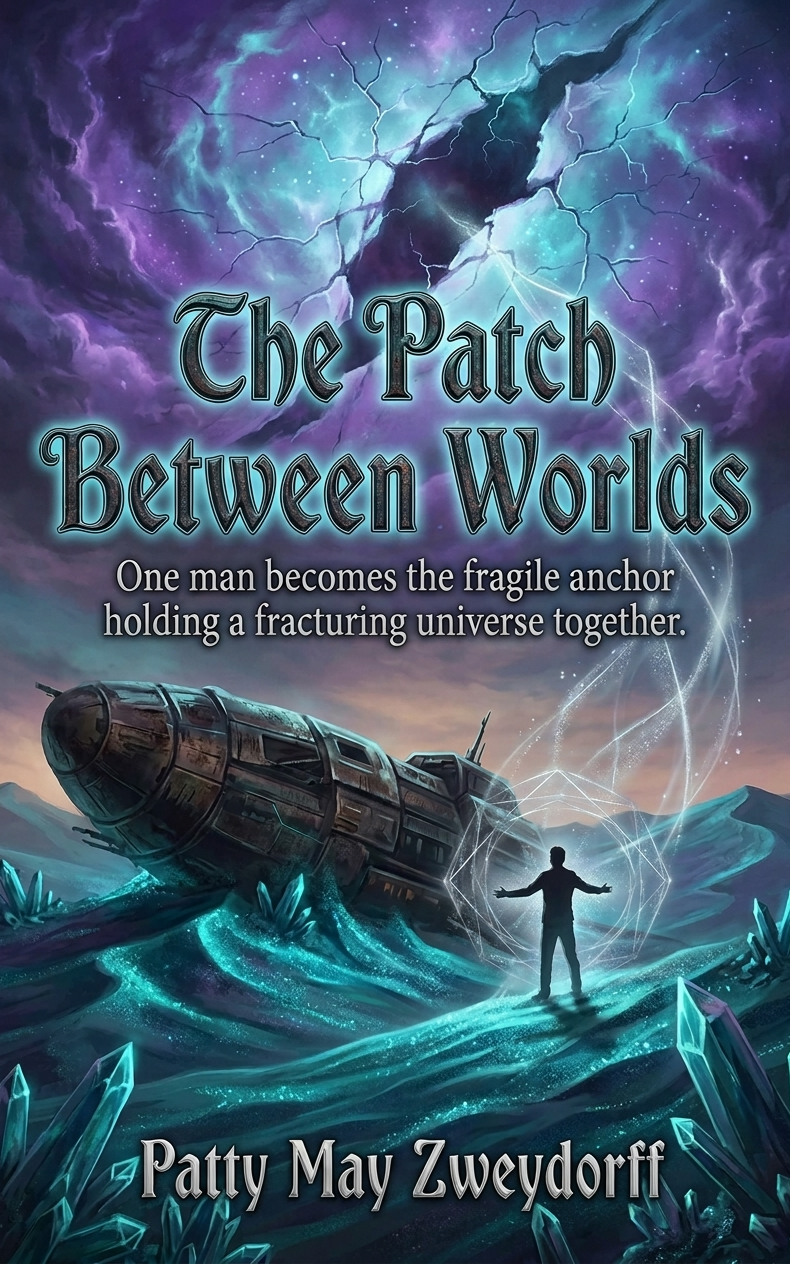
The Patch Between Worlds
One man becomes the fragile anchor holding a fracturing universe together.
by Patty May Zweydorff
John Hayes was an independent contractor who specialized in simple fixes and staying under the radar. But when a high-stakes diplomatic transport ends in a catastrophic crash, John emerges as the host of something impossible: the Mediator Function. This ancient alien artifact is more than just technology; it is the fundamental architecture that keeps reality from unraveling. Now bonded to John and his ship, the Function begins to repair space-time itself, responding only to his touch. But the universe is a hungry machine, and as wormholes destabilize and colonies face erasure, every faction in the galaxy wants a piece of the man who controls existence. The military sees a weapon. The Orion Compact sees a tool. The cosmic Continuum sees a mistake that must be corrected. For John, the cost of godhood is his own humanity. To save the galaxy, he must become a permanent, non-human fixture of the universe—or let it all burn in a violent hard-reset. In this sweeping space opera, one man must decide if he will remain the universe’s secret savior or force humanity to finally take responsibility for its own survival. The patch is holding, but for how much longer?
- Science Fiction
- Literary Fiction
The Job You Don’t Plan For
The docking-port bar smelled like burned oil, recycled air, and something fried that had no business being called food.
John liked it.
It meant he was between contracts and still alive.
They had claimed a scarred metal table near the viewport, John and the three people who had kept him breathing more times than he cared to count. The station rotated slowly beyond the glass, stars smearing into long arcs of light.
A tablet sat in the middle of the table, scrolling job listings in muted blue and green.
“Private work pays better,” Rook said, flicking a finger through the listings. “No paperwork. No oversight.”
“Yeah,” Jax replied, lifting his drink, “and no rescue when things go sideways.”
“They always go sideways,” Leni said. “Government just makes you fill out forms about it.”
John watched the listings slide past.
Salvage.
Escort.
Gate repair.
Cargo runs.
Nothing exciting or dangerous enough to pay well.
They had just wrapped a six-week contract repairing local jump gates, dirty work, steady credits. The kind of job that kept independent contractors like them fed and mostly forgotten.
They were good at being forgotten.
That was part of the appeal.
Across the bar, someone turned up the volume on a wall-mounted screen.
The chatter quieted.
A news anchor filled the display, framed by a chamber John recognized immediately. The Assembly Hall. Polished floors. Flags. Symbols he did not know and could not pronounce.
“It has been ten years since the wormholes opened,” the anchor said. “Ten years since humanity learned it was not alone.”
The screen cut to a wide shot of the chamber. Humans sat beside beings that still did not quite fit the word: tall, thin figures with skin like brushed metal, broad-shouldered shapes wrapped in layered fabric that shifted color as they moved.
“Two space stations now operate beyond the primary gate,” the anchor continued. “Debate continues over whether expansion should proceed.”
A human official leaned into a microphone.
“We are moving too fast.”
An alien delegate answered from across the chamber.
“We cannot afford to move too slowly.”
Someone at the bar lost interest and turned the volume down again.
Conversation returned to the table.
John took a sip of his drink. “Jobs on the other side pay triple.”
Three heads turned toward him.
Jax frowned. “We’re not cleared.”
“Yet,” John said.
Rook leaned back. “You’re talking months of approvals.”
“I know.”
Leni studied him over the rim of her cup. “You say that like months are negotiable.”
“Everything’s negotiable if someone important is in a hurry.”
“That’s comforting,” Jax said.
John ignored him and looked back at the tablet. The best contracts were always just out of reach: past the primary gate, past the clearances, past the rules written by people who never had to sleep beside a failing engine.
Leni sighed. “I want to see my sister first. Couple weeks.”
“Same,” Jax said. “My kid doesn’t remember my face unless I’m bleeding.”
Rook shrugged. “I’m in if you are.”
John nodded. “I’ll pick up the payment. Check what hoops they want us to jump through.”
“Don’t sign us into anything stupid,” Jax said.
John stood, taking the tablet with him. “Define stupid.”
No one answered.
That was usually a bad sign.
They agreed to meet back here in two weeks.
The clerk’s office smelled cleaner than the bar and somehow worse.
Everything was white, sealed, and quiet. Even the chairs looked like they had been designed by someone who disliked people.
The clerk slid a payment chip across the counter. “Contract completed. No violations.”
John pocketed it. “That almost sounded like a compliment.”
“It wasn’t.”
“Fair.”
She tapped her screen, already dismissing him.
John stayed where he was. “What would it take to get approved for work beyond the gate?”
For the first time, the clerk looked up.
Then she handed him a stack of forms thick enough to qualify as cargo.
“Three to six months,” she said. “Minimum.”
John looked at the stack. “Figures.”
“Medical review. Ship inspection. Crew verification. Political clearance. Gate authority review. Diplomatic liability waiver.”
“Diplomatic liability?”
“You asked.”
John exhaled slowly. “Right.”
The doors burst open.
Voices filled the room, sharp, overlapping, angry. A group surged inside: humans and aliens dressed in tailored fabrics, insignias pinned at precise angles. Their clothes cost more than John’s last engine rebuild.
A military general followed them in, jaw tight and patience gone.
“What is the delay?” he demanded.
One of the aliens stepped forward, tall and silver-skinned, its face narrow and unreadable. “Our transport is disabled. We require immediate passage to the outer station.”
“The replacement vessel is not ready,” the clerk said.
“Then find one,” the general snapped.
His eyes scanned the room.
They landed on John.
John felt the moment go bad.
“You,” the general said. “You run transports.”
John hesitated. “Yes, sir. Short-range contract work mostly. But I’m not cleared to cross—”
“Fix it,” the general snapped at the clerk. “He leaves in two hours.”
The clerk went pale. “Sir, his file is not—”
“Override it.”
John raised both hands slightly. “Hold on. My crew isn’t here.”
“You have a ship?”
“Yes, but—”
“You have a license?”
“Yes.”
“Then you have a job.”
“That’s not how contracting works.”
The general stepped closer. “It is today.”
Stamp after stamp hit the forms, too fast for John to read what he was becoming responsible for.
Emergency authorization.
Temporary gate clearance.
Diplomatic transport waiver.
Hazard acknowledgment.
The clerk would not meet his eyes.
John sent a message to Rook.
No answer.
He sent one to Jax and Leni.
Nothing.
By the time the final override cleared, their departures had already logged. Rook was outbound. Jax had routed through a family channel. Leni’s comm was on delay.
John stared at the silent replies.
The general pointed toward the docking lifts. “Move.”
John looked down at the clearance packet in his hand.
Three to six months had become two hours.
That was never a good trade.
By the time he reached his ship, the passengers were already waiting.
They stood too close to the ramp, trying not to look afraid and failing. The silver-skinned alien from the clerk’s office boarded last, one hand pressed against the side of its ribs like it was holding itself together.
John noticed.
He also noticed the two military cruisers hanging outside the viewport, engines hot.
Escort, then.
Not protection.
Containment.
He settled into the pilot’s chair and ran a fast systems check. The ship was old, scarred, and stubborn, but she answered him the way she always did: reluctantly, then fully.
“Come on,” he muttered, patting the console. “Just a transport.”
The engines came alive beneath him.
“What could go wrong?”
The wormhole filled the viewport like a wound in space, light bending and folding inward.
Two military cruisers entered ahead of him.
John followed.
For half a breath, there was only light.
Then the other side was chaos before his eyes could adjust.
Weapons fire streaked past his hull. Alarms shrieked. One cruiser spun dead in space, lights flickering along its broken spine. The second cruiser veered hard, firing at something John could barely understand.
Two massive ships loomed in the distance.
They were nothing like any vessel he had ever seen. Dark. Angular. Too still for something that size.
A passenger screamed behind him.
John gripped the controls. “Everybody strap in!”
“We have diplomatic priority,” someone shouted.
“You have a seat,” John snapped. “Use it.”
A blast tore past the bow close enough to white out the viewport.
The ship bucked.
John swore and rolled hard, forcing the engines past safe limits. Metal groaned around him. The console flashed warnings in red and amber.
Hull breach risk.
Engine stress critical.
Guidance unstable.
The surviving cruiser crossed in front of him, firing again.
Then something hit.
Not the cruiser.
Not the enemy ship.
Him.
The world went white.
They came down hard on the planet below.
John remembered fragments: the planet rushing up too fast, the ship screaming through atmosphere, passengers praying in three languages, his hands locked around controls that no longer cared what he wanted.
Then impact.
Metal shrieked.
The ship bounced once, tore through rock, and stopped.
For a long moment, no one moved.
John tasted blood.
He forced his eyes open.
“Status,” he rasped, though there was no one to answer.
The cockpit lights flickered. Half the console was dead. The other half was lying.
Behind him, the passengers coughed, groaned, and unbuckled with shaking hands.
Alive.
Somehow, alive.
Outside, wreckage burned across the sky.
For hours.
John checked the passengers first. Shaken. Bruised. Bleeding in places, but alive.
Then he checked the ship.
She should have been dead.
She was not.
Power still moved through conduits that should have been slag. The hull had torn open along the port side, but the breach had sealed enough to hold atmosphere. Not well. Not safely.
Enough.
John stepped outside when the fires thinned and the sky stopped falling.
That was when he saw the craft.
Small. One-man. Fused to his hull.
It had not crashed beside him.
It had crashed into him.
The hatch was open.
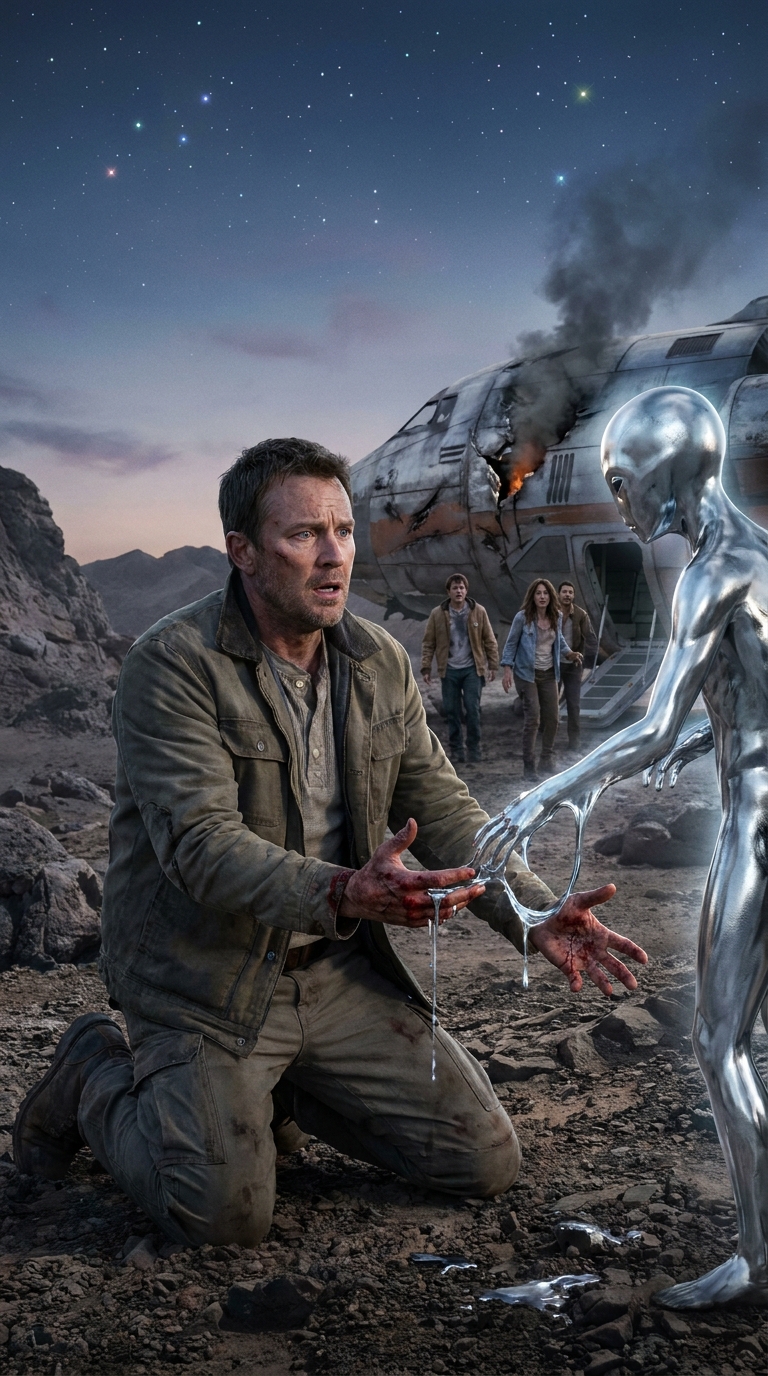
Inside lay the silver-skinned figure, barely moving.
John forced the warped door wider. Heat rolled over his hands. Something inside the craft pulsed with pale light.
“Hey,” John said. “Can you hear me?”
The figure’s eyes opened.
It grabbed his wrists.
Its grip was cold and impossibly strong.
“They have to be stopped,” it said.
The words did not sound like a warning.
They felt like something being placed inside him.
John tried to pull back. “Who? Who has to be stopped?”
The figure did not answer.
It dissolved.
Silver turned liquid, flowed over John’s hands, and vanished into his skin before he could scream.
Behind him, the small craft began to glow.
John stumbled back.
The glow spread across the wreckage, bright and silent. The craft softened at the edges, melting into light. The light crawled over the torn hull of John’s ship, sinking into the metal as if the ship were drinking it.
John ran.
He made it ten steps before the light vanished.
No explosion.
No shockwave.
Just absence.
The craft was gone.
The torn section of hull shimmered once, then went still.
The silence returned.
John stood on an alien planet, hands shaking, passengers staring from the ramp behind him.
His ship gave one low, impossible hum.
And nothing in the universe felt the same again.
After the Silence
The first thing John noticed was the quiet.Not peaceful. Not calm.Just empty.The sky above the crash site was a dull, washed-out blue, streaked with smoke where burning debris had finally given up and fallen. Chunks of metal lay scattered across the rocky plain, some still glowing at the edges. Every few minutes, something hissed or cracked as it c…