

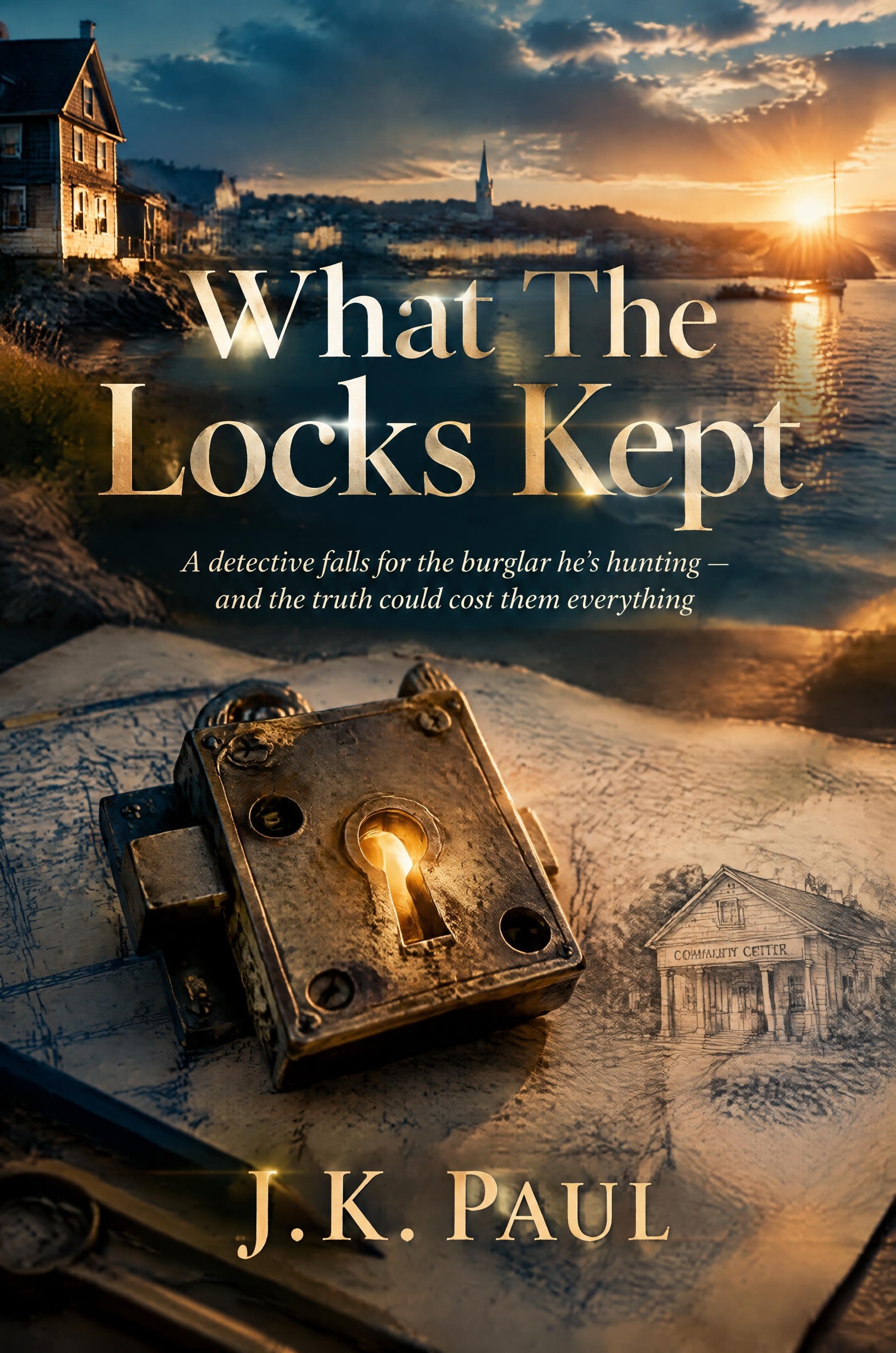
What The Locks Kept
A detective falls for the burglar he's hunting — and the truth could cost them everything
by Paul Kirby
Detective Elias Moreau came to Marlow Bay to rebuild a career, not a life. But someone is targeting the historic homes along the waterfront — not for silver or jewelry, but for papers buried in their walls and closets. The burglar never breaks a lock. They open it, gently, the way a craftsman would. And no one in Marlow Bay understands those old locks better than Noah Vale, the restoration architect the police ask to consult on the case. Eli falls for Noah in the honest way people fall for each other: walking creaking hallways, sharing late-night coffee, talking about old houses as if they have souls. Then Eli finds a sketch at a crime scene, drawn in Noah's unmistakable hand — and pockets it, telling no one. Because Noah is the burglar. He is stealing records that could expose the developer who preyed on vulnerable families and threatens his late mother's community center. But when an elderly man is hurt and Eli's trap closes, love and the law collide. To save what matters most, Eli must ask what justice is worth — and Noah must learn that some doors can't be picked back open. A tender, slow-burn mystery about the difference between keeping someone safe and locking them in.
- Romance
- Mystery
- Crime Fiction
- Slow Burn Romance
- Contemporary Romance
- Detective Story
The First Lock
The rain had stopped by the time Elias Moreau crossed the Marlow Bay city line, but the gray stayed. It hung low over the water and turned the Victorians into silhouettes, their turrets and gables softened by the kind of damp that never quite lifted. He drove with one hand on the wheel and the other resting on the manila folder Maya Okonkwo had couriered to his old precinct three days before. Burglaries. Six of them, all in historic homes undergoing some stage of redevelopment. Nothing taken that made sense.
He turned onto Harbor Street and found his cottage wedged between a boarded-up saltbox and a house painted the color of a faded hydrangea. Small. Whitewashed. A porch that listed slightly to the left. He sat in the car for a minute after cutting the engine, listening to the tick of cooling metal and the distant complaint of gulls. The air smelled like salt and wet wood and something else—fish scales and creosote, the low-water smell of pilings that had been standing in the tide since before anyone alive had a say in it.
His phone buzzed before he got his key in the lock.
"You're here," Maya said. No greeting. No preamble. "Good. Camille Delgado, fourteen twenty-two Pelican. Someone walked through her attic last night and she is not the kind of woman who handles violation quietly."
"I haven't even seen the inside of my house yet."
"Your house will wait. Mrs. Delgado will not."
He left his bags in the car.
The Victorian on Pelican Street was three stories of weathered cedar and intricate gingerbread trim, the kind of house that had been someone's pride a century ago and was now someone else's investment. A sign staked in the front garden read Acquired for Redevelopment — Reeve Properties. The letters had been sprayed with something dark that might have been coffee.
Maya met him at the gate. She was smaller than he had expected, compact and still in a way that felt deliberate, her blazer a deep emerald against the gray afternoon. Her handshake was firm and brief.
"They took a photograph," she said, leading him up the walk. "Her late husband. And a lockbox from the attic. She says it had insurance papers, his military discharge, letters. Nothing a pawn shop would touch."
"The lock?"
"Picked. No scratches on the plate, no tool marks on the doorframe. Whoever did this knew what they were doing and knew exactly what they wanted." She paused at the porch steps. "She's angry, but she's also scared."
Camille Delgado was seventy-four and sat in her parlor like a queen receiving bad news. She had wrapped herself in a cardigan the color of weak tea, and her hands shook slightly around a cup that had gone cold. She looked at Elias the way she might look at a third contractor giving an estimate: skeptical, exhausted, and already deciding whether he was worth the trouble. Her eyes kept drifting past him to the mantel, to the silver frame that stood there empty now, its facing angled toward the room as if it had something left to say, and pressed her lips together as if holding something back.
"You're the new one," she said.
"I am." He sat in the chair across from her without being asked, because she had been holding that cold cup for so long her knuckles had gone white, and there was no one else in the room who was going to sit down first.
"It was in a silver frame on the mantel. My Henry, the year we married. He's wearing his uniform and he looks terrified, though he'd never admit it. I told the other officers already."
"I know. I read their reports." He leaned forward. "What I want to know is why that photograph. You have other pictures of him."
She looked at him for a long moment. Her eyes were pale blue and watery with age, but there was nothing soft in them. "There were four photographs on that mantel. Three of Henry, one of my sister. The thief took the one from our wedding day. The only one with both of us in it."
"And the lockbox?"
"In the attic. I haven't opened it in fifteen years. It had our marriage certificate, his discharge papers, the deed to this house before those vultures started circling." Her voice caught on vultures and she steadied it with a sip of cold tea. "Nothing worth stealing."
Elias watched her hands. The tremor was not just age.
"I know plenty of people who want this house. I know plenty of people who want me gone so they can knock it down and build something with granite countertops." She set the cup down hard. "But I don't know anyone who'd steal my wedding picture to do it."
He believed her. That was the problem. If she had been lying, he would have known what to do next—follow the money, find the motive, build a case that ended with someone in handcuffs. But her eyes kept returning to the empty frame, and when she spoke of the photograph she did not say a picture of Henry. She said the one from our wedding day. The only one with both of us in it. A thief who knew which picture mattered. A thief who knew there was a lockbox in an attic no one had opened in fifteen years, and did not bother with the silver downstairs, the jewelry in the bedroom, the trunk with brass fittings that a fence would have paid for. He watched her wrap both hands around the cold cup again, watched the tremor that had nothing to do with age, and knew her fear was not the shapeless dread of a woman who had been violated. It was narrower than that. Aimed. She was not afraid of what had been taken from her. She was afraid of what it was going to be used for.
Maya walked him through the house afterward. The attic access was in the upstairs hallway, a pull-down ladder that groaned under his weight. The space above was cramped and smelled of cedar and old paper. A single bare bulb lit a circle of floorboards, and in the center of that circle was a clean rectangle of dust where the lockbox had sat for years. Nothing else had been disturbed. Boxes of Christmas ornaments. A dress form draped in yellowed sheets. A trunk with brass fittings that had not been opened in decades.
"Surgical," he said, more to himself than to Maya.
"That's the word I used in my notes." She stood at the base of the ladder, arms crossed. "Six houses in eight weeks. All historic. All in some stage of redevelopment. All owned by people who've been fighting Reeve Properties. And in every single one, the thief took documents. Personal papers. Things that don't have market value but might have leverage."
He descended and wiped his hands on his trousers. "You think someone's building a case against the developer."
"I think someone already has a case and just needs the evidence to prove it." She met his eyes. "And I think whoever it is knows these houses better than the people living in them."
Outside, a news van had appeared at the curb. A reporter with hair that was too blonde for the weather was setting up a shot with the Victorian behind her. Elias gave them his back and a statement that said nothing, the kind of words that filled air without giving anyone anything to quote. The reporter seemed disappointed. He did not care.
By the time he got back to the cottage, the gray had deepened into a dusk that felt earlier than it should. He carried his bags inside and stood in the empty living room, listening to the silence. The cottage made its indifference known before he'd set down both bags—the couch slumping toward its center as if it had given up on company years ago, the kitchen table rocking on three legs every time someone passed it, the sheets on the bed still holding the detergent of whoever had slept there last, their ghost warmed into the cotton. He set his suitcase on the floor and unpacked the boxes he had shipped ahead.
In the third box, wrapped in a sweater he had not worn in two years, was a photograph. His family, taken at a reunion the summer before everything fell apart. His mother smiling. His father with his arm around her. His brother, standing slightly apart, already holding the words he would use six months later to tell Elias not to come home.
He looked at it for a long time. His brother’s hand rested on their mother’s shoulder in the frame, the gesture easy and unguarded, the way you touched someone you had not yet learned to leave.
He put it in the nightstand drawer and closed it. The drawer stuck, swollen with coastal damp, and took two tries to shut. He did not open it again.
Somewhere out in the bay, a foghorn sounded once, and then the quiet came back, and Elias stood alone in the dark cottage and tried to remember what it felt like to be somewhere that wanted him.
The Community Meeting
Three days later, the basement of St. Anne's Church smelled of old coffee and wet wool. Someone had set up folding chairs in uneven rows, the kind with metal legs that scraped against the linoleum whenever anyone shifted weight, and by the time Elias arrived with Maya the room was already full. Residents crowded the walls between posters for last s…