

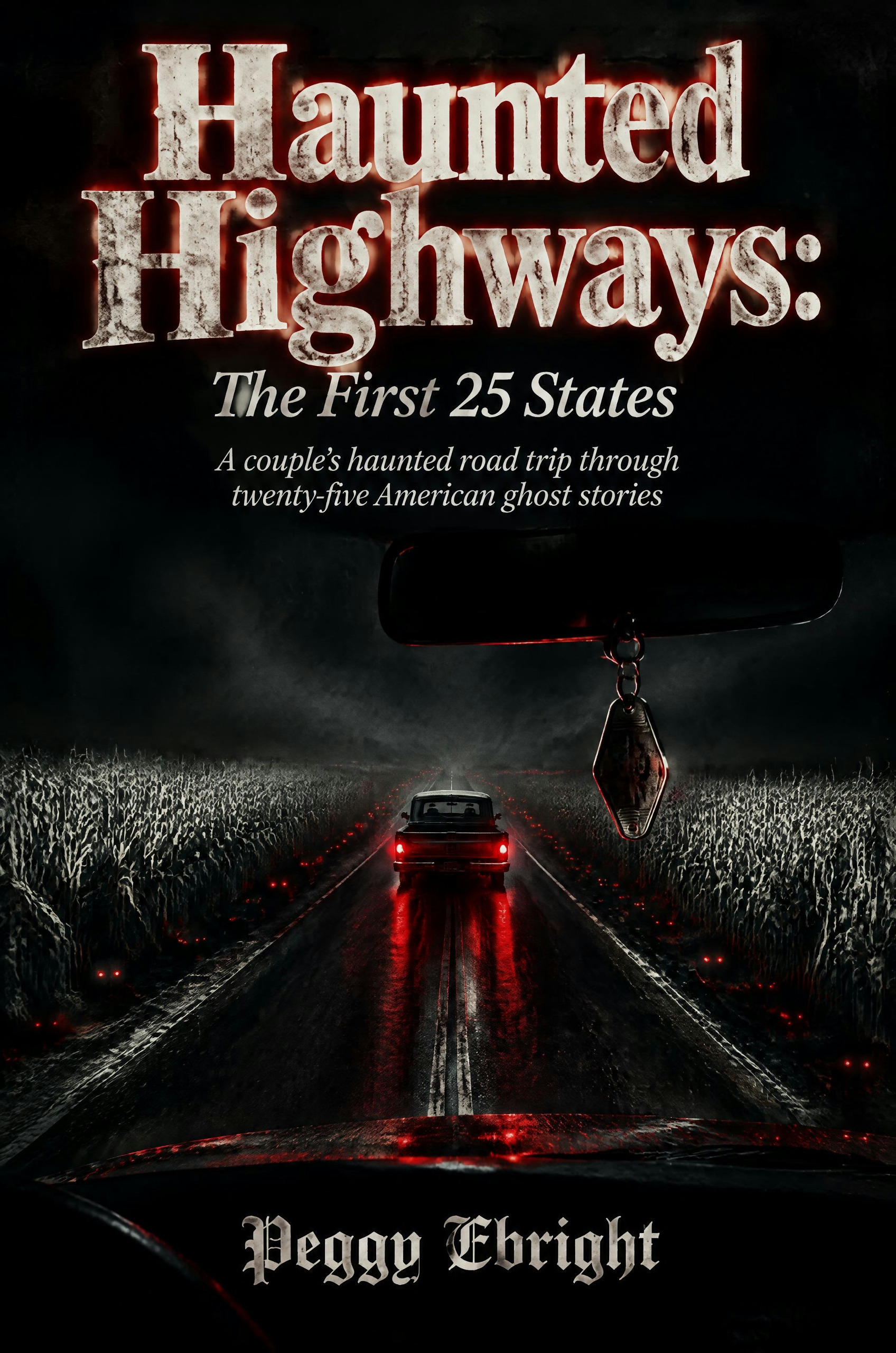
Haunted Highways: The First 25 States
A couple’s haunted road trip through twenty-five American ghost stories
by Peggy Ebright
Marcus and Elena load a vintage truck and leave ordinary life behind. Their bucket list is not beaches or national parks. It is America’s most infamous haunted houses, battlefields, sanatoriums, and roadside legends—starting in the farmlands of Indiana and rolling through twenty-five states of local folklore and night-road dread. Each stop is a test. They document crumbling homesteads, abandoned wards, and stories of real historical violence that refuse to stay in the past. Equipment catches what skepticism cannot explain. Arguments over the map turn into arguments over what is real. In Ohio, recordings seem to know their private history. In West Virginia, something leaves a mark that will not fade. Haunted Highways: The First 25 States is both a dark travelogue and a couple’s survival story: a practical-feeling route through famous hauntings, and an intimate account of two people whose relationship is strained by every locked door they open. Use it as a guide to retrace the journey—or as a warning about what follows you home from the dark highways.
- Non-Fiction
- Horror
- Adventure
- Paranormal
- Memoir
- Ghost Story
Crossroads in the Heartland
You told me that you were different. You told me that you were not like the rest of the guys who tried to boss me around, and like an absolute fool, I believed you. I packed three duffel bags, shoved my field notebooks under the passenger seat of your beaten-up Chevy, and thought we were going to chase real history across America. But here we were, barely an hour outside of Indianapolis, and you were already checking your watch every thirty seconds like a drill sergeant running a supply convoy. The dusk was turning into a muddy, bruised purple over the cornfields of Hendricks County, and your knuckles were bone-white against the worn leather of the steering wheel.
"We are twelve minutes behind schedule, Elena," you said, not even turning your head to look at me. "The GPS said we should have crossed County Road 625 four miles back. If we lose the daylight, setting up the microphones is going to be a mess."
"Then let it be a mess," I told you. I leaned my head against the cool passenger window, watching the dead stalks of late-autumn corn blur past. "The bridge has been standing there for over a century, Marcus. It survived trains, suicides, and drunk teenagers. It isn't going to pack up its bags and leave just because you had to stop for beef jerky."
"It is about discipline," you snapped back, clicking your turn signal with an aggressive snap of your finger. "If we are going to document twenty-five states in one raw travelogue, we cannot treat it like a damn Sunday stroll. I need structure. We need to stay on track."
"You do not need structure. You need total control," I said, rolling my eyes at the dark dashboard. "You are an egotistic control freak who thinks the universe runs on your personal stopwatch. Hate to break it to you, but you fail the test if you think you can manage the dead on an hourly spreadsheet."
You huffed, jaw tight, but you did not answer. That was your usual routine: clam up, pout, and stew in your own self-importance. You turned the truck down Old State Road 36, following the narrow gravel access that led into Haunted Bridge Park. The trees grew thick, tangled, and low, their branches scraping the rusty cab of the pickup like long wooden claws. The headlights bounced across puddles of murky rainwater. Down below the grade, half-swallowed by shadow and the wet earth of the creek bed, the massive concrete arches of the Avon bridge rose into the night sky.
When you cut the engine, the sudden quiet was heavy enough to press down on my eardrums. A thick, crawling fog rolled off the creek, weaving through the brush like steam off a hot boiler. We climbed out into the chill. The air carried the stink of rotting weeds, damp soil, and old lime.
"Grab the Pelican case with the omnidirectional mics," you ordered, popping the tailgate. You were already slinging your camera strap over your shoulder, determined to play the fearless expedition leader. "Let us get down to the base before the mist gets any thicker."
"I know what to grab," I muttered, hauling the heavy black plastic box out myself. "And do not act like you know the route better than I do. I spent three weeks reading town archives while you were busy color-coding the highway map."
We scrambled down the slick bank, our boots sliding through wet clay. The bridge loomed above us, towering forty feet over the ravine. It was a monstrous piece of engineering, built out of poured concrete and heavy timber trestles to carry the rail line over the water. Moisture wept from every seam in the stone, dripping into the stagnant creek with steady, hollow plinks.
I set the hard case on a flat limestone slab near the main abutment and unlatched the hinges. You pulled out the digital audio recorder, clicked on the little red monitor light, and shone your flashlight up the concrete pillar.
"So what is the actual record here?" you asked, trying to sound casual and patronizing, like a professor humoring an eager student. "Just local kids scaring each other on Halloween?"
"Try actual blood and bone," I said, pointing the beam of my penlight toward the central arch. "Nineteen fifty-seven was when the big tales took off, but the real trauma started when they poured the original foundation. A construction worker fell right into the wooden frame when the wet cement was being pumped. They could not shut down the pour. The company was behind schedule and losing money, so they left him in the mix. He suffocated under hundreds of tons of liquid concrete, thrashing while it hardened around his legs and chest. His crew had to stand there and watch him disappear into the wall."
You gave a dry, dismissive snort, though you glanced uneasily at the gray stone right behind your elbow. "Urban legends love a construction accident. Concrete cures too slowly to trap an adult who actually wants to climb out. It is physics, Elena."
"Tell that to the county coroner reports from the early rail booms," I countered, pulling out the stereo microphone leads. "And that was not the only death. A young mother, barely twenty, was walking the tracks late at night in the winter of nineteen ten. Her baby was sick, burning up with fever, and she was desperate to reach the doctor in Plainfield. She got her coat caught on the cross-ties right in the middle of the trestle. When the midnight freight engine came through the cut, the engineer blew the whistle, but she could not pull free. Rather than watch the locomotive crush them both on the ties, she threw her infant into the ravine and jumped straight after him. They found her body broken open on the rocks below, skull split, with the dead child cradled against her shattered ribs."
You shook your head, waving your hand to brush it away. "Folklore. Distressed mothers and buried workers. People tell these ghost stories because flat corn country gets too boring to bear."
"Keep complaining about everything, you ungrateful prick," I said, snapping the microphone into its mount. "You wanted to find genuine terror. You wanted to make a raw document of real pain. Well, here it is. This dirt is soaked in it."
You opened your mouth to fire back another petty insult, but the sound never left your throat.
A piercing wail tore through the trees directly above our heads. It did not sound like an owl, and it did not sound like wind scraping through branches. It was the raw, shredded scream of a human voice, sharp with agony, tearing through the cold fog until the hairs on the back of my neck stood up stiff. The cry echoed off the underbelly of the arch, bouncing back and forth across the water until it died down into a wet, choking gasp.
You froze in place. The flashlight beam in your hand shuddered against the mud.
"What was that?" you whispered. Your cocky swagger vanished in a second.
"Probably just shifting wood, right?" I whispered back, my voice trembling despite my best efforts to keep it steady. "Just physics, Marcus."
Above us, on the overhead deck where the iron rails rested, heavy thuds rang out. Thump. Thump. Thump. The rhythmic, dragging cadence of heavy boots paced along the wooden cross-ties. The timber creaked. The bridge vibrated under the weight, sending flecks of dried moss and old gravel drifting down into our hair. Nobody was up there. We had walked the access lane ourselves; there was no maintenance crew, no night train, no living soul for miles around this dark ditch.
"Let us check the display," you muttered, your breath coming fast and shallow as you fumbled with the digital recorder. "Maybe we caught an audio spike."
You jabbed your thumb against the power switch, but the small screen did not glow green. The LCD screen flickered once, showing a dying battery icon, and died completely. You hit the button again, your face pale in the penlight beam.
"The battery is completely dead," you stammered. "I charged these lithium packs in the motel room for four hours. It was at full bars ten minutes ago."
A blast of air rolled down through the ravine, so bitterly cold it burned my lungs. In less than three seconds, our breath was puffing out in thick, white clouds. The moisture on the steel brackets of our tripod formed a thin crust of frost before my eyes. The cold bit straight through my denim jacket, digging into the bone.
"Marcus," I said, my voice dropping low.
"We need to swap the batteries," you muttered, digging frantically into your canvas pocket, your fingers stiff and clumsy. "I brought spares. We have to document this, Elena, we cannot miss the recording."
"Marcus. Look at the pillar."
You stopped moving. I took two slow steps toward the concrete abutment, aiming my penlight at the spot you had leaned against only moments before. Five feet off the ground, where the concrete was supposed to be dry, mottled gray, smeared marks were running downward.
They were handprints. Broad, rough palms, with thick fingers dragged through the surface, clawing frantically toward the ground. And the fluid was not muddy creek water. It was dark, rich, and crimson. Thick trails of fresh blood were oozing down the porous stone, pooling along the edge of the footing.
I reached out with a trembling hand, my fingertip barely grazing the edge of the deepest smear. It was not cold like the freezing air around us. It was slick, sticky, and sickeningly warm.
"Oh god," you breathed out, stepping back until your boot caught on a slick root, nearly sending you into the creek. "That is not... that is impossible."
Above us, another wail ripped through the dark, louder this time, accompanied by the frantic, thrashing sound of boots pounding the rails right over our heads. The vibrations shook the bridge, and the bloody handprints slid faster down the wall, multiplying before our eyes as unseen fingers dragged across the stone.
"Back to the truck!" I screamed, grabbing the Pelican case by its handle.
We did not bother packing the tripod. We scrambled up the muddy embankment on our hands and knees, our boots slipping in the clay, tearing our fingers against briars and rotten roots. Every shadow in the park leaned toward us, suffocating and cold. We reached the pickup, slammed the doors, and you turned the ignition key until the starter roared to life. You threw the transmission into reverse, tires spinning in the gravel, tearing out of Haunted Bridge Park as if the devil himself was hanging off the tailgate.
We hit the asphalt of the main road, the headlights slicing through the dark Indiana fog, both of us panting, shaking, and staring ahead. On the dashboard between us, the little recorder clicked back on by itself, its digital screen glowing a harsh, steady blue.
The Cellblocks of Mansfield
The state line swept past under the tires, but Marcus was still holding onto the receipts like they were government bonds. We had barely cleared the toll plaza into Ohio, and he was already tapping the dashboard, running through the gas mileage and complaining about the five dollars I spent on black coffee at the rest stop. He had told me that he w…