
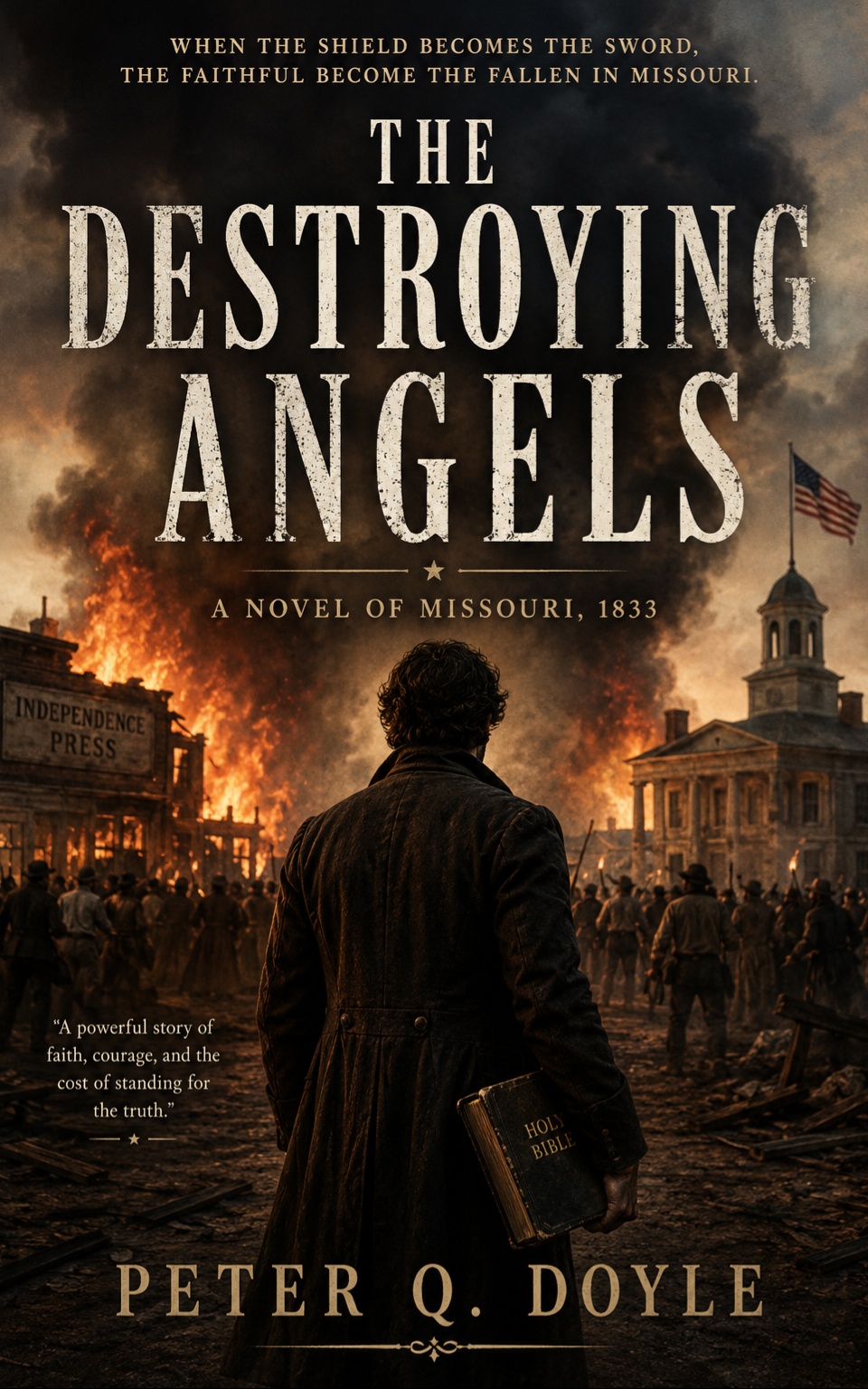
The Destroying Angels
When the shield becomes the sword, the faithful become the fallen in Missouri.
by Peter Q. Doyle
Missouri, 1833. Jacob Allred is a man who knows the cost of war. After his community is driven from their homes by a lawless mob, Jacob is done turning the other cheek. He seeks only to protect his family and the land they were promised. Enter Sampson Avard, a charismatic physician with a vision for a secret defense society. At first, it feels like salvation—a brotherhood bound by oath to ensure no settler is ever hunted again. But as the 'Destroying Angels' grow in power, the line between protection and persecution begins to blur. Jacob, disciplined and loyal, finds himself trapped within a structure that is slowly turning its blades inward. While Jacob is blinded by duty, Rebecca sees the rot from the outside. She witnesses the hushed threats and the chilling transformation of a righteous impulse into a weapon of tyranny. As the state of Missouri descends into open conflict, Jacob and Rebecca must forge a dangerous alliance to expose the man who has hijacked their faith for his own ambition. In this high-stakes historical thriller, the most dangerous enemy isn't the mob at the gate—it's the brother standing beside you. Based on the true events of the Missouri Mormon War, Peter Q. Doyle delivers a blistering tale of power, betrayal, and the enduring spark of conscience.
- Thriller
- Historical Fiction
- Wild West
- Revenge Thriller
What the Square Remembers
Independence, Jackson County, Missouri — July 1833
The mob had already broken the press by the time Jacob Allred reached the square, and the sound he'd mistaken from two streets over for a barn raising turned out to be men tearing the print shop apart board by board and throwing the pieces into a pile that was already smoking.
He stopped running. Running toward a mob got you noticed, and being noticed in Independence today was a way to die.
"Jacob." Someone had his arm — Nathan Pratt, sweat cutting clean lines through the dust on his face. "Don't. There's nothing you can do for the Bishop now."
"Where is he?"
Nathan didn't answer. He didn't have to. The crowd around the square had a shape to it, the way water finds a shape around a stone, and the shape was pointing at something happening near the old hide-tanning yard, and the sound coming from that direction was not a sound Jacob had ever heard a crowd of Christian men make before.
He went anyway. Nathan's grip slid off his arm like it had never been there.
The tanning yard smelled the way it always did — lime and rot and old blood worked into the ground so deep no rain would ever wash it out — and under that now, something worse. Tar, heating in an iron kettle over a fire someone had built too fast and too hot, the black surface of it already starting to smoke at the edges. A dozen men stood in a rough circle. More were arriving every second.
Jacob had spent fourteen months the year before chasing Black Hawk's people across the Illinois and Wisconsin country under an officer who cared more about discipline than glory, and if that year had taught him anything worth keeping it was this: a mob is not an army. A mob has no flank discipline, no rear guard, no one watching the man beside him. A mob is a dozen individual angry men who have temporarily forgotten they are individuals, and the moment you remind one of them of his own separate, breakable body, the whole shape of the thing changes.
He didn't push into the circle. He came in low and fast along its outer edge, the way he'd been taught to come at a picket line — not where they were looking, but where they weren't — and the first man he hit never saw him coming. Jacob's forearm caught him under the jaw and dropped him where he stood, and Jacob had the man's own club out of his slack hand before the body finished falling.
"Christ, it's one of them," someone shouted, and that was true and it bought Jacob nothing, but the surprise of it bought him two more seconds, and two seconds was enough to put himself between the kettle and the bishop's kneeling body.
The second man came at him swinging wide and wild, the kind of blow that would have taken a man's head off if it landed and would put its owner on the ground if it didn't, and it didn't — Jacob stepped inside the arc of it, drove the borrowed club up under the man's ribs, and felt him fold around it with a sound like a bellows losing its air.
Two down. The rest of the circle was turning now, the ordinary business of tar-and-feathering forgotten in favor of the more interesting business of a man fighting back, and Jacob understood with the flat clarity of a soldier doing arithmetic that this was the part of the engagement where the numbers stopped being on his side. Two men, maybe three, he could manage. He counted eight closing on him and more behind them.
He got a third good hit in — an elbow that opened someone's cheek to the bone — before the first blow landed on him that he actually felt, a fist into his kidney that folded him half over, and after that the fight stopped being a fight in any sense a soldier would recognize and became simply a thing that was being done to him. Boots. A length of something hard across his shoulders. He went down covering the back of his skull with both forearms because that, at least, his body still remembered how to do without being told.
He heard Nathan shouting his name from somewhere outside the circle that had closed around him now, tighter than the one around the bishop, and underneath the chaos of it he made out one clear thought with the strange calm that sometimes arrives inside the worst moment of a person's life: three men. I put down three men and it bought him nothing. There were always going to be more of them than there were of me. There are always going to be more of them.
Someone hauled him up by the back of his shirt. He got one boot under himself before his legs gave out and he was moving anyway, dragged, his feet finding the ground in broken rhythm, and the tanning yard tipped sideways and became sky and then dirt and then sky again.
The last thing he saw clearly before the world narrowed down to the singular business of breathing through what he was fairly sure were two or three broken ribs was the bishop, still on his knees, tar running down his bare back in slow black rivers that steamed faintly in the July heat, his eyes closed now, his lips moving. Not screaming. Not begging.
Praying. For the men who were doing this to him. For the men Jacob had just put on the ground, too, probably — the bishop's God did not seem to Jacob like the kind who kept score by whose side a man had swung his fists for.
Jacob didn't have a prayer like that in him. He never had, not really, not the kind that could survive contact with an enemy the way Nathan's could, the way the bishop's could. What he had instead, lying in the dirt with his ribs grinding when he breathed, was a soldier's plain understanding of the shape of the problem: three men down had not been enough. Three men down had not even slowed them. And a religion built entirely on turning the other cheek was going to keep losing to men willing to swing at it until somebody built something else standing next to the cheek-turning — not instead of it, he told himself, even then, even half-conscious in the dirt, not instead of it — something built to make the arithmetic come out different next time.
"We have to go," Nathan said, close to his ear, urgent, already pulling. "Jacob. We have to go now."
Jacob let himself be pulled. Behind them, the mob's noise was already changing shape — not finished, just moving on to whatever came next, the particular hunger of a crowd that has tasted something and wants more of it, three of its own bleeding in the dirt not enough to cool it.
He looked back once.
The bishop was still praying.
Jacob was already doing arithmetic.
The Price of Broken Ribs
Sarah's hands did not shake, though her voice did, and Jacob understood without being told that she had already decided which one she was going to let him see. "Hold still," she said, for the third time, winding a strip of torn bedsheet under his arm and around his ribs, pulling it snug enough that he sucked air through his teeth. "If I don't bind…