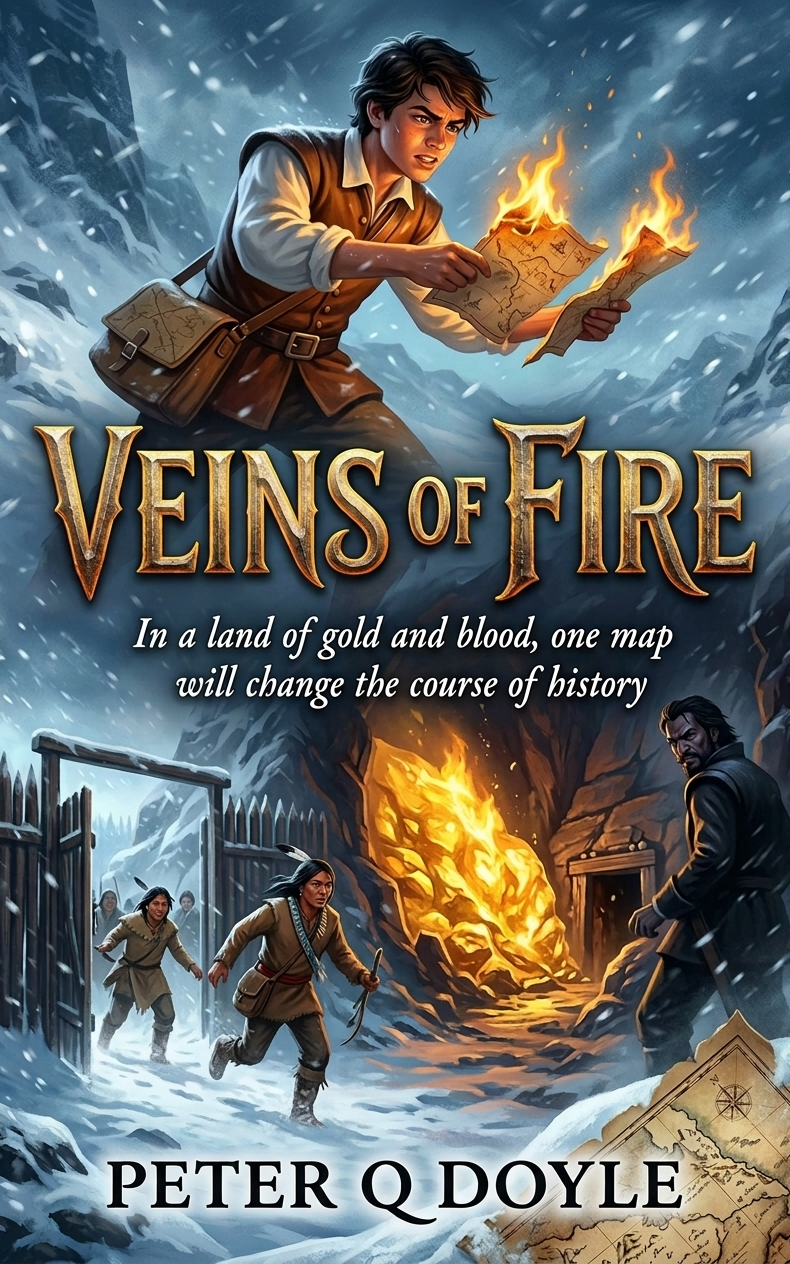
Veins of Fire
In a land of gold and blood, one map will change the course of history
by Peter Q. Doyle
1698, Santa Fe. The Spanish Crown hungers for wealth, and seventeen-year-old Mateo Valerio is the only one who can map the way. When he joins a secret expedition into the treacherous Uinta Mountains, he seeks only to follow in his father’s footsteps. But the wilderness is a cruel teacher. After his father perishes on the trail, Mateo discovers the 'Vein of Fire'—a legendary gold deposit that promises infinite power. But the discovery comes at a devastating price. Under the command of the ruthless Captain Salazar, the expedition turns into a campaign of brutal enslavement against the local Ute people. Caught between his duty to the Empire and his conscience, Mateo strikes up a forbidden alliance with a Ute youth named Taka. As greed consumes Salazar, Mateo realizes that some secrets are too dangerous to be mapped. To save an innocent people and preserve the sanctity of the land, he must become a saboteur, burning his official charts and leading a desperate escape through a lethal blizzard. Returning to Santa Fe as a fugitive, Mateo must play a high-stakes game of colonial politics to ensure the mine stays buried forever. In a world of steel and fire, can one young man protect the future by erasing the past?
- Historical Fiction
- Adventure
- Western
- Mystery
- Action Adventure
- Gold Rush
The Governor's Command
The nugget sat on the Governor's table like an accusation.
It was smaller than Mateo had imagined — smaller than the stories men told in the cantinas along the Camino Real, smaller than the weight of what it represented. The size of a man's thumbnail, maybe less. But the color was wrong for ordinary gold, too amber, too warm, as though it held light from a fire that had burned somewhere deep in the earth and not yet gone cold. Governor Diego de Vargas set it on the cedar table between three candles and folded his thick hands behind his back, and the three men in the room watched the light play across its surface without speaking.
Mateo stood near the wall. He was not supposed to be in this room. His father had not told him to wait outside, and so he had followed Alejandro through the Governor's Palace with the specific silence of a boy who understands that his presence will only be questioned if he draws attention to it. No one had looked at him twice. He was seventeen, narrow-shouldered, with ink on his left hand and a surveyor's leather case tucked under his arm, and in the Governor's anteroom he looked like furniture.
"A Ute trader brought it into Taos three weeks ago," De Vargas said. "He would not say where it came from. But our men know the Uinta country, and there is only one place the stone runs that color."
Alejandro Valerio stood with his arms at his sides. He was a tall man made taller by the way he held himself, and his scarred hands were still. He studied the nugget the way he studied every formation in the field — without hunger, without hurry, reading it the way a priest reads a verse he has translated before and does not entirely trust.
"The Uintas are not mapped," Alejandro said.
"No," the Governor agreed. "They are not."
Captain Rodrigo Salazar stood to the Governor's left. He wore a steel cuirass over a coat of dark leather, and he had said nothing since the three of them entered the room. He was watching the gold with a stillness that Mateo found more uncomfortable than greed would have been. Greed moved. It shifted in the eyes and set the jaw. What Salazar wore was different — a flat, patient attention, the look of a man who has waited a long time for something he was certain was coming.
"The terrain is severe," Alejandro said. "There are no trails north of Taos that I would call reliable. The passes flood in spring. The Ute know this country and we do not, and they are not disposed to teach us."
"I am aware of the difficulties," De Vargas said, and his voice carried the weight of a man who governed a province that had nearly consumed him. "I am also aware of the Crown's treasury. New Mexico costs more than it yields, Alejandro. That will not change without this." He touched the nugget with one finger, briefly, and pulled the finger back. "A secret expedition. Thirty men, perhaps thirty-five. The commission goes under the guise of a missionary resupply to the northern pueblos. Father de Mendoza will accompany you as chaplain. Captain Salazar commands the military escort."
Alejandro looked at Salazar. Salazar looked back without expression.
"A tenth share," Alejandro said. "And land grants for my family, registered in Santa Fe. Not promises — deeds."
De Vargas was quiet for a moment. Then he nodded, once, the way men nod when they have already calculated the concession and found it acceptable. "Agreed."
They found Mateo in the anteroom, waiting on the bench where the servants sat. Alejandro stopped when he saw him and his expression did not change, which was itself a kind of answer to a question Mateo had not yet asked aloud.
"You heard," Alejandro said.
"Some of it."
His father looked at him for a long moment — at the surveyor's case, at the ink on his hand, at whatever he found in Mateo's face that he was reading as carefully as he read stone. Then he walked past him toward the courtyard, and Mateo followed.
Outside, the morning air carried dust and the smell of the forge from the armory two streets over. The plaza was beginning to fill — women with water jars, a cart loaded with dried corn, two soldiers eating from a cloth laid across a wall. Alejandro walked until they were clear of the palace gate, and then he stopped.
"I want to come," Mateo said.
"I know what you want."
"I can draw maps. I can read the instruments. You need someone who can survey the terrain accurately, and there is no one in that company who has done it — not in country that far north." He paused. "You know I'm right."
Alejandro studied the mountains to the north, the Sangre de Cristos going blue in the morning light. When he spoke, his voice was level and without sentiment, which was how he spoke when he was serious.
"There are no trails where we are going," he said. "No church bells. No surgeons. No road back that a man can count on." He looked at Mateo then, and whatever was in his eyes was not quite fear — his father was not a man who feared easily — but something adjacent to it, something older. "You understand that."
"Yes," Mateo said.
A long silence. The forge rang twice, distant and metallic.
"You are part of my crew," Alejandro said. "You take orders. You draw what I tell you to draw and you say nothing about what you see to Salazar without my leave. Nothing." He turned and walked toward the Valerio adobe without looking back. "We pack tonight."
The packing took three days. Black powder in waxed leather bags. Iron picks and short-handled adzes. Rope, enough to drop a man fifty feet into a shaft and haul him back. Mateo wrapped his instruments in oiled cloth and packed them into the surveyor's case with the care of a man handling breakable things, which they were. He packed his grandfather's journal without reading it. He had been told it contained field notes from the Cerrillos surveys, and he had no reason yet to think otherwise.
They left Santa Fe before dawn on the third week of April, thirty-four men and eighteen mules, the animals loaded so heavily that their hooves struck the Camino Real in a slow, deliberate rhythm that Mateo felt in his chest before he heard it. The city was dark behind them. A dog barked once from somewhere near the mission wall and then went silent.
Mateo rode a roan mare with a white blaze and a temperament that bordered on contempt. He pulled his coat tighter against the cold and watched the column take shape in the grey pre-dawn — the soldiers in front with Salazar at their head, his black gelding moving with the quiet authority of its rider; behind them the miners and laborers; and at the rear Father Tomás de Mendoza on a grey mule, his cassock wrapped around him against the cold, his lips moving in what Mateo recognized as the office of morning prayer.
His father rode beside him and said nothing, which was how Alejandro rode when he was reading the land.
They passed through Española by midmorning, the cottonwoods along the river gone pale gold with new leaf. They pushed north through the afternoon, the Rio Grande cutting its dark channel to their left, the mesas rising in red and ochre bands on either side. Mateo drew as they rode, sketching the skyline in the small field book he kept in his coat — not true survey work, not yet, but the habit of a man who cannot see a ridge without wanting to record where it falls.
They rested at Taos Pueblo for two nights. The people there watched the column from their doorways with faces that gave nothing away, and the soldiers did not meet their eyes. Father Tomás spent both evenings in conversation with an old man near the kiva, speaking in a Spanish so careful and slow it sounded like something being carried with great attention across a distance. Mateo listened from twenty feet away and could not make out the words.
North of Taos, the road ended. It did not end dramatically — there was no gate, no marker, no last carved stone. It simply thinned and then ceased, the wheel ruts softening into deer tracks, the deer tracks dissolving into grass, the grass giving way to juniper and piñon pine that closed around the column like water closing over a thrown stone. The mountains ahead were white along the crown. The sky above them was the hard, particular blue of high altitude, a blue with no softness in it.
Salazar rode to the head of the column and stopped, and the column stopped behind him. He looked north for a moment without expression. Then he turned his horse and rode back down the line without speaking, and the column began to move again, and the known world fell away behind them.
The Trail North
Alejandro called what he did reading the bones of the earth, and he taught it the way he taught everything — without ceremony, without announcement, simply by doing it in front of his son until the lesson became visible. On the third day north of Taos, he dismounted on a limestone shelf and crouched with his scarred hands flat against the rock. Ma…