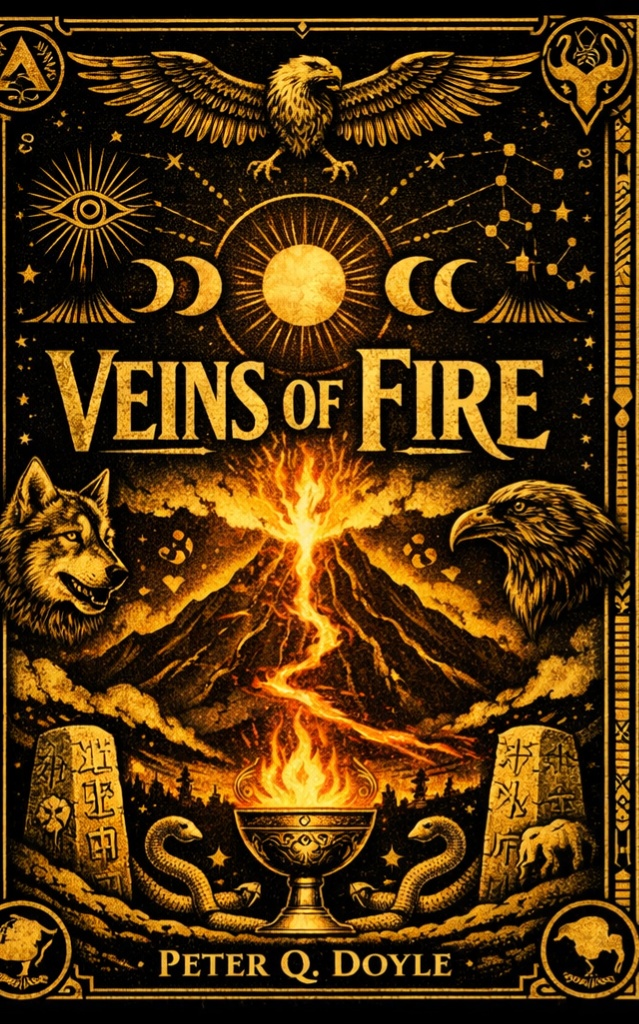
VEINS OF FIRE
A haunting epic of colonial greed, sacred lands, and the map that could destroy them all
by Peter Q. Doyle
In the untamed wilderness of 1698, the Spanish Crown hunts for a myth. Young Mateo Valerio, a cartographer’s son, joins a secret expedition into the treacherous Uinta Mountains, led by men whose hunger for gold outweighs their humanity. As the expedition pushes deeper into uncharted territory, Mateo witnesses the brutal cost of empire. When his father dies leaving behind a warning and a secret, Mateo finds himself caught between the ruthless Captain Salazar and the indigenous people who have guarded the mountain's secrets for generations. What begins as a quest for wealth transforms into a desperate struggle for survival and moral clarity. From the forced labor of the mines to a daring escape through a lethal winter storm, Mateo must decide if he will be the hand that maps the destruction of a people or the one who erases the path to the 'Vein of Fire' forever. Spanning generations from the Spanish frontier to the rise of the Mormon trail, Peter Q Doyle delivers a sweeping historical masterpiece about the weight of gold, the power of silence, and a land that refuses to be tamed. Some treasures are better left in the dark, and some maps are meant to be burned.
- Historical Fiction
- Western
- Literary Fiction
- Adventure
- Spanish colonial frontier nove
- literary western historical novel
The Governor's Command
The nugget sat in the center of the Governor's table like something that did not belong there.
It was smaller than Mateo had imagined gold to be. The size of a thumb joint, rough at the edges, with a dull orange cast that deepened toward yellow where the light from the window struck it clean. He could see it through the gap in the heavy door his father had not fully closed, and he understood, without being told, that this object was the reason they had been summoned.
Governor De Vargas stood at the head of the table with the particular stillness of a man who had learned to let others speak first. He was thick through the chest, and his beard had gone mostly white, and his eyes moved across the room the way a surveyor's eyes move across terrain. Captain Salazar sat to his right, spine straight against the chair back, hands resting flat on the table. He had not touched the nugget. He had looked at it once when Mateo's father entered, and then he had looked away.
Alejandro Valerio crossed the room and sat where the Governor indicated. He did not reach for the nugget either, but his eyes settled on it and stayed there.
"A trader brought it down from the north," De Vargas said. "Tierra de los Yutas. He could not say precisely where, and he could not be made to remember more precisely than that." He paused. "I believe the vagueness was intentional."
Alejandro said nothing.
"What I need," De Vargas continued, "is a man who can read what a mountain is made of. Not a soldier. Not a priest." He glanced at Salazar briefly. "Not only a soldier. A miner."
"The Ute mountains are not mapped," Alejandro said.
"I am aware."
"The country past Taos is rough territory. Canyons, fast water, altitude. Men have gone in and not come out."
"Men have also gone in and come out with their pockets full," De Vargas said. "I am asking you to be among the latter."
Alejandro's hands were folded on the table. The knuckles were large, scarred across the tops from years of stone, and they did not move. "What are the terms?" he asked.
De Vargas reached into the breast of his doublet and produced a folded paper. "A tenth share of whatever is extracted, paid against the Crown's portion. And a land grant. Three hundred varas, south of the river, once the mission is documented and complete."
Alejandro studied the paper. He did not read it quickly. Outside, the plaza was loud with ordinary noon — a dog barking, the sound of a cart, children. Mateo pressed his shoulder gently against the door frame and kept still.
"The mission will be documented as a supply run," Salazar said. It was the first time he had spoken, and his voice was exactly what his face suggested: controlled, unhurried, without warmth. "Provisions for the northern missions. Father Tomás de Mendoza will accompany us as chaplain and as cover."
Alejandro looked at the Captain. "And if we find what you're looking for?"
"Then we extract it."
"And the Ute?"
Salazar's expression did not change. "The Ute are a concern I am equipped to manage."
A long silence passed between the three men. Alejandro set the paper down and touched the edge of the nugget with one finger, turning it slightly, reading the surface the way he read everything — with patience, with a kind of professional reverence. Then he drew his hand back.
"I'll go," he said.
Mateo was already moving away from the door by the time his father rose from the chair.
He waited in the plaza, in the shade of the portal, until his father came out into the white afternoon light. Alejandro walked the way he always walked — with that particular economy of movement, nothing wasted, as though the ground itself were something to be conserved. He stopped when he saw his son and studied him for a moment with the same expression he used when he was reading stone.
"You were listening," he said. It was not a question.
"I want to come," Mateo said.
"No."
"I can draw maps. You'll need maps."
"I'll need someone who does exactly what he's told, exactly when he's told, and doesn't ask questions that will get him killed." Alejandro looked past him at the mountains that rose beyond the town, blue and distant in the afternoon haze. "That isn't you."
"I can learn to be."
His father was quiet for a time. A pair of soldiers crossed the plaza below them, boots raising small puffs of dust with each step. The air smelled of pine resin and dry earth and the faint sulfur of the blacksmith's forge two streets over.
"You follow every command," Alejandro said at last. "Mine first. The Captain's second. You don't speak to the soldiers unless spoken to. You don't wander." He looked at his son directly. "And if I tell you to stop, you stop. If I tell you to come back, you come back. Without argument."
"Yes," Mateo said.
"I mean it."
"I know you mean it."
Alejandro put his hand briefly on the back of his son's neck, the way he had done since Mateo was small, and then let it drop. "We leave before dawn," he said. "Pack light. We'll carry what we can't replace."
They spent the remainder of that day and most of the next loading the pack mules. Heavy iron tools went into canvas sacks — picks and chisels, a hand drill, three hammers of different weights. Black powder, measured and wrapped in oilcloth. Rope, tallow candles, a small balance scale. Food for thirty days, calculated against thirty-four men. Mateo was given the task of waterproofing the map cases, and he worked at it until his fingers were stiff with the lanolin paste and the cases were sealed tight enough to hold against rain.
Father Tomás de Mendoza arrived at the staging area in the early afternoon, carrying a single leather satchel and wearing sandals that had been resoled more than once. He was old and thin, with white hair ringing a brown pate that the sun had worked over for decades. He greeted the men with mild, courteous words and found a place near the mules without being asked and made himself useful tying off a loose pack strap. He did not seem troubled by the nature of the journey. He seemed, if anything, quietly glad to be going somewhere.
Salazar arrived at dusk and walked the line of equipment without speaking. He paused once at the powder sacks, pressed one with his thumb to test the wrapping, and moved on. His black gelding was stabled nearby, and one of the soldiers had already brushed it down. The Captain gave no particular instructions. He did not need to.
They left Santa Fe before the sun came up, in a cold that settled into the lungs like iron. The thirty-four men moved north along the Camino Real with their breath rising in white columns above the mules, and the town fell away behind them in the darkness without ceremony.
For three days they rode through the familiar world — through Española, where the cottonwoods were turning along the river, and across the mesa country above the Rio Grande, where the land was red and wind-cut and the sky in the mornings was the color of old iron. Mateo rode near his father and said little, watching the land the way his father had taught him: not as scenery, but as information. The rock formations. The direction of water drainage. The color of the soil where it changed.
At Taos, they rested two days and bought corn and dried meat and traded a mule with a bad shoe for one that stood well. The men drank and slept and did not speak much about what came next. Father Tomás said a Mass in the small church near the pueblo, and a few of the soldiers attended, and Salazar did not.
When they moved again, the land began to change. The desert scrub thinned and gave way to juniper, and the juniper gave way to piñon, and the piñon gave way to something older and higher — stands of ponderosa with bark the color of cinnamon, and above those, dark belts of spruce climbing toward peaks that still held snow in the shadows of their northern faces. The trail narrowed. The air thinned and cooled and carried a smell that had no name Mateo knew, something green and mineral and old.
He rode near the back of the column that afternoon, his map case slung across his chest, and watched the mountains rise around them like walls being built from the inside. In his coat pocket, the small journal his grandfather had left — a thing his father had pressed into his hands the night before they departed, without explanation — was a weight he had not yet opened.
He would open it that night, by firelight, when the camp was quiet and the mountains pressed close on all sides and the known world was already behind them.
The Trail North
His father used the long days of riding to teach him. "Look at the cut of that hillside," Alejandro would say, pointing to a slope where erosion had exposed a cross-section of layered stone. "See how the strata tilt? That is folding — the earth was pushed here, long ago, by forces beneath the surface. Where rock folds, it fractures. Where it fractu…