

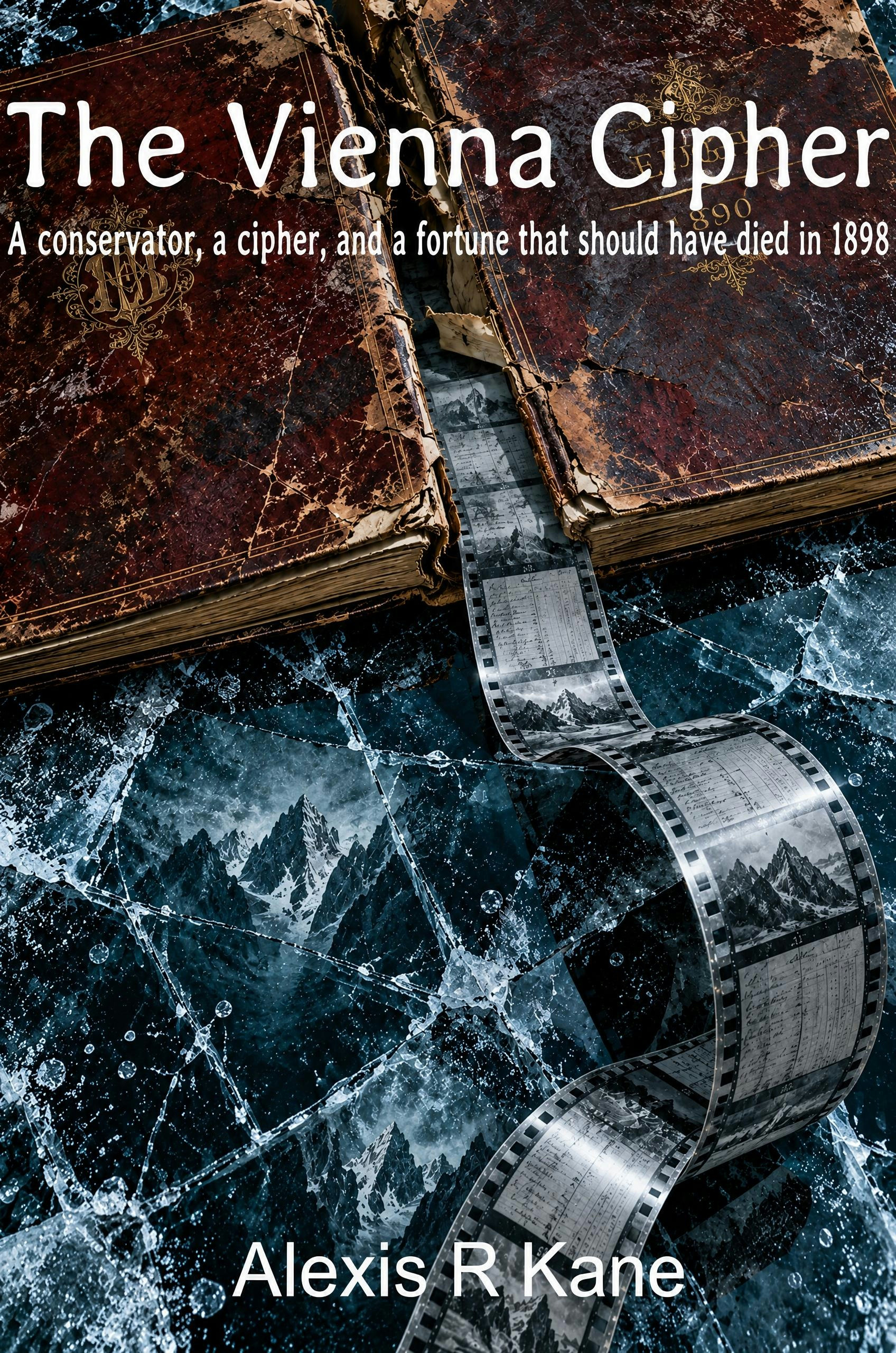
The Vienna Cipher
A conservator, a cipher, and a fortune that should have died in 1898
by Phil Hovey
In Lisbon, conservator Zara Carell opens a damaged 1898 Austrian banking register and finds what should not be there: modern microfilm, a massacre from 1995, and her own buried operational alias. The ledger points to Vienna, then to a nineteenth-century trust still feeding a living criminal apparatus. Field operative Declan Farr joins her again. Together they follow a murdered courier, a convalescent who recognises Cold War ciphers, and a financier who was supposed to be dead: Matthias Falkenrath. Ambushes on the Ringstrasse, a violent border pursuit, a listening station that still answers, and Falkenrath’s scorched-earth Winter Protocol close in. Witnesses vanish from Bratislava to Dublin. The black register holds one last map: an Alpine estate in Tyrol and an underground archive waiting to be erased. If they fail, a century of stolen capital disappears with the people who can prove it. If they succeed, Lisbon still has one more manuscript, and Prague is already waiting.
- Thriller
- Mystery
- Crime Fiction
- Conspiracy Thriller
- Spy Thriller
- Action Thriller
The Vienna Dispatch
The morning courier arrived precisely at eight o'clock, his scooter exhaust puttering down the cobbled slope of the Rua dos Remédios before cutting out against the kerb. Zara Carell heard the metallic scrape of the stand hitting stone, followed by two firm knocks on the heavy cedar door of her conservation studio. She had already brewed her first pot of chicory-laced coffee and set out the tools on her zinc-topped workbench: bone folders, micro-spatulas of Swedish surgical steel, camel-hair dusting brushes, and two glass dishes of methyl cellulose adhesive.
When she opened the door, the courier did not ask for a signature. He wore a sodden yellow rain cape, smelling of Atlantic drizzle and wet wool. He handed her an oblong wooden box bound with vulcanised parcel tape and left without speaking, the engine of his scooter kicking into a wet sputter before she had even shut the deadbolt.
Zara carried the box into the workshop, where the high north-facing windows captured the grey, flat daylight off the Tagus. There was no sender address, no customs manifest, and no return stamp. The wood beneath the tape was untreated Baltic pine, roughly cut and nailed together with brass tacks that showed light oxidation. She took a utility knife, scoring the heavy tape along the seam, and prised the top panel loose with a bevelled palette knife.
Inside, nested in dry wood shavings and acid-free archival tissue, lay a bound volume. It was a ledger of significant size, perhaps fourteen inches by ten, bound in dark calfskin that had suffered disastrous moisture exposure. The leather was desiccated, crazed across the spine like dried lake mud, and cracked open along the lower outer hinge to reveal the raw hemp sewing supports underneath.
Zara put on her nitrile gloves. She handled the volume by its lower boards, lifting it clear of the shavings and resting it gently on a padded velvet doughnut on the workbench. The front cover bore a faint blind-stamped crest: the double-headed imperial eagle of the Austro-Hungarian monarchy, beneath which ran gold-leaf lettering that had degraded into dull greenish flakes. She adjusted the articulating gooseneck lamp above the desk, focusing sixty watts of clean daylight illumination across the tooling.
K.k. Privilegirte Oesterreichische Credit-Anstalt für Handel und Gewerbe. Hauptbuch 1898.
It was an official Austrian banking register from the close of the nineteenth century. The volume had survived over a hundred and twenty years, but it had recently spent time in an unsuitable environment, possibly a damp basement or an unheated stone vault. The odour rising from the rag paper was distinct: damp lignin, mouldering animal glues, and the bitter trace of iron gall ink that had begun to burn through the cellulose fibres of the leaves.
Using a flexible micro-spatula, she tested the front endpaper. The marbled paper, a classic Turkish wave pattern in indigo and ochre, had partially detached from the paste-down. When she slid the polished steel blade beneath the paper flap, she met unexpected resistance. The paste had not failed naturally; someone had deliberately reopened the paste-down and resealed it using a modern synthetic adhesive that remained rubbery to the touch.
Zara worked with slow, surgical precision. The steel tip teased the lifted corner backward millimetre by millimetre, loosening the synthetic bond without tearing the brittle eighteenth-century rag fibres beneath. As the flap folded back against the inner board, a small pocket carved directly into the millboard substrate came into view.
Tucked into the cavity was a single strip of high-density polyester film. It was thirty-five-millimetre modern photographic microfilm, roughly five inches long, preserved between two clear acetate sleeves.
She did not touch it with bare fingers. Using rubber-tipped tweezers, she carried the strip over to the illuminated light table near the chemical cabinet. She switched on the base light and lowered the optical magnifying arm, aligning the first frame beneath the lens.
The image was razor sharp. It was not a Victorian banking document. The frame showed an exterior photograph taken with a telephoto lens, bathed in the sharp, chalky sunlight of high summer. In the background stood a cluster of scorched masonry structures and the unmistakable silhouette of a Balkan valley, limestone scree rising steeply behind a derelict agricultural co-operative. In the foreground, standing near an olive-drab personnel carrier, was an older man in a tailored charcoal wool jacket. He held a leather map case beneath his arm and was speaking to two uniformed irregulars whose shoulder flashes bore the distinct insignia of an eastern Bosnian paramilitary unit.
Zara adjusted the fine-focus knob. The man's face was unmistakable. His patrician features, silver hair swept cleanly off high cheekbones, and the thin scar running across his left jaw belonged to Christian Falkenrath. The Austrian industrialist and private banking trustee had officially died in an executive jet crash near Klagenfurt in November 1987. The wreckage had burned for twelve hours, and a closed-casket funeral had been held at St. Stephen's Cathedral in Vienna.
Yet here he stood, clearly photographed in the summer heat of 1995, his leather map case tucked under his arm while smoke rose from the village roofs behind him.
The timestamp encoded into the bottom margin of the film strip recorded the date: 11 July 1995. The coordinates followed in military grid reference system format, pinpointing a valley just north of Srebrenica.
A quiet tap came at the workshop's reinforced side entrance. Three rhythmic raps, followed by two quick beats. It was not a courier.
Zara left the light table illuminated, walked to the side alcove, and disengaged the deadbolts. Declan Farr stood in the alleyway, the collar of his wax-cotton jacket turned up against the Atlantic mist. He stepped inside without ceremony, his boots making no sound on the terracotta floor tiles as he scanned the street behind him and pulled the door shut until the heavy latch engaged.
"You received it," Declan said, his voice low and stripped of superfluous inflection. His eyes immediately took in the opened pine crate, the wood shavings on the worktop, and the glowing square of the light table.
"Forty minutes ago," Zara said. "Delivered by local courier. Unmarked crate."
"It didn't come through the intended chain," Declan said, pulling his gloves off and dropping them onto the edge of the shelf. He walked to the light table, his posture taut, carrying the quiet, compact stillness that came from years of reconnaissance work. "The courier in Vienna didn't make the train out of the Hauptbahnhof."
Zara stopped beside him. "Who was he?"
"A senior archivist named Josef Meindl. He worked in the private manuscripts division of the Österreichische Nationalbibliothek, but he moonlit as an independent authenticator for private banking collections on the Herrengasse. He was supposed to board the night sleeper to Zurich yesterday evening and pass the parcel to an intermediary. They found him at four this morning in an alley behind the Belvedere gardens. Single blunt-force trauma to the base of the skull, wallet untouched, his apartment cleared out within an hour of his death."
"Then how did the crate reach Lisbon?"
"Meindl knew he was being monitored," Declan said, his gaze fixed on the negative under the lens. "He never took the volume to the station. He split his route three days ago, logged the consignment through a private freight forwarder in Linz under an emergency routing code, and left a dummy portfolio in his office locker. The people watching him killed him for an empty briefcase."
Declan leaned down, peering through the magnifying lens at the microfilm frame. His jaw hardened as he read the date and coordinates. "Falkenrath. The father."
"He was supposed to have burned in Carinthia eight years before this was taken," Zara said quietly. "Everyone accepted the dental identification. The family trust was transferred to his son Matthias without probate dispute. Yet here he was, standing on the perimeter of an active cleansing sector three days before the mass executions began."
"The Falkenrath family bank handled sovereign debts during the imperial era," Declan said. "When the Habsburg structures broke down, they redirected their capital into offshore trusts, maintaining private logistics accounts that ran through Switzerland, Liechtenstein, and the Cold War buffer zones. If Christian Falkenrath was on the ground in Bosnia in July 1995, he wasn't there as a bystander. He was paying for the fuel, the trucks, and the munitions."
"There is more," Zara said. She guided him back toward the central workbench where the heavy volume lay cradled in its velvet support.
The ledger was opened to the middle gatherings. The paper was heavy machine-made rag with deckled edges, but the binding sewing had parted at the seventh station, causing several leaves to slip forward out of alignment. Zara took her bone folder and eased the pages flat, revealing the hand-ruled red and black columns typical of fin-de-siècle Viennese accounting.
The original entries were penned in meticulous Kurrent script, listing bond yields, railway expansion loans, and imperial timber concessions dating from September 1898. But on page three hundred and forty-two, beneath the original balance figures, a second sequence of records had been inserted decades later.
The ink was modern ballpoint, written in a cramped, disciplined hand using German banking abbreviations. Entries from the 1990s were recorded directly against historic sub-accounts that had remained dormant since the collapse of the Austro-Hungarian central bank.
Zara adjusted the magnifying visor over her eyes, bringing the steel spatula to bear on the gutter margin. The spine was split down the centre, and the adhesive holding the gatherings had crystallised into yellow shards.
"The provenance marks on the inner spine are consistent with the Falkenrath private archive on the Herrengasse," Zara noted, her voice steady but tightly reined. "This register was never meant for public audit. It was an internal black ledger used to track off-balance transfers through historic legacy foundations. Look at the reconciliation codes on this page."
Declan leaned over her shoulder, his hand resting on the edge of the workbench. His breathing was slow, mechanical, measuring the room with the instinctive vigilance of an operative who expected the glass to break at any second.
"Numbered clearing routes through Graz and Klagenfurt," Declan murmured, tracking the handwritten numerical chains. "The same clearing corridors we saw during the Aegean operation. Corvin's maritime accounts were drawing down against these exact ledger references."
"It goes deeper than maritime charters," Zara said. Her gloved fingers turned the page with infinite care, using the micro-spatula to prevent the brittle edge from crumbling under the pressure of her touch. "Look at the date on this specific disbursement."
The entry was dated 8 July 1995.
The sum recorded was four million Austrian schillings, debited from an account titled Sonderkonto Habsburg-Nord and routed through a private clearing agent in Graz to an offshore holding in Nicosia. Below the transaction code ran a string of operational authorisations and delivery confirmations.
Written directly beside the receiving corridor, in clean, sharp block letters, was an operational codename.
KORR-07 / HELENA.
Zara froze. The room seemed to narrow until the only visible object was that single line of black ink pressed into the century-old paper. The skin beneath her nitrile gloves grew cold.
Declan had spotted it too. He did not speak immediately. He knew the history. He knew the operational reports from the UNPROFOR sectors, the shadow couriers who had moved medical supplies, radio components, and diplomatic pouches through the besieged enclaves before the frontline collapsed entirely.
"That was your callsign," Declan said, his voice flat, stripped of judgement, holding only the brutal weight of the fact. "Sector North. The Tuzla-Zvornik corridor."
"It was," Zara said. The word was barely more than a murmur, caught in the dry roof of her mouth. Her hand remained poised over the page, the steel spatula held perfectly still, though every muscle in her forearms had locked tight.
"Who knew that designation?" Declan asked.
"Three people in the operational cell in Sarajevo," Zara said, her voice dropping into a register of cold, clinical clarity. "My regional handler, the signals dispatcher in Split, and the logistics officer who cleared our convoy manifests through the forward checkpoints. Nobody else. It was an emergency channel set up exclusively for tactical extractions."
"And this ledger shows a four-million-schilling transfer authorised against that callsign on the eighth of July," Declan said, studying the ink. "Three days before the perimeter fell. Three days before the column was intercepted at the bridge."
Zara remembered the heat of that July morning with sudden, visceral intensity. The stench of diesel exhaust hanging over the valley floor, the roar of heavy lorries backing up against the grain depots, and the cold terror of the civilian families who had crowded the roads, believing that the UN blue helmets would hold the high ground. She had been on the mountain track with a dispatch pouch strapped to her chest, listening to the mortar fire echoing off the limestone crags, waiting for a relief convoy that had never arrived because the fuel had been diverted sixty miles north.
Now, twenty-eight years later, the transaction sat before her in black ink, inscribed into the blank margins of an imperial ledger that had sat in a private vault in Vienna.
"I never carried currency," Zara said, her knuckles tightening around the spatula. "My cell handled documentation and field medicines. We moved civilian lists out of the valley so the families could be traced if the enclave fell. We never touched banking drafts. We never saw a single schilling."
"You didn't," Declan said. "But someone in the ministry used your movement schedule as the clearance flag. They attached your callsign to the wire so the border guards would wave the transport through without inspecting the cargo. While you were guiding refugees through the forest, the Falkenrath network was moving bullion and weapons under the cover of your courier manifest."
Zara set the bone folder down against the zinc top, aligning its edge parallel to the steel rule. She drew a slow, measured breath through her nose, feeling the cold weight of the tools ground her pulse, then picked up the micro-spatula once more, her grip settling into familiar, mechanical precision. She brought the tip down to the lower margin of the leaf, where a faint impression in the paper indicated an erasure.
"Someone attempted to scrape out the authorisation initials," she said, angling the raking light across the paper fibres. The surface of the rag paper had been disturbed with a sharp blade, leaving a roughened patch where the sizing had been removed. She picked up a soft squirrel-hair dusting brush, dipped the tips into a fine vial of powdered graphite, and lightly brushed the area.
The raised edges of the paper impressions caught the carbon dust. Two letters emerged from the scarred surface: M.F.
"Matthias Falkenrath," Declan said. "The son. He was thirty in 1995. Working as a junior director in the family merchant bank in Vienna, handling logistics accounts for Eastern European reconstruction."
"He didn't just inherit the bank," Zara said. "He managed the execution accounts. His father provided the political clearance and the military connections on the ground, and Matthias balanced the books in Vienna. And when the war ended, they buried the records inside nineteenth-century registers where no war crimes tribunal would ever think to look."
"Until Josef Meindl opened the vault," Declan said.
Declan turned toward the studio windows, drawing the linen blind slightly aside to inspect the narrow street below. A fishmonger's van was rattling down the cobbles, but nothing else stirred in the morning rain. The city went about its business, completely oblivious to the paper trails of thirty-year-old murders lying exposed on the zinc workbench.
"Meindl's murder was clean," Declan continued, turning back to the table. "Professional. Lukas Brenner's signature. Brenner runs private security for the Falkenrath group out of an office on the Schubertring. He uses former Austrian army recon personnel, men who know how to sterilise a crime scene in under ten minutes. If Brenner was sent to eliminate Meindl, it means Matthias Falkenrath knows the register is missing."
"They don't know where Meindl sent it," Zara pointed out, looking at the roughly packed pine crate.
"They will soon," Declan replied grimly. "Linz isn't that large. A private freight forwarder leaves a paper trail, and Brenner has access to municipal transport registries. Once they track the consignment number to Lisbon, this studio becomes a kill zone."
Zara did not flinch. She set the bone folder down on the bench with a soft, deliberate click. Her operational past had never truly vanished; it had simply remained dormant beneath layers of gum arabic, Japanese tissue, and the quiet routine of Alfama. But the names on the page were not merely historical abstractions. They were connected to the people she had failed to save, to the voices she had heard through the radio static as the artillery had closed around the valley.
"We need to stabilise the document before we move," Zara said, her professional instincts taking over. "If the binding shears completely, the gatherings will separate, and we will lose the sequence of the ledger entries. I need fifteen minutes to secure the spine with archival tape and wrap the text block in Melinex."
"Take ten," Declan said, reaching inside his wax jacket to check the seating of the Sig Sauer in his shoulder holster. "I have a vehicle parked two streets down near the Santa Apolónia freight yard. We leave everything else. We take the register, the microfilm, and our weapons."
Zara nodded. Her movements became swift and economical. She laid down strips of acid-free polyester film, encasing the damaged leaves of the 1898 register to protect the fragile graphite tracings from smudging. She sealed the microfilm strip into an aluminium field case, dropping it into the inner pocket of her jacket, and packed the ledger into a padded waterproof courier satchel.
As she zipped the satchel closed, she looked once more at the open drawer beneath her desk. Resting inside, beneath a stack of parchment trimmings, lay her Glock 19. She pulled the weapon out, checked the chamber with a crisp mechanical slide rack, and holstered it beneath her dark wool coat.
"Where do we go?" Zara asked, pulling her gloves snug over her wrists.
"Vienna," Declan said, his hand already on the latch of the side door. "Meindl had an associate in the financial crimes division, an investigator named Eva Weiss. If we want to bring down Falkenrath before he burns the rest of the archive, we have to hit them on their own ground."
Zara lifted the satchel, the heavy frame of the ledger pressing against her ribs. Declan eased the deadbolt back with a faint metallic click and drew the door open an inch into the rain, his hand dropping to the grip of his pistol.
Across the narrow cobbles of the Rua dos Remédios, an unmarked grey saloon was idling against the kerb, its headlights cutting through the mist straight toward the studio threshold.
The Dead Archivist
The morning train from Schwechat rolled through the grey suburbs of Simmering under a ceiling of low, yellow cloud. Rain slicked the switch tracks outside the station, turning the ballasted gravel into dark, sodden ridges. Zara Carell carried the courier satchel close against her ribs, her arm pressed over the heavy perimeter of the register inside…