

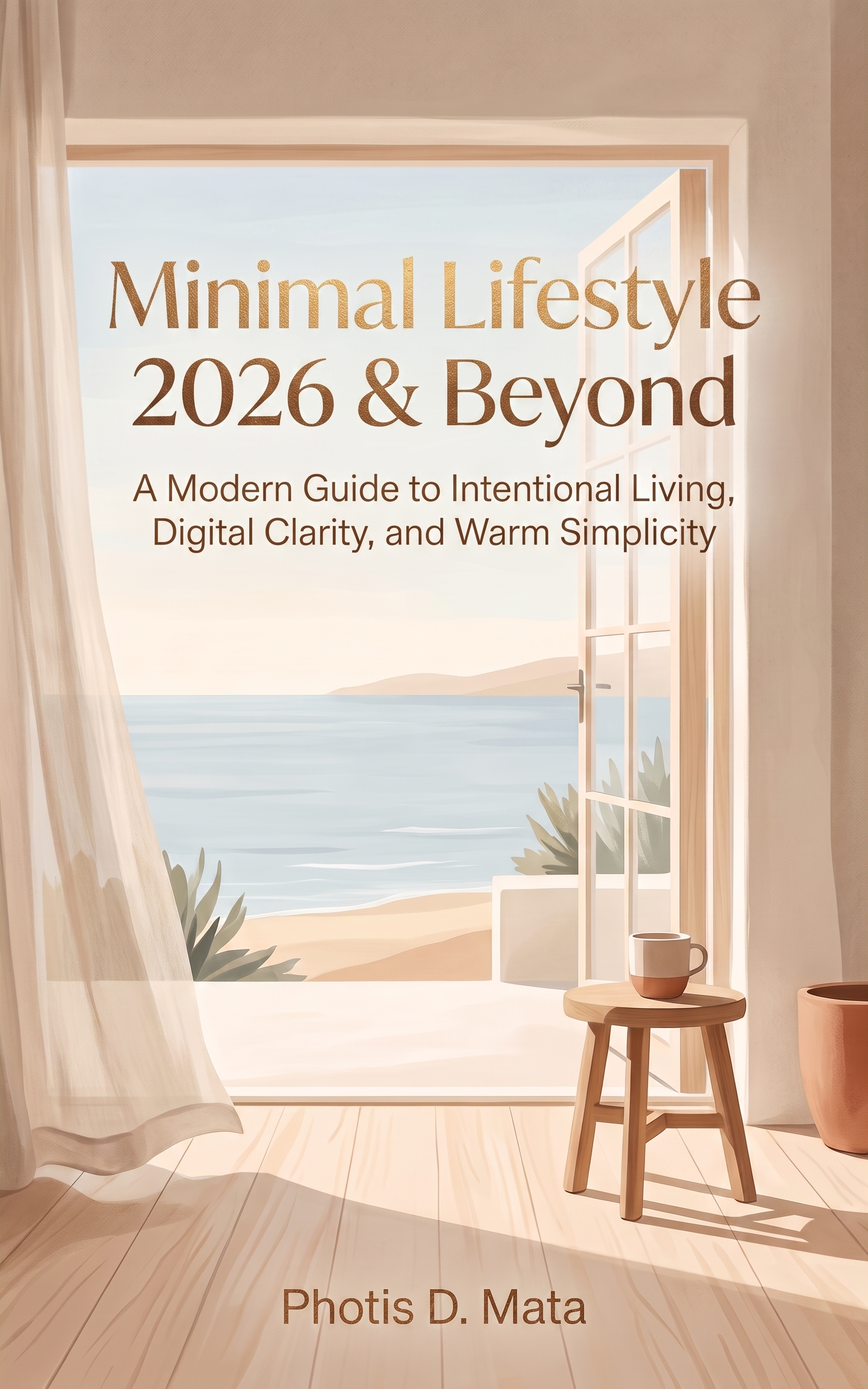
Minimal Lifestyle 2026 & Beyond
A Modern Guide to Intentional Living, Digital Clarity, and Warm Simplicity
by Photis D. Mata
In an era of relentless algorithmic noise, endless notifications, and recurring subscription fatigue, modern life feels heavier than ever. We are constantly connected, yet perpetually distracted. We own more, yet feel satisfied with less. Minimal Lifestyle 2026 & Beyond is not about living in sterile, empty white rooms or counting your worldly possessions. Instead, author Photis D. Mata reclaims minimalism as a warm, human-centered philosophy designed specifically for the modern age. This book provides a practical roadmap to help you quiet your nervous system, declutter your digital existence, and cultivate a deeply intentional life. Discover how to: • Silence digital overwhelm and reclaim your fractured attention span • Transition from cold aesthetic emptiness to a cozy, organic home environment • Audit financial clutter, break subscription loops, and regain true financial clarity • Cultivate genuine, deep human connections over performative digital presence • Implement a simple five-step daily framework to sustain long-term balance It is time to stop chasing the next upgrade and start experiencing the abundance already around you. Reclaim your space, master your mind, and design a life that truly matters.
- Self-Help
- Minimalism & Simplicity
- Personal Growth & Habits
- Mindset & Motivation
- Gratitude Practices
- Productivity & Time Management
The New AHA
Ten years ago, when people talked about minimalism, they pointed at a closet. Maybe a garage. Maybe a kitchen drawer stuffed with mismatched Tupperware lids that hadn't matched a container since 2019. The advice was simple: get rid of the stuff you don't use, fold your shirts a certain way, buy a capsule wardrobe, and take a photo of your empty countertop for the internet to admire. That version of minimalism made sense for its time. It was a reasonable response to a culture that had spent decades convincing us that happiness lived inside a shopping bag.
But here we are in 2026, and something has shifted. I still own fewer things than most people I know. My closet is still small. My kitchen drawer still has exactly the lids it needs. And yet, some nights I go to bed feeling more scattered, more depleted, more full than I ever did back when my apartment was crowded with things I didn't need. The clutter didn't disappear. It just moved. It moved from my shelves into my pocket, and from my pocket into my mind.
This is the new AHA of minimalism, and it's the reason I sat down to write this book. The stuff was never really the problem. The stuff was just the most visible symptom of a deeper habit: the habit of letting things pile up because we never stopped to ask if we wanted them there in the first place. In 2026, that pile isn't made of sweaters and knickknacks anymore. It's made of open tabs, unread notifications, seventeen half-used apps, four AI assistants competing for the same five minutes of your attention, and a low hum of anxiety that whispers you are somehow already behind on a day that hasn't even started yet.
Where the Clutter Actually Lives Now
Think about your morning. You wake up, and before your feet touch the floor, your thumb has already found your phone. There's a banking app asking you to review a "personalized insight." There's a fitness tracker congratulating you, or shaming you, depending on how you slept. There's an email inbox that refilled itself overnight like a spring that never runs dry. There's a work chat with three unread threads, a family group chat with forty-one messages about something that could have been one text, and somewhere in there, a notification from an AI tool reminding you that it "generated a summary" of something you never asked it to summarize.
None of this is inherently evil. Each individual app or tool was probably built by well-meaning people trying to solve a real problem. But stacked together, they form something that behaves exactly like the clutter of the old world, just invisible. You can't see it piling up the way you'd see a closet bursting at the seams. You feel it instead, as a tightness in your chest, a shortened attention span, a strange exhaustion that doesn't match how little you actually did with your body that day.
The old minimalism asked: do I need this object? The new minimalism has to ask a harder, less visible question: do I need this claim on my attention? Because attention, unlike a sweater, can't be donated to Goodwill. Once a notification steals thirty seconds of your focus, that thirty seconds is gone forever. Multiply that by the average person's daily notification count, which by some industry estimates sits well over a hundred, and you start to see the shape of the problem. We are not drowning in objects anymore. We are drowning in demands.
The Rise of the Machines (and the Tabs, and the Subscriptions)
Artificial intelligence deserves its own honest conversation here, because it has changed the texture of daily life faster than almost anything before it. In just a few years, we went from having one or two digital assistants to having AI embedded in our email, our search engine, our word processor, our photo app, our car, and increasingly, our refrigerator. Each one promises to save us time. Some of them actually do. But collectively, they've created a strange new tax on our mental bandwidth: the tax of constant decision-making about tools we never asked for.
Should I use the AI summary or read the article myself? Should I let the algorithm suggest my grocery list or make my own? Should I respond to the chatbot that popped up on this website, or close the tab and pretend I never saw it? Each of these micro-decisions seems trivial on its own. But they accumulate the same way loose change accumulates in a jar, except this jar is sitting on your nervous system, and it never actually gets full enough to cash in for something useful. It just gets heavier.
Add to that the quiet financial clutter of the subscription economy. Streaming services, cloud storage, meditation apps that were supposed to help us relax, productivity apps that were supposed to help us focus, and diet apps that track calories we already know we ate. Most people I talk to can't even list all their monthly subscriptions from memory. That alone tells you something. We've built an economy that profits from our inability to notice what we're carrying, and we call it convenience.
The New AHA
Here's the realization that reshaped how I think about this whole philosophy, and the reason this book exists: modern minimalism is no longer primarily about owning less stuff. It's about protecting three resources that are far more limited than closet space ever was: your attention, your time, and your nervous system.
You can own four shirts and still live a cluttered life if your phone buzzes ninety times before lunch. You can have a bare, empty apartment and still feel overwhelmed if you're running twelve browser tabs, three AI tools, and a mental list of subscriptions you keep forgetting to cancel. The battlefield moved. If we keep fighting the old war, tidying our sock drawers while ignoring the fifty apps competing for our eyeballs, we'll win a battle that barely matters and lose the one that actually determines how we feel every single day.
This doesn't mean physical decluttering is pointless. It's still valuable, and we'll get into it later in this book. But it's no longer the main event. The main event now is learning to say no to demands on your focus with the same confidence you'd say no to a pushy salesperson trying to sell you a set of steak knives you'll never use. Your attention is the steak knives now. Guard it accordingly.
Goodbye, Sterile White Room
There's a particular image that used to define minimalism in the public imagination: a white room, a single potted plant, one chair, hard lighting, and absolutely nothing on the walls. It looked calm in photographs. It looked, frankly, a little bit like a waiting room at a dentist's office. For a while, this aesthetic was everywhere, and I understand why. After years of being buried under stuff, that kind of emptiness felt like relief. It photographed well. It sold a fantasy of control.
But somewhere around the last few years, people started admitting something quietly to each other: that room didn't feel like home. It felt like a hotel lobby designed by someone who was afraid of personality. Living in that kind of space day after day didn't feel peaceful, it felt hollow. There's a difference between a calm space and an empty one, and cold minimalism often confused the two.
I've talked to readers of my blog, friends, and people in online minimalism communities who tried the all-white, all-empty approach and eventually gave up on it, not because minimalism failed them, but because that specific version of it asked them to erase too much of themselves. A blank room doesn't tell a story. It doesn't hold a memory. It doesn't smell like the vacation where you bought that one wooden bowl from a market stall, or feel like the blanket your grandmother knitted before she passed. Cold minimalism, taken to its extreme, mistook emptiness for peace and sterility for simplicity. They are not the same thing.
Enter Warm Minimalism, Organic Minimalism, and Midimalism
What's replacing that old aesthetic is something people are calling by a few different names: warm minimalism, organic minimalism, or my personal favorite because it captures the idea so simply, midimalism. Think of it as the middle path between hoarding your grandmother's entire china cabinet and living in a room so bare it echoes.
Midimalism keeps the core principle that made minimalism useful in the first place: remove what doesn't serve you, so what remains can actually be seen and appreciated. But it rejects the idea that "remaining" has to mean "sparse and cold." Instead, it embraces:
- Natural materials like wood, linen, clay, and wool, which age with character instead of looking worn out
- Earthy, warm color palettes, terracotta, cream, sage, and soft browns, instead of stark white and gray
- Objects that carry a story, a hand-thrown mug from a local potter, a well-worn book, a piece of art made by a friend
- Texture over sterility, a woven basket, a chunky knit throw, a rug with some history in it
- Enough negative space to breathe, without demanding that every surface stay completely bare
This isn't a contradiction of minimalism. It's a maturation of it. The goal was never to feel like you live in a museum exhibit about restraint. The goal was to feel calm, clear, and free from the weight of unnecessary things, and it turns out that a soft wool blanket and a wooden bowl full of lemons can support that goal just as well as an empty white wall, arguably better, because they also feed something in us that pure emptiness never could: a sense of being at home.
Midimalism says you can have fewer things, chosen well, and let them carry warmth instead of demanding they carry nothing at all. It's the difference between a closet with three neutral, high-quality sweaters that all feel good against your skin, versus a closet with three sweaters chosen only because gray was the "correct" minimalist color. One is a philosophy. The other was a costume.
Less, But With Soul
If early minimalism could be summed up in three words, it might have been "less is more." That phrase did a lot of good work. It got people to question consumption, to donate what they didn't need, to stop buying things just because they were on sale. But "less is more" eventually curdled into something a little joyless for some people, a race to see who could own the fewest items, who could keep the emptiest apartment, who could win at subtraction.
The updated philosophy for 2026 and beyond is simpler and, I think, truer: less, but with soul. This applies just as much to your physical space as it does to your digital life, your schedule, and your relationships, which we'll get into over the coming chapters. It means you don't need forty apps on your phone, but the five you keep should genuinely serve you. You don't need a house full of decorations, but the handful of objects you keep on display should mean something, not just fill space efficiently. You don't need to respond to every notification the second it arrives, but the people you do make time for deserve your full presence, not a distracted half-glance while your thumb hovers over another tab.
This is the real shift this book is built around. Old minimalism cleaned out the closet. New minimalism cleans out the mind, the calendar, the subscription list, and the notification center, and then, once that's done, it makes room for warmth again instead of leaving the space empty out of fear that warmth equals clutter. It doesn't. Warmth, chosen intentionally, is the opposite of clutter. Clutter is what accumulates without your permission. Warmth is what you choose to keep, on purpose, because it adds something real.
In the chapters ahead, we'll get practical about what this looks like: how to burn the digital ships that keep pulling your focus in six directions at once, how to stop chasing the next upgrade when what you already have is enough, how to build a home that feels calm without feeling cold, and how to protect the relationships that actually matter from the shallow noise of performative connection. But it all starts here, with this one shift in understanding. The clutter moved. Your response to it has to move with it. Less, but with soul, is not a slogan. It's the whole point.
Burn the Digital Ships
In 1519, Hernán Cortés landed on the shore of what is now Mexico with a small fleet of ships and an army that was badly outnumbered by the empires he intended to challenge. According to the story that has been retold for five hundred years, some of it exaggerated by time and some of it probably true, Cortés gave an order that seems almost insane on…