

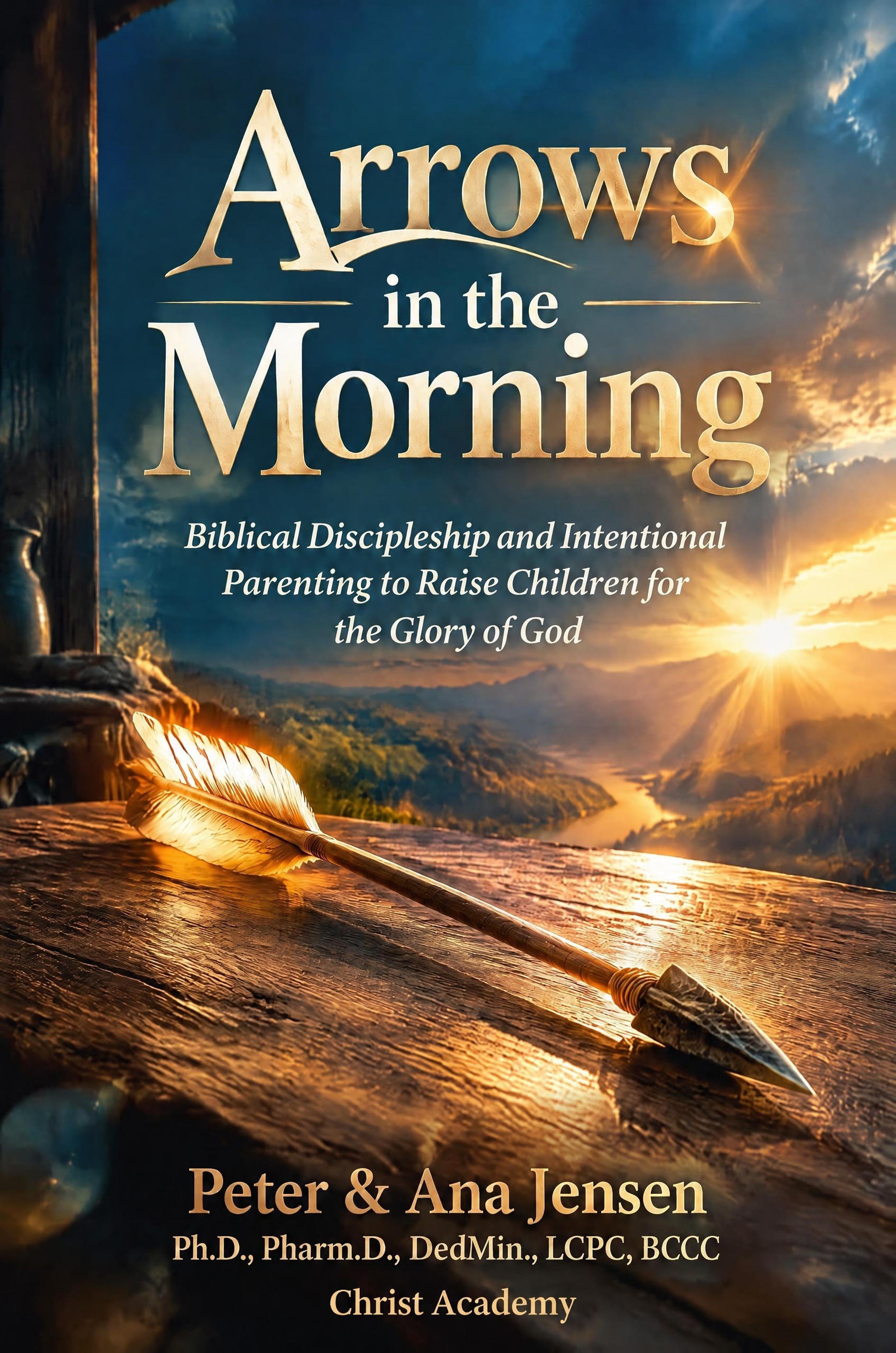
Arrows in the Morning
Biblical Discipleship and Intentional Parenting to Raise Children for the Glory of God
by Peter Jensen
In a culture full of shifting values and endless distractions, raising children grounded in lasting faith can feel overwhelming. Yet scripture does not describe children as burdens to manage or lifestyle accessories to maintain. They are divine heritages—purposeful arrows crafted to fly boldly into a future parents will never see. Arrows in the Morning offers a comprehensive, Scripture-saturated framework designed to guide parents, single caregivers, and grandparents through the sacred calling of spiritual parenting. Rooted in patient grace rather than reactive discipline, this book shows how an authentic, repenting faith at home serves as the greatest testimony children will ever witness. Across practical chapters, you will discover how to cultivate daily scripture rhythms, build generational prayer habits, guide prodigals with patient hope, and establish a healthy home dynamic. Whether you are steering toddlers through daily wonder, helping teenagers navigate digital spaces, or praying over grown children, this volume provides the wisdom and encouragement needed to lead your home with clarity. Equip your family to stand firm, love courageously, and proclaim with timeless resolve: As for me and my house, we will serve the Lord.
- Parenting & Family
- Religion & Spirituality
- Family Relationships
- Discipline & Behavior
- Christianity
- Prayer & Devotional
The Workshop Where Arrows Are Made (A Quiver Full of Arrows)
Before you ever held your child, you probably held a picture in your mind, a sweet and simple picture of what parenting would be like, and this morning we are going to discover why the real thing, with all its three o'clock feedings and slammed doors, is actually far more glorious than the picture ever was.
I have to tell you, I am excited about this book, because parenting is one of those subjects where almost everybody feels two things at once, a deep love and a quiet sense of being in over their heads.
I would guess that describes most of you this morning. You love your children more than you can put into words, and at the same time you have had moments, maybe even this week, where you thought, Lord, I am not sure I know what I am doing here.
And that is precisely why we are starting where this chapter starts, not with techniques, not with discipline strategies, not with schedules and charts, but with wonder. Before we talk about anything else this month, we need to recover what the Bible actually says children are.
Yes, and the anchor text for today is Psalm one hundred twenty seven, one of the most quoted passages in all of Scripture about children, and as this chapter points out, one of the most misunderstood. Let me read the heart of it. Behold, children are a gift of the LORD, the fruit of the womb is a reward. Like arrows in the hand of a warrior, so are the children of one's youth. How blessed is the man whose quiver is full of them.
And let me say a word to the parent who is meeting this book on the very first morning and wondering whether thirty chapters on
parenting are really for them. If you are a parent of little ones, it is for you. If you are in the thick of the teenage years, it is for you. If your children are grown and you are now watching grandchildren take their first steps, it is for you, because the Bible's vision of family stretches across generations. And each morning we are going to open the Scriptures together, sit with the Scriptures slowly, ask the honest questions, and end with something you can actually do that day. Think of it as thirty mornings of coffee with the Word of God, aimed at the most important classroom most of us will ever teach in, the home.
Each day will build on the one before. Today is the foundation, the vision of what children are. In the next chapter we turn to one of the most searching subjects in all of parenting, the loving correction, and we will see how God's own discipline of His children becomes the pattern for ours. But foundations first. You cannot build well on a vision you do not hold, so let us take our time today and let Psalm one hundred twenty seven do its deep work in us.
I love that this psalm is a Song of Ascents, which means pilgrims sang it while climbing toward Jerusalem for worship. So these words about children were not originally spoken in a nursery. They were sung on the road, by ordinary families, as part of their worship of God.
That is a beautiful observation, and it tells us something important. In Israel's life, children were not a side topic, tacked onto the real business of faith. They stood right at the center of the worshiping community. And notice where Psalm one hundred twenty seven begins, because this chapter makes this point carefully. The psalm does not begin with parenting techniques. It begins with theology, with the truth that unless the Lord builds the house, those who build it labor in vain. Parenthood is not first a task. It is a calling, and callings are received on our knees.
Let us stay with that word gift for a moment, because this chapter draws out something I had never noticed. The Hebrew word for gift here is nachalah, and it more precisely means an inheritance, the same word used for the land God allotted to Israel.
That changes everything about how we hear the verse, does it not? An inheritance is wealth passed down by a generous father. It is not wages you earned, and it is not compensation for your performance. You did not manufacture this blessing. You received it, and now you steward it. Children are not our achievement. They are God's inheritance handed to us in trust.
And then the psalm moves straight from inheritance to the arrow image, and this chapter is right to say that it is no gentle metaphor. In the ancient world, arrows were crafted with intention, straightened with care, sharpened for a purpose, and then released.
Yes, and a warrior does not keep his arrows in the quiver forever. He draws, he aims, and he lets them fly toward an enemy he cannot reach with his bare hands. The Hebrew word chets, the word for arrow, always implies direction and intent. So here is the picture. Your children are being shaped in your home for a battle you will not fight yourself, the battle for truth in a generation you will only partly see.
That is both thrilling and a little sobering. It means the everyday work of parenting, the patient correction, the bedtime prayer, the honest apology, is not babysitting. This chapter uses a wonderful word for it. It is craftsmanship. We are fletching arrows.
Fletching, for you who may not know the term, is the careful work of fitting the feathers to the shaft so the arrow flies true. A crooked arrow, or a poorly fletched one, will not hit the target no matter how strong the bow is. And that is exactly the kind of quiet, patient, repetitive work that fills a parent's ordinary day.
Nobody applauds it. Nobody sees most of it. But the flight of that arrow, years from now, will depend on it.
You know, I think this is where a lot of parents quietly lose heart. They look at the endless laundry, the refereed arguments between siblings, the same instruction given for the fortieth time, and they wonder whether any of it matters. And Psalm one hundred twenty seven answers, it all matters, because none of it is random. It is the shaping of a weapon of purpose, placed in your hand by God Himself.
And notice, the psalm says the blessed man is the one whose quiver is full. This chapter helpfully points out that the point is not a quota. It is a posture. A full quiver in the ancient world meant readiness, confidence, and strength at the city gate. Children, rightly aimed, are not a liability in the spiritual war. They are the advance guard.
Now let me pose the hard question that I think you might ask at this point. Someone is hearing this while driving to work, and they are thinking, that sounds beautiful, but my home does not feel like a workshop for warriors. It feels chaotic. My teenager barely speaks to me. Am I failing at this whole arrow picture?
That is the right question, and it is an honest one. I think this chapter's answer is to remember where the psalm starts. Unless the Lord builds the house, we labor in vain. The arrow picture was never meant to crush parents with pressure. It was meant to lift the work out of drudgery and into calling. And a calling means God is the senior partner in it. You shape, you aim, you pray, but the Lord builds the house. The chaos you feel does not disqualify you. It is the very reason the psalm starts on our knees.
And can we name the contrast with our culture for a moment? Because this chapter opens with it, and it is sharp. Our culture often treats children as accessories to an adult lifestyle,
scheduled around careers, postponed until convenient, limited to what is affordable.
Whereas the Bible tells a radically different story. Children are not interruptions to your real life. They are not projects to manage or problems to solve. They are arrows, weapons of purpose, placed in your hand by God Himself, meant to be aimed at a target far beyond your own comfort. If we absorb the culture's story, we will resent the very people God calls a reward. If we absorb Scripture's story, even the hard days carry meaning.
Let us move to the second passage, because it puts flesh on this idea of children as a gift of grace. Genesis thirty three, verse five. Jacob is limping toward Esau, terrified of the brother he cheated twenty years earlier. Esau looks past the flocks and the servants, sees the women and children, and asks, who are these with you? And Jacob answers, the children whom God has graciously given your servant.
Stop and feel the weight of that sentence, as this chapter invites us to do. Jacob, the deceiver, the schemer, the man who clawed for every blessing he ever got, looks at his children and names them for what they are, a gift of grace. The Hebrew emphasizes God's initiative. The word is chanan, to show favor, to bend down in kindness to one who has no claim on it. Jacob knew he deserved nothing. Esau's forgiveness was grace, and his children were grace.
This chapter calls this the antidote to two parenting poisons, and I want you to hear both of them clearly. The first poison is entitlement, treating children as our right, our achievement, our property. And the second poison is resentment, treating children as the obstacle between us and the life we wanted.
And grace destroys both poisons. Grace given children cannot be owned; they can only be received, so entitlement dies. And you cannot resent what you have named as grace, so resentment dies too. The parent who daily rehearses the sentence, God graciously
gave me these children, parents from gratitude rather than grievance. Those are two very different homes, even if they look identical from the street.
There is something else in that scene that moves me. Jacob said this while walking into the most frightening confrontation of his life. He did not present his children as his strength, and he did not use them as bargaining chips. They were simply evidence of God's kindness in the middle of his fear.
Which means, parent, that your children are the same for you. In your hardest seasons, the diagnosis season, the job loss season, the season where you do not know how this ends, your children stand as living proof that God has been kind to you. Not proof that life is easy. Proof that God is kind.
Now, the third passage takes us from receiving children as grace to the hardest and holiest part of the arrow picture, releasing them. First Samuel chapter one, verses twenty seven and twenty eight. Hannah is standing in the temple with the little boy she prayed for.
And for you, she says, for this boy I prayed, and the LORD has given me my petition which I asked of Him. So I have also dedicated him to the LORD; as long as he lives he is dedicated to the LORD. Now, this chapter draws out a beautiful piece of Hebrew wordplay here. The verb for dedicated is sha'al, which literally means lent, or asked for. Samuel's very name sounds like sha'al, asked of God. Hannah asked for a son, and then she lent the answered prayer back to the Giver.
The child she begged for became the child she released. I think every parent hearing that feels the ache in it, because that is the whole trajectory of parenting in one sentence. We begin by asking God for children, or at least receiving them with joy, and we must end by giving them to God.
And this chapter is careful to say that dedication is not a ceremony you attend once with a cute outfit and a photograph. It
is a daily surrender. This child is Yours, Lord, not mine. I am the steward. You are the Owner. That sentence, prayed daily, will carry a parent through every stage, the first day of school, the driver's license, the wedding day, and all the letting go in between.
Here is the paradox at the heart of it, and I think it might be the single most important sentence in this chapter. The tighter you grip your children, the more you lose them. The more you lend them to the Lord, the more securely they are kept.
Hannah gave up Samuel to the tabernacle, and she gained a prophet. She released her grip, and she watched God do what her grasping never could. Your children were never meant to be held forever. They were meant to be aimed, and arrows, by definition, leave the hand. So let me ask the question directly to you this morning. As you think about each of your children, where are your hands right now? Are they open, in the posture of a steward, or are they clenched, in the posture of an owner? Because those two postures produce two very different kinds of parents, and two very different kinds of homes.
And let me be gentle with the parent who realizes their hands are clenched. Most clenched hands are not rebellious hands. They are frightened hands. We grip because we love, and because the world feels dangerous, and because letting go feels like losing. But Hannah's story tells us that surrender is not losing. Lent children, this chapter says, are the safest children of all, because they are kept by God Himself.
That is well said. Now let us bring all three passages together, because they form one beautiful arc. Psalm one hundred twenty seven tells us children are an inheritance and arrows. Genesis thirty three tells us they are a gift of pure grace to people who deserved nothing. And First Samuel 1 tells us the right response to grace received is grace returned, lending back to God what He first gave to us. Receive, rejoice, release. That is where
our journey begins, and honestly, if a parent got nothing else out of this entire book, that arc alone could reshape a home.
Before we move on, I want to go back to the opening of the psalm, because we mentioned it but we have not really sat with it, and I think it might be the most restful truth in the whole passage for a tired parent. Psalm one hundred twenty seven opens by saying, unless the LORD builds the house, they labor in vain who build it, and it goes on to speak of rising up early and sitting up late and eating the bread of painful labors, because God gives to His beloved even in his sleep.
That is such a needed word. Because so much of modern parenting runs on anxious toil. We rise early and sit up late, not always with our hands, but with our minds, rehearsing fears, comparing our children to other children, reading one more article, worrying that we have missed the one thing that will make the difference.
And the psalm does not rebuke work. It rebukes vain work, work that assumes everything depends on us. The Lord builds the house. That does not make the parent passive. It makes the parent dependent, which is a very different thing. A dependent parent still corrects, still teaches, still shows up, but does it all while trusting that the outcome rests in stronger hands than theirs.
I think that is where the sleep line is so tender. God gives to His beloved even in his sleep. In other words, while you are unconscious and doing absolutely nothing, God is still at work on your children. The night shift belongs to Him. Parents who believe that can actually rest, and parents who can rest are kinder, more patient people in the morning.
Yes, and notice how that connects back to the arrow image. A warrior does some of his best work before the battle, in the shaping, and then he trusts the craftsmanship in the moment of release. In the same way, the parent's work is front loaded with
faithfulness and back loaded with trust. What you cannot do is control the wind after the arrow leaves the bow. And you were never asked to. You were asked to craft well and aim well and then to commend the flight to God.
Let us talk a little more about the crafting, because I think parents of different aged children hear this differently. If you have a toddler, your crafting looks like simple, repeated, patient instruction, the same boundary kindly enforced a hundred times. If you have a school aged child, your crafting includes the slow straightening of character, teaching honesty when lying would be easier, teaching diligence when shortcuts call. And if you have a teenager, your crafting increasingly looks like influence rather than control, long conversations, respect for a mind that is forming its own convictions, and a great deal of prayer behind a closed door.
The arrow image holds up at every stage, because at every stage the direction of the work is the same, toward release. The toddler will walk. The school child will make choices you cannot supervise. The teenager will soon live a life you can bless and advise but not manage. Parents who understand this from the beginning raise their children toward independence in Christ rather than dependence on themselves, and that makes the eventual release a celebration instead of a crisis.
There is also that picture at the end of the psalm of the man at the city gate, speaking with his enemies in the gate and not being ashamed. This chapter mentions strength at the city gate. In the ancient world, the gate was where justice was done and where the community's strength was displayed. Children raised well became a father's honor in public, his allies, his joy.
And there is a modern echo of that, is there not? One of the sweetest experiences of an older parent is watching adult children stand for truth in places the parent will never go, a workplace, a university, another city, another generation, and to
realize, the arrows flew further than my arm could ever reach. That is the promise folded inside this psalm. Your faithfulness now reaches places your presence never will.
Let me ask one more hard question, because I think someone needs it. What about the parent whose child has already flown, and flown in a direction that breaks their heart? Does this psalm have anything to say to them, or is it only for parents still shaping little ones?
It has everything to say to them, because Hannah's story is their story too. The lent child is never out of the Owner's hands. Release was never abandonment. The arrow that seems to have flown crooked is still known to God, still loved by God, and still within reach of the God who bends down in kindness, that word chanan again, to people who have no claim on Him. So the parent of the wandering child keeps doing what Hannah did. They pray, they surrender, and they refuse to let go of hope, because the story is not finished while God is still writing it.
I would add, the parent of the wandering child should hear Genesis thirty three again too. Jacob named his children as grace while he was walking toward the hardest day of his life, not after it was resolved. Gratitude and grief can live in the same heart. You can weep over a child's choices and still say, God graciously gave me this child, and God is not done.
So, parent, wherever you find yourself this morning, with a newborn in your arms, with a teenager behind a closed door, or with grown children scattered to places you can only reach by prayer, the word of this first chapter is the same. Your children are a gift of the Lord. They are an inheritance, not an interruption. They are arrows, not ornaments. Receive them with gratitude, shape them with patience, aim them with prayer, and hold them with open hands.
Before we close, let us anchor the day in the memory verse, because we want you carrying one line of Scripture with you.
Psalm one hundred twenty seven, verse three. Behold, children are a gift of the LORD, the fruit of the womb is a reward.
Say it over your children this week. Say it on the good days, and say it through your teeth on the hard days if you have to, until your heart catches up with your mouth. Children are a gift of the Lord. That sentence, believed, will change the temperature of your home.
So let us draw the threads together. Here are the key points we want you to carry into your day. First, children are an inheritance from the Lord, received by grace and stewarded with care, never owned and never resented. Second, children are arrows, crafted with patience, aimed with prayer, and one day released toward a target far beyond our own comfort. Third, the parent's daily posture is Hannah's posture, open hands, lending back to God the very gifts He gave, trusting that lent children are the safest children of all.
And now, some questions to reflect on, perhaps in your journal, perhaps around the table tonight. First, do you functionally treat your children more as an inheritance to steward, or as possessions to manage, and what would change this week if you truly believed they were lent to you by God? Second, Psalm one hundred twenty seven pictures children as arrows, crafted, aimed, and released. At what target are you currently aiming your children? Is it God's glory, or something smaller, like comfort, success, or your own reputation? Third, Hannah's prayer was answered, and then she gave the answer back. Is there an area of your child's life, their future, their choices, their safety, that you are gripping too tightly to surrender to the Lord? And fourth, when parenting feels like drudgery, how does the image of fletching arrows reframe ordinary faithfulness, like bedtime prayers and patient correction?
One more thought before we wrap up, because I do not want anyone to miss the sheer counter cultural force of this psalm's
opening word. Behold. It is a word that means stop, look, pay attention to this. The psalmist is calling us to notice something we are in danger of overlooking precisely because it is right in front of us every day. Familiarity can dull wonder. The child asking the hundredth question, the teenager leaving shoes in the hallway, the little one who needs one more drink of water at bedtime, behold, says the psalm, children are a gift of the Lord. Wonder is a discipline, and parents have to practice it on purpose.
That is so true. I think that is why this book begins here, with wonder, before it ever gets to correction, prayer, and teaching, which are all coming in the chapters ahead. Because the posture of the heart determines the quality of everything else. Correction from a heart that has lost wonder becomes harsh. Teaching from a heart that has lost wonder becomes mechanical. But correction and teaching that flow from a heart that still says behold, this child is a gift, those carry the warmth of gratitude into every corner of the home.
And let us not forget the reward language either. The fruit of the womb is a reward. In a culture that tallies children mainly as costs, financial costs, career costs, costs to our free time, Scripture tallies them as reward. That does not mean parenting is easy money, so to speak. Rewards in Scripture are often weighty things. But it does mean that when a parent lies down exhausted at the end of a long day of faithful, unseen work, heaven's accounting of that day is different from the world's accounting. God calls it gain.
I also want to speak to the parents who are not parents, or whose children are grown, because this book is still for you. Grandparents, you are still part of the shaping of arrows, and your prayers and your presence carry a weight you may underestimate. Aunts, uncles, mentors, teachers, youth workers, the church is a family, and the children in it are watching all of
us. And for those still waiting and hoping for children, Hannah's story at the temple is tender toward you. God heard the weeping of a woman who felt forgotten, and He hears you too.
The quiver belongs to the whole people of God in that sense. We shape the next generation together, in our homes first, and then shoulder to shoulder in the household of faith. So whether your part today is fletching an arrow at your own kitchen table or encouraging a tired young parent in the hallway at church, it matters, and it will matter for longer than you will live to see.
And here is your call to action for today, something simple and concrete. Sometime today, get each of your children in front of you, or get them on the phone if they are grown, and say Jacob's words over them in your own way. Tell them, God graciously gave me you. And then, tonight, pray one short prayer of release for each child by name. This child is Yours, Lord. I am the steward. You are the Owner. That is obedience right from the start, and it takes about five minutes.
Friend, if you begin this book feeling weary, take heart. The God who gave you these children knew exactly what He was doing when He placed them in your hands, and He has not left you to shape them alone. Unless the Lord builds the house, we labor in vain, but the wonderful news is that the Lord is building the house. Your job is faithfulness. His job is the flight of the arrow. So open your hands this morning, receive the gift again with fresh wonder, and trust the God who has been kind to you.
One more conversation before we finish, because I keep thinking about the word youth in the psalm, the children of one's youth, and about how long the crafting season actually is. We tend to think of the shaping years as the little years, but the psalm's picture stretches much further. A warrior's arrows were not made in a day, and neither are ours. The shaping of a child runs from the first lullaby to the last long conversation before they walk out the door with their life packed in boxes, and every stage
has its own craftsmanship, its own straightening and sharpening, its own prayers.
And that long view is a comfort for parents in the middle stages, because it means the story of your child's formation is not decided by any single season, neither the season where everything felt sweet and easy nor the season where everything felt like a battle. The craftsman keeps working. A warp discovered at fifteen can be addressed at fifteen. A dull edge at seventeen can be sharpened at seventeen. And the God who gave the arrow delights in the craftsman's persistence far more than in speed.
There is also a word here for the parent's own formation, is there not? While we are shaping our children, God is shaping us, with the same patience, the same straightening, the same refusal to give up on the finished flight. Many parents testify that nothing in their lives was used by God to form them like raising the arrows did. The workshop changes the craftsman too.
And let me leave you with one final picture to carry through your day. Somewhere in the ancient world there is a craftsman sitting in the quiet of his workshop, holding a shaft of wood up to the light, turning it slowly, feeling for the warp, running his thumb along its length. Nobody is watching him. Nobody will ever know his name. But one day that arrow will fly straight and true, and in that moment all the quiet craftsmanship will be vindicated. Parent, that is you. The quiet work counts. The thumb along the shaft counts. The prayer nobody heard counts. God sees the craftsman in the workshop, and He delights in the work, even when the work is slow. So do not despise the day of small shaping. Straighten what you can straighten today, sharpen what you can sharpen today, and leave the flight to the God who gave you the arrow in the first place.
Love with a Backbone (The Loving Correction)
Every parent has stood in that moment, the moment when your child has done something wrong, wrong, or perhaps wrong for the tenth time today, and you feel the surge rising in your chest, and in that split second you discover that how you correct your children says as much about your heart as their behavior says about theirs.This is the chapter I ha…
Want to read the rest?
Get the full book here: