

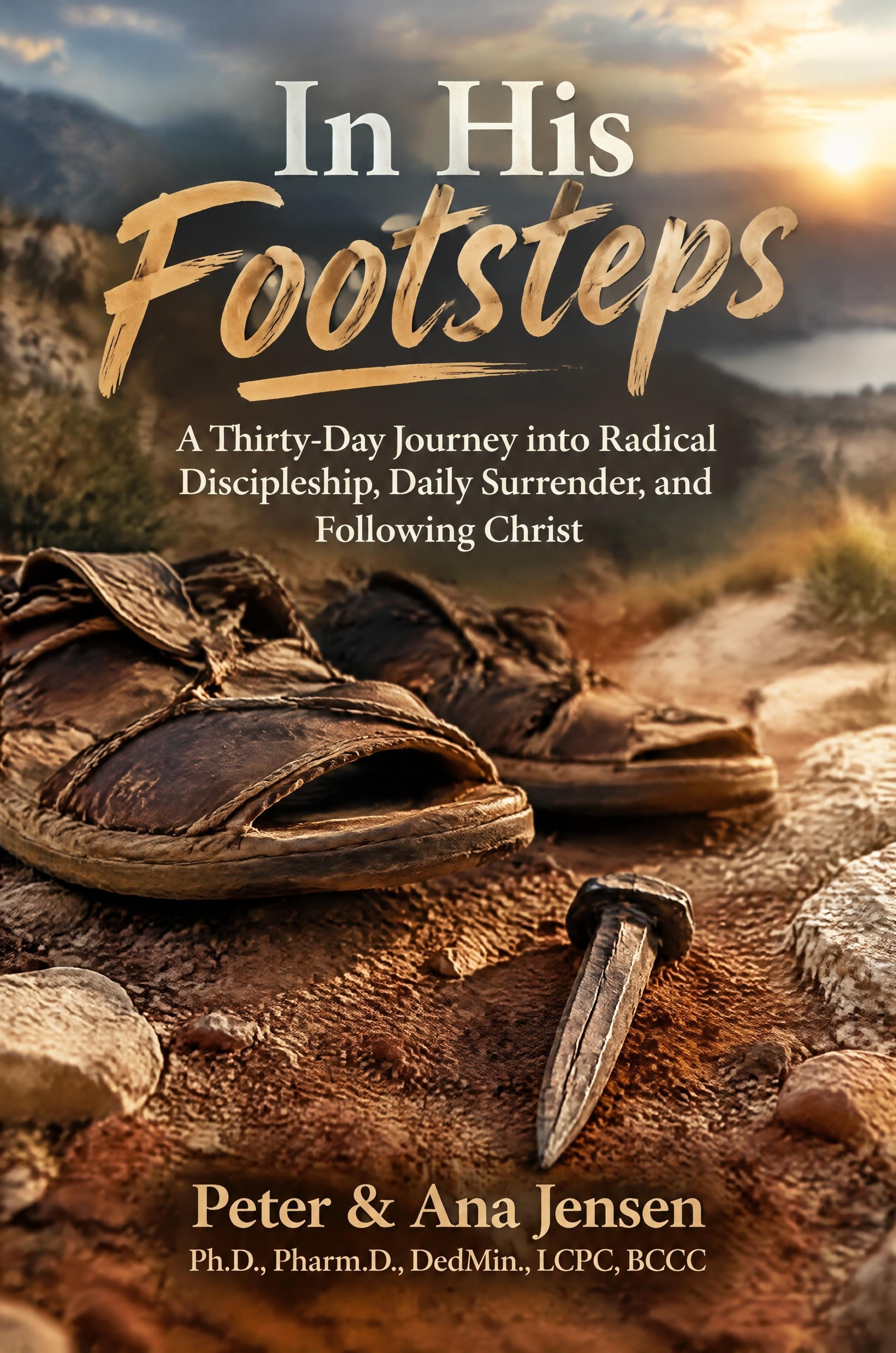
In His Footsteps
A Thirty-Day Journey into Radical Discipleship, Daily Surrender, and Following Christ
by Peter Jensen
Are you ready to move beyond cultural Christianity and truly walk with the living Lord? Too often, modern faith is reduced to comfortable routine and passive belief. Yet Christ never invited believers into safe complacency; He issued an uncompromising summons to count the cost, take up our cross daily, and follow Him without reservation. In His Footsteps presents an intensive thirty-day journey into the heart of genuine discipleship. Rather than treating faith as a rigid religious checklist, this guide reframes your walk as an active apprenticeship with Christ. Across these pages, you will examine foundational spiritual disciplines: cultivating unceasing prayer, recovering biblical fasting, immersing yourself in Scripture, and offering your daily life as a living altar of worship. You will also be challenged to embrace downward mobility through humble servanthood, wage steadfast spiritual warfare, practice radical forgiveness, and steward your resources with generous faith. For every believer seeking to persevere through trials and invest in eternal fruit, this journey will reorient your priorities and empower you to finish your race well. Step out of nominal religion and into the joy of total surrender. The call has been spoken. Will you walk in His steps?
- Religion & Spirituality
- Christianity
- Spiritual Growth
- Prayer & Devotional
- Sacred Texts & Scripture
Two Words That Change Everything (Come and See — Answering the Call of Jesus)
Two words changed the world on the shore of an ordinary lake, and those same two words are still changing lives this morning, because Jesus looked at ordinary working men in the middle of an ordinary workday and said, follow Me, and nothing about their lives was ever the same again.
I am delighted to be walking through this book with you.
I love that we are not starting this book with a list of rules or a program to complete, because discipleship does not begin with what we do for Jesus; they begin with Jesus coming to us, speaking to us, and inviting us to arrange our whole lives around His presence, His voice, and His direction.
That is such an important distinction, because a lot of people have believed in Jesus as Savior for years, and they are grateful for forgiveness, and yet if we are honest, they have quietly resisted Him as Leader, adding Him to a life they still intend to run themselves rather than surrendering that life to Him.
This first day names that tension gently but honestly. Christianity is not merely the teaching of Jesus about how to live, as wise and beautiful as that teaching is, because at its heart Christianity is Jesus Himself, a living Person who calls living people to follow Him, and following always means movement, you cannot follow Him and stay where you are.
Our topic in this first chapter is come and see, answering the call of Jesus, and before we talk in the days ahead about the cost, the cross, or the crown, we have to answer the question those fishermen faced on the shore of Galilee, and the question is simply this, will you follow Him?
Let us begin where this chapter begins, with the call that interrupts an ordinary day. Matthew chapter four, verses eighteen through twenty, says this in the New American Standard Bible. Now as Jesus was walking by the Sea of Galilee, He saw two brothers, Simon who was called Peter, and Andrew his brother, casting a net into the sea, for they were fishermen. And He said to them, Follow Me, and I will make you fishers of men. Immediately they left their nets and followed Him.
The detail that always stops me is where Jesus finds them. They were not in the synagogue that morning, and they were not away on a spiritual retreat trying to get their lives organized, because they were at work, casting nets into the sea and doing the same hard, smelly, ordinary work they had done every day of their adult lives.
It tells us something wonderful about the heart of Jesus, because He does not wait for us to get our spiritual lives organized before He calls us. He steps into a Tuesday morning, into a commute and a kitchen and a workshop and an office, and He speaks right there, in the middle of the life we actually live, not the polished life we imagine presenting to Him someday.
And the call itself is so brief, just follow Me, and yet there is a promise attached to it that I think many readers need to hear today. Jesus did not say, follow Me and I will make you comfortable, and He did not say, follow Me and I will make you successful by the standards of this world. He said, I will make you fishers of men, which means He took the skill they already had and redeployed it for a kingdom purpose.
He does not waste your past when you follow Him, He repurposes it. Your trade and your temperament and your story, including the chapters you would rather forget, all of that becomes raw material in His hands. The word follow in the Greek carries the picture of a soldier following his commander, staying in line and keeping pace and going where the leader goes,
whether the road ahead is easy or whether it is hard, and that means discipleship is never admiration from a distance.
I think that is a hard question a disciple has to ask, and maybe we should ask it plainly this morning. Where am I admiring Jesus from a distance when He has actually called me to keep step with Him up close, in a specific area of my life where I would rather watch than walk?
Notice also the urgency in that summons. The Greek word behind come here carries the sense of come now, a personal and urgent invitation, and the response of Simon and Andrew matched it, because the Scripture says immediately they left their nets and followed Him. There was no committee meeting and no long delay while they weighed every option, and their greatness, if we can call it that, was not in their goodness but in their responsiveness, because they heard, and they went.
And Jesus still calls people today the way He called those fishermen, although the shoreline looks different. He calls through His Word when a verse arrests your attention and will not let you go, and He calls through His Spirit when conviction stirs your conscience, and He calls through His people when a brother or sister speaks truth to you in love, and He even calls through your circumstances when He rearranges plans you thought were settled.
Which means the question is never really whether He is calling, because He is, and the deeper question is whether we are listening. A disciple is not first someone with unusual talent or an unusual background, because a disciple is someone who has learned to recognize the voice of the Shepherd in the noise of an ordinary day and then to respond to that voice with obedience.
Let us move to the second passage, because Luke tells the fuller story and it raises the stakes in a way that should stop us cold. In Luke chapter five, verses ten and eleven, Jesus says to Simon, do
not fear, from now on you will be catching men, and then Luke tells us that when they had brought their boats to land, they left everything and followed Him.
Context matters so much here, because these men had just pulled in the largest catch of their entire lives. Their nets were breaking and their boats were beginning to sink under the weight of the fish, and it was the kind of morning that could have set a fisherman up financially for months. That was the moment they walked away from, not a failed morning and not an empty net, but the greatest haul they had ever seen.
That is what makes it so searching, because it is one thing to follow Jesus when following costs us nothing, and it is quite another thing to follow Him when He asks us to walk away from the very thing we have been working toward. That catch represented security and provision and reputation, everything a first century fisherman lived for, and yet Jesus was offering them something better than a full net, He was offering them a full life.
And every reader today has a boat, so to speak, something that represents that everything we are tempted to hold back from Him. It may not be a career itself, but it might be our grip on that career, and it might be a relationship or a habit or a dream we have been clutching, or simply the right to run our own lives without interference. Discipleship always involves leaving, because you cannot follow a moving Person while standing still.
It is the grip rather than the thing itself, because Jesus is not cruel, and He is not calling every reader to quit a job this afternoon. He is calling us to hold everything with open hands, so that nothing we own becomes something that owns us, and so that when He does ask us to leave something on the shore, our hands are already open and our feet are already ready to move.
And there is also courage in the words do not fear, because Jesus knew that leaving everything feels frightening, even when the
One calling you is perfectly trustworthy. Fear often whispers that if you surrender control you will lose everything that matters, but Jesus answers that fear personally, because the life He gives in exchange is not smaller than the life you leave, it is larger, deeper, and more purposeful by far.
Let me pose the hard question the way a real disciple might ask it in a quiet moment. What if following Jesus actually costs me the thing I have spent years building, the opportunity I have prayed for, or the security I thought I could not live without, and how do I know He is worth that kind of trust?
It is a fair question, and the answer is not that the cost is imaginary, because the cost is real and Jesus never pretends otherwise. The answer is the character of the One who calls, because these fishermen had just watched Him fill empty nets by His word, and they were learning that a Lord who can provide a miraculous catch can also provide for the men who leave the catch to follow Him. Trust grows as we watch Him keep His word, step by step and day by day.
And that brings us to the third passage, which may be the most tender moment in all the Gospels. It comes after the resurrection, after failure, and after restoration. In John chapter twenty one, verse nineteen, Jesus speaks about the kind of death by which Peter would glorify God, and then the Scripture says, and when He had spoken this, He said to him, follow Me.
To understand the tenderness here, we have to remember who Peter was at that moment. This is the man who swore he would never deny Jesus, even if everyone else fell away, and then denied Him three times in a single night. He sits by a charcoal fire on the beach, and three times Jesus asks him, do you love Me, and three times Peter answers, and then, having restored him completely, Jesus says the same two words He spoke on the very first day, follow Me.
What moves me is what Jesus does not say. He does not say, follow Me again and try harder this time, and He does not put Peter on probation or demote him to the back of the class while the more faithful disciples move ahead. The call is renewed, full and undiminished, spoken to a man who had failed spectacularly, because Peter's denial did not cancel his discipleship; it deepened it, since now Peter knew his following would depend on grace rather than on his own strength.
That is such good news for readers this morning who have failed. Some of you answered the call once, and then you wandered or compromised or quietly quit, and you have assumed the invitation expired. Hear the risen Christ speaking your name today, because His call is not revoked by your failure, and discipleship is not for the flawless, it is for the forgiven, and the same voice that called you at the beginning is calling you still.
And notice that restoration and mission belong together in that beach scene, because Jesus does not restore Peter merely to make him feel better, He restores him in order to send him again. Grace is never the end of the story in isolation, since the forgiven disciple is given work to do and people to feed and a road to walk, and that is a pattern we will see again and again in this book.
Our memory verse for today gathers all of this into one sentence from the lips of Jesus in John chapter ten, verse twenty seven. My sheep hear My voice, and I know them, and they follow Me. There is such comfort in the middle of that verse, because before it says they follow Me, it says I know them, which means the call to follow rests on the reality that we are already known, fully and personally, by the Shepherd who calls us.
And hearing comes before following in that verse as well, which means a listening life is the foundation of a following life. In a world full of noise and opinions and distractions, the disciple learns to tune the heart to one voice above all the others, and that
tuning happens as we stay in the Word, as we pray honestly, and as we walk with other believers who help us recognize when the Shepherd is speaking.
I want to linger a little longer on what it actually looks like to hear His voice in everyday life, because some readers may be thinking that they have never heard Jesus call them at all, and yet when they look back, they can see moments when a verse would not leave them alone, or when a quiet conviction kept returning, or when a trusted friend said the very thing they needed to hear.
This chapter reminds us that He calls through His Word, through His Spirit, through His people, and through our circumstances. Those are not four competing voices, because the Spirit who convicts is the same Spirit who inspired the Word, and He often uses the counsel of His people and the rearrangement of our plans to underline what the Word has already said. The test of any impression we receive is always Scripture itself, since the Shepherd never contradicts His own written Word.
And that gives us a practical way to begin. If a reader wants to become more responsive to the call of Jesus, the starting place is not waiting for an unusual experience, it is opening the Gospel accounts and listening to Jesus as He actually speaks, in His commands and in His invitations and in His promises, and then responding to what is already clear before asking for anything further.
Clarity often comes on the far side of obedience rather than before it. The fishermen did not receive a map of the next three years on the shore that morning, and Peter could not have imagined the sermons he would preach or the churches he would strengthen or the courage he would one day show, and none of that was revealed in advance. They were given two words and a Person to follow, and the road unfolded one step of
obedience at a time, which is still the way discipleship works for us.
There is another side to this call that I think brings comfort to people who feel ordinary in the wrong way, so to speak. Simon and Andrew were not scholars, and James and John ran a family fishing business with their father, and none of them was chosen because a résumé set them apart. Jesus called working people with calloused hands, and He formed them by walking with them, teaching them as they went, correcting them when they stumbled, and patiently turning fishermen into fishers of men over time.
And He is still forming people that way today, in kitchens and classrooms and hospital corridors and construction sites, because the call of Jesus dignifies ordinary work rather than discarding it. The skills a reader has spent a lifetime developing, the patience learned in a difficult job, the credibility earned in a neighborhood over many years, all of that can be redeployed for the kingdom when it is surrendered to the Master, and nothing surrendered to Him is ever wasted.
Let me ask another honest question that I have heard from thoughtful believers. If Jesus calls me in the middle of my ordinary responsibilities, does following Him mean neglecting those responsibilities, my family and my work and the people who depend on me, in the name of being spiritual?
That is an important question, and the answer is no, because the Jesus who called fishermen away from their nets also taught His followers to provide for their households, to love their neighbors, to work honestly, and to keep their word. Following Him reorders our responsibilities rather than erasing them, because He becomes the Lord over our work and our family life instead of a competitor with them, and the people closest to us should experience our discipleship as deeper love, greater integrity, and more faithful presence, not less.
That ordering idea is helpful, because the issue is rarely whether we will follow something, since every one of us is following something, whether it is comfort or approval or ambition or the expectations of people around us. The real question is who holds the place of the leader, whose voice gets the final say when voices conflict, and whose direction we take when the road becomes costly or unpopular.
That is why this first day matters so much for the twenty nine days that remain in this journey. Every topic ahead of us, abiding and prayer and generosity and forgiveness and perseverance, all of it flows out of this original surrender, because a disciple is not someone who has mastered a set of techniques, a disciple is an apprentice to a Person, learning His way of life by staying close to Him over a lifetime.
I also want to speak to the reader who feels late to all of this, perhaps someone who has followed Jesus at a distance for many years and wonders whether a closer walk is still possible after so much time has passed. The beach scene with Peter answers that fear, because the call came to him after his worst failure, not before it, and the Lord who renewed that call did not treat Peter as damaged goods, He treated him as a beloved friend being restored to a meaningful life.
And the same Lord treats you that way today. Shame tells us to hide from the voice of Jesus, but the Gospel tells us to run toward it, because His voice is the voice of the Shepherd who lays down His life for the sheep. Whatever has kept you at a distance, whether it is failure or fear or simple drift over a long season, the invitation stands in the present tense, and it is spoken by One who knows you completely and loves you completely.
One more practical thought before we gather this together, and it concerns the word immediately in Matthew chapter four. Delayed obedience has a way of becoming disobedience with good intentions, because the nets we plan to leave next month
tend to be the nets we are still holding next year. The disciples teach us that there is a grace in prompt response, a freedom that comes from moving when He speaks instead of negotiating the timing until the moment passes.
And prompt obedience does not mean impulsive living, because these same disciples spent years walking with Jesus and learning slowly, making mistakes and being corrected along the way. Immediacy is about the direction of the heart, a settled readiness to say yes to Jesus without conditions, while the details of a lifetime of growth unfold gradually under His patient teaching. A quick yes and a long walk belong together in the life of a disciple.
There is a phrase in this chapter that has stayed with me, and it is the observation that we have often added Jesus to our lives rather than surrendering our lives to Him. Those are two very different arrangements, because adding Him leaves us in charge of the calendar and the budget and the final decisions, while surrendering to Him means He holds that place, kindly but truly, as Lord and Leader.
Most of us drift toward the first arrangement without ever deciding to, because addition feels safe and surrender feels costly. But a Jesus who is merely added to an already full life eventually gets crowded to the edges of it, consulted occasionally and obeyed selectively, and that is not the relationship He calls us into. He calls us to follow, which means He leads and we arrange everything else around His leading, and strangely, that surrender is where freedom begins, because the burden of running the whole universe was never ours to carry.
And surrender is not a single dramatic moment only, although it can begin in one, because the fishermen kept following day after day, through sermons they did not fully understand and through storms that frightened them and through moments when Jesus said hard things that made others walk away. Following is a daily
posture renewed each morning, and that is encouraging, because it means today is a fresh opportunity to take the next step, whatever the past looked like.
That daily renewal is exactly where this book will take us, and it is why we will end each chapter with reflection and a concrete step rather than with information alone. A reader who responds to Jesus in one small, specific act of obedience today has done more for the formation of a discipleship than a reader who merely agrees with everything we have said, because agreement is easy to give and costs nothing, while a step of obedience engages the will and the affections and the schedule all at once.
Before we close, I want to return once more to that beautiful promise, I will make you fishers of men, because the verb matters. Jesus says I will make you, which places the making in His hands rather than in ours. Our part is to follow, and His part is to form, and when we reverse those parts we end up either striving to manufacture our own transformation or despairing when we cannot, but when we keep them in order, following closely and trusting Him to make us what He has called us to be, growth becomes His work received through our obedience.
That is the note of hope to carry out of this chapter. You do not have to make yourself into a disciple by sheer effort before you come to Jesus, because you come to Jesus as you are, in the middle of your ordinary work, with your ordinary story, and He does the making as you do the following. Stay close to Him, listen for His voice, respond promptly when He speaks, and leave the results of that following in the hands of the One who called you.
There is one more scene worth picturing as we finish this first day, and it is the simple fact that the first disciples followed Jesus together. Andrew followed with his brother Simon, and James followed alongside his brother John, and partners in the fishing business became partners in the kingdom work, which tells us that the call of Jesus is personal without being private. He calls
us by name, one by one, and then He places us in a company of fellow followers, because the road of discipleship was never meant to be walked alone.
That companionship is a gift we should not underestimate, because there will be days when your own resolve is weak and the faith of a brother or sister beside you carries the day, just as there will be days when your obedience encourages someone else to take a step they had been postponing. When Jesus said follow Me to those men on the shore, He was forming a community as well as calling individuals, and the church today is still where that calling is lived out together, in worship and in service and in honest friendship.
So as we begin this journey, perhaps the invitation for you is twofold, to answer Jesus personally with a fresh and unreserved yes, and to answer Him together, by drawing closer to the people of God who will walk this road with you, encourage you when the way is hard, and remind you of the Shepherd and His voice when the noise of the world grows loud.
Before we close, I want to return to the shoreline one last time and notice the simplest detail of all, which is that Jesus came to the fishermen, they did not come to Him first. The initiative in discipleship belongs to grace from the very first moment, because the Shepherd seeks the sheep and the Master seeks the servant and the Savior walks the shoreline of an ordinary life looking for the very people He intends to call. No reader today is an accident or an afterthought in that search, because the voice that spoke beside the Sea of Galilee is the same voice that finds people in hospital waiting rooms and in quiet bedrooms and in the middle of a working day that feels entirely unremarkable.
And because He came to them where they were, we can be confident that He meets us where we are as well, not where we pretend to be and not where we hope to be someday, but in the actual circumstances of this actual morning. He knows the nets
in our hands, the work that fills our days and the worries that fill our nights, and He speaks His call into all of it without waiting for any of it to be tidied away. That is the kindness of the call, and it is also its urgency, because a Savior who comes to us where we are does not intend to leave us where we are, He intends to lead us, step by step, into a life we could never have built for ourselves.
Which means the right response today is not to promise Him a perfect future, but to give Him an honest present, this day and these nets and this next step of obedience, trusting that the One who calls is also the One who makes, and the One who makes never leaves His work unfinished in the lives of those who keep following Him.
This first chapter has given us a foundation for everything that follows. We have seen that Jesus calls ordinary people in ordinary places, that He repurposes rather than wastes the life we bring to Him, that following Him involves leaving whatever competes with Him, and that even our failure does not have the final word, because the risen Jesus renews His call to the forgiven.
We have seen that the disciples were not remarkable because they were flawless or because they had impressive credentials, since their distinguishing mark was responsiveness, the willingness to hear and to go, immediately and with open hands. That same responsiveness is available to every reader today, whatever your age, whatever your background, and whatever your history with Jesus has been so far.
So here are a few questions to reflect on as you go into your day. Where in your ordinary routine is Jesus most likely calling you to follow more closely right now? What is one boat you are still holding onto that keeps you from following Him fully? Is there a failure in your past that you have allowed to silence His voice, and what would it look like to hear Him say follow Me again
today? And in what specific area of your life are you walking beside Jesus in general agreement, but not actually in step with Him in daily practice?
And here is a clear call to action for today. Do not wait for a dramatic sign or a perfect moment, because the call usually comes in the middle of the ordinary. Choose one concrete act of obedience you already know Jesus is asking of you, whether it is a hard forgiveness or a postponed step of faith or a habit you need to leave on the shore, and take that one step today, promptly and with open hands, trusting the Shepherd who knows you by name.
Friend, there is real hope in this for you today, because the One who calls you also goes before you, and He does not ask you to find a road He has never walked or to trust a voice that has ever been unfaithful. The disciples who left their nets discovered a life far larger than the one they left behind, and the Peter who failed discovered a grace far deeper than his failure, and the same Jesus is speaking the same invitation over your life this morning.
And if you are just beginning with Jesus, perhaps hearing His call clearly for the very first time today, know that you are welcome on this road exactly as the fishermen were welcomed, not because you have everything figured out, but because He has spoken and because His grace is sufficient for the first step and for every step after it. Bring Him your questions and your fears and your unfinished story, and follow Him at the pace of obedience, learning as you go, held by a Shepherd who never loses one of His own sheep and who delights to make His followers into what He has called them to be.
In the next chapter we count the cost of discipleship with our eyes wide open. Keep listening for His voice, and keep following, one faithful step at a time.
May the Lord bless you and keep you as you follow Him today.
Settled Before the Storm (Eyes Wide Open — Counting the Cost of Discipleship)
Jesus never used fine print, and He never lured anyone in with promises of ease only to surprise them later with the bill, because when the crowds grew large and excited, He turned to them with complete honesty and said, before you go any further, sit down and count the cost.In the previous chapter we heard the call of Jesus on the shore, follow Me…
Want to read the rest?
Get the full book here: