

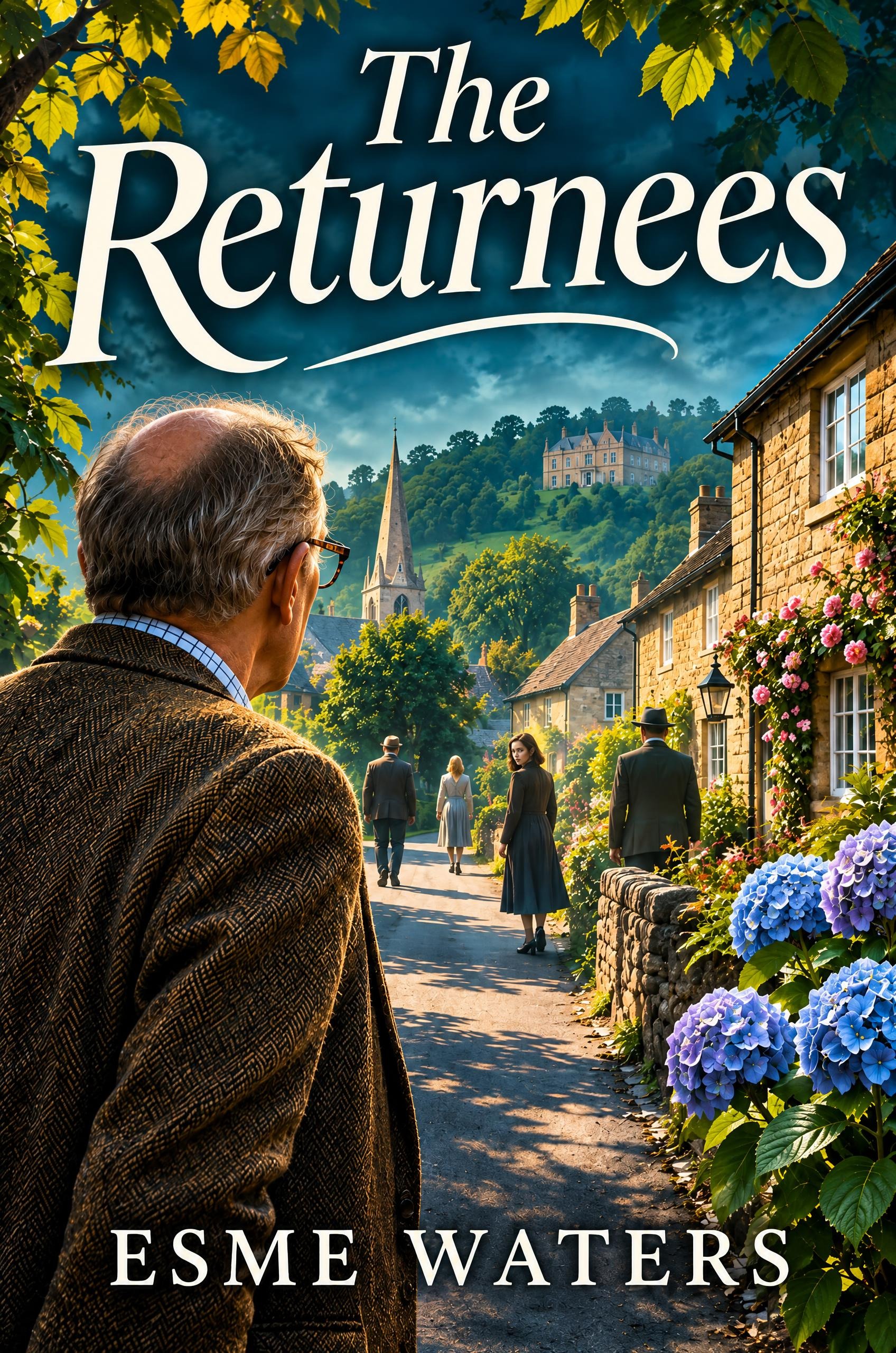
The Returnees
by quiet heron 506
In the tranquil village of St Leonards-on-the-Wolds, the timid and conventional Mr Harving notices unsettling behavioural changes in his neighbours. After overhearing a covert discussion about 'switches' and witnessing the murder and immediate resurrection of a domineering parishioner, he realises that people are being systematically replaced by sinister impostors. Confiding only in the elderly village resident who shares his suspicions, Mr Harving finds himself trapped when his car, telephone, and belongings are compromised. Following the sudden death of his sole confidante, an attempt on his life by the replaced village butcher forces him to defend himself, leave his cherished home behind, and flee on foot across the countryside into the night.
- Science Fiction
- Thriller
- Mystery
- Alien Contact
- Psychological Thriller
- Conspiracy Thriller
Mr Harving takes a walk
Mr Harving was a very sensible man; indeed, he prided himself on being most respectable, dependable and, above all, conventional. He was an ever-present fixture at the village church on Sundays – not because he was particularly religious, but because he felt it proper and traditional, and therefore something he should do. He participated in all the local meetings – not because he felt any great interest in whether a bouncy castle should attend the May Day Fair or if Colonel Denham’s raucous singing would set quite the right tone at the village concert, but because he felt obligated as a respectable citizen. He played golf every week – not because he particularly enjoyed the fiddly game, but because he viewed it as a gentleman’s sport; and, as a gentleman, he felt he should master it in some degree. Everyone grew used to his neat little figure, his thin, pale, bespectacled face, and carefully brushed black hair; and all his neighbours liked him as somebody they could depend upon not to do anything without a good, solid, conventional reason.
And when Mr Harving fled St Leonards-on-the-Wolds one night, he did have a good solid reason, though not altogether conventional: he believed that he was about to be murdered.
It began one hot summer morning, at precisely eleven o’clock. It was Mr Harving’s habit to take a little perambulation at this time and his neighbours had grown so familiar with his habit that once, when Mr Harving had favoured gardening over walking, the queries the following day as to “Why, Mr Harving, no walk yesterday?”, “Mr Harving, didn’t see you yesterday, everything okay?” and “Where did you get to yesterday, Mr Harving?” were such that he had felt obliged to continue his mid-morning walk, long after he’d grown tired of it. He consoled himself with the thought that it was most respectable to have a nice, regular routine.
As usual then, eleven o’clock found Mr Harving walking slowly down his lane, for the morning was a hot one and it would never do for him to perspire. He nodded to elderly Mr Watkins, his neighbour, busily gardening.
“Good morning, Mr Harving. Out for your walk, I see?”
“Yes, yes, I’m out for my walk,” replied Mr Harving, somewhat crossly. As he ambled past, he noticed Mr Watkins determinedly uproot a bed of magnificent hydrangeas. “Why, Mr Watkins, whatever are you doing to those flowers?” he cried.
Mr Watkins looked up in surprise.
“Getting rid of them, of course. I’m going to plant a nice begonia or two instead.”
“But I thought you loved hydrangeas,” said Mr Harving, puzzled, “and – and you hate begonias.”
Mr Watkins hesitated for a second.
“You must have been mistaken,” he said easily.
He resumed his attack on the hydrangeas and Mr Harving hastily continued down the lane, clucking to himself. His clucks turned to depressed tweets as he espied Colonel Denham marching towards him – a golf bag slung over his shoulder. This was another regular morning occurrence, and Mr Harving felt a flutter of nerves. The directness, forcefulness, and confident sense of ability of military men always had a disastrous effect on timid Mr Harving.
“Morning, Harving.”
“Good morning, Colonel.” He pushed himself to make a further effort. “What a lovely morning for golf.”
“Very nice. But I’m not a fair-weather player, mind you. Out in all weather, I am.” He turned a ferocious glare on Mr Harving who hastily concurred, vividly calling to mind a time when he had been dragged around a never-ending golf course in a deluge. “Care to join me?”
Colonel Denham invariably made this offer every morning and Mr Harving invariably declined. Aside from his fear of the military man, the Colonel was a robust player, bordering on aggressive – hitting the ball with a terrific crack regardless of what obstacles lay before him and striding around the course at breakneck speed, carrying a rather scared Mr Harving in his wake.
“Maybe another time, Colonel,” said Mr Harving diplomatically, completing their customary exchange. “Have a good round.”
“Will do. Going to tee off with a blast” – Colonel Denham gave a vigorous swing with his club, nearly taking out Mr Harving – “and land it neatly on the fairway.” Mr Harving stopped listening. The Colonel possessed the unfortunate habit of insisting on taking people through every element of his proposed play. “Then whack it in the goal and –” Mr Harving started. This was new.
“Er – the hole, Colonel.”
“Eh? What’s that?”
“We don’t have goals in golf.”
He peered at the Colonel in concern. Colonel Denham laughed.
“Of course, my dear fellow, of course. Just what I meant. The hole. Jolly good.” He clapped Mr Harving on the shoulder. Mr Harving’s knees buckled. “So long.”
Mr Harving watched him stride down the lane. Really, people were behaving a little odd today. He trotted on towards the last cottage in the lane, Mrs Woodcock’s. His puzzled frown lifted, for before him was a real fairytale cottage, belonging to the idealised visions of fiction rather than hard reality. A sandy thatched roof, whitewashed walls and quaint, slanted windows were framed by a colourful, flourishing garden, shining brightly in the heat of the day and reflected in a gentle, clear stream. The windowsill was packed with little cakes, for Mrs Woodcock was a keen and, importantly, generous baker. She poked her plump, rosy face through the window.
“Morning, Mr Harving. Would you like to try a little of my chocolate cake? It’s just come out of the oven.”
“Very much so, Mrs Woodcock,” twittered Mr Harving eagerly. “Very generous of you indeed, most kind.”
He continued to chirrup happily as he took the proffered slice and bit deeply into its depths. A ghastly taste assailed him. The sponge was undercooked; the eggs had a distressingly moist quality about them; and the flour remained apparent in clear white streaks. He looked at Mrs Woodcock in bewilderment, rather as a small boy might look at a favourite dog who had failed to pull off his usual trick.
“Is it alright?” asked Mrs Woodcock in concern.
Mr Harving was reminded of the politeness he owed as a highly respectable citizen.
“Oh, yes, thank you, Mrs Woodcock,” he gabbled. “Very nice.”
He hastily moved away before she could offer him something else. The rest of the slice was thrown in the high street bin in disgrace. Fancy Mrs Woodcock losing her touch like that. He wouldn’t have believed it possible. Why, her cakes had been the talk of the Christmas fair.
After this tragedy, Mr Harving turned to happier thoughts of the morning’s shopping. He sauntered towards the butcher’s, taking a brief detour down a side street to avoid Miss Perkins (a sprightly widow with an open interest in acquiring a new husband) who was ostentatiously promenading herself down the middle of the road. When the coast was clear, he quickly darted into the butcher’s, nodding as he passed old Mrs Fowler in the doorway, widely acknowledged to be the oldest resident in the village, a claim hotly contested by Mr Watkins. Four sausages and a couple of chops for the week ahead perhaps, he decided, and maybe a little steak to console himself after that nasty business with the chocolate cake.
He gave his order to Mr Jowitt – a huge, muscular, rubicund man, only looking several generations removed from the slabs of meat on his counter – and idly admired the various cuts, contentedly planning future little meals. His attention was caught, however, by Mr Jowitt. Whatever was the man doing? He was making a perfect hash of his lovely bit of ribeye, not at all like the butcher’s usual easy, clean handling.
“Is everything okay?” asked Mr Harving, looking with some concern at his mistreated steak.
“Fine, sir,” replied Mr Jowitt, breathing heavily. “Won’t be a moment.”
Twenty minutes later Mr Harving put his packages in his basket and left the shop. Mrs Fowler was still outside, frowning perplexedly.
“It’s not right,” she muttered to herself. “Not right at all.”
She walked off. Mr Harving looked after her. Had she been wondering about Mr Jowitt too? Was he not the only one to think that it had been a strange morning? He shook himself and hurried on his way.
“Really,” he told himself sternly, “this won’t do. You are getting fanciful in your old age.”
He made a couple more stops at the baker’s, fishmonger’s and library before turning his feet towards home. As he neared the end of the high street, he glimpsed Mrs Evans walking towards the post office. Something stirred in his memory, but he couldn’t put his finger on it. He dismissed the matter from his mind and spent a peaceful afternoon pottering in his garden and tending to his orchids.
It wasn’t until Mr Harving was drifting off to sleep that night that he remembered. Of course. Mrs Evans had told him – in addition to a general announcement to the whole village – that she was to take a cruise around the Mediterranean. He had heartedly approved the idea, thinking that any trip that would place a continent between them was to be encouraged. Mrs Evans, with her busy tongue, inquisitive nature and prying ways was universally disliked. But surely, she was supposed to have left by now? Yes, she was to leave on the … Mr Harving started. But that was days ago! Indeed, she should be endearing herself to her fellow passengers, happily investigating possible scandals and sniffing out secrets, real or imagined.
Why, then, had she forsaken all that delight to stay in St Leonards-on-the-Wolds?
Mr Harving goes out at night
The next night Mr Harving did not sleep well. His mind ran over the events of the day ceaselessly. Once again, the day had been peppered with peculiar instances: people acting out of character; people changed; people odd. As Mr Harving had walked to the high street that morning for the village meeting on the summer fete, he had noted Mr Watkin’s hy…