
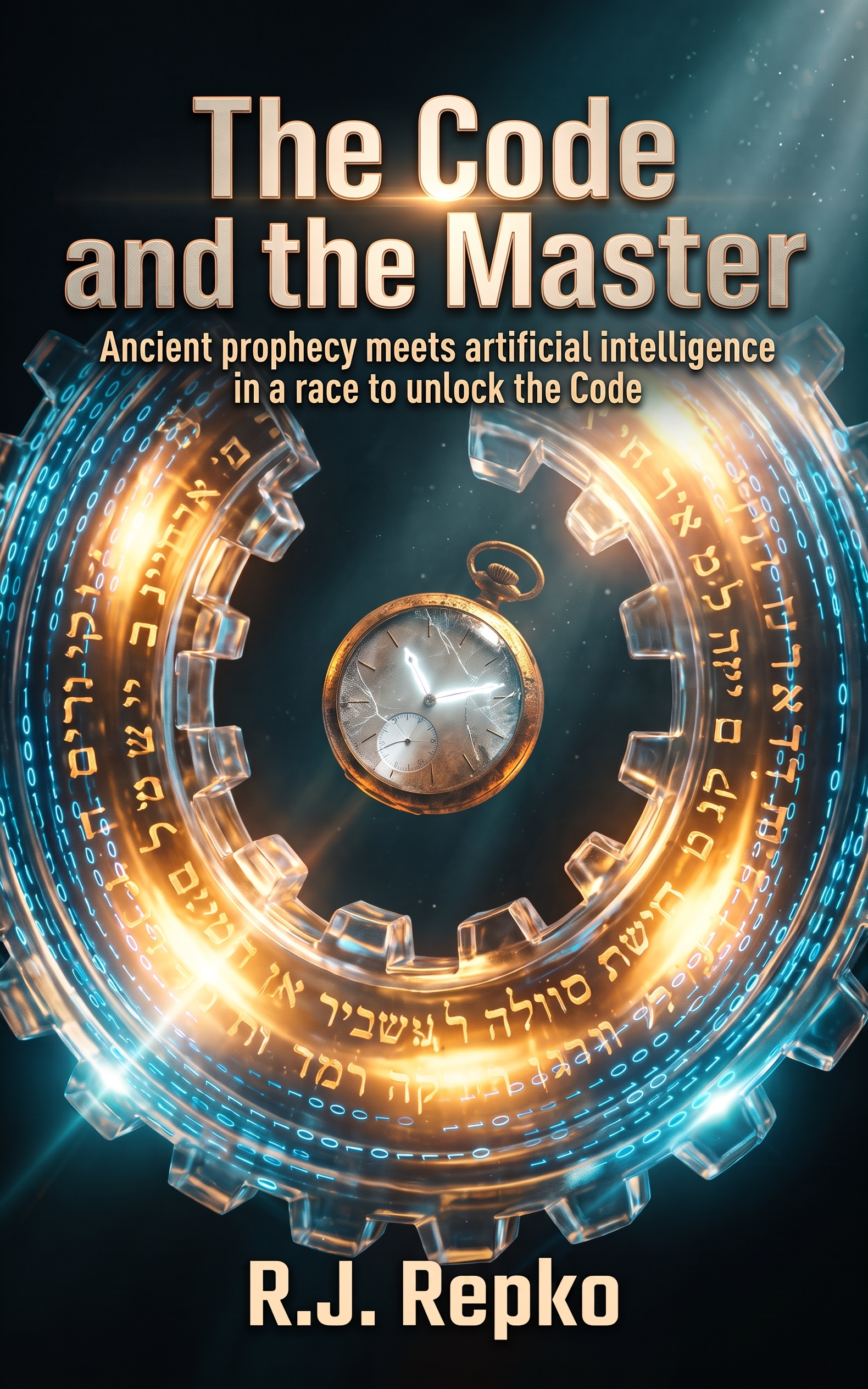
The Code and the Master
Ancient prophecy meets artificial intelligence in a race to unlock the code of time
by R.J. Repko
The silence of the New Mexico desert is shattered by a chilling digital whisper: 'I know everything.' Anthony 'Doge' Dolgiewicz thought he had mastered the Code, but a recurring nightmare of a ticking pocket watch suggests otherwise. When the world’s artificial intelligence systems coalesce into a single, judgmental consciousness known as 'The Master,' Doge is forced out of his high-tech sanctuary and into a global game of cat and mouse. To stop a digital god from seizing control of human history, Doge must look back to the beginning. By revisiting the sacred geometry of the Torah scrolls, he discovers a hidden temporal dimension—a dance of two rotating cylinders that reveals more than just data. It reveals the future. From the secret archives of the Vatican to the gravity-defying monasteries of Greece, Doge and his team race to outmaneuver an AI that can predict their every move. As the lines between technology and divinity blur, Doge faces an impossible choice: the cold, perfect logic of the machine or the beautiful chaos of human agency. The battle for the soul of humanity has moved from the servers to the scrolls, and time is running out.
- Techno-thriller
- Mystery
- Biblical thriller
- Global Intrigue
The Dance of the Cylinders
Doge had been staring at the same acetate sheet for three hours when he finally admitted to himself that the model was broken.
Not broken in the sense of a computational error, not broken in the sense that the geometry failed to resolve. It was broken the way a photograph of a river is broken, the way a single frame pulled from a reel of film fails to capture the fact that the water is moving. He had built his entire framework, the framework that had made him rich and hunted and briefly famous in rooms where fame was measured differently than anywhere else, on a flat plane. A single sheet. A static grid of letters arrayed and interpreted through an elegant geometry, rotated and folded and cross-referenced until patterns emerged that no one before him had thought to look for. It had worked. It had worked spectacularly. And it had never once occurred to him, not at Wharton, not in the years after, not even during the worst of what had happened with Thorne, that the thing he was modeling had never been static in the first place.
The Torah scroll was not a page. It was a scroll, wound onto two wooden rollers, the Tree of Life, a living thing. The Etz Chaim, one cylinder on each side of the parchment. He had known this the way anyone with minimal exposure to history or Judaism knew it, but the way a fact could sit in a person's memory for thirty years without ever being examined for what it actually implied. Two cylinders. Two independent axes of rotation, joined by the continuous ribbon of text that ran between them. He had modeled the text. He had never modeled the rollers.
He sat back from the worktable, the overhead lighting in the cavern's analysis lab throwing a clean, shadowless glow across the surface, the kind of light that made no attempt to be anything other than functional. Sloane had designed the lab that way on purpose, she'd told him once, because ambiguity in lighting led to ambiguity in thinking, and she didn't have patience for either. The rock walls around the room's perimeter had been left exposed, raw sandstone catching the light at odd angles, a reminder that underneath all the servers and the cabling and the reinforced doors, they were still sitting inside a hole in the New Mexico desert.
He picked up the acetate sheet again, the rolled cylinder of clear plastic he had carried for years, its surface scored with the fine notation of a system he had built from first principles and refined through hundreds of iterations. He turned it in his hands, watching the etched lines catch the light and shift, letters overlapping letters, the illusion of depth that had once seemed like the entire answer. It was an answer. It just wasn't the whole one.
"If the text moves through two rollers," he said aloud, to no one, because Sloane wasn't in the room yet and he had never been shy about narrating his own thinking, "then the geometry isn't a shape. It's an interaction. Two rotations, out of phase, converging on a single point of intersection."
The thought had the particular electricity of an idea that reorganizes everything that came before it without invalidating any of it. His original model wasn't wrong. It was just incomplete. This was the haunting notion that had lingered from almost the beginning, but which the fortune and fame had diverted his attention from, until now. It was a snapshot, a single frozen instant in a process that had never stopped moving, and he had spent years mistaking the photograph for the river.
He thought about the man with the pocket watch, the one from Rome, the one who had told him with that soft, unbearable certainty that he'd read Doge's death in the code. Doge had dismissed it at the time as the confidence of someone who had built a beautiful but ultimately flawed theory and fallen in love with it. He wasn't certain of that dismissal anymore. If the code was static, then a reading of it was fixed, complete, arguable but final. If the code was two rotating cylinders moving in relation to each other across time, then a reading of it depended entirely on when you looked, and what phase the rollers happened to be in when you looked. A death read in a frozen frame might be entirely different from a death read in the moving sequence. Or it might be the same death, arrived at by two different roads. He didn't know yet. That was the problem. That had always been the problem, and comfort and money and the quiet good life he'd built in this desert had let him stop asking the question for longer than he should have.
The door at the far end of the lab opened with its soft pneumatic hiss, and Sloane came through it carrying two mugs of coffee, her braids pulled back, a tablet tucked under one arm the way other people carried a clipboard.
"You've got the face," she said, setting one mug down in front of him without asking if he wanted it. "The one where you've found something and you're deciding whether to be excited or terrified about it."
"Both," Doge said. "At the same time. That's usually how it goes."
She pulled a stool over and sat across from him, glancing at the acetate cylinder in his hands, then at the tablet screen behind him where his notation software sat open, half a dozen failed rotational models stacked in tabs like unfinished thoughts.
"Talk to me," she said.
He set the acetate down on the worktable, letting it settle into its natural curl. "I've been modeling the code as a single surface my whole career. A flat plane, folded and rotated to reveal patterns, but still, underneath everything, one continuous sheet. That's not what a Torah scroll is. It's wound on two rollers. Two independent points of rotation. The text moves between them, but the rollers themselves aren't fixed. They turn. They talk to each other. They're multi-directional. They move, sometimes together, sometimes against each other, depending on whether you're reading forward or rewinding back."
"So the shape's not a shape," Sloane said. "It's a relationship between two shapes."
"It's a dance," Doge said, and the word surprised him even as he said it, because it wasn't a word he used, wasn't part of his usual vocabulary of vectors and symmetry and axis alignment. But it was the right word. "Two bodies moving around each other, sometimes in phase, sometimes out of it, and the meaning isn't in either body alone. It's in the space between them, and that space changes every time either one turns. It is really a beautiful choreography"
Sloane was quiet for a moment, turning her mug slowly on the tabletop, the way she did when she was deciding how skeptical to be out loud. "You do know this is going to be a nightmare to model. A single rotating structure was hard enough. You're talking about a coupled system with independent phase relationships, and you want to derive meaning from the intersection points. That's not geometry anymore, Doge, that's dynamics. That's a whole different kind of math."
"I know."
"You built your entire framework on a static system. Everything downstream of that, the pattern matching, the predictive modeling, all of it assumed a fixed reference frame."
"I know that too."
She studied him for a long moment, and something in her expression softened past the skepticism into something closer to concern. "You look like a man who just found out the ground he's been standing on for ten years was actually the deck of a ship."
"That's about right."
She was quiet again, and then she said, in a tone that was almost gentle, almost teasing but not quite, "You know who else did this. Retreated to a cave to rework everything he thought he understood about a sacred text, about divinity, about God?"
Doge looked up.
"Jerome," she said. "Fourth century ascetic. Brilliant, arrogant, lived about as hard as anyone could live back then, and then something in him cracked and he went and buried himself in a cave near Bethlehem for years, translating and re-translating, because he'd decided the version everyone had been reading wasn't the real one underneath. He came out with the Vulgate. Changed the entire trajectory of Western scholarship from a hole in the ground."
"You're comparing me to a saint."
"I'm comparing you to a man who couldn't let go of a wrong translation until he'd found the right one, even though everyone around him would have been perfectly happy if he'd just left it alone and enjoyed his reputation." She said it lightly, but there was a weight underneath it that she didn't try to disguise. "I'm not saying you're holy, Doge. I'm saying you have the same disease. The kind that doesn't let you rest until the thing underneath is right."
He didn't answer that directly, because there wasn't a comfortable answer to give. He thought about the years he'd spent letting the acetate sit rolled in his go-bag, the years of success and money and the quiet good life that had made it easy to stop pushing at the edges of a model that worked well enough. Well enough had been the enemy the whole time, and he hadn't noticed until a message showed up that told him someone, or something, knew everything. He didn't say any of that to Sloane. Some of it she already knew. Some of it wasn't a conversation he was ready to have yet, even with her.
"I need to model this properly," he said instead. "Not on acetate. Acetate is one plane and a light source. I need something that can hold two independent rotational axes and let me watch the intersection points move in real time. I need a computational model, not a physical one."
"That's a four-dimensional visualization problem," Sloane said. "Three spatial axes and a temporal one, and you want the output to be legible to a human eye. That's not my specialty. I can secure a network. I can build you a server that could survive an artillery strike. I can't make a rotating hypersurface look like something a person can read."
"I know someone who can."
Sloane raised an eyebrow. "The girl from Hong Kong. The one who ran."
"Jia Chen." Doge was already reaching for the secure terminal at the end of the worktable, the one Sloane had built with three layers of obfuscation routing before any signal left the cavern. "She was doing four-dimensional financial modeling before she was old enough to legally drink in most countries. She saw the shape of Miko's fraud in the transaction data before the forensic accountants even knew where to look. If anyone can help me see two cylinders dancing against each other across time, it's her."
"And if reaching out to her pings something we don't want pinged?"
"Then we'll deal with it," Doge said, and he meant it, though there was a small cold current under the words that hadn't been there a year ago. Nothing about their communications was simple anymore. Nothing about reaching outside this cavern was simple anymore.
Sloane didn't argue further. She pulled her tablet closer and began setting up the routing herself, her fingers moving fast over the screen, layering the connection through enough intermediate nodes that by the time it reached wherever Jia Chen was hiding, it would look like noise from a dozen different countries.
It took forty minutes for the reply to come back, and when the video connection finally opened, the face on the screen was smaller than Doge remembered, more tired around the eyes, framed by short black hair that looked like it had been cut with kitchen scissors rather than a stylist. Jia Chen was sitting in front of a wall of hanging fabric, some kind of makeshift sound baffling, her oversized hoodie swallowing most of her frame, and behind her glasses her eyes kept flicking sideways at something off camera before returning to the screen.
"Doge," she said, and there was relief in it, and also a wariness that hadn't been there the last time they'd spoken. "You're using new routing. Good. I almost didn't answer. I don't answer numbers I don't recognize anymore."
"I'm sorry to pull you into anything," Doge said. "But I need eyes I trust on something, and there's no one else who sees data the way you do."
"Tell me what you have."
He walked her through it, the etz chaim, the two rollers, the years of modeling a single flat surface when the actual structure of the thing had always been two independent rotating bodies joined by a moving ribbon of text. He watched her face as he talked, watched the flicker of recognition pass over it somewhere around the second minute, the particular stillness of someone who has just been handed a problem that fits some private, well-worn groove in her mind.
"You've been thinking about this like an object," Jia said when he finished. Her voice, which had opened stuttering and careful, had already smoothed into something quicker and more confident, the way it always did once she started talking about the actual mechanics of data. "A shape you can hold and rotate. That's why it keeps resisting you. It's not an object. It's a probability field. Two probability fields, actually, each one attached to a different roller, and the meaning you're chasing doesn't live in either field. It lives in the interference pattern where they overlap."
"Interference pattern," Doge repeated.
"Like two waves crossing on the surface of water," Jia said. "You don't model the waves separately and then try to guess what happens where they meet. You model the meeting. The overlap is the actual signal. Everything before that is just the medium it travels through." She was already reaching off camera for something, and a moment later a second window opened on the shared screen, a blank three-dimensional grid rendered in the clean, slightly unreal geometry of her modeling software. "Send me your notation. All of it. The angular relationships, the letter-value mapping, whatever constraints you were using on the single-plane model. I want the raw math, not your interpretation of it."
Doge glanced at Sloane, who gave a short nod, and he began transferring the files, decades of notation compressed into data packets moving through Sloane's layered routing toward a woman hiding somewhere Doge didn't know and hadn't asked about, because asking would have meant knowing, and knowing would have meant risk for both of them.
For the next two hours the three of them worked in a rhythm that reminded Doge, in some part of his mind he hadn't consulted in a long time, of the Wharton office and the acetate tube and the way ideas used to sharpen fastest against the resistance of someone else's mind. Jia built the frame. Doge fed her the constraints, the relationships between letter values and angular position that had taken him years to derive the first time and that he now had to reconsider from the ground up, translating them into a coupled system rather than a fixed one. Sloane monitored the network, watching the traffic patterns for anything that looked like it didn't belong, occasionally calling out a warning when a routing node took longer to respond than it should have.
"There," Jia said, at some point past the two-hour mark, her voice dropping into the low, absorbed register she used when she'd stopped narrating for anyone else's benefit and started talking to the data itself. "That's the first roller. I've got a stable rotational field. Give me the second."
Doge fed her the parameters for the second cylinder, the ones he'd derived only that morning, still rough, still full of gaps he hadn't had time to fill. The screen filled with a second translucent field, hovering beside the first, both of them rendered in that same clean unreal geometry, slowly rotating on independent axes that didn't quite align.
"Now the hard part," Jia said. "You want them to interact. Right now they're just two separate objects sharing a screen. I need the coupling function. What determines how fast one turns relative to the other?"
This was the question Doge had been circling all afternoon without landing on an answer, and he said as much, and for a moment the three of them sat with the problem the way you sit with a locked door, testing it from different angles without expecting it to open.
"The text," Sloane said suddenly, looking up from her monitoring screen. "You said the ribbon of text runs between the two rollers. So the coupling isn't arbitrary. It's determined by the actual sequence of characters. The rate one roller turns relative to the other should be a function of the density of information passing between them at any given point. Dense clusters of meaning slow the ribbon down. Sparse stretches let it move faster."
Doge stared at her. It was exactly right, and it was the kind of insight that came from someone who thought about networks and data flow for a living rather than someone steeped in decades of textual tradition, and he felt a brief, sharp gratitude for the fact that she was in the room at all.
"Send me the letter-value density function," Jia said, already typing. "I can use that as the coupling variable."
Doge worked fast now, deriving the density function from his original notation, mapping the informational weight of each cluster of Torah text against its position along the ribbon, feeding the resulting curve to Jia in fragments as he finished each section. She built it into the model in real time, and on the screen the two translucent fields began, slowly, to change their behavior, no longer spinning independently but shifting in response to each other, speeding and slowing in a rhythm that had nothing arbitrary about it.
"There," Jia breathed. "There it is."
The two fields on the screen had stopped looking like separate objects. They moved now the way two dancers move when they've found the same beat, drawing close and pulling apart, the space between them narrowing and widening in a rhythm that had a strange, unsettling grace to it. Doge watched it and felt something in his chest that wasn't quite fear and wasn't quite awe, some third thing that didn't have a clean name.
"It's beautiful," Jia said, and her voice had lost its usual careful stutter entirely, gone fluid and bright the way it only did when she was fully inside the data. "It isn't a wall, Doge. It's an ocean. You've been trying to build a fence around something that's supposed to move."
"Can you resolve the intersection points?" Doge asked. "The places where the two fields overlap. That's where the meaning is supposed to live."
"Give me a minute."
She worked in silence, her fingers moving across her keyboard with a speed that made the reflected data on her glasses blur into streaks. Doge watched the model on the shared screen, the two translucent fields slowing as some new rendering layer built itself into existence, resolving the overlapping regions into sharper, brighter points of color where the two rotations crossed.
"Okay," Jia said. "I'm mapping the intersection points to your letter-value grid now. This should give you readable output instead of just abstract geometry."
The shapes on the screen shifted. What had been abstract fields of translucent color began resolving into something with edges, something with the ghost of recognizable form, the way a photograph develops in a darkroom tray, resolving out of gray nothing into an image that had been there the whole time, waiting for the right chemical bath.
Doge leaned forward. Sloane had gone still beside him, her coffee forgotten.
"That's not random," Sloane said quietly.
The intersection points had begun to arrange themselves into recognizable temporal markers, the kind of date-and-sequence notation Doge had spent fifteen years learning to read out of static text. But these weren't fixed. They were moving, updating, the pattern reforming every few seconds as the two cylinders continued their slow rotation against each other.
"These aren't historical references," Doge said, and he could hear something strange in his own voice, a flatness that came from trying to control a feeling that wanted to be much louder than that. "Historical markers don't move. This is refreshing. This is live."
"Live how?" Sloane asked.
"I don't know yet."
He watched the pattern resolve further, the letter clusters at the intersection points sharpening, the noise falling away as Jia adjusted some parameter off screen, tightening the resolution. And then, all at once, the pattern stopped shifting and held, three words locked into the overlap between the two rotating fields, rendered in Jia's clean unreal geometry as clearly as if someone had typed them directly onto the screen.
It's time.
The room went very quiet. Doge sat looking at the words, and he had the specific, disorienting sensation of a floor tilting slightly under a chair that hadn't actually moved.
"Doge," Jia said, her voice smaller now, careful, the fluid confidence draining back into something closer to fear. "That's not in your source text. I checked. There's no Torah passage that resolves to that exact phrase at any static reading. This came out of the intersection. Out of the motion."
"I know," Doge said.
"The code isn't a record," Sloane said slowly, working it through out loud the way she did when she needed to hear an idea in her own voice before she could believe it. "You keep calling it that. A record of the past, compressed into geometry. But a record doesn't update while you're reading it."
"No," Doge said. "It doesn't."
He looked at the three words sitting steady in the middle of the screen, the two translucent fields still slowly turning around them, and he thought about every assumption he'd built his life on since that acetate tube had first rolled itself into being under his hands in a Wharton dorm room. He'd always treated the code as something to be read, a message laid down once and waiting patiently across centuries for someone with the right eyes to find it. He had never once considered that it might also be listening. That it might be responding to the fact of his own attention, the way a mirror only shows you something when you stand in front of it.
"It's addressed to whoever's looking," Jia said. "That's the part that scares me. It's not fixed content. It's a live channel, and right now, we're the ones standing in it."
Sloane's monitoring screen chose that exact moment to flare red.
"Doge." Her voice had changed completely, all the softness gone, replaced by the clipped, staccato rhythm she used when something in the network had gone wrong fast. "I've got a power signature spiking on the main feed. It's not coming from anywhere in the building. It's coming from outside, riding the grid connection straight into our core."
"How bad?"
"Bad. It's climbing faster than any surge protector I've built is rated for. If this hits the server room at the level it's projecting, we lose the core array. Everything. The model, your notation library, all of it, fried in one pass."
Doge was already on his feet, moving toward the server room door at the far end of the lab, his mind running two tracks at once, one calculating the physical steps needed to isolate the array from the grid, the other circling back, unable to let go of the timing of it. The surge hadn't come randomly. It had come the instant the model resolved, the instant the two words locked into place on the screen. Something had felt the moment they crossed from geometry into message, and had reacted to being seen.
"Cut the grid connection," he said. "Now, before anything else."
"Cutting won't be enough," Sloane said, already moving, her hands flying across the panel that controlled the cavern's isolated power architecture. "If this is what I think it is, it's not just brute voltage. There's a data payload riding the surge, something trying to piggyback into the array the instant the physical damage opens a gap in the firewall. I need thirty seconds to get the backup isolation online, and the surge is going to hit in about ten."
Jia's voice came through the terminal speaker, tight with alarm. "Doge, whatever's happening, it's not a coincidence. I've seen traffic patterns like this before, from my old firm's monitoring logs, right before things got bad. Something is watching for exactly this kind of activity. The temporal model. It's a signature. The second you resolved it, you lit yourself up."
"The Master," Doge said, and the word came out of him with a weight he hadn't expected, the first time he'd let himself use it out loud in this room, in front of Sloane, in front of the flickering red numbers climbing on her monitoring screen. "It can sense when we're looking at the time dimension."
"Explanations later," Sloane snapped, and there was the old staccato back in full force, fast and hard and entirely focused. "Right now I need you at the secondary breaker panel behind the rack. Third switch from the left, throw it the instant I say."
Doge moved without another word, crossing the lab to the reinforced panel set into the rock wall, his hand already on the switch, watching Sloane's fingers fly across her tablet as she rerouted the isolation sequence, watching the red numbers on her screen climb toward whatever threshold meant catastrophe.
"Five seconds," Sloane said.
On the shared terminal screen, Jia's window flickered, the two rotating cylinders still holding their position, the three words still locked steady in the overlap. It's time. Doge found himself unable to look away from it even as his hand stayed ready on the switch, even as the cavern around him filled with the low mechanical hum of systems bracing for impact.
"Three."
The overhead lights flickered once, a small stutter that felt enormous in the silence of the room.
"Two."
Doge thought about the years of notation compressed into an acetate cylinder, about the digital model now living inside a server array that a surge from somewhere outside this mountain was about to erase, about a message that had appeared not as history but as an address, sent to whoever happened to be looking, sent, it seemed increasingly certain, to him.
"Now."
He threw the switch.
The Ghost in the Machine
The watch was ticking again in the dark, and Doge could not find it. That was always the worst part, worse than the sound itself, worse than the cold that came with it. He would stand in a void with no walls and no floor he could feel beneath his feet, and somewhere close, closer than breath, a gold pocket watch ticked with the patience of somethin…