

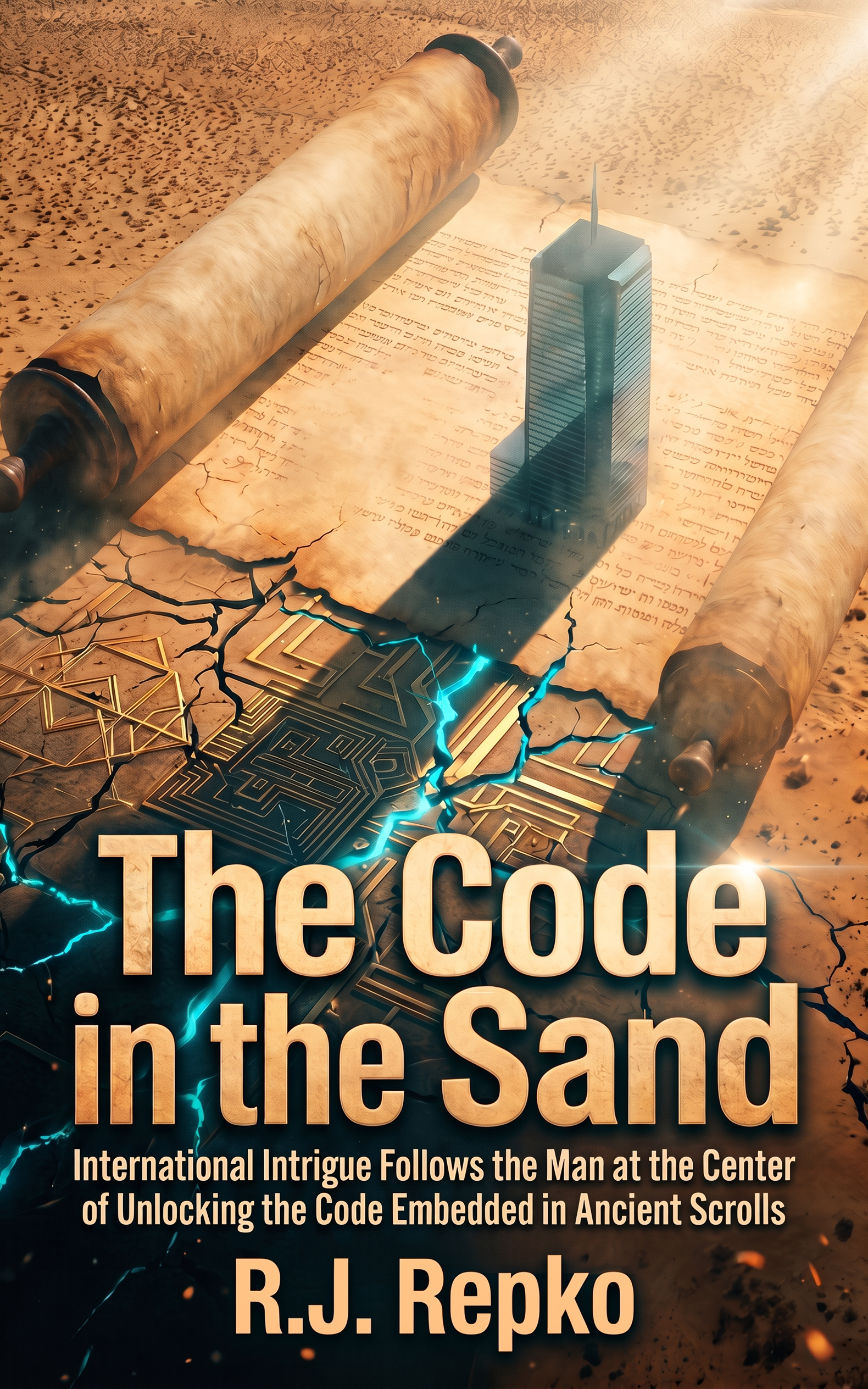
The Code in the Sand
International Intrigue Follows the Man at the Center of Unlocking A Code Embedded in Ancient Scrolls
by R.J. Repko
Anthony ("Doge") Dolgiewicz was never just an athlete from a small town in Pennsylvania's Anthracite coal region; never just a student-scholar at an elite Ivy League University. He was a man who saw the world in dimensions others couldn't see. By decoding the physical geometry of ancient Biblical texts - Torah scrolls - he didn't just find a prayer—he found a mathematical algorithm that unlocks the future. Now a billionaire consultant living in self-imposed exile in the American Southwest, Doge hoped to leave the world behind. But the world isn't finished with him. A shadowy cabal known as The Prism is hunting the code to rewrite the global order, and they’ve enlisted Doge’s old mentor to track him down through the scorched Mojave desert. From classrooms in Philadelphia to the high-stakes trading floors in the world's financial centers, to the secret corridors of international espionage, Doge is thrust into a race against time. With a rogue FBI agent and a brilliant desert hacker as his only allies, he must protect a secret that has been hidden for millennia. As an energy crisis threatens to spark global war, Doge realizes his discovery isn't a burden—it’s the ultimate key to human survival. In this pulse-pounding thriller, the line between ancient prophecy and modern technology vanishes, leaving one man to open the lock that preserves the future and holds the fate of the world.
- Thriller
- Adventure
- Mystery
- Fantasy
- Conspiracy Thriller
- Action Adventure
The Sand and the Silicon
The morning came in slow, the way it always did out here, light dragging itself up over the canyon rim like it had somewhere better to be and knew it. The Sangre de Cristo range sat purple and distant to the east. A hawk turned lazy circles above the arroyos. Nothing moved on the dirt road that wound down from the highway and disappeared into the scrub three miles north. Nothing ever moved on that road. And if it ever did, he would see it. That was the point.
Anthony "Doge" Dolgievicz stood at the edge of his converted shipping container, a mug of black coffee cooling in his hand, and watched the desert wake up. A three-year-old unable to pronounce "Dolgiewicz", he settled on "Doge", and so "Doge" it was.
He'd been out here about two years now, give or take the time he stopped counting. The container was forty feet long, insulated, and anchored to a concrete pad he'd poured himself over the course of a week that nearly killed him in the September heat. Solar panels ran along the roof in two parallel rows. A water reclamation system he designed on a legal pad one idle afternoon fed a small cistern buried in the hillside. He had a propane range, a cot, a worktable, and server towers that hummed behind a partition he'd framed in with salvaged two-by-fours. It wasn't much, and he now liked it that way. He'd had much, once, and it cost him things he couldn't get back. So he jettisoned the things he could to some vaults in Hong Kong and withdrew here; clean, ascetic, unencumbered. A voice in the wilderness with WIFI and air conditioning.
He let his mind drift, the way it did most mornings before the work of the day pressed in. The coffee steamed faintly. The hawk dropped out of its ever-widening gyre and vanished behind a ridge. And Doge thought, as he sometimes did when the desert was quiet enough to let him, about a bicycle lock.
It was a cylindrical lock. One of those combination jobs with rotating numbered tumblers running along the barrel. His friend Marcus was kicking his bike on Locust Walk just outside of Wharton one Tuesday in February, the kind of cold that came off the Schuylkill and found every gap in your coat, and Marcus was swearing with a creativeness that Doge genuinely admired. The lock wouldn't open. Or rather, Marcus couldn't make it open, which was a different problem entirely. Doge crouched down and took the cylinder in his hands, and he'd started working the tumblers, not randomly, but with a kind of listening quality, feeling for the faint mechanical resistance that told him when a tumbler was close to its seat. His hands knew this kind of thing. Growing up in the coal region, you learned early that machines were not your enemies if you paid them proper attention. His father drove a truck for forty years and could diagnose an engine problem by the sound it made backing out of the driveway.
But as Doge worked on the lock in his hands that afternoon, his mind drifted sideways, the way it did when it was most alert and alive. He was taking a course that semester, a "gut" course, the kind designed to shepherd seniors across the graduation finish line with minimum friction. "Biblical Texts and Modern Interpretation." It was three credits and required almost no work. The professor was affable and easily distracted, and in recent weeks the syllabus wandered away from the canonical texts entirely and into the territory of Bible codes, the popular books that claimed hidden messages and prophetic mathematics embedded in the Pentateuch. The first five books. The Torah.
Doge hadn't paid the course or those books much mind beyond getting the grade and the credits. But as his fingers turned the tumblers on Marcus's cylindrical lock, something happened in the back of his skull. A click that had nothing to do with the tumblers in the lock in his hands.
The Torah was written on parchment. The parchment was wound around wooden rollers, the Etz Chaim, the Trees of Life. Unrolled for reading. Re-rolled afterward. The letters on the surface of the scroll were fixed, but their spatial relationship to every other letter on the scroll was not fixed at all. It changed with every fraction of a turn. When you rolled the parchment one way, letter aleph in verse three sat directly above, in three-dimensional space, letter bet in verse forty. Roll it a quarter turn further, and the alignment was completely different. The scroll was not a flat document. It was a cylinder. Two cylinders. Like the lock in his hands. How the letters aligned in relation to one another was not linear, it was three-dimensional, or multi-dimensional, and it was ever-changing as the scrolls rolled and unrolled.
He got Marcus's lock open. He didn't remember exactly when. What he did remember was walking back to his apartment in the cold and not feeling the cold at all, because his mind was elsewhere entirely, constructing a geometric model of a rolled scroll and the ways letters could align through the layers if connected with imaginary lines, the lines changing their direction and length and the letters they connected with every infinitesimal rotation of the parchment. It was not a code embedded in the text. It was a code embedded in both the text and the object. In the physical geometry of the scroll itself. A dance with meaning in three dimensions.
He spent the rest of that semester building the model. Not on a computer at first, but on paper, then on a length of transparent acetate he'd rolled around a cardboard tube, marking letters and drawing connecting lines with a red marker. The patterns he found were not random. They were recursive, self-similar, the same geometric relationships appearing at different scales, like a fractal that never stopped resolving into finer detail. He'd shown the work to his graduate teaching assistant, a woman named Reza Malak who had a mind like a surgical instrument and who looked at his acetate tube and its web of red lines for a long time without speaking. Then she said, quietly, that she thought he should keep this to himself for a while.
He hadn't, entirely. He'd kept it to himself long enough to run the algorithm against commodity futures data, which was the part he was least proud of and most grateful for, depending on the day. The geometric sequences in the scroll corresponded, in ways he still could not fully explain, to cyclical patterns in certain market movements. Not perfectly. Not like a machine. But well enough. Well enough to turn a small stake into a large one, and a large one into something that required lawyers in three countries.
After that, the world found him despite his best efforts at discretion. It found him because money, however quietly accumulated, left tracks. And because Reza Malak, he would later come to understand, had been watching those tracks from the beginning. There were others, too. Academics. Intelligence analysts. A defense minister from a country he'd agreed never to name. They came to him with their problems, these princes and potentates, their geopolitical puzzles and their market crises and their diplomatic impasses, and he sat with those problems the same way he'd sat with Marcus's bicycle lock, listening for the click and the tumbler to fall, and more often than not he found it. The reputation grew and with it the invitations multiplied. There was a period of roughly four years where he moved through the world like a man whose hair was on fire and was constantly surprised that people noticed. He was an object of intense curiosity, greed and, increasingly, danger. For every flattering or flirtatious solicitation there was, increasingly, a threat.
When the risk-benefit ratio turned against him, as he saw it, when the threats seemed to outnumber the benefits, and when the weight of being a spectacle or side-show freak was no longer bearable, he put the fire out by moving to the desert. It seemed like the only logical solution, and for a time it was the perfect solution. The solitude suited him, and the quiet suited him even more. The noise had stopped, and that was just fine with him.
The mug in his hand had now gone cold. He drank the last of the coffee anyway and went back inside.
The server towers behind the partition were running their morning diagnostic cycles, the indicator lights cycling green in the dimness. He started work on the network a few months after he arrived, and built it himself over eighteen months, using hardware sourced through five separate purchasing agents, no single component traceable back to him through anything shorter than a chain of eight transactions. The primary array handled his encrypted correspondence and his market monitoring. The secondary array was essentially a sensor grid, interfaced with half a dozen hardware nodes he'd buried at intervals across a two-mile radius around the container. Motion sensors. Acoustic monitors. An IR tripwire along the dirt road. A weather station doubling as a signal detector on the ridge to the west.
He was pouring a second cup of coffee when the secondary array went down.
Not a graceful shutdown. Not a power fluctuation. It went down the way a candle goes out in a sudden draft, everything present and then nothing, the diagnostic lights going dark in a cascade that took about four seconds from left to right. He stood in the kitchenette with the coffeepot in his hand and watched it happen.
He set the pot down carefully and went to the partition.
The secondary towers were not just offline. Two of the three had their status indicators showing red in a pattern that meant hardware failure, not software. He'd seen software failures. They had a particular signature in the logs, a trail of error codes and timeout notices. This had no log trail. The servers had simply ceased to function, as though something had reached inside them and turned off whatever made them go.
He pulled the access panel on the nearest tower and checked the primary board. The capacitors on the power regulation circuit were blown. Not worn out. Not failed through ordinary use. Blown, as in subjected to a voltage spike that the surge protection should have caught but hadn't, because the surge protection had been bypassed. He checked the second tower. Same pattern. Someone had sent a localized electromagnetic pulse through his sensor grid, and it then traveled back up the cable runs to the servers.
Not a hack. A physical act.
He thought about that for a moment. Then he went to the gun safe mounted to the interior wall beside the door and took out the short-barreled twelve-gauge he kept there, loaded it with the low-velocity shells he preferred for close work in tight spaces, and went outside.
The desert was still. The hawk was gone. The light had climbed fully over the canyon rim now, and the scrub cast short shadows that would disappear by noon. He did a slow circuit of the container's perimeter, checking the conduit runs that carried the sensor grid's signal cables, looking for the point of intrusion. He found it at the northeast corner, where a buried conduit surfaced briefly to pass through a junction box mounted on a steel post. The junction box had been opened. The work was clean and fast, the kind done by someone who knew exactly what they were looking for and brought the right tools. A small device was clamped to the bus bar inside the box, a device he carefully did not touch. It was no larger than a deck of cards. It had a small antenna.
He straightened up and looked north, toward the dirt road.
There was a figure in the scrub about sixty yards out. Sitting cross-legged in the dirt with a ruggedized tablet on her knee, watching him with the calm expression of someone who had been watching for long enough that the novelty had worn off.
"You found the node," the figure called out. Not a question.
Doge kept the shotgun at a relaxed low-ready and considered the figure. Young woman. Dark skin. Hair in tight braids. Some kind of utility vest over a long-sleeved shirt. The tablet on her knee had what looked like an antenna array attached to its case with a zip tie.
"You want to come out of the scrub?" he said.
"I want to make sure you're not going to shoot me first."
"I won't shoot you. I haven't shot anyone in days, weeks maybe."
"Says the man holding a shotgun."
"I won't shoot you," he said again, with more weight to it. "I promise."
She unfolded herself from the ground with a fluid economy of motion that told him she'd been sitting there for a while and kept her muscles loose deliberately. She walked toward him across the scrub, stepping over a cholla cactus without looking down at it. When she got to within ten feet she stopped and looked at the junction box on its post, then at him.
"I didn't put that there," she said. "I found it three nights ago. I've been running analysis on its transmission signature since then."
"And you didn't think to tell me."
"I didn't really know who you were until recently. I knew you were living out here, and I knew someone was very interested in you, and I wanted to understand why before I knocked on your door. I had to learn more before just wandering in. After all, you did come out with a gun."
He looked at her for a moment. "How long have you been watching this place?"
She had the grace to look slightly uncomfortable. "Six weeks, approximately."
"Six weeks."
"Give or take."
"If she's been there that long," he thought, "she's not a threat. Not a physical one, anyway." He lowered the shotgun the rest of the way. "Come inside," he said. "There's coffee."
Her name was Sloane Kalu, and she talked the way some people typed, fast and with minimal punctuation, one thought running directly into the next without apparent pause for breath. She sat at his worktable with the tablet in front of her and a mug of coffee she didn't drink, and she walked him through what she'd found with the focused efficiency of someone waiting to deliver a briefing and not wanting to waste the chance.
"The device in your junction box is a pulse emitter," she said. "Directional. Whoever planted it was aiming it at your conduit runs specifically. They knew your layout, which means they had prior surveillance. But here's what I haven't been able to figure out." She turned the tablet to face him. The screen showed a signal map, a visual representation of radio frequency activity in the area, rendered in false color. There was a bloom of activity centered roughly on his location. "That's been live for at least three weeks. A carrier signal, very low power, bouncing between a commercial telecom relay twelve miles west of here and something orbital."
"Something orbital," he repeated.
"A satellite that is not listed in any public registry I can find. It's using a frequency allocation that should belong to a defunct Korean weather service. It's mapping your location with enough precision to drop a package on your doorstep from two hundred miles up." She picked up the coffee, seemed to remember she wasn't drinking it, and set it back down. "I call the network running it the Ocularis. I don't know who operates it. I know it's been tracking you specifically for at least six weeks, which is how I found you, because I found the Ocularis first and followed it to you."
Doge sat across from her and thought about the junction box and the blown capacitors and the clean, professional work of whoever placed the pulse emitter. He thought about the fact that his secondary array being down meant his perimeter sensors were down, which meant he was currently operating blind across two miles of desert terrain.
"When did it fire?" he asked. "The pulse emitter."
"Approximately four-seventeen this morning. I was monitoring it. I think last night's firing was a test. A calibration shot. They weren't trying to permanently disable you. They were confirming the device's effective range." She paused. "My guess is the real move is coming soon."
He stood up and went to the small window cut into the container's south wall. From this angle he could see a stretch of the dirt road where it curved around a sandstone outcropping about a mile and a half out. The road was empty. For now.
"You said you followed the Ocularis signal to find me," he said. "What were you doing looking for the Ocularis in the first place?"
She was quiet for a beat, which was the first time since she'd sat down that she was quiet for any appreciable interval. "I was living about forty miles east of here. I've been off grid for two years. I do some work for communities out here, helping them stay dark. Keeping their communications out of surveillance databases. Last spring I started finding anomalous traffic in the regional RF environment, signals that didn't belong to any infrastructure I could account for. I started pulling on that thread." She looked at the tablet. "You pull on enough threads, you find the loom."
He turned back from the window. There was something in the way she said it, the resigned practicality of it, that he recognized. The sense of having arrived at a conclusion you neither foresaw nor particularly desired.
"What do you know about me?" he asked.
"I know what the Ocularis knows," she said. "Which is more than you'd want anyone to know." She pulled up a different screen on the tablet. "Your financial architecture. Not specifics, but the shape of it. Trust accounts in three jurisdictions. The account activity update from a trust account managed out of Hong Kong, a flag went up in the Ocularis traffic the day before I first detected the pulse emitter's test signals. Someone in that network has a tap on your financial accounts. The Hong Kong update was the trigger that moved them from passive monitoring to active operation."
A trust account in Hong Kong. He had several, in addition to those in Switzerland and Panama, but the one that came immediately to mind was the largest, the one managed by a round-faced, perpetually smiling man named Saburo Shimaki, who went by Sam to his English-speaking clients and Miko to his closer associates, and who shook your hand like a man who wanted you to believe he was your best friend and the eyes of a man who was calculating your net worth to the nearest thousand while he shook it. Doge had always maintained a careful distance from Shimaki, using the account as a holding vehicle for a portion of his market gains precisely because it was structured to require minimal contact. It apparently had not been minimal enough.
"Someone leaked my location through a routine account update," he said.
It wasn't entirely a question. Sloane answered it anyway.
"That's what the signal traffic suggests. Yes."
He filed that away behind his eyes and moved on to the next problem, which was the immediate one. He went back to the window. The dirt road was still empty, but empty roads in the desert were not necessarily reassuring. The desert hid things with surpassing competence.
He'd learned that from growing up in the coal region, actually, though the coal region hid things in different ways. The anthracite hills of Pennsylvania didn't hide things in open space, they hid them in density, in the packed-together row houses and the underground seams and the things families did not say out loud because there was no room in a twelve-person household for the luxury of saying them. His mother grew up in the tiniest of row houses with eleven siblings in a small patch of a town known only as "The Gap." She had been a teacher. His father drove an eighteen-wheeler on routes that took him away for days at a time, which meant Doge spent a good portion of his childhood in his own small house that felt, by the standards of the region, almost palatial. Two parents, three kids, a house in an alley off the main street. By coal-region math that was practically an estate.
He played football because that was what you did. The running joke had a different quality when you heard it from inside. There were two sports allowed in coal country: football, and getting ready for football. It was just a joke until it shaped your whole life, and your future, and then it was the most serious thing in the world. You got a scholarship, or you became a breaker boy, picking slate out of coal at the processing tipple until your fingers bled, and then you went underground. Or you drove a truck like his father. So, the scholarship came; Penn came; the Wharton School came. They all came, and it was all perfect. The chance to follow in the path of his hometown idol came with it - Glenn "Bonesy" Adams, a multi-position star at the scholastic and collegiate level, revered at home and across the nation, and a guy who always came back to mentor and advise long after he found a life and success elsewhere. He didn’t have to come back, but he did anyway. A decent and inspiring man, who never seemed to forget where he came from. And another Penn grad. Doge wanted to be like that. Known, loved, and successful. And from a cylindrical bicycle lock on that February afternoon, he found all of that. But the rest came too.
He was still at the window when he saw it. A glint on the road, south of the sandstone outcropping, too regular to be quartz in the rock. A windshield. Black, from what he could tell at this distance. Moving slowly, which was more concerning than if it had been moving fast. Fast was someone who'd taken a wrong turn. Slow was someone making sure of their approach.
"We have a vehicle," he said.
Sloane was on her feet before he finished the sentence, the tablet already in her hand. She came to the window and looked. "Black SUV. High-end, probably armored. That's not a lost tourist."
"No," he agreed.
"How far to the road from here?"
"Mile and a half. Maybe a little less."
"They'll be here in ten minutes at that pace." She was already running calculations on the tablet, her fingers moving over the screen with the rapid certainty of someone for whom the keyboard was a native language. "Your perimeter sensors are down. Do you have any other way to monitor their approach?"
"I have a way to make their approach less interesting," he said.
He went to the back of his container, to the utility panel where his irrigation system's control board was mounted. The irrigation system was the one feature of his setup that struck every visitor, of whom there had been few, as incongruous. He was growing nothing out here. The system ran a network of buried drip lines across roughly an acre of desert surrounding the container, ostensibly for erosion control, in reality because he'd designed it with secondary functions in mind. He'd read once about a technique for defeating infrared surveillance, using temperature differentials to mask heat signatures, and he'd spent a wet November afternoon calculating how a precisely timed irrigation cycle could create a thermal fog, a wash of ground-level moisture that evaporated in the desert heat at a rate that would confuse an IR sensor trying to isolate specific heat signatures from a moving vehicle or an airborne drone.
It was a long shot. It was also the play he had. But when you only have one shot, you take it.
He pulled up the irrigation control panel and started entering the sequence. Not the standard cycle. A modified pattern he'd programmed and never used, running all the lines simultaneously in a rolling wave from the northwest quadrant to the southeast, timed to create the maximum thermal disruption across the approach vectors that mattered.
"What are you doing?" Sloane asked.
"Old football trick," he said. "Misdirection. You don't fool the defense by going where they're not looking. You fool them by making them look at two things at once." He finished the sequence and hit execute. Somewhere out in the desert, a network of drip emitters opened and the moisture hit the hot ground and began its immediate conversion to vapor. "Whoever's in that SUV is running sensors. I'm giving their sensors something to argue about."
Sloane looked at him for a moment with an expression that was somewhere between skeptical and impressed, and that was clearly uncomfortable with being either. "You built an IR countermeasure into your irrigation system."
"I had a wet November."
"That is insane."
"It might not work," he said honestly.
"Somehow that's less reassuring than you think it is."
The SUV slowed further. Through the window he could see it had stopped entirely, about a mile out, sitting on the dirt road with what he imagined was considerable electronic confusion going on inside. Thermal sensors reading a broad wash of ground-level heat differential. No discrete signatures. Just desert, radiating in complex and unhelpful patterns.
"How long will that last?" Sloane asked.
"Twenty minutes. Maybe twenty-five before the ground dries out enough to resolve." He stepped back from the window. "We should not be here in twenty minutes."
"Agreed." She was already pulling gear together, snapping her tablet into its thigh mount with practiced efficiency. "I have a place. Forty-minute drive, half of it off-road. You have a vehicle?"
"Old Land Cruiser. Around back."
"How old?"
"Old enough that it doesn't have a GPS module or a cellular transceiver. Which was the point."
She almost smiled. "Okay. That works." She picked up her pack. "There's one more thing you should know before we leave."
He was moving toward the server partition, pulling a ruggedized hard drive from the primary array, the one containing his encrypted correspondence archives. He paused and looked at her.
"The Ocularis network," she said. "The signal structure. I've spent six weeks analyzing it. The way it's structured, the way it moves, the way it adapts when I probe it." She stopped for a moment as though choosing words with unusual care. "It's not just sophisticated. It's familiar. The mathematical framework it uses to route its signals, the pattern of its evasion protocols. It's built by someone who thinks in a very specific way. Geometrically. In three dimensions." She looked at him steadily. "Someone who thinks the way you do."
Doge held the hard drive in his hand and felt something settle cold in his chest. He thought about Reza Malak, who had looked at a rolled acetate tube covered in red marker lines and told him, quietly, to keep it to himself for a while. He thought about the fact that he hadn't, entirely, and that she had been there for all of it.
"I know," he said.
He pulled a second drive from the array, pocketed both, and went to the gun safe for his go-bag. The bag had been packed for two years, ready for the morning he'd always feared would come. He slung it over one shoulder and looked around the container one last time, at the cot and the propane range and the three server towers that would never work properly again, at the worktable where he'd spent two years not solving problems for princes and potentates and feeling, most of the time, that this was the correct decision.
His self-imposed exile was over. He had known it the moment the secondary array went dark, the same way he'd known, crouching over Marcus's bicycle lock on a cold afternoon on Locust Walk, that the thing clicking into place in his mind was not a small thing. Some locks, once picked, couldn't be locked again. He'd learned that the hard way, and apparently the lesson hadn't taken, because here was the desert doing the same thing a bicycle lock on Locust Walk had done, opening a door he'd carefully closed and standing back to show him what was on the other side.
He went out the back of the container and around to the Land Cruiser, an old FJ-series in a sun-faded tan that was almost the same color as the rock and dirt surrounding it. Sloane came around the corner behind him, moving fast and quiet.
The SUV was still stopped on the road to the north. Waiting, or rerouting, or calling someone. Probably all three.
He got in the Land Cruiser and started the engine. It caught on the first try, because it was a machine that had been maintained with proper attention, and machines that received proper attention repaid it. He pulled out from behind the container and headed south, away from the road, onto a track through the scrub that was barely a track at all, just two faint lines in the caliche where he'd driven before.
"You knew someone was eventually coming," Sloane said from the passenger seat. It wasn't entirely a question, either.
"The world has a way of finding people it wants something from," he said. "I made myself hard to find. That bought time. It doesn't buy forever."
"What did you do? Before the desert. Whatever it is they want from you."
He watched the track ahead, navigating around a dry wash that cut across their path. The Land Cruiser dropped into it and climbed out the other side without complaint.
"I solved problems," he said.
"What kind of problems?"
"The kind that don't get solved any other way." He glanced at her. "The kind where someone with too much at stake and not enough room to think straight needs someone who has no stake at all and can look at the elemental structure of the situation fresh, unencumbered by history or orthodoxy."
She processed that. "And the money?"
"The money came first," he said. "Before the problem-solving. I found a pattern. I used it. I shouldn't have used it the way I did, but I did." He paused. "It's a complicated thing to live with. I like the money, and hate it too. I hated the attention it brought, so I banished the money to banks in Asia and elsewhere. But I didn't give it away. You know - Augustine praying for chastity, 'but not yet.' Love and hate."
"What kind of pattern did you find?"
He thought about the pattern he found in the acetate tube and the red marker lines. About a cylindrical lock and a cold afternoon and the image of a Torah scroll unrolling in his mind, letter by letter, the spatial relationships between every character shifting with every fraction of a turn, a structured web of meaning that existed not in the text but in the geometry of the object itself. And he thought about the haunting feeling he'd had almost from the beginning, that no matter how sophisticated or refined the model became, and no matter how successful it became, there was still something missing. But it had worked well enough to amass fame and fortune. That, and the validation it brought, was enough. So he set the gnawing thoughts aside, fled the fame, and kept the fortune.
"The kind of pattern that shouldn't exist," he said, "but does." Even as he said it his thoughts turned to the haunting feeling he'd had almost from the beginning that, no matter how sophisticated and refined his model was, and no matter how successful it proved to be in operation, there was something more to it. But it worked well enough to bring fortune and fame, so he stopped looking for that something more. At least for now.
They drove south through the scrub, the Land Cruiser raising a low rooster tail of dust that the morning wind pulled apart and scattered before it could tell anyone anything. The container shrank behind them and then disappeared behind a ridge. The dirt road with the black SUV on it was hidden by the same terrain that had hidden his life for two years.
It wasn't hidden anymore. He understood that with the same flat clarity he understood most things, the clarity that came not from training or education but from the habit of looking at what was actually there rather than what he wanted to see. The Ocularis had found him. Someone who thought in three dimensions had built the Ocularis. His financial fortress had been penetrated, and the penetration had been used as a trigger. And somewhere out on the road behind him, a vehicle full of people with professional intentions and no apparent concern for his preference for solitude was recalculating its approach.
The lock on his self-imposed exile had been picked by someone who understood the mechanism from the inside. That was the problem with teaching people how you thought. They learned how you thought.
"How far to your place?" he asked.
"Thirty-eight minutes if we push it," Sloane said, her eyes on the tablet, reading the terrain. "Thirty-four if you drive the way I think you can."
He pressed the accelerator down, and the old engine answered, and the desert opened up ahead of them in all its vast and impartial silence, keeping its own counsel as it always had, hiding nothing and revealing everything to anyone willing to pay it proper attention.
Some places had a way of doing that.
He'd spent two years learning the desert the way he'd spent his childhood learning the coal banks and hills in the Anthracite region, by moving through them until they stopped being foreign and became the unique grammar of the place. The Anthracite hills were dense and dark and close, everything compressed by geology and economics and generations of hard use. They bred an unspoken understanding that with enough pressure and time, you get hard coal; with even more, you get diamonds. That pinned a confidence and optimism in him about life and the challenges it brought. The desert was the opposite in almost every measurable dimension, open and pale and indifferent to human scale, a landscape that promised nothing, and kept the promise. He had come here to be small. To be irrelevant. To be a man in a container who grew nothing and solved nothing and owed the world precisely that: nothing. Or so he thought. But he was meant for more.
That plan, like so many, had survived right up until contact with reality.
He drove south, and Sloane navigated, and behind them the desert erased their tracks with the wind, and above them, in an orbit that appeared in no public registry, something watched with the cold patience of a thing that did not need to hurry because it already knew exactly where they were going.
The Fibonacci Ghost
The abandoned silver mine sat at the end of a road that barely merited the name, a pair of wheel tracks pressed into caliche hardpan by decades of ore carts and pickup trucks and, more recently, by Sloane's own comings and goings. The entrance was framed by rotting timber supports that looked structurally unreliable but were—as Sloane explained whi…