

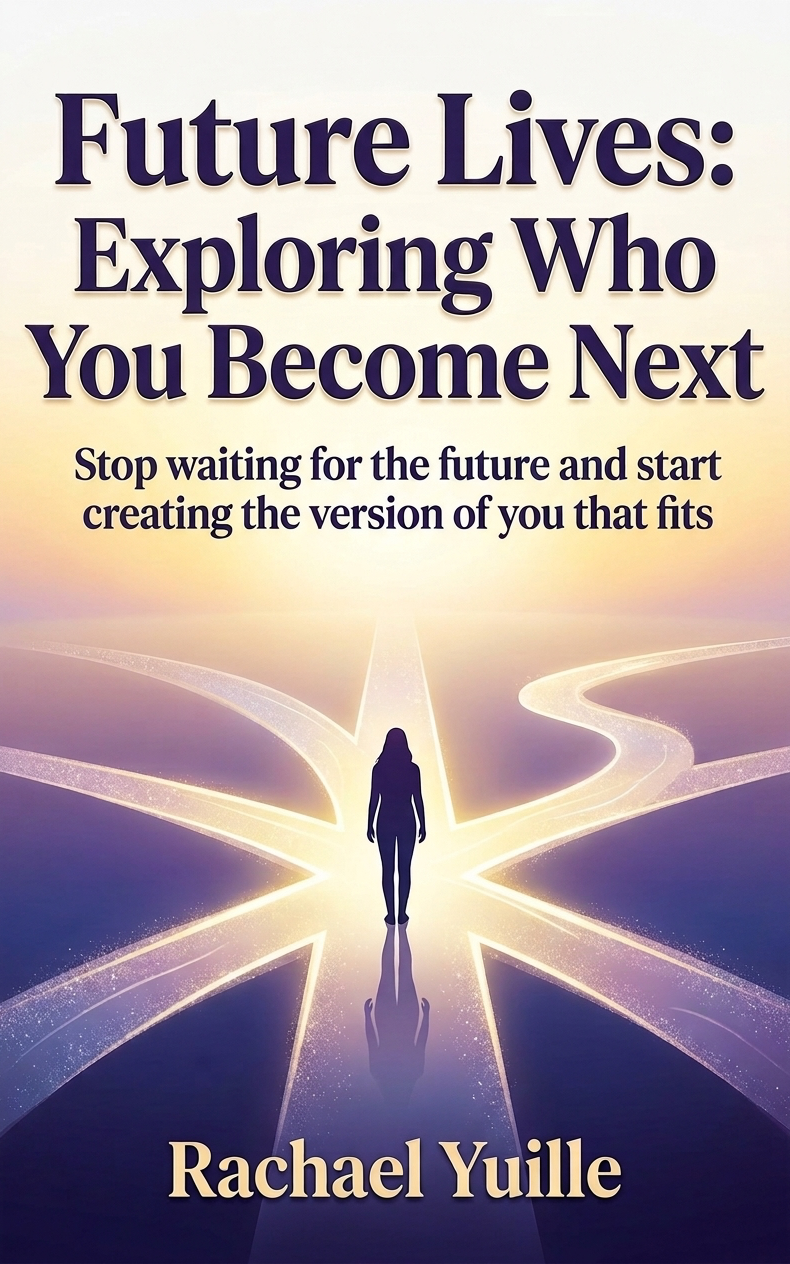
Future Lives: Exploring Who You Become Next
Stop waiting for the future and start creating the version of you that fits
by rachael jean
Who are you becoming? Most people view the future as a distant destination, a vague 'someday' that arrives by chance. But what if your future self isn't a mystery? What if the person you become is already being forged by the habits, choices, and patterns you inhabit today? In Future Lives, Rachael Jean introduces a transformative perspective on personal growth. By shifting the focus from who you were to who you are becoming, this book provides a grounded roadmap for navigating the Spectrum of Possibility. You will learn to identify your 'Current Orbit'—the subconscious momentum that dictates your default path—and recognize the 'Shadow Future' that unfolds if nothing changes. This isn't about fortune-telling; it's about clarity. Through the Trajectory Framework, Jean offers practical tools to heal past trauma, break limiting loops, and utilize micro-habits to pivot toward a life that truly resonates with your soul. Stop being a passenger in your own life. Whether you feel stuck in a repetitive cycle or are standing at a major crossroad, Future Lives empowers you to step into the architect's role. It is time to bridge the gap between spiritual mindfulness and psychological action to build a future that finally fits.
- Self-Help
- Religion & Spirituality
- Meditation
- Self improvement
- Spirituality & Self-Discovery
- Healing & Trauma
The Gravity of Now: Understanding Your Current Orbit
Imagine you are standing in the middle of a vast, open field. The grass is tall, swaying gently in the breeze. You decide to walk toward a distant tree on the horizon. As you move, you notice something strange. Your feet keep finding a narrow, dirt-packed groove in the earth. It is a path you have walked a thousand times before. Even when you try to step onto the fresh grass, your ankles naturally tilt back toward the hardened soil. Without even thinking about it, you are following the same line you took yesterday, last month, and three years ago. This is not because the path is the best way to the tree. It is simply because the path is there.
Most of us believe we are the conscious architects of our daily lives. We wake up and think we are making fresh choices about what to eat, how to speak to our partners, or how to tackle our work. However, the reality is far less deliberate. We are governed by a powerful force known as psychological gravity. Just as the earth pulls objects toward its center, our past behaviors and subconscious routines pull us into a predictable orbit. We are not just living our lives; we are repeating them.
The Current Trajectory
The concept of momentum is easy to understand when we think about a train. A locomotive pulling fifty cars has immense momentum. It takes a long time to get moving, but once it reaches full speed, it cannot stop on a dime. Even if the engineer slams on the brakes, the train will glide for a mile or more before coming to a complete halt. Our lives work in exactly the same way. Every time you repeat a thought, a reaction, or a habit, you add another heavy car to your personal train. You are building momentum in a specific direction.
We often ignore this momentum because it feels invisible. We tell ourselves that tomorrow is a blank slate. We say, "I will start my diet on Monday," or "Next month, I will finally look for a new job." We treat the future as if it is a different country where we will magically become different people. But the person who wakes up on Monday is the same person who had the habits of Sunday. The "Future You" is not a stranger; they are a mathematical extension of the "Present You."
To understand your trajectory, you have to look at the invisible tracks your life is currently running on. These tracks are made of your default responses. Think about the first thirty minutes of your day. Do you reach for your phone before your eyes are even fully open? Do you feel a surge of anxiety about your inbox? Do you drink coffee to mask a lack of sleep? These are not isolated events. They are the initial sparks that set the tone for your entire orbit. If you do this every day for five years, you aren't just a person who checks their phone; you are a person whose brain is wired for reactive stress.
You have built a trajectory that leads directly toward burnout.
Identifying these tracks requires a level of honesty that can be uncomfortable. It means admitting that we are often on autopilot. We are living in a loop, governed by the gravity of our comfort zones. Change is difficult because it requires us to fight against this established momentum. When you try to change a habit, you aren't just making a new choice; you are trying to derail a heavy train that has been moving in one direction for years. Understanding this gravity is the first step toward freedom.
You cannot change your destination until you realize which way the tracks are actually heading.
The Shadow Future
If you want to see where you are going, you don't need a crystal ball. You only need to look at your last forty-eight hours. This is what I call the Five-Year Echo. It is a simple but seriously sobering mental exercise. Take your current lifestyle—exactly as it is right now—and project it five years into the future. Do not imagine a version of yourself that finally gets it together. Imagine that nothing changes. You keep eating the same food. You keep spending the same amount of time on social media. You keep avoiding the same difficult conversations. You keep the same internal monologue of self-criticism.
This projection creates what I call the Shadow Future. The Shadow Future is the version of your life that happens by default. It is the destination you reach if you simply stay in your current orbit. For many people, the Shadow Future is a place of quiet desperation. It is a place where health problems have worsened, relationships have grown colder, and career dissatisfaction has turned into a permanent state of resentment. It is not a place of sudden catastrophe, but of gradual erosion.
Let's look at a specific example. Suppose you have a habit of staying up until 1:00 a.m. scrolling through videos because you feel like it is the only "me time" you get. In the short term, the cost is just a bit of tiredness the next morning. But let's apply the Five-Year Echo. Five years of chronic sleep deprivation leads to elevated cortisol levels. High cortisol leads to weight gain around the midsection and a weakened immune system. It also means five years of being less present at work and more irritable with your family. In five years, the "you" at the end of that track is physically heavier, emotionally drained, and potentially facing a strained marriage. That is the Shadow Future of a single late-night habit.
Hows that for "me time", hey?
This is not about being pessimistic or scaring yourself. It is about radical realism. We often live in a state of cognitive dissonance, believing that our small, daily choices won't have large-scale consequences. We think the bill will never come due. But the Shadow Future is always waiting. By visualizing it clearly, you strip away the illusion that "later" will be different. You realize that the person you will be in five years is being built, brick by brick, by what you are doing right now. If you don't like the look of that house, you have to change the materials you are using today.
The Breaking Point
There is a hidden price we pay for staying in our current orbit. It is the Cost of Consistency. We usually think of consistency as a virtue, but it is only a virtue if the behavior is serving us. When we are consistently stagnant, we are paying a heavy tax on our potential. This leads to a phenomenon I call silent stagnation. It is the feeling that life is happening to you rather than through you. You feel like a passenger in a car that someone else is driving.
The breaking point usually doesn't arrive as a loud explosion. It arrives as a slow, heavy realization that you are bored with your own excuses. You start to notice the gap between the person you know you could be and the person who is currently sitting on the couch. This gap is where most human suffering lives. The wider the gap, the more intense the anxiety. We try to fill this gap with distractions—entertainment, food, shopping, or work—but the gap remains. The cost of staying the same is the loss of your own vitality.
Staying in a comfortable but unfulfilling orbit eventually leads to a specific kind of exhaustion. It is not the exhaustion that comes from working hard; it is the exhaustion that comes from not working on the things that matter. It is the fatigue of the unused soul. When you stop growing, you don't just stay the same. In nature, anything that isn't growing is dying. The same is true for your mind and your spirit. If you aren't intentionally moving toward a future you want, you are being pulled toward a future you didn't choose.
Consider the physical impact of this stagnation. When we are stuck in repetitive loops, our brain's neuroplasticity begins to decline. We become more rigid in our thinking. We lose our ability to solve problems creatively. Physically, the stress of living a life that doesn't fit us manifests as chronic tension, headaches, or digestive issues. Your body knows when you are off-track long before your mind is willing to admit it. The breaking point is actually a gift. it is your system's way of saying, "This path is no longer sustainable." It is the moment when the pain of staying the same becomes greater than the fear of changing.
The Pivot Point
So, how do we break the gravity? How do we jump the tracks and start moving in a new direction? It starts with a technique called The Observer's Pause. Most of our habits are triggered by an external event and followed by an immediate, unconscious reaction. For example: Your boss sends a sharp email (Trigger) → You feel a knot in your stomach (Feeling) → You go to the kitchen for a snack (Action). This sequence happens in a fraction of a second. There is no space for a choice.
The Observer's Pause is about creating a tiny gap between the trigger and the reaction. In that gap, you reclaim your power. It is a moment of pure mindfulness where you stop being the person who reacts and start being the person who observes. When you feel that familiar impulse to follow an old pattern, you simply stop. You don't have to do anything heroic. You just have to wait.
I recommend using The Three-Second Gap. When you feel an impulse—the urge to check your phone, the urge to snap at your partner, the urge to give up on a task—count to three. One. Two. Three. During those three seconds, you are engaging your prefrontal cortex, the part of your brain responsible for decision-making and impulse control. You are pulling the steering wheel back from the primitive, habit-driven part of your brain. In those three seconds, the gravity loses its hold. You are no longer a satellite locked in orbit; you are an architect standing at a drawing board.
This is the pivot point. It is small, almost invisible to anyone else, but it is the most important moment in your life. Every significant transformation begins with a single choice that was different from the thousand choices that came before it. You don't need to change your entire life today. You just need to win the next three seconds. By creating this gap, you prove to yourself that you are not a slave to your momentum. You are the one who decides where the train goes next. This pause is the bridge between your Current Orbit and your Spectrum of Possibility.
Stepping Into the New Life
To truly break the gravity of now, we must do more than just think about change. We have to experience the feeling of a different trajectory. This is where we use the concept of The Parallel Self. While your Current Orbit is the path of least resistance, there is a parallel version of you that exists right now—a version that has already made the pivot. This isn't a fantasy; it is a potential reality that is accessible the moment you change your internal state.
Imagine there is a version of you who woke up this morning and felt completely aligned with their purpose. This version of you isn't a different person; they just have different momentum. How does that person sit? How do they breathe? What is the expression on their face? When you spend ten minutes intentionally acting as if you have already shifted your trajectory, you are not "faking it." You are training your nervous system to recognize a new frequency. You are showing your body what it feels like to be free from the old gravity.
When you step into this Parallel Self, you will notice an immediate change in your internal energy. Your shoulders might drop. Your breathing might become deeper. The "problems" of your Current Orbit suddenly look smaller because you are viewing them from a different vantage point. This exercise creates a psychological "anchor" for your future self. It gives you a destination to aim for that feels real and attainable, rather than distant and abstract.
The journey from who you are to who you want to become is not a single, giant leap. It is a series of small, intentional pivots. By recognizing your current trajectory, facing the Shadow Future, and utilizing the Observer's Pause, you begin to weaken the pull of your old life. You are no longer just a product of your past. You are becoming the creator of your future. The gravity of the old path is strong, but the power of a new choice is stronger. Today, you are simply noticing the tracks. Tomorrow, we begin to build new ones.
The Habit Audit
To begin your journey out of the Current Orbit, you need a clear map of where you are right now. For the next forty-eight hours, pay close attention to your recurring behaviors. These are the things you do without thinking—the way you start your morning, the way you respond to stress, the way you spend your evenings. List five of these behaviors and categorize them into one of the following three groups:
- Growth: Behaviors that move you toward a better version of yourself (e.g., reading, exercising, practicing a skill).
- Static: Behaviors that keep you exactly where you are, neither helping nor hurting (e.g., routine chores, neutral entertainment).
- Decay: Behaviors that pull you toward the Shadow Future (e.g., mindless scrolling, negative self-talk, unhealthy eating).
Be honest. The goal isn't to judge yourself, but to see the math of your life clearly. If your list is mostly "Decay" and "Static," your current trajectory is leading you toward a future of stagnation. If you see more "Growth," you are already building positive momentum. This audit is your baseline. You cannot change what you do not measure.
The Three-Second Gap Technique
This is your primary tool for breaking the momentum of a bad habit. Practice this today with something small. When you feel the impulse to check your phone while you are in the middle of a task, or when you feel the urge to eat something just because you are bored, stop. Count to three slowly. Use those three seconds to ask yourself: "Does this action belong to the person I want to become?" Usually, the answer is no. In that moment of awareness, the habit loses its power over you. You might still choose to do the action, but it will be a conscious choice, not a mechanical reaction. Over time, these gaps will become the foundation of your new life.
Action Steps
- Identify a Morning Pivot: Choose one minor habit in your morning routine to change tomorrow. It could be something as simple as drinking a glass of water before your coffee or leaving your phone in another room for the first ten minutes of the day.
- Document the Shift: Immediately after you perform this new action, take thirty seconds to write down how you feel. Do you feel more in control? Do you feel a sense of resistance? Capturing these feelings helps your brain realize that change is possible and even rewarding.
- Visualize the Echo: Before you go to sleep tonight, pick one "Decay" habit from your audit. Spend two minutes vividly imagining your life in five years if that habit remains unchanged. See the consequences clearly. Then, spend two minutes imagining your life if that habit was replaced by a "Growth" habit. Notice the difference in your body's reaction to these two futures.
Key Takeaways
- The Future is a Mathematical Extension: Your life is not random. It is the result of the momentum you have built through your daily choices. Your current habits are the tracks you are running on.
- Awareness is the First Step: You cannot escape a prison if you don't realize you are in one. Recognizing the "Gravity of Now" is essential for making a pivot.
- Small Shifts Create Massive Distance: You don't need to change everything at once. A one-degree shift in a ship's course doesn't seem like much at first, but over a long journey, it puts the ship in a completely different continent.
- The Shadow Future is a Real Destination: If you don't change your current habits, the Shadow Future is where you will end up. Use this realization as fuel for change, not as a reason for despair.
Reflection Questions
- What is one habit you perform daily without thinking? (e.g., the way you walk into your house, the way you start your work day, the way you talk to yourself in the mirror).
- If you repeat this specific habit every single day for the next ten years, what does your life look like? Be specific about your health, your finances, and your relationships.
- What emotion do you feel deep in your chest when you imagine that ten-year future? Is it peace, or is it a sense of heavy regret?
- Who is the "Parallel Self" that is waiting for you to make a different choice? What is the very first thing they would do differently tomorrow morning?
The tracks of your life are not set in stone. They are more like paths in the woods—the more you walk them, the deeper they get, but you can always choose to step off and start a new trail. It will be difficult at first. The grass will be high, and the ground will be uneven. You will feel the pull of the old, smooth dirt under your feet. But every step you take in a new direction makes the new path easier to follow. You are not stuck. You are just in orbit. And today is the day you start to change your trajectory.
Subconscious Blueprints: Why We Repeat the Same Day
Most of us like to believe we are the captains of our souls and the masters of our fate, making fresh, conscious decisions from the moment we wake up until the moment we close our eyes. We imagine our minds as a clean slate every morning, ready to be written upon by our willpower. But if you look closely at your life, you will see a different story…