

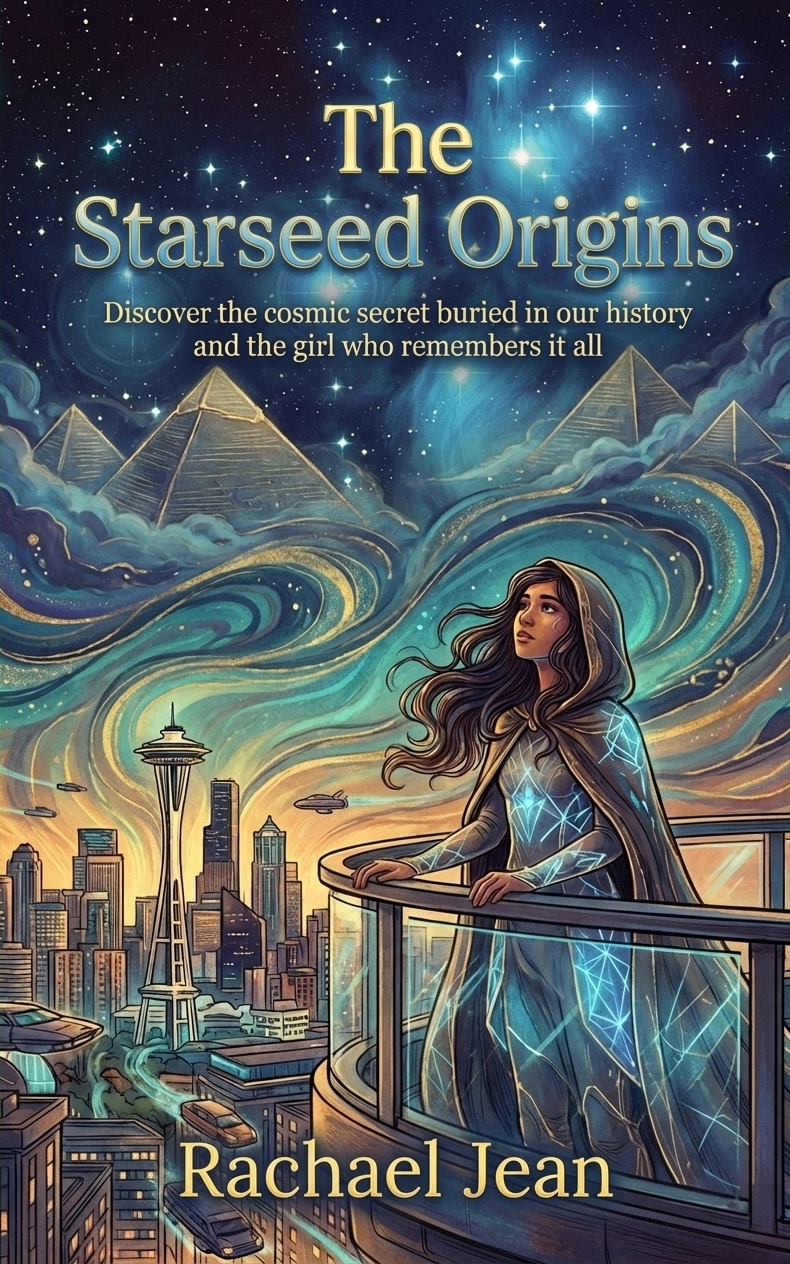
The Starseed Origins
Discover the cosmic secret buried in our history and the girl who remembers it all
by rachael jean
Kora Vance was just an ordinary seventeen-year-old in near-future Seattle until a high-speed accident awakened a memory that wasn't hers. Now, she is haunted by echoes of a life lived among the stars as a celestial ambassador from the Pleiades. As dormant DNA activates within her, Kora realizes she isn't just human—she is a Starseed, a member of an ancient team sent to guide humanity through its most pivotal moments. From the shadow of the Great Pyramids to the submerged secrets of Atlantis, Kora’s past lives reveal a hidden history of cosmic intervention. But she isn't the only one seeking the truth. Director Silas Vane and his shadowy Aegis Initiative are hunting her, desperate to weaponize her alien heritage for global control. With the help of Jaxen, a brilliant hacker who feels strangely familiar, Kora must race across the globe to unlock the Akashic Records. As a manufactured energy crisis threatens to plunge the world into darkness, Kora must bridge the gap between her human heart and her cosmic origin. The time of awakening has arrived. Will Kora activate the ancient planetary grid in time, or will humanity’s future be extinguished before it truly begins?
- Fantasy
- Science Fiction
- Adventure
- Young Adult
- Colony Worlds
- Near Future
The Spark in the Static
The rain in near-future Seattle doesn't just fall; it clings. It wraps around the neon spires of the downtown district like a cold, damp wool blanket, turning the glow of holographic billboards into smeared watercolor stains. I leaned my forehead against the cool glass of the drone-taxi, watching the city blur by. My head felt like it was being squeezed in a hydraulic press. It wasn't just a headache anymore. It was a rhythmic, pulsing pressure that timed itself to the flickering streetlights and the hum of the mag-lev rails beneath us. My brain felt like a radio trying to tune into a station that didn't exist yet, catching nothing but high-frequency static that made my teeth ache.
I tried to focus on something normal. My phone buzzed in my pocket—a persistent, vibrating reminder that I was late for dinner again. I pulled it out and saw my mother’s face smiling back at me from the contact photo. Kora, where are you? the text read. I sighed and shoved the device back into my hoodie. I couldn't deal with "normal" right now. I couldn't explain why the sound of the rain felt like it was composed of mathematical equations, or why the very air in the cabin felt heavy with an impending sense of change. To her, I was just a moody seventeen-year-old with a penchant for thrift-shop flannels and a wandering mind. She didn't know that my "daydreams" were starting to feel more real than the damp seat of the taxi.
The drone-taxi accelerated as we hit the bridge. The AI's voice, a smooth, synthetic alto, chirped a reassurance about the traffic flow. Then, the world broke. It started with a glitch—a jagged stutter in thečw blue light of the dashboard. The car didn't just veer; it lunged. The steering column locked, and the vehicle screamed as it fought its own internal logic. I watched, frozen, as the reinforced railing of the bridge rushed toward us like a silver blade. My stomach dropped, my mind raced, and for a heartbeat, I wondered if this was the end of my story.
But instead of the crunch of metal, time simply stopped. It didn't just slow down; it stretched, pulling the seconds thin until they became transparent. The interior of the cheap plastic taxi dissolved. The grey upholstery and the smell of stale air-freshener vanished, replaced by a cockpit that hummed with a deep, melodic resonance. Where the dashboard had been, there were now glowing crystalline consoles, pulsing with a soft violet light that felt familiar to my very bones. I wasn't sitting in a car; I was suspended in a seat made of woven light, looking out through a canopy that didn't show the rainy Seattle skyline. Instead, I saw a deep, velvety void peppered with seven brilliant, diamond-white stars. They burned with a fierce, ancient intensity, calling to a part of me I hadn't known was awake.
I felt a presence beside me, something vast and calm. A voice, melodic and resonant like a silver bell struck in a quiet room, echoed through the chamber of my mind. "Wake up, Little Star," it whispered. The words weren't just sound; they were a command, a key turning in a lock that had been rusted shut for a thousand years. The sensation was overwhelming—a rush of heat that started at the base of my skull and flooded down my spine.
Then, the silence shattered. The world slammed back into place with the violence of a physical blow. The crystalline cockpit vanished, and I was back in the drone-taxi, bracing for an impact that was already happening. The car plowed into the bridge barrier. Airbags exploded like white thunder, filling the cabin with dust and the smell of burnt chemicals. Metal shrieked, glass sprayed across the interior like diamonds, and the world spun in a dizzying kaleidoscope of grey and black. When the motion finally stopped, the only sound was the ticking of a dying engine and the frantic patter of rain on the mangled roof.
I sat there for a moment, my heart hammering against my ribs like a trapped bird. I should have been dead, or at least broken. But as I pushed the deflated airbag away, I realized I didn't feel any pain. I climbed out through the shattered window, my combat boots crunching on the debris. My hands weren't shaking. In fact, I felt a strange, electric clarity I’d never known before. I looked down at my left wrist, where the sleeve of my oversized hoodie had pushed back. The small birthmark I’d had since birth—a cluster of tiny dots shaped like a constellation—wasn't just skin anymore. It was glowing. A faint, rhythmic silver light pulsed beneath the surface, perfectly synced with the throb of the city's power lines overhead.
Nearby, a first responder scrambled toward me, his face a mask of professional concern. "Hey! Don't move! You've been in a high-speed collision!" he shouted, his boots splashing through the puddles. He reached me, his hands hovering as if he expected me to fall apart. He checked my pupils, his brow furrowing in confusion. "You... you don't have a scratch on you. How is that possible? The sensor log says the impact force was enough to—" He stopped, staring at my wrist. I quickly pulled my sleeve down, shielding the silver glow from his sight. I couldn't explain it to him because I couldn't explain it to myself. I didn't feel like a survivor; I felt like a ghost who had accidentally stepped back into a body.
As I backed away from the wreckage, the sensory input of the city began to change. I didn't just hear the sirens and the rain; I could feel the frequency of the power grid. Every wire in the bridge, every fiber-optic cable buried in the asphalt, hummed with a distinct vibration. It was a symphony of invisible energy, and I was suddenly tuned to its every note. The world I had lived in for seventeen years—the high school dramas, the thrift stores, the rainy mornings—felt like a thin veil that had finally been torn. Beneath it lay a landscape of light and data that was much larger, much older, and far more dangerous.
I didn't wait for the police to take a statement. I didn't want to be a miracle or a medical anomaly. I turned and started walking toward the pedestrian ramp, my mind spinning with the image of those seven stars. The voice—the one that called me Little Star—felt more real than the cold rain hitting my face. It felt like a memory of a home I had never visited, a promise made before I was even born. The Death card of my old life had just been flipped, but it wasn't an ending. It was a clearing of space for something new to grow.
I reached the sidewalk and began to weave through the crowd of onlookers. People were huddled under umbrellas, their faces illuminated by the blue light of their personal devices, completely unaware of the invisible world humming around them. I felt a sudden, sharp prickle of intuition—the kind of warning that tells you you're being watched. I stopped at the corner and glanced back through the curtain of rain. Standing several yards back, idling at the curb, was a charcoal-colored SUV with tinted windows. It had no markings, no license plate that I could see, and it sat with a predatory stillness that made the hair on my arms stand up. It wasn't an ambulance or a police car. It was something else. As I turned the corner, the SUV began to roll forward, keeping a consistent, haunting distance behind me. The game had changed, and I was no longer just a girl in a taxi. I was a signal, and the hunters had already picked up my frequency.
The Shipping Container Sanctuary
The Industrial District of Seattle is where the city’s shiny, holographic future goes to die. Away from the sleek mag-lev rails and the towering needles of the corporate elite, the streets are lined with rusted warehouses and stacks of shipping containers that look like oversized Lego bricks left out in the rain. This is where the noise of the powe…