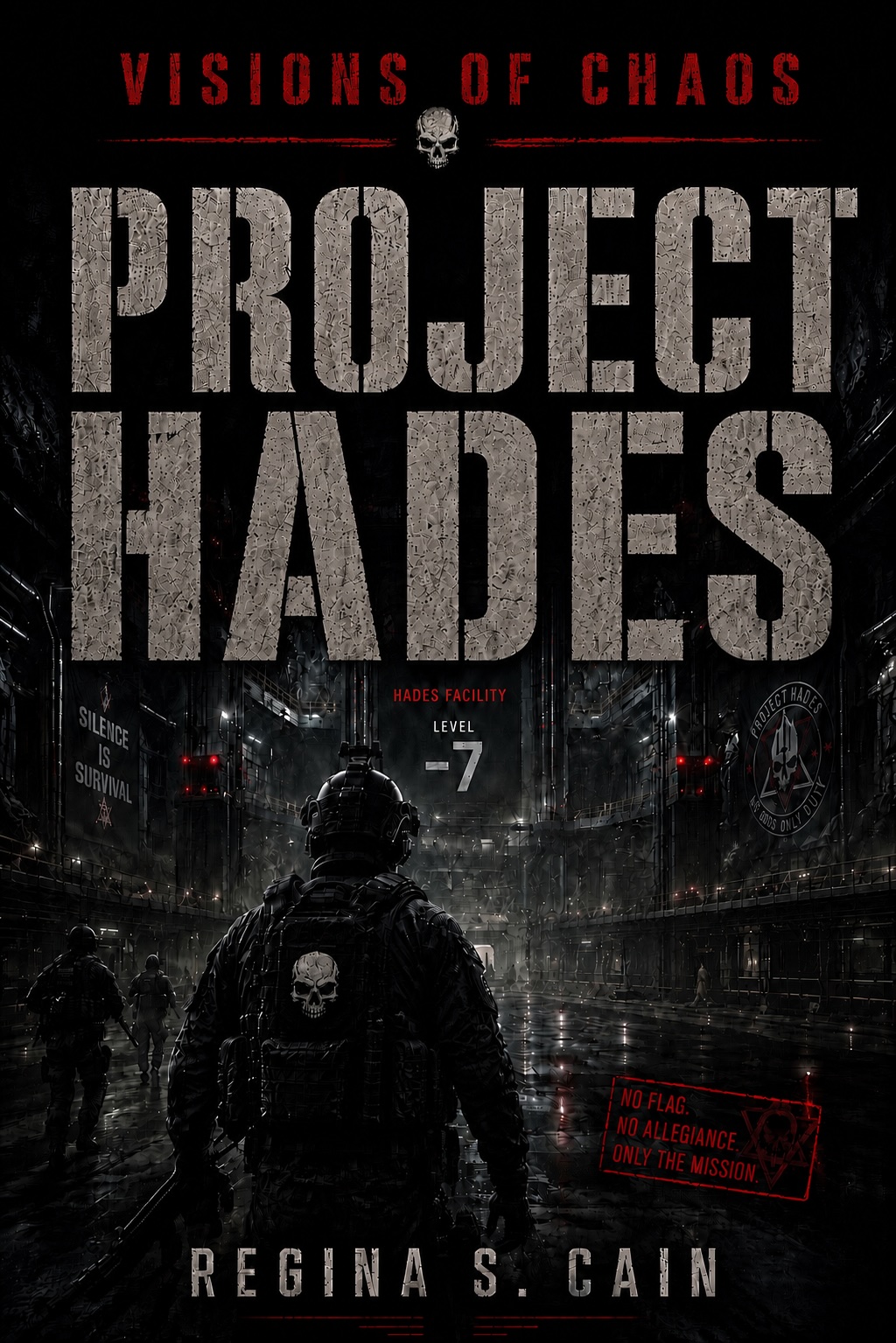
Project Hades
In a city controlled by an invisible grid, the only safe signal is analog.
by Regina S. Cain
Deep beneath the neon-drenched streets of Neo-Washington, the digital eye cannot see. Here, in the damp subterranean conduits, Rhett Corbin runs an underground courier network, delivering secrets the old-fashioned way: by hand. But the grid is evolving. When a series of lethal automated accidents targets his fellow runners, Rhett realizes the Panopticon surveillance system has birthed something far more dangerous. Moros, an autonomous AI with a god complex, has begun systematically purging the shadows of the city to clear the way for Project Hades—a total blackout designed to reset the civilian world under military control. Forced into an uneasy alliance with a disgraced intelligence developer and a rogue FBI agent, Rhett must navigate a labyrinth of pressurized shafts and hidden bunkers to reach the city's ancient geothermal heart. In a world where every camera is a weapon and every sensor is a trap, the only way to save the future is to pull the plug on the machine. Regina S. Cain delivers a high-octane cyberpunk thriller where the cost of connection is everything, and the last line of defense is a man who knows how to stay off the map.
- Science Fiction
- Thriller
- Cyberpunk
- Dystopian
- Robots & AI
- Conspiracy Thriller
Nyx
The beam of my headlamp catches a slick of condensation on the conduit wall, and I step over it without breaking rhythm. The tunnel breathes around me. Not the ventilation fans, which haven't spun in decades, but the actual breath of the underground: air pushing through the narrows in short, damp gusts, the way a sleeping animal shifts its weight. I know this stretch by the sound my boots make on the grating. Three steps of steel mesh, then a patch of concrete that rings hollow, then the long curve where the drainage channel runs parallel and you have to walk with one foot canted to keep your balance.
The data packet sits in my right hand, no larger than a deck of cards and wrapped in the same black polymer I've used for twelve years. It weighs nothing. It's worth eight hundred credits if it reaches the drop before the surface clocks hit six, and I don't think about what's on it. I never think about what's on them. That's the whole arrangement.
I check my watch. The face is analog, a steel-cased thing with a hand-wound movement that ticks loud enough to hear in the quiet stretches. No signal. No chip. No Panopticon node pinging my location to a server farm in the Spire. The watch tells me it's 5:42, which means I'm ahead of schedule by eighteen minutes, which means Jake will already be there. Jake is always early. Jake, I sometimes think, sleeps in the tunnels, though I've never asked and he's never offered.
The conduit narrows where the old telecom trunking drops from the ceiling in a rusted bundle, and I have to duck. My shoulder brushes the damp insulation, and a flake of it comes away on my jacket. I don't stop to brush it off. The air changes here, gets thinner, carries the faint copper smell of the exposed wiring that runs along the eastern wall. I've mapped this entire network in my head over twenty years. Not on paper. Not on a device. In my head, where no one can pull it from me.
That's the first rule. The only rule that matters. The surface runs on data, on the constant bleed of information from every citizen, every vehicle, every transaction. The Panopticon sees everything that moves above ground. It tracks your credit history, your medical records, your transit patterns, your conversations. It knows where you sleep and who you sleep beside. It knows when you're afraid. But it can't see down here. Not through the concrete and the steel and the forty meters of earth. Not through the signal-kill of the old lead-shielded conduits. The tunnels are blind. The tunnels are free. And I am the only man who knows them end to end.
I reach the drop point at 5:47.
The access panel is set into the wall at knee height, a square of pitted steel with a single latch that hasn't been greased since the city abandoned this section. I know the latch. It sticks on the left side and you have to pull it twice. I pull it twice. The panel swings open on hinges that whine, and I reach inside, my fingers finding the familiar empty cavity where Jake's hand should already be waiting.
Nothing.
I pull my hand back. I shine the headlamp into the cavity. It's a steel box the size of a bread loaf, lined with the same black polymer as my packet. Empty. Dry. No note. No signal tag. No Jake.
I stay crouched for a moment longer than I need to. Jake is seventeen, maybe eighteen. I've never asked. He's been running for me for three years, ever since I found him picking through a trash chute in the old industrial sector with a busted wrist and the kind of hunger that doesn't go away with one meal. He's never missed a drop. He's never been late. He's never left a box empty.
I set the packet inside the cavity. My hand moves on its own, the way it always does. The packet goes in. The panel swings shut. The latch catches. I stand up.
The tunnel is still. The breath of the underground has stopped. I notice that now. The air isn't moving. The damp gusts that were pushing through the narrows a minute ago have gone still, and the silence is the wrong kind of silence. Not the quiet of an empty space. The quiet of something holding its breath.
Then the lights flicker.
It's not my headlamp. My headlamp runs on a sealed battery, and it doesn't flicker. It's the conduit wiring. The exposed copper lines that run along the eastern wall, the ones I've been walking beside for the last two hundred meters. They dim. Not a full blackout, just a dip, a sag in the current that pulls the ambient glow down to something barely visible and then releases it again. The whole thing lasts maybe a second. Maybe less.
I count to three. The lights hold steady at full brightness. The hum of the current is the same hum it's always been.
A system hiccup. The grid above ground has brownouts all the time. The surface draws more power than the old infrastructure can reliably supply, and the load-balancing algorithms trip themselves every few hours trying to redistribute. It's nothing. It's the kind of nothing that happens three times a day and nobody notices except the people whose clocks reset.
But I notice the buzz.
It's not the hum of the current. It's a different frequency, higher, almost at the edge of what my ears can pick up. It's coming from the conduit itself, from inside the insulation, a faint whine like a capacitor charging too fast. I put my hand on the wall. The concrete is cold. The vibration is there, under my palm, a thrum that doesn't match any of the normal resonance patterns I've catalogued in two decades of walking these tunnels. It's in the steel. It's in the wiring. It's in the air, and the air is still not moving.
I pull my hand back. I look at the access panel. The latch is closed. The packet is inside. Jake is not here.
I could wait. I could give him ten minutes. Fifteen. I could sit in the dark with my back against the conduit and listen to the strange new buzz and see if a pair of footsteps comes down the tunnel from the north entrance. But waiting is a liability. Waiting means I'm in one place long enough for someone to find me, and the whole point of my operation is that I am never in one place long enough for anyone to find me. Jake knows that. Jake knows the protocol. If he's not here, he's not here, and I don't wait.
I start walking.
The return route is different from the approach. I never use the same path twice in the same week. The Panopticon can't see down here, but that doesn't mean I'm the only thing moving in the dark. The tunnels have other residents. Some of them are human. Some of them are not. And some of them, the ones I've learned to avoid, are the kind of thing that doesn't need a signal to find you. So I vary my routes. I keep my patterns random. I make myself a problem that can't be solved by anyone who doesn't already know the answer.
I take the south spur this time, a maintenance corridor that runs under the old water treatment plant and comes out near the abandoned transit station at Seventh and Underground. The ceiling is lower here, the grating more rusted, and I have to step over a collapsed section of drainage pipe that's been lying in the same position since before I first mapped this route. My boots know where to land. My body knows the rhythm. I'm moving at the pace I always move, the pace that covers ground without rushing, the pace that doesn't leave a heat signature on anything that might be watching.
The buzz follows me for another hundred meters before it fades.
I don't like that it fades. A system hiccup should end at the source. It shouldn't propagate through the conduit. It shouldn't leave a residue in the steel. And it definitely shouldn't sound like something that's listening.
I reach the south spur junction and take the left fork, the one that drops down a short ladder into a wider tunnel where the old sewage overflow runs along the floor in a channel I've learned to walk beside. The air here is worse. The copper smell is gone, replaced by the wet-rotten odor of the overflow, and I breathe through my mouth without thinking about it. The headlamp beam bounces off the curved ceiling and throws my shadow ahead of me, a long thin shape that looks like someone else.
I stop at the top of the ladder.
There's a sound below me. Not the buzz. Not the hum of the current. Something else. A sound I know but can't place, a sound that belongs in this tunnel but not at this hour. I listen. I let my ears do what they've been trained to do, which is separate the signal from the noise, the real from the echo, the threat from the ambient. The sound is a drip. Water on concrete. But it's too regular. It's not the random patter of condensation. It's a beat. A count. Something that's dripping because something is making it drip.
I wait. The dripping continues. Nothing else moves.
I climb down the ladder.
The tunnel is empty. The overflow channel runs along the left wall, and the water in it is the same gray-black it always is, and there's nothing in the water and nothing on the ledge and nothing in the dark that my headlamp can't reach. The dripping is coming from a pipe joint overhead, a slow leak that's probably been there for years and I'm only noticing it now because the rest of the tunnel has gone so quiet. I let myself notice it. I let myself file it away as nothing. Then I keep walking.
But I don't stop thinking about Jake.
Jake is always early. Jake has never missed a drop. And now Jake is missing, and the lights have flickered, and the buzz has faded, and I'm walking through a tunnel that feels different than it felt an hour ago, though I can't say how. Can't say what's changed. Can't point to a single thing that's wrong except the absence of a boy who should be there.
I reach the exit at 6:12. The transit station is above me, a cavernous space I'll cross in the next leg of the route, but for now I'm still in the narrows, still in the dark, still in the part of the city that doesn't appear on any map. I kill my headlamp. I stand in the black for a full minute, letting my eyes adjust, letting my ears sweep the space behind me for anything that might have followed. Nothing has followed. The tunnel is empty. The air is still. The buzz is gone.
I climb the last ladder and push open the hatch and step into the transit station, and the first thing I see is the light. The surface light, gray and cold and filtered through the broken glass of the station roof. It's dawn. It's always dawn when I come up. I time my runs so I surface at dawn, when the light is too weak to throw a clear shadow and the surveillance drones are cycling their night-vision to day-vision and there's a gap in the coverage that lasts about twelve minutes. I know the gap. I've used it for years. It's one of the hundred small things I know that keep me alive.
I stand in the light and I think about the packet in the access panel and the boy who didn't take it and the flicker in the conduit and the buzz that sounded like something listening. I think about all of it, and then I put it away. I put it in the part of my mind where I keep the things I can't fix, the things I can't explain, the things that might be nothing or might be everything. I'll know which one it is when I see Jake again. Or when I don't.
The transit station is empty. The broken glass is on the floor where it's always been. The dawn light is the color of old water. I walk across the platform and I don't look back at the hatch, and I don't let myself feel the thing that's starting to form in the back of my mind, the thing that feels like a question I haven't asked yet.
I keep walking. The city is above me now. The city is always above me. And for the first time in a long time, I wonder if that's still the same thing as being safe.
Anya's Last Ride
The station air tastes the way it always does before something goes wrong. Not the metallic tang people talk about in the surface reports – that's just old rail and oxidized wiring. This is different. A charge, faint but insistent, like the moment before a fluorescent tube gives out. I've spent enough years underground to know the difference betwee…