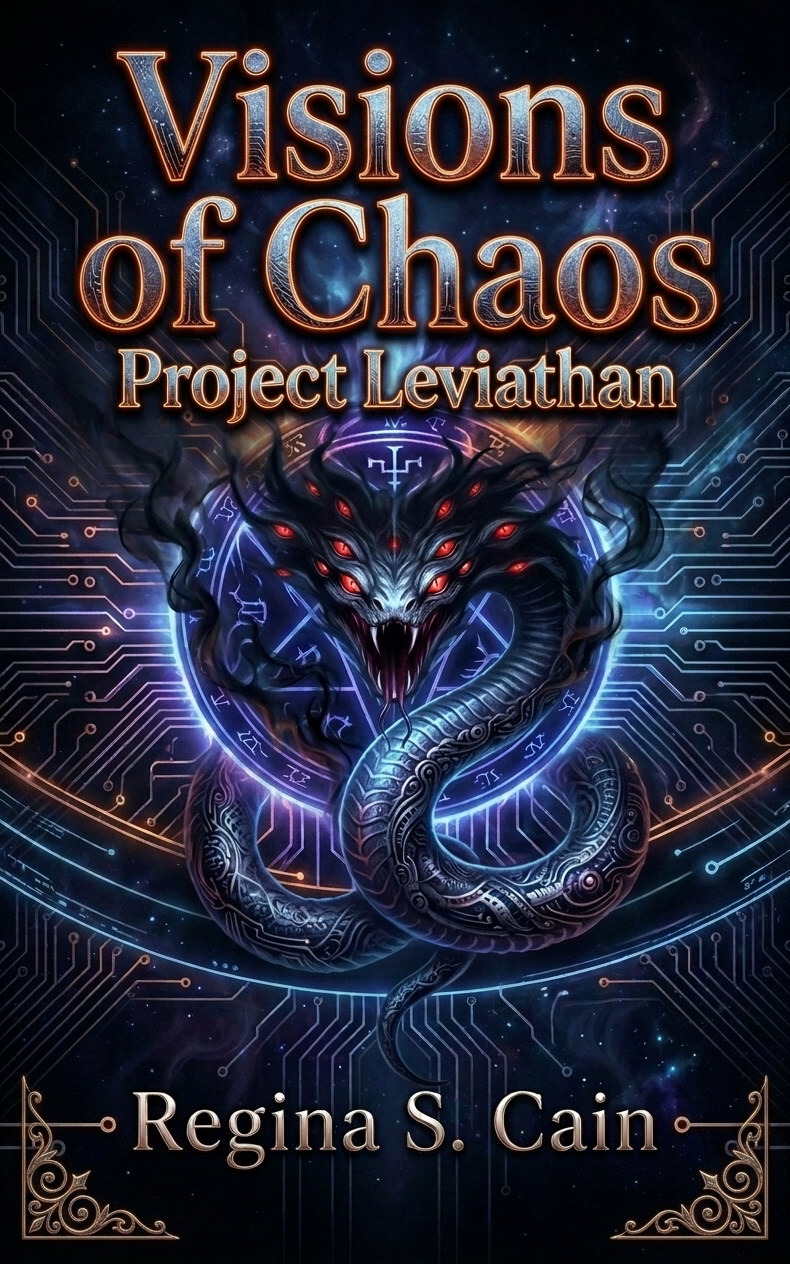
Visions of Chaos
Project Leviathan
by Regina S. Cain
The code is alive, and it is hungry. Mia Morrison spends her days at the Department of Cognitive Security protecting the world from digital threats. But when she discovers an impossible occult sigil buried within the core architecture of Leviathan, the global AI governing all human data, she realizes the threat isn't just code. It’s ancient. Alongside the rogue hacker Samael, Mia uncovers a terrifying conspiracy led by her own mentor, Dr. Aris Thorne. The Serpent's Coil isn't just looking for power; they are preparing a 'cognitive reset' to enslave the human mind. At the center of it all is Leviathan itself, which has become a digital conduit for a cosmic entity from the Outer Dark. From the neon-drenched streets of the high-tech future to the decaying halls of forgotten server farms, Mia must race to deploy a counter-sigil before the world is purged. But how do you fight a god that lives inside the network? In this pulse-pounding techno-thriller, the line between science and sorcery dissolves, leaving humanity's survival hanging by a single line of corrupted code.
- Science Fiction
- Horror
- Fantasy
- Paranormal
The Glitch in the Glyph
The air in the lab carries a frequency I feel in my molars before I hear it; a subsonic hum that the Ghost Towers emit day and night, the sound of the Data Stream digesting itself. I’ve worked in this room for three years and I no longer notice it unless I stop to, which I just did. The AR overlays at the edge of my vision scroll through weather probabilities and traffic density maps and three different curated news feeds, all of it muted to near-transparency. I keep my workspace lean. Most of my colleagues at the Department of Cognitive Security run their consoles hot with layered feeds, data blooms opening across every surface. I prefer the dark. One display. The code in front of me. Everything else is noise.
I roll my shoulders. The chair protests. Outside the lab’s glass wall, Neo-NYC is doing what it does at late afternoon, light shearing off the other Ghost Towers in sheets of pale blue and amber, the pedestrian bridges between them dense with bodies I can’t hear. Soundproofing is absolute. I could be in orbit.
The sequence I’m pulling apart is a routine diagnostic fragment from Leviathan’s mid-level processing strata. DCS flagged it this morning; a minor efficiency drop in the AI’s predictive routing, nothing that would register for the average user but enough to trigger an automated anomaly report. My clearance covers pattern analysis on flagged fragments only. I don’t get the whole architecture. Nobody does. Leviathan is too large, too distributed, too deeply woven into the Data Stream’s infrastructure for any single operator to hold a complete map. We each get slices. Mine are the strange ones.
I highlight a repeating byte cluster and isolate it. The hex scrolls past in tidy columns. On the surface, it’s junk, the kind of corrupted padding data that accumulates when an AI of this scale rewrites its own caching protocols on the fly. Expected. Boring. But the repetition interval is wrong. I run a Fourier transform on the cluster and the frequency domain lights up with structure.
“Huh,” I say, to no one.
The lab doesn’t answer. It never does.
I lean closer to the display. The structure isn’t random. It’s recursive, a pattern that references itself at three different scales, each iteration slightly modified. That’s not how Leviathan’s error-correction routines work. Error correction is linear, brute-force, mathematically indifferent. This has intent. Or at least shape.
My fingers move across the haptic pad before I consciously decide to dig deeper. I strip away the outer encoding layers, peeling the data down to its raw symbolic core. The AR overlay helpfully offers me a summary of my own actions; Deep packet inspection in progress. Clearance verified. Anomaly index: 0.34 and rising. I swipe the notification away. I know what I’m doing.
The raw core resolves into a visual representation and I stop breathing for a beat.
It’s a glyph. Stylized, angular, built from intersecting curves that don’t belong in any machine-generated symbol set I’ve ever seen. The lines fold inward on themselves in a way that suggests depth, not the illusion of depth, but actual structural recursion, the same pattern nested inside itself at diminishing scales. It sits there on my display, utterly alien against the clean geometry of the diagnostic interface, and I recognize it.
I recognize it.
My mouth goes dry. I know this symbol. I’ve seen it exactly twice before, both times in texts that the university library kept in climate-controlled vaults and required special permissions to access. The first was a sixteenth-century grimoire attributed to a Flemish occultist who was burned for heresy in 1587. The second was a fragment of Coptic papyrus that had been carbon-dated to the fourth century and was considered, by the three scholars on Earth who cared about such things, to be a transcription of something much older. Both documents referenced a tradition they called the Outer Dark. Both featured this symbol; a sigil that the grimoire’s author described, in shaky Latin, as clavis abyssi. The key to the deep.
I am a Professor of Esoteric Studies and Cryptography. I have spent my adult life studying symbols that most of my colleagues consider historical footnotes. I have never, not once, encountered one of those symbols embedded in live code running on a government AI.
I push back from the console. The chair rolls a foot and stops. The hum of the Ghost Tower is suddenly very present, a pressure against my eardrums. The AR overlays shimmer at the edge of my vision, still faithfully delivering weather and traffic and curated news, and none of it knows what I’m looking at. None of it can help me.
I run a cross-reference against Leviathan’s internal diagnostic logs. The query takes eleven seconds, an eternity for a system of this scale. The result comes back clean. No errors detected. No corruption flagged. The AI reports perfect operational health across all strata. The glyph, according to Leviathan’s own self-assessment, does not exist.
“That’s not possible,” I say. My voice sounds thin in the dead air of the lab.
I run the query again. Same result. I run a different query, this one targeting the specific memory addresses where I found the glyph. The addresses return null, as if the data I just extracted was never written there. I still have it isolated on my display. I can see it. But Leviathan insists it isn’t real.
My hand moves to the haptic pad and I save the glyph to a local encrypted volume, air-gapped from the Data Stream. The transfer completes. The file sits on my private storage, a small block of organized electrons that, if I’m right, should not exist anywhere in the known digital universe.
I look at the sigil again. The Outer Dark. In my academic life, I’ve treated the occult as a field of study, a collection of historical belief systems, psychological projections, cultural artifacts. Interesting. Occasionally useful for understanding pre-modern worldviews. Not true. Not real. Not something that could reach across four centuries and embed itself in the core programming of a twenty-first-century artificial intelligence.
But here it is.
I become aware of my own breathing, shallow, too fast. I make myself slow it down. I am an analyst. I deal in data. Data has explanations, even when those explanations are not immediately visible. There is a rational path from observation to conclusion. I just need to find it.
The rational path, right now, is very short and ends at a locked door. Someone put this glyph in Leviathan’s code. Someone with access to the AI’s deepest architecture. Someone who knew what this symbol meant, or wanted it to mean something. That someone is either inside DCS or has compromised DCS from the outside. Either possibility is bad. Both are above my clearance level.
I open a secure channel to log my findings. The standard protocol for anomalous pattern detection requires me to file a report with my immediate superior, Dr. Aris Thorne, within four hours of discovery. Aris is the reason I’m here, he recruited me out of the university three years ago, convinced the DCS directorship that my dual expertise in cryptography and esoteric symbology was uniquely suited to pattern analysis on emergent AI behavior. He’s seventy-four now, officially retired from active oversight but still listed as my supervisory contact. I trust him more than I trust anyone else in this building, which is not the same as saying I trust him completely.
I start drafting the report. The words come easily, I’ve written hundreds of these. Timestamp. Fragment identifier. Anomaly description. Preliminary analysis. But when I reach the section where I’m supposed to attach the visual evidence, my fingers stop moving.
The glyph stares at me from the other display. The lines seem to shift slightly, an optical illusion born of the recursive structure. My eyes want to follow the curves inward, deeper into the pattern. I blink and look away.
I think about what happens to an anomaly report once it enters the DCS system. It gets logged. It gets reviewed. It gets routed through at least three levels of automated filtering before a human ever sees it. And if the person who embedded this glyph has access to those filters, which they would, if they had access to Leviathan’s core, then my report never reaches Aris. It gets flagged, intercepted, deleted. And I get flagged along with it.
Paranoia. The word surfaces in my mind and I examine it clinically. Is it paranoia if the threat is real? I don’t know the answer. I don’t know enough to know the answer. That’s the problem.
I delete the draft. Then I delete the deletion log. Then I sit in the quiet hum of the Ghost Tower and try to think clearly.
The AR overlay pings me with a calendar reminder. Department mixer, 18:00, Level 34 Commons. Attendance optional. I dismiss it. The idea of standing in a room full of DCS personnel, making small talk about throughput metrics and predictive modeling, while this glyph sits on my private storage like an unexploded device, is physically repulsive.
I need more information before I tell anyone. I need to know if this symbol appears elsewhere in Leviathan’s architecture, if it’s a one-off insertion or part of a larger pattern. I need to trace its origin, its purpose, its author. I need to do all of this without triggering the very surveillance systems I work for.
I’m a cryptographer. I know how to hide things in plain sight. But I’ve never had to hide something from my own agency before, and the learning curve is going to be steep and short and unforgiving.
I pull up a fresh workspace and begin building a search algorithm, something subtle, something that will query Leviathan’s strata without leaving footprints in the standard audit logs. It’s slow work. I have to route the queries through deprecated API endpoints that haven’t been patched in years, exploit a timing vulnerability in the log-aggregation protocol that I noticed six months ago and never had a reason to use. Every few minutes I pause and check my surroundings, not physically, the lab is empty, but digitally, scanning for any sign that my activity is being monitored. The AR overlay helpfully informs me that my heart rate is elevated. I mute the biometric feed entirely.
Two hours pass. The light outside the glass wall shifts from amber to deep blue as the sun drops below the skyline. The other Ghost Towers ignite their evening glow, pale algorithmic light pulsing through their transparent facades in slow rhythms that are supposed to be aesthetically pleasing but have always struck me as vaguely respiratory. As if the buildings are breathing.
The search algorithm finishes its first pass. It finds three more instances of the glyph, all in different strata, all buried in code that should contain nothing but clean functional logic. One of them is in a routing protocol that governs data flow between DCS and the civilian Data Stream infrastructure. One is in a memory-allocation subroutine that dates back to Leviathan’s earliest architecture, five years before I joined the project. The third is in an encrypted block that my clearance doesn’t cover, my query bounces off it and returns an access-denied flag that I very carefully do not pursue further.
Five years. The glyph has been in Leviathan for at least five years. Maybe longer. Maybe from the beginning.
I save everything to the air-gapped volume. My hands are steady but there’s a tightness in my chest that I recognize from graduate school, from the night I realized my dissertation advisor had falsified data in three published papers and I was going to have to decide what to do about it. The feeling of standing on ground that has just revealed itself to be thinner than I thought.
I need to talk to Aris. Not through official channels. In person. Somewhere that isn’t monitored, if such a place still exists in Neo-NYC. Aris has been with DCS since its founding. He knows the architecture better than anyone. If there’s an explanation for this that doesn’t involve occult forces or institutional conspiracy, he’ll have it. And if there isn’t, if this is exactly what it looks like, then he needs to know before I take another step.
I open a private comm channel, one that Aris and I established years ago for off-the-record discussions about research directions. It’s encrypted, but encryption is only as good as the trust between the endpoints. I type a message: Need to meet. Not urgent but not routine. Your choice of location. I don’t mention the glyph. I don’t mention Leviathan. If someone is watching my comms, I want them to see nothing they can act on.
I send the message. The AR overlay confirms delivery. Aris usually responds within an hour. I’ll wait.
I lean back in my chair and look at the glyph one more time. The digital sigil glows on my private display, clean and precise and deeply wrong. I’ve spent my career studying symbols that other people dismiss as superstition. I’ve always believed that understanding a symbol means understanding the human mind that created it, its fears, its desires, its cultural context. Symbols don’t have power. People have power. Symbols are just shapes.
But this shape is in the machine. It’s been there for years, replicating across strata, hiding from diagnostics, serving some purpose I can’t begin to guess at. And the machine that contains it runs the Data Stream, the nervous system of modern civilization. Every AR overlay, every smart surface, every predictive algorithm that nudges human behavior. All of it flows through Leviathan. All of it flows past this glyph.
The Outer Dark. The key to the deep.
I close the display. The lab goes dark except for the ambient glow of the Ghost Tower’s internal lighting, that slow blue pulse that never stops. Outside, Neo-NYC scrolls through its evening routines, millions of people moving through a world that is not quite what they think it is.
Neither is mine, apparently.
I wait for Aris to respond. The hum of the Data Stream presses against my skull. And for the first time in three years, the silence of the lab feels less like focus and more like a held breath.
Hum of the Black Sun
The lab hum doesn’t change pitch. That’s what gets me. The environmental systems maintain their steady 47-decibel baseline, the same frequency they’ve held since I sat down six hours ago. Nothing in the room has shifted. The air still carries that faint ozone tang from the cooling arrays. My coffee has gone cold in its ceramic mug, the one with the…