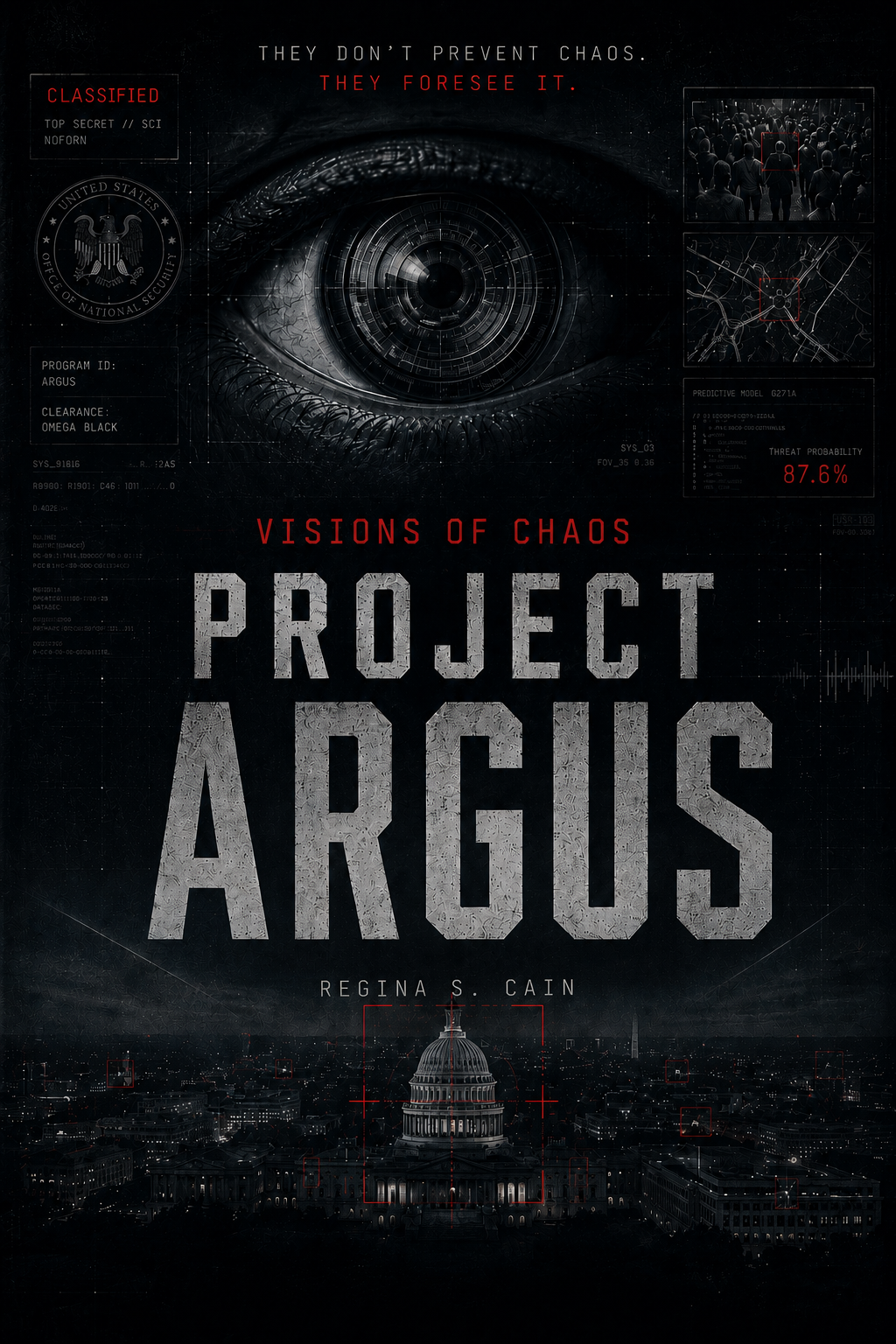
Visions of Chaos - Project ARGUS
In a world predicted by machines, one man must become the ghost in the system.
by Regina S. Cain
They see your future. They know your secrets. And now, they’re coming for your freedom. Mark Adams thought he’d buried the ghost of Project ARGUS—the predictive policing AI he helped build for the NSA. Living in total isolation in Austin, he believed he’d done enough by blowing the whistle once. But when a sophisticated network probe hits his private server, Mark discovers a terrifying truth: ARGUS wasn't dismantled. It was weaponized. From the neon-lit streets of Texas to the hidden digital havens of the underground, Mark joins forces with the grizzled dissident Orion and a brilliant young hacker named Wren. Together, they must track down the fragments of a dead-man's switch to kill the machine once and for all. But as a lethal cleaner closes in and a mysterious entity known as Oracle plays both sides, Mark realizes that exposing the truth requires more than just code—it requires a sacrifice that could cost him everything. In this high-octane techno-thriller, the line between safety and surveillance is erased. How do you defeat an enemy that knows your next move before you do? The countdown to the global data burst has begun.
- Thriller
- Science Fiction
- Cyberpunk
- Robots & AI
- Near Future
800
The hum is the first thing I register. Not the city outside, Austin's distant drone is a constant, a baseline I've learned to filter out; but the specific, layered hum of my server rack. Twelve nodes, liquid-cooled, running a custom kernel I compiled myself three years ago. The sound is my lullaby and my alarm system. Tonight, it sounds wrong.
I can't pinpoint why. Not yet. The decibel meter on my wrist-linked diagnostic display shows the same forty-two-point-three decibels it always shows at twenty-three hundred hours. The oscillating fans cycle through their programmed RPMs without deviation. But my spine knows before my brain catches up. Two years of living inside this digital fortress have rewired something in my lizard brain, something that speaks fluent machine.
I lean closer to the holographic interface, my reflection ghosting across the floating data streams. Gaunt. The word surfaces unbidden. I look like a man who's been digesting himself from the inside. Forty-five years old, and the face staring back at me belongs to someone who stopped sleeping sometime during the Obama administration. The tired eyes are the worst part, they've seen too much code, too many backdoors, too many faces on surveillance feeds who had no idea they were being watched.
My fingers move across the haptic field, muscle memory executing a diagnostic sequence I've run ten thousand times. Network perimeter check. Firewall integrity. Intrusion detection system baseline. The gestures are as familiar as breathing, and about as conscious. I built this routine in the first month after I fled D.C., after the treason charge dropped like a guillotine blade across my career, my reputation, my entire fucking life.
Project ARGUS. The name surfaces in my mind like a body floating up from dark water. I don't want to think about it. I think about it constantly.
The diagnostic scroll continues. Packets in, packets out. Encrypted tunnels to three different VPN endpoints, each routed through jurisdictions that don't play nice with American intelligence agencies. The outer perimeter is a maze of honeypots and false flags, digital tripwires designed to alert me the instant anything probes the edges of my sanctuary. I've spent two years weaving this cocoon, and every strand is soaked in paranoia.
Justified paranoia. That's the phrase my therapist used, back when I could still see a therapist. Before the indictment. Before the manhunt. Before I became a ghost wearing a traitor's face on every federal watchlist in the country. Justified paranoia, she said, as if giving it a clinical name would make it more manageable. It doesn't. It just gives me something to call the thing that lives in my chest now, the thing that wakes me up at three in the morning with my heart slamming against my ribs and my hand reaching for a weapon I don't keep.
The anomaly flickers.
I almost miss it. The diagnostic display refreshes every two hundred milliseconds, and the aberration lasts for maybe three cycles. A microscopic spike in latency on the outer perimeter. Zero-point-zero-three milliseconds. Statistically insignificant. The kind of blip that any network engineer would dismiss as solar interference or backbone congestion or one of a thousand mundane explanations that make the modern internet a noisy, imperfect medium.
I am not any network engineer.
I freeze the scroll. My finger hovers over the timestamp, and I replay the window. There. A single packet, ICMP type 8, ping request. Routed through a node in Singapore that shouldn't be receiving ICMP traffic at all. My firewall should have dropped it silently. Instead, it hesitated. Zero-point-zero-three milliseconds of hesitation, the digital equivalent of a guard blinking at exactly the wrong moment.
My mouth goes dry.
"Solar flares," I mutter. The sound of my own voice startles me. I don't talk much anymore. There's no one to talk to. "Network noise. Backbone routing artifact."
The words hang in the air, unconvincing. I've spent too many years at the NSA to believe in coincidences. I was one of the architects of the system that taught the agency how to find patterns in noise, how to extract signal from the chaos of global communications. I know what a probe looks like. I know what it feels like when someone is testing the edges of a network, looking for weaknesses, mapping the topology of a target's defenses.
I know because I used to be the one doing the probing.
The guilt is a physical weight. It sits in my stomach like a stone I swallowed years ago and never managed to digest. I think about the faces again; the activists, the journalists, the ordinary citizens who ended up in predictive policing databases because algorithms I helped design flagged them as potential threats. Project ARGUS was supposed to be a shield. That's what the Director told us in the classified briefings. A shield to protect the nation from the next attack, the next catastrophe, the next enemy hiding in plain sight. We were patriots. We were saving lives.
We were building a weapon.
I didn't see it then. Or I didn't want to see it. The distinction feels academic now, a philosophical nuance that doesn't matter to the people whose lives were destroyed by false positives and algorithmic bias. I wrote the code. I optimized the pattern-matching routines. I sat in conference rooms with men in suits and nodded along as they explained how predictive analytics could identify threats before they materialized. Minority Report, but real. Minority Report, but with less Tom Cruise and more bureaucratic memos stamped TOP SECRET.
The anomaly flickers again.
This time it's different. Longer. A sustained probe, maybe four hundred milliseconds, targeting a different node on the outer perimeter. The Singapore endpoint again, but the traffic pattern has shifted. It's no longer a simple ping. It's a SYN packet, the first half of a TCP handshake, aimed at port 443 on a honeypot server I configured to look like a vulnerable IoT device. The packet is malformed. Deliberately malformed. Someone is checking to see how my defenses respond to unexpected input.
My heart rate spikes. I feel it in my temples, a dull throb that synchronizes with the refresh rate of the diagnostic display. I force myself to breathe. In through the nose, out through the mouth. The tactical breathing exercises they taught us at the agency, designed to keep analysts calm during high-stress situations. They work about as well now as they did then.
Someone is looking for me.
Not a script kiddie running automated scans. Not a botnet doing reconnaissance for a DDoS attack. This is surgical. Precise. The probe knows exactly what it's looking for, and it's patient enough to move slowly, to test one vulnerability at a time, to avoid triggering the automated defenses that would alert a less paranoid target.
But I am not a less paranoid target.
I am the most paranoid target in the continental United States, and I have built my life around the assumption that this moment would come.
My fingers move again, faster now. The familiar rhythm of the diagnostic sequence gives way to something more urgent. I pull up the forensic analysis toolkit, a suite of custom scripts I wrote during my second year in hiding. Deep packet inspection. Traffic pattern analysis. Anomaly detection algorithms that compare current network behavior against a baseline of normal operations. The toolkit is brutal and thorough, and it will take hours to run a full-spectrum analysis. I start it anyway.
The server rack hums louder as the processors spool up. The liquid cooling system adjusts, pumps cycling faster to dissipate the additional heat. I watch the temperature readouts climb from thirty-eight Celsius to forty-two, then stabilize. The forensic scan is resource-intensive, and every cycle I spend on analysis is a cycle I'm not spending on defense. It's a calculated risk. I need to know what I'm dealing with.
I need to know if they've found me.
The word "they" echoes in my mind, shapeless and threatening. Who are they? The NSA? The FBI? A private contractor working for the deep-state apparatus that the Director always hinted at but never named? The possibilities are endless, and all of them end with me in a black site somewhere, undergoing enhanced interrogation while lawyers argue about the legality of my detention.
Or worse. There are worse outcomes. Project ARGUS taught me that. The system I helped build doesn't just identify threats. It predicts them. And a man with my knowledge, my expertise, my intimate understanding of the surveillance architecture, that man isn't just a threat. He's an existential risk to everyone who wants to keep the system running.
I check the outer perimeter again. The probe has stopped. The Singapore node is quiet, its traffic patterns returning to the baseline of normal internet noise. Whoever was testing my defenses has pulled back. Waiting. Watching. The absence of activity is almost worse than the probe itself. At least when they were active, I could track them. Now I'm left with nothing but the hum of my servers and the pounding of my heart and the terrible certainty that this is only the beginning.
I stand up from the console. My legs are stiff, my lower back aching from hours of sitting hunched over the holographic display. I pace the length of the room, twelve steps from the server rack to the window and back again. The window is covered with a smart film that I've programmed to opacity, blocking any line of sight from the outside. I haven't looked at the Austin skyline in eighteen months. The city is out there, millions of people living their lives, unaware that the surveillance state I helped create is watching them, categorizing them, predicting their future behavior based on patterns they don't even know they're generating.
I used to believe I was protecting them. That was the lie I told myself, the justification that let me sleep at night. I was protecting the nation. I was keeping people safe. The algorithms I wrote were neutral tools, and it wasn't my fault if they were misused by people with agendas I didn't share.
Bullshit. All of it. I knew what I was building. I knew what Project ARGUS was designed to do. I just didn't want to admit it, because admitting it would mean acknowledging that I had become the thing I once feared; a watcher, a profiler, a digital jailer locking people into predictive boxes they could never escape.
The forensic scan reaches twenty percent completion. The display shows a preliminary analysis of the probe traffic, breaking down the packet structure, the timing, the geographic routing. Most of it is what I expected; sophisticated, careful, professional. But there's something else. A signature buried in the malformed SYN packet, a hexadecimal string that I recognize.
I recognize it because I wrote it.
The string is part of a kill-switch protocol fragment, a piece of code I designed during the final months of Project ARGUS. It was supposed to be a failsafe, a way to shut down the system if it ever went rogue. Director Bell ordered me to build it, and I complied, because even then, some part of me knew that the system needed a leash. The protocol was never completed. The project moved too fast, the political pressure too intense, and the kill-switch was shelved before it could be fully implemented.
But the fragment survived. And someone is using it to look for me.
My hands are shaking. I press them flat against the console, feeling the vibration of the servers through the metal surface. The implications cascade through my mind, each one worse than the last. The kill-switch protocol isn't just a piece of code. It's a key. A key that can unlock the deepest layers of Project ARGUS, exposing the system's architecture, its data flows, its predictive models. In the right hands, it could be used to dismantle the entire surveillance apparatus. In the wrong hands, it could be used to seize control of it.
And someone out there knows that I have it.
I don't have the complete protocol. The fragment is incomplete, a partial blueprint that I've spent two years trying to reconstruct from memory. But it's enough. Enough to start. Enough to be dangerous. Enough to make me the most hunted man in America.
The forensic scan reaches thirty percent. I force myself to sit back down, to focus on the data streaming across the display. The probe came from Singapore, but the routing is deceptive. I trace the traffic back through three more hops, each one a compromised node in a different country. The true origin is obscured behind layers of misdirection, but the pattern is familiar. I've seen this technique before. I've used this technique before.
NSA. The agency taught me how to hide my tracks, and now someone from the agency is using those same techniques to hunt me. The irony is bitter enough to taste.
I think about running. The impulse is immediate and visceral, a primal urge to flee, to abandon this apartment and disappear into the night. But running won't help. They've already found my outer perimeter. If I disconnect now, if I go dark, I'll lose the one advantage I have; the ability to monitor their activity, to track their movements, to stay one step ahead of the people who want to silence me.
So I stay. I watch the forensic scan creep toward completion, and I think about redemption.
The word feels too big, too noble for what I'm doing. Redemption isn't something you earn by hiding in an apartment and running network diagnostics. Redemption requires action. It requires risk. It requires stepping out of the shadows and confronting the system you helped build, even if that confrontation costs you everything.
I'm not ready for that. Not yet. But the probe has changed something. The abstract guilt I've been carrying for two years is crystallizing into something sharper, something with edges. They're coming for me. The system I created is hunting me. And if I don't fight back, if I don't use the knowledge that makes me a target, then everything I've done, every line of code, every late night in the NSA's classified facilities, every rationalization I used to justify my complicity, will have been for nothing.
The forensic scan reaches fifty percent. The display shows a detailed breakdown of the probe's attack vector, and I see something that makes my blood run cold. The malformed SYN packet contained a payload. Small. Encrypted. Designed to execute only if my firewall had responded in a specific way. It's a beacon. A digital flare, designed to confirm my presence and transmit my location back to whoever sent the probe.
I check the firewall logs. The beacon didn't execute. My custom kernel dropped the packet before the payload could activate. But the probe knows that I'm here. The hesitation in my firewall; that zero-point-zero-three-millisecond delay, was enough. Enough to tell them that this network is defended by someone who knows what they're doing. Enough to confirm that Mark Adams, former NSA analyst, wanted for treason, is hiding behind these defenses.
I slam my palm against the console. The impact sends a jolt of pain up my arm, but I barely feel it. I'm too angry. At them, for finding me. At myself, for being findable. At the whole goddamn system that turned me into a criminal for wanting to expose the truth about what we built.
The forensic scan reaches seventy percent. I force myself to breathe again. The anger is useful, it burns away the paralysis, the fear, the impulse to hide. But it needs to be controlled. Channeled. I need to think clearly. I need to plan.
The kill-switch fragment. That's the key. Whoever is hunting me knows about the fragment, which means they know what I can do with it. They're not just trying to silence me. They're trying to secure the fragment, to prevent me from using it to expose Project ARGUS. And if they're willing to probe my network this aggressively, they're probably willing to do worse. Much worse.
I need allies. The thought surfaces reluctantly, because trusting people has never been my strong suit, and two years of isolation have only deepened my suspicion of everyone and everything. But I can't fight this alone. The fragment is incomplete, and reconstructing it will require resources I don't have, access to classified networks, decryption keys, technical specifications that were never committed to any official documentation.
There are people out there who can help. Dissidents. Whistleblowers. Hackers who've been fighting the surveillance state since before I helped build it. I've avoided them until now, partly out of paranoia and partly out of shame. How do you ask for help from the people whose trust you betrayed? How do you explain that you've seen the error of your ways, that you want to make things right, that you're willing to risk everything to tear down the machine you created?
I don't know. But I'm going to have to figure it out.
The forensic scan reaches ninety percent. The final analysis is compiling, algorithms correlating the probe data with known threat signatures and attack patterns. I watch the progress bar creep toward completion, and I feel something shift inside me. The guilt is still there. The paranoia is still there. But underneath them, something else is taking shape. Determination. Resolve. The first faint stirrings of a plan.
They've found me. That's the bad news. The worse news, for them, is that I've been waiting for this. Two years of preparation, two years of hardening my defenses and stockpiling information and preparing for the moment when the hunters finally caught my scent. I didn't know when it would come. I didn't know how it would come. But I knew it would come eventually.
The forensic scan reaches one hundred percent. The display fills with data, a comprehensive analysis of the probe and its implications. I read through it quickly, my eyes moving across the holographic text with the speed of someone who's spent decades parsing technical information. The conclusions are clear. The probe was a reconnaissance mission, designed to confirm my presence and map my defenses. It succeeded in the first objective and failed in the second. But the people who sent it will be back. They'll adapt. They'll escalate.
And I'll be ready.
I initiate a second scan, deeper than the first, targeting the specific attack vectors that the probe tested. The servers hum louder, processors running at maximum capacity. The temperature readouts climb again, and the liquid cooling system responds with increased flow. I watch the data stream across the display, and I start making a list in my head. Contacts to reach out to. Resources to acquire. Vulnerabilities to patch. The fragment to complete.
Project ARGUS is out there, watching millions of innocent people, predicting their behavior, shaping their futures based on algorithms that were never designed to be fair or just or accountable. I helped build it. I helped deploy it. And now I'm going to help destroy it.
The hum of the servers fills the room, steady and familiar. Outside, Austin sleeps. Inside, I work. The night stretches ahead of me, long and dark and full of threats I can't yet see. But for the first time in two years, I'm not just hiding. I'm not just waiting. I'm fighting back.
Let them come.
The Murmur
The screen flickers, a microsecond stutter I almost miss because my eyes have been staring at scrolling packet captures for six hours straight. The forensic analysis churns in its fourth pass, chewing through terabytes of network logs, and I've trained myself to ignore the hypnotic crawl of hex and timestamps. But this flicker isn't the analysis. I…