

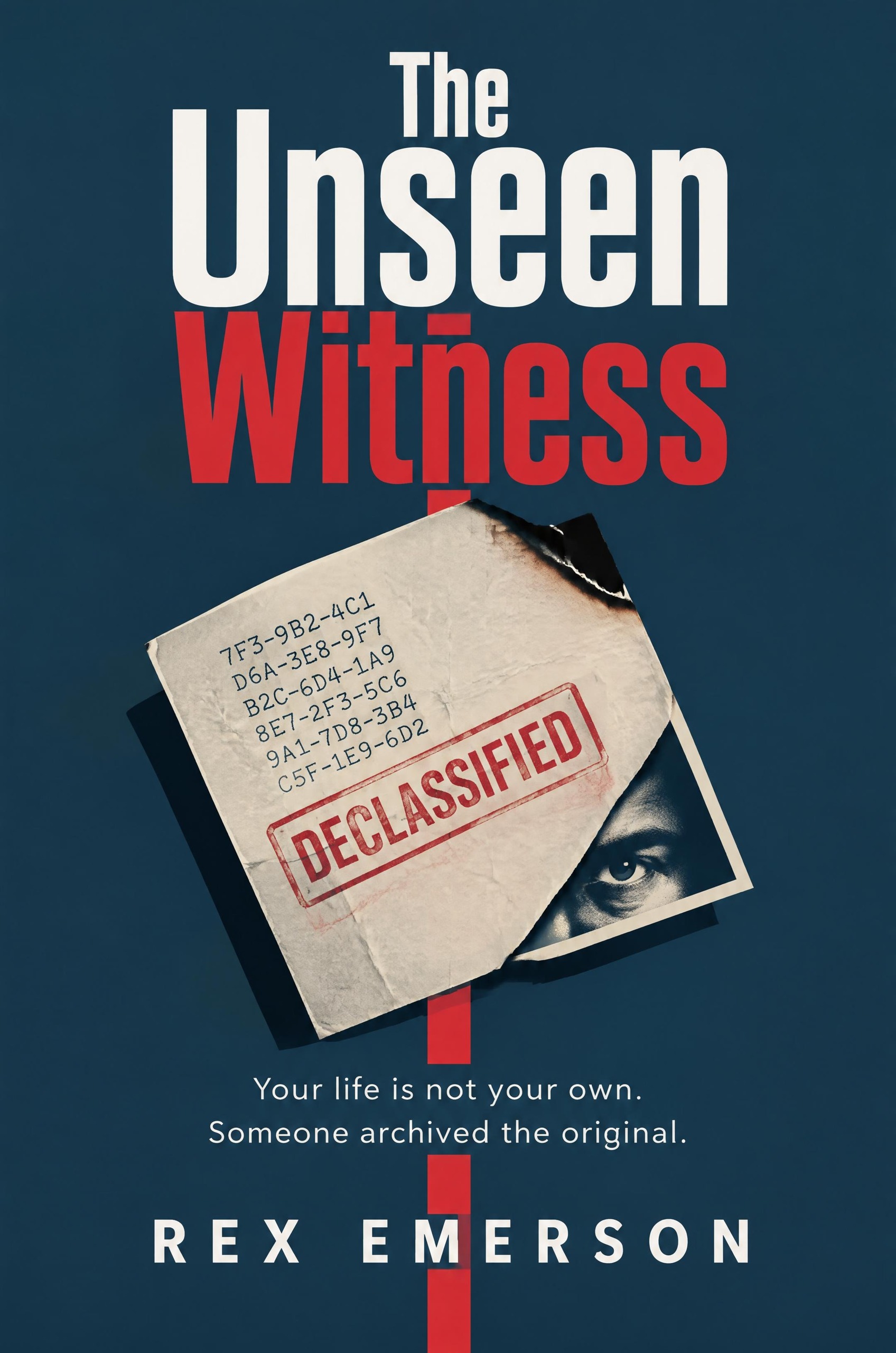
The Unseen Witness
Your life is not your own. Someone archived the original.
by Rex Emerson
Marcus Cole films everything. It is how he makes a living as a forensic imaging analyst, and it is how he catches the explosion at the Lake Balboa records facility on camera. The masked figure fleeing the scene does not see him. The charcoal sedan driving away does not slow down. Marcus uploads the footage anonymously to LAPD Detective Elena Vance and expects to stay invisible. Then something writes to his terminal. It knows his name. It knows everything. Vance discovers her credentials were hijacked before the upload arrived. Her civilian IT consultant finds Marcus's profile so clean it glows like a forgery. And Julian Thorne, the man sent to clean up the aftermath, finds a file stamped DECEASED that shows Marcus Cole is really Arthur Vale, an operative erased seven years ago by a covert body called the Continuity Board. Now the men who built his fake life want it destroyed. Marcus must rediscover forgotten instincts, survive a city that was never his, and decide if the person he became is worth saving. The Unseen Witness is a breakneck conspiracy thriller about identity as infrastructure and the people who get archived alive.
- Thriller
- Mystery
- Conspiracy Thriller
- Cat & Mouse
- Police Procedural
Chapter 1
The Unseen Witness
by Rex Emerson
Chapter 1: The Margin of Error
Marcus Cole did not consider himself a remarkable man, but he trusted his eyes.
Most people moved through Los Angeles as if the city existed only directly in front of them. Marcus noticed what happened at the edges. He saw the hairline fracture spreading across a parking garage support before engineers closed the structure. He spotted a mismatched button on a passing executive's cuff. Watching someone cross a crowded intersection, he could tell an old injury from an uneven stride.
It was not intuition. He simply had trouble letting details go.
That habit paid his rent. Insurance firms and the occasional attorney sent him files other analysts had marked unusable: footage from a smashed dash camera, a flooded lobby recording, and a still so compressed that the faces had weathered into abstraction. Marcus rarely restored what was lost; he recognized what remained.
Tuesday had begun with that kind of work.
At 9:40 he sat in his downtown apartment with the blinds half drawn and a wrecked intersection paused on his monitor. Three camera angles covered the collision, two of them useless. The third held a reflection in a bus shelter that the responding officer had never logged. Marcus isolated the pane, lifted the midtones, and found a license plate that did not belong to either vehicle in the report. On a second pass, he saw the car's brake lights flare before the first impact. The report had assigned fault without accounting for the third vehicle. He logged the frame, transmitted his findings, and closed the job before his coffee cooled.
The apartment was kept by habit rather than taste. White walls. A single plant that survived on neglect. On the closet shelf sat a black ballistic-nylon go-bag, its corner aligned precisely with the shelf's edge. It had been there for years. Checking its position had become part of Marcus's morning routine, though he could no longer remember when the routine had begun, or who had packed the bag.
By noon, a supplier in Lake Balboa called. The replacement imaging sensor Marcus needed for a county contract was off the freight truck but held in inspection. If he wanted it that day, he would have to wait at the yard.
He went that afternoon. The freeway carried him out of downtown. As the surface streets gave way to the grid of Lake Balboa, Marcus found himself checking the rearview more often than the route required. A white van stayed two cars back for three lights, then turned. A delivery truck changed lanes without signaling and dropped behind him for half a mile. Neither stayed. He told himself it was the heat on the asphalt. His hands stayed tighter on the wheel than the speed warranted until he turned into the service lot.
The Lake Balboa Records and Archiving facility stood three hundred feet beyond the supplier's fence, a windowless concrete block between a service road and a row of aging workshops. Marcus parked at the edge of the adjoining service lot, screened by a row of weathered delivery trucks, and watched the building. Windowless walls always invited the eye to look for seams.
At 2:21 he cut the engine. Twenty-seven minutes passed.
A clerk stepped out twice, checked the same clipboard, and went back inside. A delivery van changed lanes without signaling. A pedestrian hurried across against the light, favoring the left leg. None of it mattered, which was why Marcus noticed all of it.
At the archive, a loading-bay door rose halfway, hesitated, and lowered again. No truck waited behind it. Above the service gate, a municipal camera faced the alley instead of the entrance.
Marcus wrote both details in his notebook and let them sit. He was waiting for a sensor, not working a scene.
Then came the second before the sound.
The ground reached him first.
A deep shudder traveled through the asphalt and up the steering column into his palms. Before the blast reached his ears, his shoulders locked, his foot braced against the floorboard, and his breath caught.
Then the explosion tore through the lot.
The archive's rear wall blew outward in a sheet of brick, structural steel, and rolling fire. A wall of gray dust swept across the service yard, carrying glass, siding, and roofing fragments into the boulevard.
The shockwave rocked his sedan on its springs.
Alarms wailed. One car mounted the curb; another spun sideways across two lanes. People scattered blindly through falling debris.
Marcus expected his hands to shake.
They did not.
His breathing remained slow, his pulse steady. In the chaos, his hands moved before he decided they should.
His hand went to the center console.
Phone. Camera app. Telephoto.
He pointed the lens away from the blast. Everyone else was staring into the fire.
For a moment the viewfinder showed only smoke and the edge of a delivery truck, and Marcus did not know why he had turned the phone. The thought arrived after the action: he was filming an empty alley while people were still running from the wall. He did not lower the phone.
Marcus worked the edges.
Oily smoke poured over the ruined warehouse. While survivors scrambled away from the bays, Marcus swept the margins until he caught movement cutting against the panic.
A sedan idled beside the service gate in the side alley, shielded by the surviving masonry. Charcoal gray, clean enough to look alien against the falling soot. Its driver's door stood ajar.
The car had not been caught there. It was staged.
A man in a dark coat stood by the open door, moving with mechanical calm. In one gloved hand he held a rectangular black device. A single amber LED pulsed once on its face as he lowered it into the driver's footwell. The light died. He heard nothing from the device itself—no click, no tone—only the alarms and the debris still falling.
Marcus framed the shot, rolling back the digital zoom until the edges sharpened.
The man paused. His head turned toward the delivery trucks screening Marcus's car.
Two hundred feet of drifting ash separated them. Marcus could not make out the man's eyes, but the line of sight was unmistakable.
Neither moved.
Then the man slipped behind the wheel and pulled the door shut. The sedan laid two clean tracks through the dust and vanished down the alley.
Sirens rose in the distance.
Marcus lowered the phone. The clip showed forty-two seconds recorded.
His hand hovered over the emergency screen. Police would want his name, his business address, and a reason for filming an empty alley instead of the casualties. They would also take the phone, or copy it, before he understood what he had recorded.
He should have stayed to give a statement.
Instead, a quiet, absolute certainty surfaced:
Leave now.
He checked the alley once more. Nothing moved in the smoke. The warning carried the same cold authority that had braced his body before the blast, not fear, but instruction.
Marcus threw the car into reverse. He backed slowly along the perimeter, keeping the row of weathered delivery trucks between his sedan and the street until the first cruiser tore past, followed by the deafening horn of an engine. Only after the patrol unit cleared did he angle out into the moving lane and let the evacuation carry him south. He had maneuvered for concealment rather than speed without ever consciously deciding to.
In the rearview mirror, a black plume climbed into the afternoon sky.
Marcus thought he was simply an observer who caught what others missed.
It never occurred to him that someone might have staged the scene knowing he would look.
Chapter 2: The Digital Breadcrumb
Marcus did not drive straight home.
Traffic crawled through the first two intersections beyond the archive, then loosened.
The streets carried him back through Van Nuys toward the freeway. The freeway was running clear for a Tuesday afternoon, and he covered the distance without slowing. He watched the mirror until the Valley gave way to the approach into downtown. Only after leaving the freeway did he begin to vary the route. Twice he looped off the main boulevard and rejoined traffic three blocks later. He shifted lanes beneath an overpass, let a cluster of vehicles clear, and pulled into his building through the subterranean garage instead of the street. Only when he reached his floor, key already indexed between his thumb and forefinger, did he acknowledge what he was doing: clearing his tail.
No one had followed.
At least, no one was visible.
He unlocked the door, set the deadbolt, and stood silent in the dark entryway for precisely eleven seconds. The building hummed around him: a television two floors down, pipes cooling behind drywall, the distant groan of the elevator cable. Nothing moved in the corridor.
At 3:24, he sat down at his workstation, killed the wireless radio, and pulled the physical network cable before docking the phone. He dumped the forty-two-second clip to an isolated external drive, generated an MD5 checksum, logged the hash by hand in his desk notebook, and created a working copy.
Preserve the original. Log the hash. Work exclusively on duplicates.
The procedure was second nature to an imaging analyst. It did not explain why he had run it before he had decided what the file was for.
Enlarged across his monitors, the footage yielded more structure. Marcus advanced frame by frame to the moment the sedan appeared beside the service gate.
The rear license plate was unreadable. A faint, polarized glare washed out the characters as the car backed away, catching the afternoon light unnaturally.
Marcus opened his notebook and wrote: Rear registration intentionally obscured.
He struck the middle word, replacing it to keep the observation clinical: Rear registration obscured by unknown material.
Precision mattered.
He turned to the man in the coat.
The rectangular handheld unit featured two recessed toggle switches and a stub antenna. It looked like an RF trigger, though the recording could not prove its function. It proved only that the subject had handled it seconds after the wall failed.
Marcus stepped forward three frames. The man stowed the unit and turned toward the delivery trucks.
Directly toward Marcus's lens.
Marcus paused playback. For a long moment, he stared at the pixelated silhouette. His throat was dry.
He stepped to the window, stopping just inside the frame where the wall hid his outline from the street below. A white utility van passed; an empty sedan followed. He returned to the desk.
On the third zoom pass, a pale shape caught the light near the man's right cuff.
Marcus enhanced the crop. The pixels frayed, but stepping back across the adjacent frames revealed the geometry: interlocking chevrons enclosing a lowercase Greek delta.
He exported the four clearest frames.
In the third still, a dark vertical mass showed through the sedan's rear glass. Someone appeared to be standing motionless beyond the vehicle, even as dust and fleeing workers blurred the background.
Or it was a section of gate hardware distorted by the heat haze.
Marcus flagged the coordinates in his notes and left the pixels raw. If he forced the contrast, his eyes would manufacture whatever shape they expected.
Outside, the street hummed with late-afternoon traffic. The man had handled the device calmly beside a car parked clear of the blast, then looked straight toward Marcus's lens.
The recording belonged with the police.
Yet dialing 911 would stamp his phone number and GPS coordinates into an unencrypted CAD log. Walking into the Central Division desk would log his face across a dozen high-definition lobby feeds.
Marcus kept a private archive of investigators whose filings demonstrated independence from departmental politics. Detective Elena Vance was one of the few he remembered by name. Eight months earlier, she had challenged an official shooting timeline after discovering a reflected storefront clock in a cruiser's windshield that placed two officers on scene eleven minutes before they claimed to have arrived.
She understood how to read a margin.
Marcus opened the public evidence upload portal and selected Detective Elena Vance's tip queue.
He removed identifying metadata from a transmission copy of the video and the four stills, verified the files, and plugged the network cable back in. He routed the session through three commercial VPN services opened under disposable accounts.
Every anonymous packet left an artifact. He could minimize the friction; he could not eliminate the physical route.
He attached the clip and four stills, hovering over the transmission button.
He listened to the apartment once more. Pipes. Distant traffic.
He clicked submit.
The progress bar climbed to ninety-eight percent and hung.
The primary relay in the chain dropped offline. A second node flickered from active to unreachable. Marcus reached for the master power strip. Before his fingers touched it, the upload resolved.
A green confirmation dialog appeared: Upload Successful.
The disconnected relay reappeared on his dashboard, its interruption logged as under eight hundred milliseconds. The connection showed as clean. Marcus did not trust the readout.
He pulled the Ethernet line, unmounted the scratch drive, and walked into the kitchen. He poured a glass of water and watched the street through the blinds. He was halfway through the glass when an alert chime sounded from the dark study.
The browser was closed. The network cable lay coiled on the hardwood.
At the desk, a borderless terminal window had populated across the center screen. Plain text was rendering into the console, character by character:
RECEIPT CONFIRMED, MARCUS. WE APPRECIATE THE DELIVERY.
A line break followed.
YOUR RESPONSE TIME HAS IMPROVED.
Marcus gripped the water glass until his knuckles blanched. He had never typed his name into the portal.
The relay drop had not been network lag. Something had been waiting on the other side of the handshake, or was already residing inside his machine.
His mind flashed to the brace before the sound. Every reaction since had been practiced, and he could not remember the practice.
He reached for the workstation's main power cord.
Above the monitor, the webcam's pinhole LED lit green.
Chapter 3: Already Opened
At the Lake Balboa archive, Detective Elena Vance stepped across a twisted length of rebar and stopped at the sheared perimeter of the records vault. She had spent twenty minutes inside the blast footprint. Concrete dust coated the shoulders of her jacket. Deeper in the facility, a salvage saw screamed against structural iron as emergency crews shored up the central load-bearing posts.
The vault did not match the rest of the destruction.
Elena remained outside the inner barrier tape. The primary loading-bay collapse radiated outward toward the street, throwing structural members and racking into the yard.
Here, the reinforced slab had caved inward. The perimeter edges angled down rather than lifting with the pressure wave. The filing tracks nearest the breach had collapsed into the sub-floor, while the adjacent bays remained square. Every carton within fifteen feet had been incinerated down to a fine, carbonized sediment.
The warehouse had suffered an explosion. The vault had suffered an ignition.
An arson investigator crouched over a core sample near the threshold.
"The loading dock went first?" Elena asked.
"Outward venting," he said, not looking up. "Blast traveled the path of least resistance through the bay doors."
"And this room?"
He tapped the slagged steel of a door frame. "Separate charge. High-temp accelerant. The exterior blast opened the envelope; this charge sanitized the contents."
Elena photographed the boundary line where the blast charring gave way to white-hot oxidation. Whoever designed the breach wanted nothing inside the vault recovered.
A technician showed her a heat-blackened equipment tag recovered beside the vault. Its contractor code matched none of the facility's approved vendors. She entered it in the debris log, below an inventory notation for the destroyed federal retention files.
Outside, forensic techs worked around two tire impressions pressed into the soot near the side alley. Elena followed the tracks toward the property line.
A municipal traffic dome hung from an arm above the gate. It was turned twenty degrees off its nominal intersection view, aimed directly down the narrow corridor between the buildings.
Chapter 2
She logged the serial number.Her phone vibrated in her interior pocket.Elena pulled off a nitrile glove and opened the department's mobile interface. A direct upload had hit her portal queue: a forty-two-second MP4 and four extracted stills.The delivery timestamp was less than sixty seconds old.The audit trail showed her credentials had accessed th…