

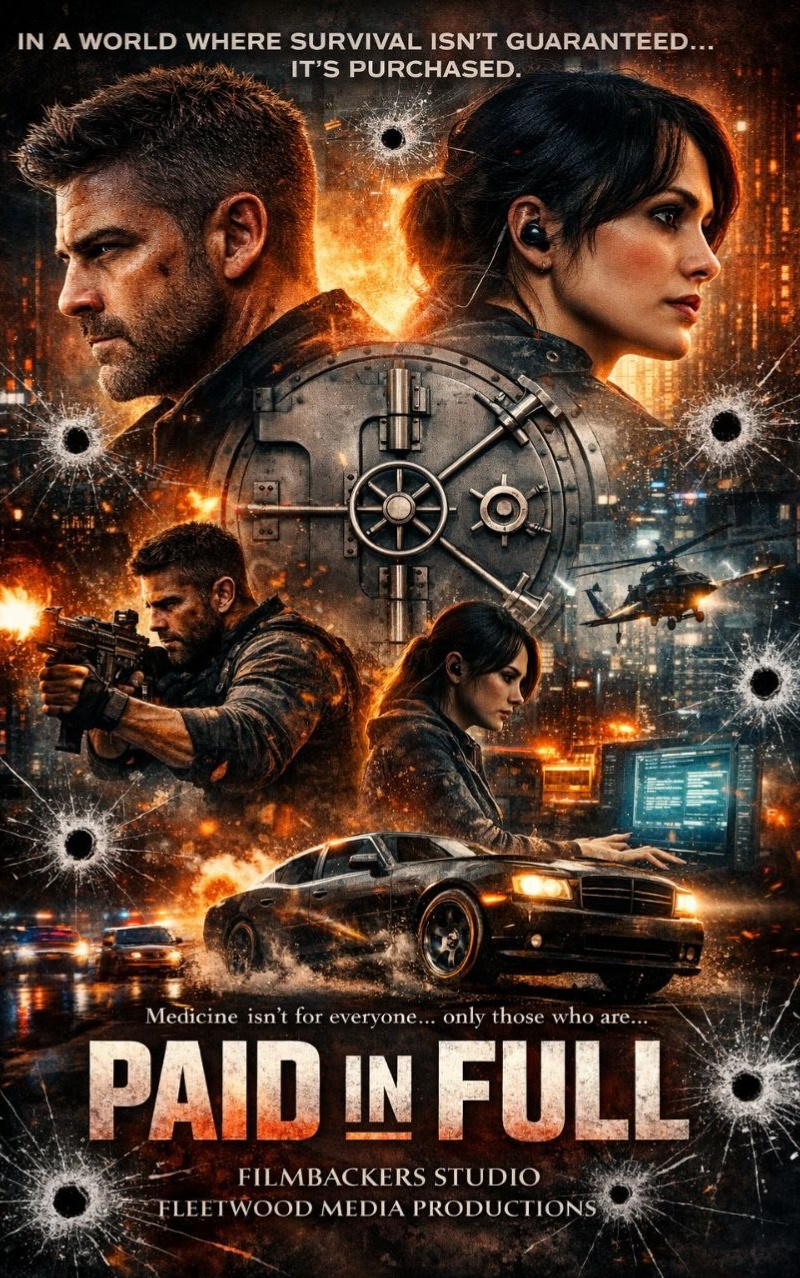
PAID IN FULL
In a world where life has a price tag, some debts are paid in blood
by Rich Story
The cost of living has never been higher. In a near-future where healthcare is a privatized commodity, Ethan and Mara Kane are facing every parent's worst nightmare. Their children are dying, and the life-saving treatment they need is locked behind a corporate paywall they can never hope to afford. Desperation leads them to Victor Voss, a ruthless predator who offers them a deal: execute a series of high-stakes heists against the medical elite, and their children live. But as the Kanes descend into a world of high-octane robberies and neon-drenched crime, they realize they aren't just thieves—they're pawns in a much deadlier game. When Mara uncovers evidence that the system is rigged and the promised cure is a lie, the mission shifts from survival to scorched-earth vengeance. From the gritty streets to the high-tech vaults of Mercy Tower, Ethan and Mara must decide how much they are willing to sacrifice to dismantle the corporate machine. Richard Story delivers a pulse-pounding neo-noir thriller that explores the dark intersection of greed, technology, and a parent's unbreakable love. In the end, the system will fall, but the price of freedom might be everything they have left.
- Neo-noir crime thriller
- Dystopian action
- Heist Thriller
- Cyberpunk
- Social sci-fi
Opening
The air inside the Aethelgard Medical Center didn’t smell like a hospital. It smelled like expensive rain and white tea, a pressurized fragrance designed to mask the scent of human frailty. Here, the floors were seamless slabs of polished obsidian that reflected the soft, recessed amber lighting of the ceiling. There were no frantic footsteps, no rattling gurneys, and certainly no raised voices. Silence was the primary commodity, purchased at a premium by those who could afford to ignore the world outside the tinted, reinforced glass.
Behind a desk of brushed titanium, a receptionist with skin like porcelain and a smile that had been surgically perfected watched a young boy being wheeled toward the private elevators. The boy was seven, maybe eight. He was wrapped in a cashmere blanket that cost more than a foreman’s annual salary. A team of four specialists trailed him, their tablets glowing with real-time biometric data synced to a satellite array. They weren’t just treating a cough; they were managing an investment. The boy’s father, a man in a charcoal suit that shimmered with integrated smart-fibers, checked his watch. He looked bored. Death was a distant concept here, something that happened to other people in other zip codes.
“The regenerative suite is ready, Mr. Sterling,” the receptionist murmured, her voice a melodic hum. “The nanobots have been calibrated to your son’s specific DNA profile. He’ll be back on the tennis court by Thursday.”
The father nodded, not looking up from his wrist-display. “Make it Wednesday. We have the gala in the Heights.”
“Of course, sir. We’ll expedite the infusion.”
The elevator doors slid shut with a soundless hiss, sealing the elite away in their fortress of longevity. Above the desk, a holographic display flickered with the PharmaCorp logo—a stylized double helix entwined with a gold coin. The slogan pulsed in a soft, reassuring blue: Life is precious. Let us value it.
Twenty miles away, the humidity of the city’s industrial gut tasted like copper and wet soot. The transition wasn't a fade; it was a bone-deep jar. The fluorescent lights of the St. Jude’s Public Ward didn't glow; they buzzed with a dying, rhythmic flicker that clawed at the nerves. The air here was heavy, thick with the smell of unwashed bodies, industrial disinfectant, and the metallic tang of old blood. It was a place where hope came to be filed away in a rusted cabinet.
Ethan Kane stood in the center of the intake lobby, his broad shoulders hunched as if he were trying to make himself a smaller target for the misery surrounding him. He was a man built for heavy lifting, for iron and concrete, but here, his strength was a useless relic. His daughter, Lily, was a small, pale ghost in his arms. She was eight years old, but she felt as light as a bundle of dry tinder. Her breath came in shallow, ragged hitches that whistled in her throat, a sound that tore through Ethan’s chest every time he heard it.
“Stay with me, Lil-bit,” he whispered, his voice a low rumble that vibrated against her hair. “Just a little longer. We’re almost there.”
Lily didn’t answer. Her eyes were closed, her lashes dark smudges against skin that had gone the color of spoiled milk. A thin trail of sweat beaded on her forehead, despite the chill that rolled off the damp concrete walls. Ethan stepped forward, his heavy work boots thudding against the cracked linoleum. He reached the intake window—a thick slab of scratched plexiglass reinforced with wire mesh. Behind it sat a woman whose face was a map of exhaustion and institutional indifference.
“Next,” she said, her voice amplified by a tinny, distorted speaker.
Ethan pressed his hand against the glass. “My daughter. She’s having trouble breathing. Her fever is hitting a hundred and four. She has a genetic nerve disorder—we have a file on record.”
The woman didn't look at Lily. She looked at a flickering monitor to her left. Her fingers moved over a keyboard with a mechanical, soul-crushing rhythm. “Name?”
“Lily Kane. K-A-N-E.”
The clicking stopped. The silence that followed was worse than the noise of the crowded waiting room behind them. Ethan could hear a man coughing a few feet away—a wet, hacking sound that ended in a groan. He could hear the drip of a leaking pipe somewhere in the ceiling. He watched the woman’s eyes as they scanned the screen. He saw the moment the light in them went out, replaced by a practiced, defensive coldness.
“I see the profile,” she said. “Genetic Myolysis, Type B.”
“The meds we were supposed to get—the stabilizers—they never arrived,” Ethan said, his voice rising, thick with a desperate edge. “She needs an ICU bed and a neural-wash. Now.”
The woman finally looked at him. There was no malice in her gaze, only the flat reality of a system that had long ago run out of mercy. “Mr. Kane, your insurance tier was downgraded three weeks ago when your foreman contract ended. You’re currently on Basic Public Provision.”
“I’m looking for work. I’ve got leads. I just need a bridge, just a few days of treatment to get her stable.”
“Basic Public Provision does not cover Myolysis stabilizers or neural-wash procedures,” she said, reciting the words as if reading from a script she’d memorized in a nightmare. “Those are Tier 4 interventions. You’re Tier 1. Sub-level.”
Ethan’s grip tightened on Lily. He could feel her heart racing, a frantic, tiny bird trapped in a cage of ribs. “She’s eight years old. She’s dying. You’re telling me you’re going to let her die because of a clerical change?”
“I’m telling you the hospital cannot recoup the cost of the equipment required for her care,” the woman replied. Her voice dropped, losing the professional edge for a brief, flickering second. “I’m sorry. There are three hundred people in this ward and only two functioning ventilators. We have to prioritize those with viable recovery paths and active coverage.”
“Viable?” Ethan’s voice was a low growl now. He felt the heat rising in his neck, the raw instinct of a protector who had been backed into a corner. “She’s a child. Not a line item on a balance sheet.”
“Sir, please don’t raise your voice. Security is watching.”
Ethan looked over his shoulder. Two men in tactical vests with the PharmaCorp logo on their shoulders stood near the entrance, their hands resting on the grips of their shock-batons. They weren't there to help the sick; they were there to protect the assets. In this world, the only thing more dangerous than a virus was a father with nothing left to lose.
“I need to speak to a doctor,” Ethan said, turning back to the glass. “Let me talk to Lena Voss. She handled Lily’s intake last year. She knows the case.”
“Administrator Voss is in a meeting. She gave the directive on all Tier 1 denials this morning.” The woman hesitated, then pushed a small, printed slip of paper through the slot at the bottom of the window. “This is a voucher for a sedative. It will help her sleep. It’s all I can give you.”
Ethan stared at the piece of paper. It was yellow, the color of a warning light. It wasn't a cure. It was a white flag. It was the system telling him to take his daughter home and watch her go quiet so she wouldn't bother the neighbors. He didn't take it. His hand stayed clamped on Lily’s side, feeling the heat of her fever through his work shirt.
“Keep your paper,” Ethan said, his voice dropping to a terrifying, calm level. “I’m not leaving until she’s seen.”
He turned away from the window and walked toward the heavy swinging doors that led to the treatment bays. He didn't run; he moved with the heavy, unstoppable momentum of a landslide. One of the security guards stepped into his path, his hand coming up to Ethan’s chest. The guard was younger, his face hidden behind a mirrored visor, but Ethan could see the tension in the boy’s shoulders.
“Back to the waiting area, pal,” the guard said. “You heard the lady. No coverage, no entry.”
“Move,” Ethan said. It wasn't a request.
The guard reached for his baton, but Ethan was faster. It wasn't a fighter’s move; it was a worker’s move. He used his weight to shove the guard back, a massive, blunt-force redirection that sent the man sprawling into a row of plastic chairs. The second guard lunged, his shock-baton crackling with blue light, but Ethan didn't flinch. He shielded Lily with his body, taking the glancing blow across his shoulder. The electricity surged through him, a white-hot needle of pain, but he didn't drop her. He couldn't. She was the only thing keeping him upright.
“Code Blue in Lobby! We need backup!” the woman behind the glass screamed into her headset.
Ethan kicked the swinging doors open. The sound was like a gunshot in the sterile hallway. He found himself in a corridor lined with gurneys where people lay in various states of decay, ignored by the skeleton crew of overstressed nurses. He saw a woman in a white coat at the far end, her hair pulled back in a tight, severe bun. Lena Voss.
“Lena!” he shouted. “Look at her!”
The administrator turned, her expression shifting from surprise to a cold, clinical annoyance. She didn't look at Lily’s face; she looked at the security guards who were now rushing through the doors behind Ethan. She looked at the disruption of her orderly, profitable environment.
“Mr. Kane,” she said, her voice like ice water. “This is a violation of hospital policy. You are endangering the staff.”
“I’m trying to save my daughter,” Ethan said, gasping as the pain from the shock-baton finally began to register. He reached her, stopping just inches from her desk. He held Lily out, a silent plea in the form of a dying child. “Look at her, Lena. You know the protocol. You know the stabilizers work. Just one dose. Just to buy us time.”
Lena Voss looked down at Lily. For a second, just a heartbeat, Ethan thought he saw a flicker of the human being beneath the administrator. Then she looked at the tablet in her hand, the digital ledger that dictated who lived and who was a liability. She looked back at Ethan, her eyes dead.
“The cost-benefit analysis doesn't support the intervention, Ethan,” she said softly. “Weeks, not months. That was the prognosis even with the meds. We can’t justify the expenditure for a terminal case with no insurance. It’s a matter of resources.”
“Resources?” Ethan whispered. He felt the world tilting, the last of his belief in the rules crumbling into the grime of the hospital floor. “She’s a person. She’s my little girl.”
“She’s a cost center,” Lena replied, her voice turning sharp as the security guards grabbed Ethan’s arms. “Get him out of here. And call CPD. I want him trespassed.”
The guards dragged him back. Ethan didn't fight them this time. He held Lily tight, his face buried in her neck as they hauled him through the doors and into the rain-slicked street outside. The heavy iron gates of the hospital slammed shut behind them, the sound of the locks engaging like a final sentence.
Ethan stood on the sidewalk, the cold rain washing the sweat and the hospital smell from his skin. Above him, a massive digital billboard flickered to life. It showed a smiling family in a sun-drenched field, the PharmaCorp logo glowing bright against the gray sky. Your health is our priority, the text read. Invest in your future today.
Ethan looked down at Lily. Her breathing was thinner now, a ghostly rattle against the backdrop of the city’s roar. He didn't look like a construction foreman anymore. He looked like a man who had just seen the truth behind the curtain. The system wasn't broken; it was working exactly as intended. And he was done playing by its rules.
Ethan Intro
The jackhammer was a physical weight, a rhythmic violence that vibrated through Ethan’s teeth and settled into the marrow of his pelvic bone. It was six in the morning, and the industrial district was a graveyard of rusted rebar and weeping concrete. Above him, the sky was the color of a gutter, thick with the chemical haze that drifted off the Pha…