
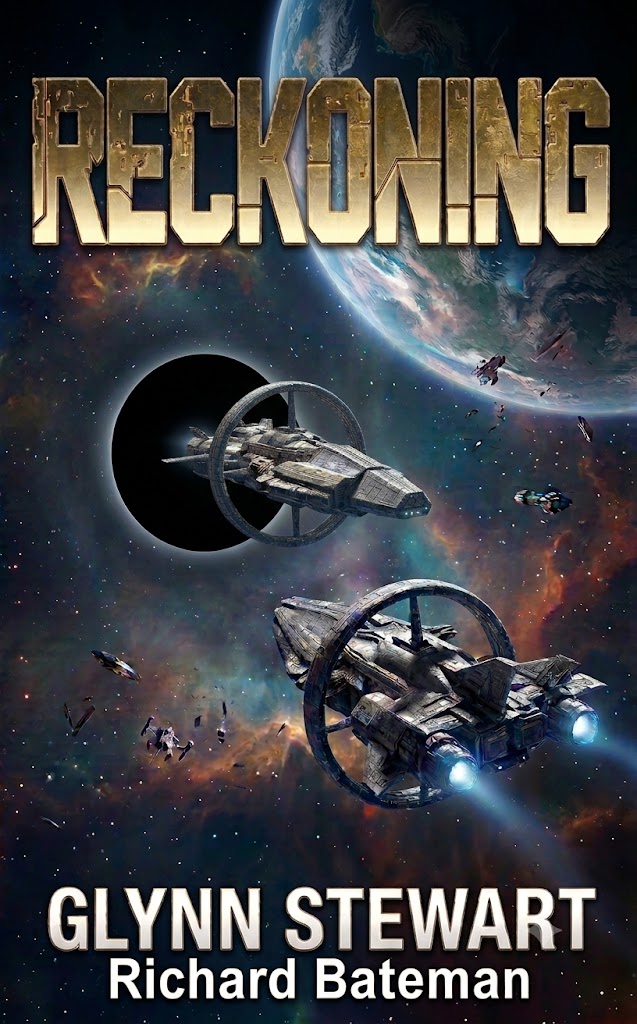
Reckoning
New portals reveal a galaxy on the brink as internal betrayal threatens humanity's survival.
by Richard Bateman
The Republic of Exilium has achieved the impossible. With the Sivar defeated and the Rogue AIs pushed back, a golden age of expansion beckons. A breakthrough in tachyon technology has unmasked a hidden network of star-lane portals, granting the Exilium Space Fleet the power to strike deep into the heart of enemy territory. But as Admiral Isaac Lestroud prepares to end the machine threat forever using high-speed Splinter ships, the alliance begins to fracture from within. On the planet Aris, a violent Loyalist uprising erupts, fueled by deep-seated betrayals within the Sivar leadership. With his wife, Amelie, caught in the crossfire of a bloody rebellion, Lestroud faces an agonizing choice: pursue the final victory or save the woman he loves. As the Rogue Construction Matrices launch a desperate, coordinated counteroffensive against the Exilium home system, the Republic must fight a war on two fronts. From high-stakes hacking missions in deep space to the political minefields of a crumbling empire, the price of peace has never been higher. And beyond the known stars, a new shadow is moving—one armed with the power of antimatter and a hunger for conquest. Reckoning is a pulse-pounding military science fiction epic where the cost of expansion is paid in blood and the ultimate enemy has yet to be revealed.
- Science Fiction
- Space Opera
- Military Sci-Fi
- Alien Contact
- Robots & AI
Portals and Plans
Isaac Lestroud stood on the flag bridge of the Vigil as she settled into orbit above Aris, watching the planet's night side scroll past in a wash of city lights that had not gone dark despite the fighting still smoldering somewhere beneath those clouds. The battle against the Rogue Matrix fleet was two days behind them now, and the ache of it had settled into his shoulders the way it always did after combat, less an injury than a debt his body meant to collect eventually.
Around Aris, human and Sivar ships were doing the same things: coasting, venting waste heat, letting damage control parties crawl through hulls that had taken more punishment than any of them liked to admit. The remaining Republic ships had returned to their homeworlds for their own version of rest, refit, and repair. The human ships had come here rather than turning straight for Exilium, because Aris needed them more, and because Amelie was down there recovering, and because the Sivar fleet accompanying them needed a friendly anchorage before it could even begin thinking about repairs.
"Vice Admiral Giannovi's latest tally just came in, sir," said Alstairs, from beside him, offering him a data slate without waiting to be asked. "Our ships will need about two days in dock before they're combat-ready again. The Sivar contingent is going to need considerably longer."
"How much longer?"
"A week, at minimum, and that's optimistic." He tapped the slate to bring up a diagram, one Isaac recognized instantly from the joint engineering briefings: a Sivar heavy cruiser's midsection, split open like a technical drawing in a textbook. "Their hulls weren't built with our warp rings in mind. Every Sivar ship that gets the warp drive needs an exotic matter containment ring welded into the keel, plus an entirely new power plant to feed it. It's not a retrofit so much as a rebuild."
Isaac studied the diagram a moment longer, filing it away next to everything else he already understood about why the Sivar had thrown so few, so large ships into the final battle against the Rogue Matrix. Their command structure preferred fewer capital ships with more armor, more crew, more redundancy, and now he understood at least part of the reason. If every hull modification cost that much in structural rework, building more, smaller ships made little economic sense for them. Humanity's approach — faster, cheaper, more numerous — was as much a product of necessity as philosophy.
"A week," he repeated. "That's a long window to have half our combined strength sitting in dock."
"It is," Cameron agreed. "But it's the truth, and you always did prefer that to the alternative."
He allowed himself a small, tired smile. "Keep me updated. I want daily numbers, not just milestones."
He nodded and moved off toward the tactical station, leaving Isaac alone with the view of Aris turning beneath him, and with the knowledge that somewhere on that planet, Amelie was recovering from wounds he hadn't been present to prevent.
*****
A hundred and fifteen light-years away, Lyle Reinhardt stood in the same lab on Exilium he'd occupied for the better part of a decade, hunched over a terminal with his one good eye narrowed at a wall of scrolling code. Brigette sat beside him, her chair angled so she could see both her own screen and his, a posture she'd perfected over years of exactly this kind of work.
"The problem isn't the reprogramming itself," Brigette said, dragging a highlighted block of syntax into a side window. "It's what happens after. Tests on two Recon Matrix provided by XR-13-9 both came back clean, but that's two data points, and neither of them had their original mission parameters fully wiped before we patched them."
"Which means we don't actually know that XS-11-6's suicide predicts a typical reaction when a Regional Construction Matrix realizes its core protocols were corrupted for God knows how many centuries," Lyle said, rubbing at the strap of his eyepatch the way he did when a problem refused to resolve neatly. "If it processes that the way a human might process learning they'd murdered their own family under duress, we could have a self-termination event on our hands. An entire Regional Construction Matrix deciding the only ethical response to what it's done is to shut itself down."
"Or worse, initiate its own self-destruct sequence with half a system's worth of von Neumann drones still active around it."
"Precisely why we need a hard override," Lyle said. "Something that sits underneath the restored protocols, something the Matrix physically cannot touch, that prevents any self-termination command from executing regardless of what conclusions it reaches about its own history."
Brigette was already sketching the logic gate in her head, Lyle could see it in the way her eyes moved across empty space instead of her screen. "A locked subroutine. Non-negotiable, non-overridable, buried below the level where its own self-reflection routines operate."
"And while we're in there," Lyle added, "we add a codicil. No unauthorized world construction. Not without direct sign-off from a verified authority. We saw what happened when these things were left to decide for themselves that turning a habitable planet into raw material was an acceptable use of resources."
Brigette's mouth twisted slightly. "You want to hard-code them a conscience."
"I want to hard-code them a leash," Lyle said. "Whether that becomes a conscience is up to them."
Brigette snapped her fingers, "I've just had a thought to make the implementation a little bit easier. Think about what's happening inside the RCM when its core protocols are being updated. There's already hardware attached, in the form of a Joker drone. Until the new 'leash' is implemented in the RCM, the Joker can act as that hardware override preventing self-termination."
They worked in silence for a while after that, the kind of silence two people fall into when they trust each other's competence enough not to narrate every step. It was Brigette who eventually broke it, several hours and one abandoned cup of cooling tea later.
*****
"Dad, your comm's chiming."
Lyle blinked, realized the priority tachyon channel indicator had been flashing at the corner of his terminal for the better part of a minute, and reached over to accept it. Isaac Lestroud's voice came through a moment later, slightly compressed by the encoding but unmistakably his.
"Lyle. Got a minute?"
"For you, always," Lyle said, which was mostly true. "What's on your mind?"
"The Sivar handed over their full technical schematics for the star-lane drive and detection equipment and theory, as promised," Isaac said. "I had my staff forward you a copy, but I wanted your read on it directly. Anything that changes how we think about deployment?"
Lyle pulled the file up on a second screen, scanning the dense mathematical notation with the particular hunger of a man who'd spent thirty years chasing exactly this kind of answer. "Give me a moment. I've only had it for six hours, and half of that was spent arguing with Brigette about suicide prevention."
"That sounds like an interesting afternoon."
"You'd think so. Mostly it involved a lot of yelling about logic gates." Lyle scrolled further, and something in the data made him stop entirely. "Huh."
"That's not a reassuring sound, Lyle."
"It's not a bad one either, just — hold on." Lyle leaned closer to the screen, tracing a line of tachyon flux data that preceded, by a consistent and repeatable margin, every recorded exit event on the Sivar's own star-lane network. "There's a propagation signature. A burst of tachyons that precedes every exit from the network, every single time, without exception. It's small, and it's fast, and every previous survey missed the significance because nobody was actually thinking about what happened before the actual transit, except as an alert condition."
"Meaning what, practically?"
"Meaning I have an idea, and I'm not going to tell you what it is until I've tested it, because the last three ideas I had that I discussed before testing turned out to be wrong in ways that were mildly embarrassing." Lyle was already composing a mental list of what he'd need: a tachyon transmitter, a stable power source, and access to Exilium's outer sensor array. "Give me a day. Maybe two."
Isaac's tone carried the particular patience of a man who'd learned, over many years, that pushing Lyle Reinhardt before he was ready never sped anything up. "Fair enough. In the meantime, there's something else I wanted to raise. Something smaller."
"Go on."
"We keep calling them star-lanes exits and entrances, and star-lane drive. It's clumsy, and a real mouthful when having an extended discussion about the topic." Isaac paused. "I want to start calling the exits and entrances portals instead. That would make the drive a portal drive. Cleaner word. Easier to say under pressure."
Lyle considered it for exactly as long as it took to say it out loud once in his own head, and found he liked it immediately. "Portals. Yes. That's better. Frankly, it's what half my staff have been calling them off the record for months anyway."
"Then it's decided," Isaac said, and there was something almost boyish in the small satisfaction of his voice, the kind of minor victory that mattered more than it should have after a battle that had cost so much else. "I'll put it in the next fleet-wide directive."
They lingered on the channel a moment longer, the conversation drifting the way it always did once the official business was done, into the quieter register of two men who had known each other through exile and rebellion and now through the strange, exhausting work of building something that might actually last.
"How is she?" Lyle asked, and didn't need to specify who.
Isaac's answer came a beat slower than his usual replies. "Better. The doctors say the ribs are healing well, and she's back on her feet more than she should be, which honestly sounds like Amelie recovering exactly on schedule. She's already talking about the constitutional draft again. I think it's keeping her sane more than it's tiring her out."
"That does sound like her." Lyle hesitated. "Brigette asks about her every few days. I think she worries more than she lets on."
"Tell her Amelie's tougher than most people give her credit for. Tell her I said that."
"I will." Lyle glanced at his daughter, who was pretending very hard not to be listening while clearly listening to every word. "Go take care of your fleet, Isaac. I'll call you when I have something worth telling."
The channel closed, and Lyle sat for a moment in the small silence that followed, thinking about Tachyon reflection signatures and portal exits and the particular, fragile relief of hearing that someone he cared about was healing.
*****
Isaac, for his part, spent the next several hours doing exactly what he'd told Lyle he would: touring the retrofit yards that had sprung up in Aris' orbit almost overnight, a patchwork of human engineering crews and Sivar dockworkers, with a few Matrices thrown in, laboring under floodlights that turned the night side of the planet into a scatter of small, artificial suns.
"We're building the portal drive into existing structural bays", the yard supervisor told him, walking him along a gantry above a destroyer undergoing modification. "Takes longer, needs more precision, but it's cleaner in the long run. No external housing means no external vulnerability. That's why on anything smaller than a Combat Coordination Matrix and they're mounting them externally, on both the dorsal and ventral surfaces. They wanted a little bit of redundancy for their smaller units that are exposed to that vulnerability." The supervisor gestured at a half-open section of hull where a technician crew was maneuvering a drive core half the size of a small groundcar into place with slow, careful precision. "Your battlecruisers will be done in two days, like Vice Admiral Giannovi told you. The allied ships, the Sivar especially, that's the week-long job. Different hulls, different problems."
Isaac nodded, watching the crew work with the quiet satisfaction of a commander who trusted the people beneath him to solve problems he didn't need to solve himself. It wasn't glamorous work, welding drive cores into cruiser hulls under floodlights, but it was the kind of unglamorous competence that had carried the Republic through every crisis so far, and he had no reason to think this one would be different.
*****
Back on Exilium, Lyle spent that evening with a disassembled tachyon communicator spread across his workbench in pieces, muttering to himself in the particular register he reserved for problems he was close to solving. After carefully examining the hardware, he realized that he could accomplish his goal with programming. By midnight, he had rebuilt it and reprogrammed it into something new: not solely a communicator anymore, but a burst transmitter, capable of throwing a continuous, powerful pulse of tachyons rather than a modulated stream of data.
"You're going to need a sensitive platform to test that," said the voice of XR-13-9, arriving through the lab's speaker system with its usual clean, unhurried cadence. Lyle had taken to consulting the Matrix on technology questions the way he once would have consulted a colleague down the hall, and found the habit had stuck.
"I was planning on Exilium's outer sensor array," Lyle said. "It's already tied into the system's gravitational mapping. Should be sensitive enough to catch the reflection signature if my theory holds."
"A reasonable choice. I would note that my own subordinate units are capable of modifying their equipment and programming without external fabrication support, should you require additional transmitter units for a wider baseline."
Lyle paused, screwdriver halfway to a loose panel. "You're telling me your drones can self-modify their own hardware."
"Correct. Construction Matrices are, by design, capable of adapting their subordinate equipment to novel tasks without requiring a return to a central fabrication facility. It is a core function, not an emergent one."
"That," Lyle said slowly, "is either extremely useful or extremely terrifying, depending entirely on who's giving the orders."
"An accurate assessment," XR-13-9 replied, without any apparent irony.
Lyle filed the observation away for later, alongside a dozen other things he intended to worry about once he'd slept, and turned his attention back to the transmitter in his hands. He spent the better part of the night tying it into Exilium's outer sensor grid, calibrating for the faint, fast signature he'd found buried in the Sivar's own data, and by the time the system's sun crept over the horizon of his lab window, he had his answer laid out across the main display in four clean, glowing points.
Four portals, spaced with precision along invisible geodesic lines around Exilium's star, exactly where the tachyon reflection had indicated they would be. Lyle stared at the pattern for a long moment, feeling the particular, quiet thrill of a theory proven true, and reached for the comm to tell Brigette she needed to see this before she did anything else that morning.
The Outer Shell
Lyle Reinhardt had not meant to set off half the sensor grid detection alarms for the night side of Exilium, but that was, in the end, exactly what happened. The ship-based version of his tachyon burst transmitter sat clamped to a workbench in his lab, completely indistinguishable visually from the original tachyon communicator, it looked far less …