

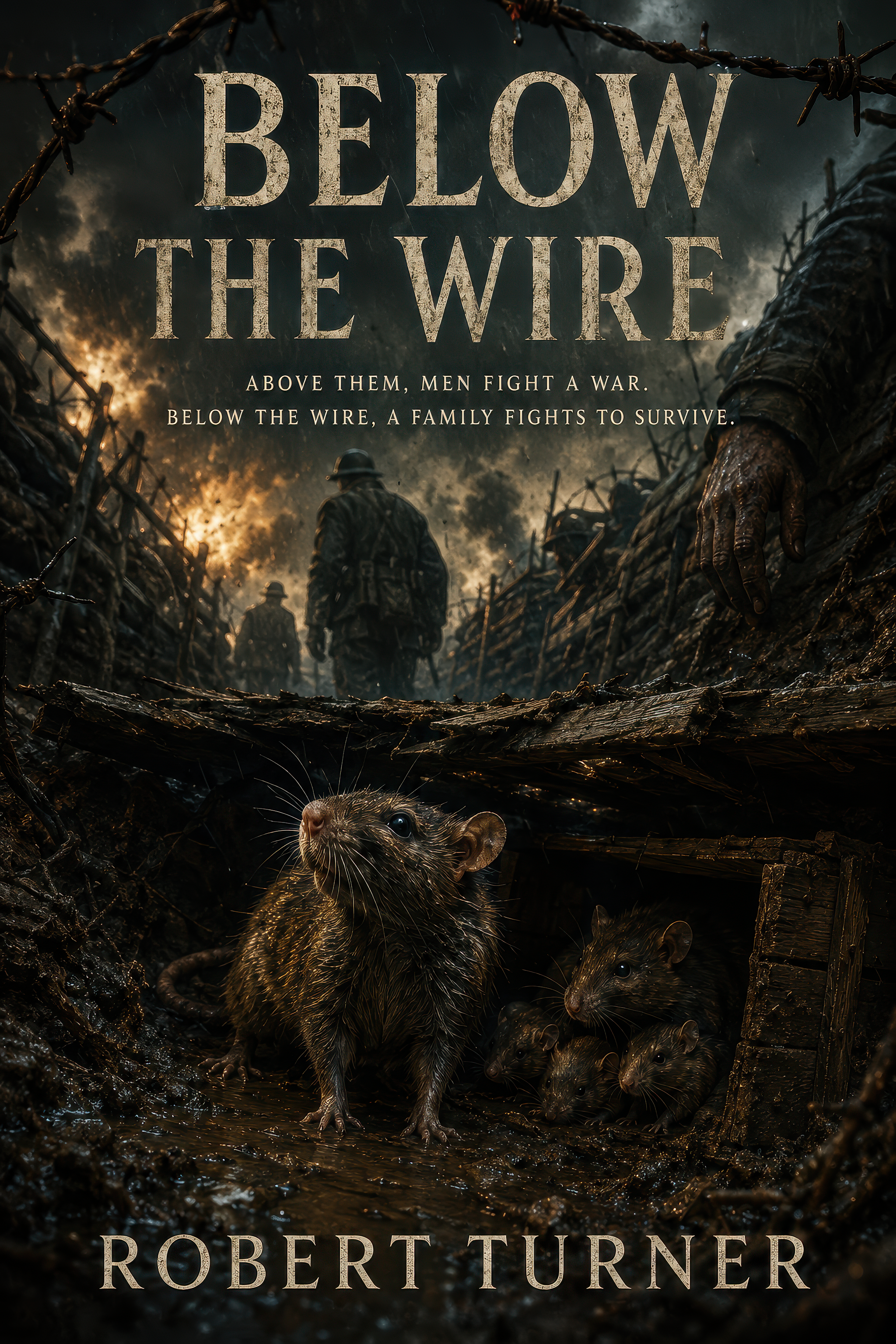
Below the Wire
Above them, men fight a war. Below the wire, a family fights to survive.
by Robert Turner
Beneath the blood-drenched chalk of the Western Front in 1916, a different kind of war unfolds. Harold Giles is a scarred trench rat who wants only to protect his mate, Enid, and nurture their newborn litter. But the subterranean maze of rotting duckboards and collapsed dugouts offers little safety. Above, heavy artillery and poison gas relentlessly batter the earth. Below, a monstrous rival rat named Victor Gunn hoards stolen rations and violently executes any who challenge his reign. When Harold discovers that an impending Allied offensive will tear the earth apart with catastrophic subterranean mines, time runs out. As detonations shatter the trenches and lethal gas floods their tunnels, Harold must lead his fragile family into the nightmare of no man's land. Across a cratered expanse choked with rusted razor wire, sniper fire, and predatory forces, they embark on an epic quest toward the forgotten green pastures beyond the slaughter. Below the Wire is an unforgettable, deeply poignant saga of resilience, unexpected kinship, and the enduring will to live amidst the madness of humanity's darkest hour.
- Historical Fiction
- Adventure
- Literary Fiction
- World War 1
- Survival
Beneath the Duckboards
The first thud came from far off, a heavy, muffled concussion that traveled through eight feet of chalk and clay before it reached Harold Giles as a tremor beneath his paws. He woke to it the way he woke to everything now, without transition, one moment folded into sleep and the next fully alert, ears flat, whiskers trembling at the vibration in the packed earth floor. Another thud followed, closer than the last. Then another. The barrage was a distant thing tonight, rolling somewhere beyond the wire, but the ground remembered every strike and passed the memory along.
Beside him, Enid Sutcliffe lay curled into a tight gray comma, her body wrapped around the litter with the fierce, unthinking geometry of a mother who has learned exactly how much warmth five small lives require. The pups were hairless still, pink and blind, their skin nearly translucent where it stretched over their ribs. They squirmed against her belly, mouths working, and she shifted to give the smallest of them better purchase, though there was precious little milk left in her to give.
Harold touched his nose to her flank. She was too thin. He could feel the shape of her spine where there should have been muscle and fat, and when she lifted her head to look at him, her eyes had gone dull at the edges, the particular dullness of a creature who has not eaten a full meal in three days.
She turned her muzzle into the crook of his neck, her breath damp and smelling of stale silt and rotted grain. Her whiskers brushed his cheek in a slow, rhythmic drag, carrying the sharp tang of stagnant sump water that had soaked through the lower gallery. He did not need words to understand; the bitter stench of waterlogged tallow and drowned stores clinging to her fur told him everything.
He had already guessed as much. He had smelled the change in the tunnel air two nights ago, a wet mineral sourness creeping up from the deep galleries where they had once stored hardtack crumbs and the waxy rinds of bully beef tins. The chalk held water strangely down here, pooling in old sump holes the engineers had dug and abandoned, and when the rains came hard enough, as they had these past four days, the pools rose and swallowed whatever the family had hidden away.
Harold pressed his notched ear against her side and let her feel the weight of his presence, the only comfort he had to offer. Then he pulled back and gave two sharp chirps, low in his throat, the sound he used only for promises he intended to keep.
Enid answered with a soft trill, equal parts gratitude and fear. She did not try to stop him. She never did, not truly, though he could see in the set of her shoulders how much it cost her to watch him go. There had been others before him who left this hollow and did not return, and she carried that knowledge the way she carried everything, silently, tucked beneath the surface where it would not frighten the pups.
He left the nest through the narrow side gallery, the one that ran up at an angle toward the drainage conduits beneath the forward trench. The chalk here was old, older than the war itself, and it still bore the marks of picks and shovels driven by hands that had died before Harold was born. He moved fast and low, keeping to the drier ridges of the tunnel floor, his claws finding purchase in grooves worn smooth by years of small traffic.
The artillery had gone quiet again by the time he reached the drainage slit, but the quiet up here was never truly quiet. Above him, through the gap where a rotted timber had pulled away from the trench wall, he could hear boots in the mud, the low murmur of men trying not to speak too loudly, and somewhere farther off, the creak of wagon wheels laboring under a weight they were not built to carry.
He waited, motionless, until his eyes adjusted to the thin gray light bleeding down from the firing step above.
A boy crouched near the parapet. Harold had seen him before, this particular soldier, thin as a fence post and shivering even when the night was not especially cold. His hands trembled as he broke a piece of biscuit in half, and in half again, working the crumbs loose with fingers that looked raw and blistered beneath their layer of mud. He glanced left, then right, the quick furtive look of someone checking that he was unwatched, and then he let the crumbs fall through the gap in the revetment, near the drainage slit, near where Harold crouched in the dark just beyond the boy's sight.
The boy murmured something under his breath, too soft for Harold to make sense of, a string of low words that rose and fell like a tune half-remembered. He wiped a dirt-caked palm against the wool of his tunic, his chin tucked hard against his collar, his shoulders pinned rigid as if braced against a blow that never came.
Harold waited until the boy's boots receded down the duckboards before he moved. He darted up through the slit, snatched the largest piece of biscuit in his teeth, and was turning to retreat when the vibration hit him first, through his paws, through the marrow of him, before any sound reached his ears at all.
Boots. Heavy ones. Moving with purpose, not the shuffling gait of sentries but a hard, deliberate tread that made the loose duckboards above shudder.
"Turner's coming," a voice said somewhere above, low and nervous.
Harold did not need to understand the words to understand the meaning. He had learned the sound of that name the way he had learned the sound of shellfire, an association burned into him through repetition and pain. He flattened himself against the tunnel wall, the biscuit crumb clamped hard in his jaws, and watched a shadow fall across the gap in the timber.
Sergeant Charles Turner walked the duckboards like a man inspecting a battlefield he had already lost twice and did not intend to lose again. His trench club hung from a loop of cord at his wrist, its iron-tipped head dark with old stains that had never fully washed away. He stopped above the drainage slit, and Harold felt the change in the air before he saw it, a stillness, a held breath.
"There's rot in this section," Turner said, to no one and to everyone. "Rot and rats. Both the same thing to me."
The club came down.
It struck the gap where the timber had pulled away, an inch from where Harold's tail lay curled against the wall, and the impact sent a spray of splintered wood and chalk dust exploding into the dark. The shockwave slammed through his hindquarters, rattling his ribs and knocking the breath clean out of his lungs, leaving every muscle locked in a violent, seizing spasm as numbness flashed down his spine.
It had not. The club had struck wood, not flesh. But the second blow came faster than the first, a short, brutal jab meant to flush anything hiding into the open, and Harold scrambled backward through the narrowest part of the conduit, the biscuit crumb still locked in his teeth, chalk dust coating his whiskers white.
"Nothing there, Sergeant," said another voice, younger, from farther down the trench.
"There's always something there," Turner answered. "You just haven't looked hard enough yet."
The club struck twice more, methodical, unhurried, each blow landing in a different gap along the revetment, and Harold did not wait to see whether the sergeant's patience would outlast his own retreat. He ran, low and fast, back through the drier ridges of the tunnel, past the old sump hole where the rainwater still pooled black and cold, until the sound of the club faded into the general grinding noise of the trench above.
Only then did he stop to breathe, his sides heaving, his heart a hard fast drum against his ribs.
He carried the crumb the rest of the way without pausing again, though the tunnel seemed longer now, the dark pressing closer, every drip of water from the chalk ceiling sounding for one sick instant like the fall of a boot.
Enid was waiting exactly where he had left her, curled around the pups, her ears pricked toward the gallery entrance the moment his scent reached her. She gave a soft, relieved chuff when he appeared, and her whole body seemed to loosen, just slightly, at the sight of him whole and moving under his own power.
He dropped the biscuit crumb near her forepaws. It was not much. It would not fill the hollow ache that had settled into her these past days, and it would do nothing at all for the milk the pups needed and were not getting. But it was something, and she took it gratefully, breaking it into smaller pieces with quick, practiced motions before nudging the largest share toward the pups who could not yet feed on solids but who pressed close anyway, drawn by the scent.
Harold settled beside her, his flank against hers, and for a moment neither of them moved.
Above them, the wagons kept coming. Harold could feel it in the ground now, a rhythm that had not been there a week ago, wheel after wheel, the deep groaning weight of something far heavier than ration crates rolling down the reserve roads toward the line. It did not stop. It had not stopped in hours. Whatever the men above were building toward, they were building toward it with more iron than Harold had ever felt pass through this stretch of earth before, and the ground beneath the nest hollow trembled faintly with the accumulation of it, a slow, patient dread settling into the chalk itself.
Enid lifted her head and looked at him, and in the dim light of the hollow, her eyes held a question he had no answer for.
He pressed close against her instead, and together they listened to the wagons roll on through the dark.
The Old Sapper's Warning
The wagons above had rolled through until dawn, and even now, hours later, Harold could still feel their weight settled into the chalk like a bruise that would not fade. He left the nest hollow while Enid slept a thin, uneasy sleep, the pups tucked into the curve of her belly, and went the way he had never gone before, down past the drainage condui…