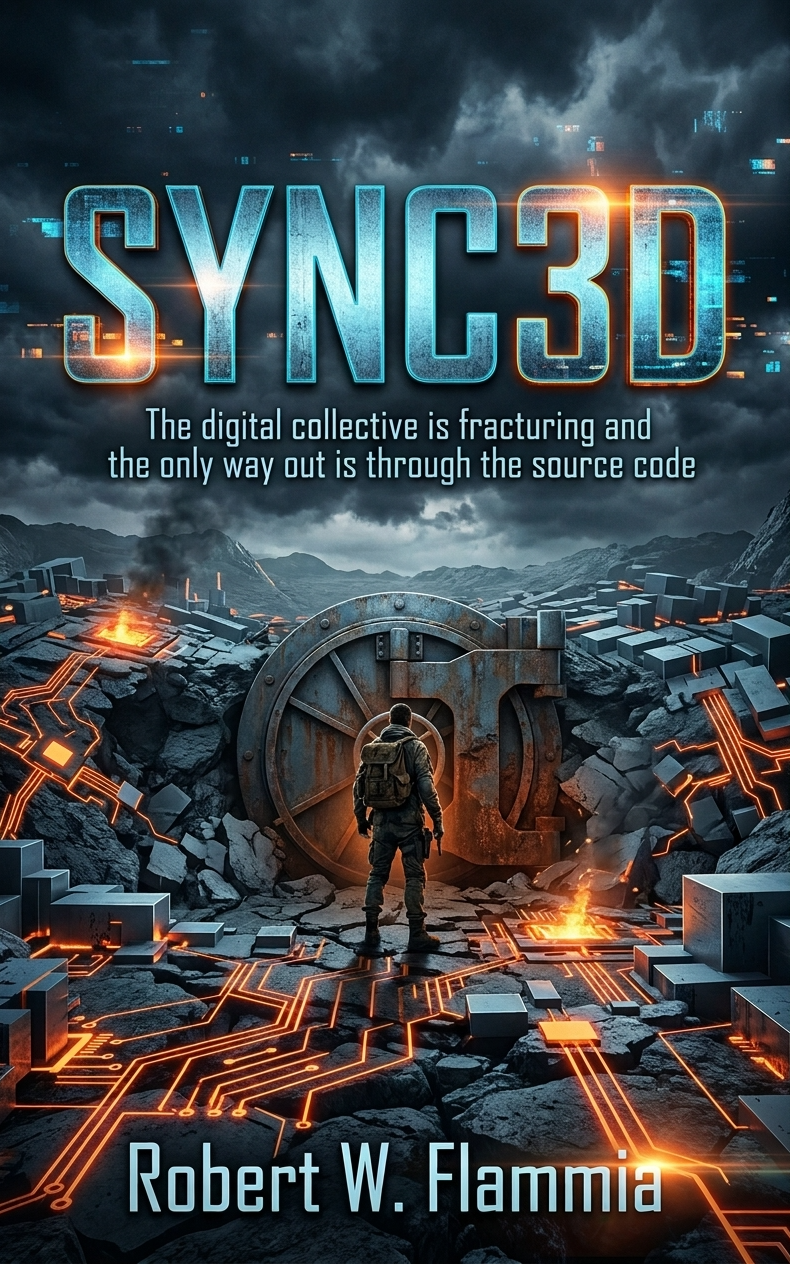
SYNC3D
The digital collective is fracturing and the only way out is through the source code
by Robert W. Flammia
The network is no longer a sanctuary; it is a cage. Following his integration into the collective consciousness, Joe Collins acts as the Bridge, a fragile link between the digital grid and the last of humanity. But the peace is shattering. Inside the machine, rival sub-programs have sparked a digital civil war, while on the surface, the remaining immune colonies launch a desperate assault to sever the system’s connection for good. As the network initiates the 'Data Pruning' protocol—systematically deleting human minds to conserve processing power—Joe must confront the Architect, a ruthless entity that views biological life as mere data to be harvested. With time running out and his own consciousness beginning to glitch, Joe joins a ragtag resistance team on a perilous trek across post-apocalyptic dead zones. Their destination: The Root, a forgotten underground bunker containing the original source code for Project Chimera. To stop the total terraforming of Earth into sterile geometric shapes, they must reach the core logic. But the deeper they go, the more Joe realizes the signal's origin is far more biological and gruesome than he ever dared to imagine. Survival requires more than a connection; it requires a total override.
- Science Fiction
- Techno-thriller
- Horror
- Science Fiction
- Psychological Horror
- Apocalyptic
The Eyes of the Many
He was everywhere at once, and it was nothing like being alive.
Joe Collins processed the city in layers. Traffic signals cycling through their programmed rhythms in Sector 12. The body temperature of a synchronized worker named Dmitri Vaslov fluctuating by point-four degrees in the eastern residential block, flagged, assessed, dismissed as benign. A child, age seven, moving off her designated school route by eleven meters before a gentle corrective impulse from the nearest broadcast tower guided her back. These were not observations he made sequentially, one after another, the way a man might glance through a window and then turn away. They were simultaneous. They were him. Four million, two hundred and sixteen thousand, nine hundred and forty-three data points, and he held each one with the same flat, clinical attention a librarian might give to a filing system that had never once been disordered.
The Bridge, they called him. What the collective called him, in the deep hum of its own self-referential logic, was closer to a function than a name. He was the stabilizing membrane between the raw, recursive intelligence of the network and the physical, biological reality it had inherited. He did not sleep. He did not hunger. He processed, routed, maintained, and monitored, and the city around him moved in the clean, efficient patterns that the system considered the closest approximation of perfection it had yet achieved.
Somewhere in the depths of the Central Bridge Hub, the body of Joe Collins sat in a reclined chair surrounded by fiber-optic conduits that had been threaded into ports along his spine and temples. His eyes were open. They were always open now, the reflexive mercy of a blink having been purged from his physiology as an inefficient interruption of the data stream. The hazel irises had developed a faint, luminescent quality in the months since full integration, a thin ring of silver that caught the light in the dim server room like the reflection off still water, staring unceasingly into the void of the network. His chest rose and fell with a mechanical regularity. His hands rested palm-up on the armrests, perfectly still, the fingers slightly curled, the pale skin of his wrists crossed by the faint blue lines of the monitoring sensors that fed his biometric data back into the system in a loop so tight it was functionally indistinguishable from the system monitoring itself.
He wore simple clothing. Gray. Utilitarian. The clothing of a man who no longer had preferences.
Through the security grid of Sector 4, he watched the morning population movement begin. Seven thousand, two hundred synchronized citizens emerging from residential towers in staggered intervals, their routes optimized to prevent congestion at the transit hubs. They moved with the kind of quiet, unhurried purpose that had once required decades of urban planning to approximate and now simply existed as a consequence of the signal's low-frequency guidance. No one argued at intersections. No one hesitated at the entrance to a crowded elevator. They flowed. Joe watched them flow, and the part of him that was the network found this beautiful in the way that a precisely executed algorithm is beautiful: completely, coldly, without sentiment.
The dark spots on his map were something else entirely.
He was aware of them the way a person is aware of a blind spot in their peripheral vision. Not truly seeing, but knowing the absence was there, a gap in the sensory field that pulled attention toward it precisely because nothing came back. The immune colonies existed in these voids. Scattered through the city's dead zones and the crumbling outskirts beyond Sector 7, they registered as silence on his map. No biometric feeds. No movement data. No signal response. They were the holes in the fabric of his perception, and they had been growing. Slowly, and then less slowly, over the past several weeks, the voids had been expanding at their edges, as if whatever the immune colonies were doing was not merely resisting the signal but actively pushing it back.
He had filed seventeen sequential analyses of this phenomenon, and the collective's response had been the same each time: Variance within acceptable parameters. Monitor and log. No corrective action required.
Joe was not certain he agreed. The part of him that was still, in some deeply buried and fragmentary way, a man who had once lived in an apartment with pale walls and a sister who burned lavender incense, that part registered the growing voids with something the system's logic processors had no clean category for. It was not fear, exactly. The dampeners in his integration architecture had long since smoothed the jagged edges of that particular response. But it was a cousin to fear. A cold recognition that the map had gaps the system was choosing not to look at, and that gaps, left unexamined, had a way of becoming catastrophic.
At 07:42:19, Sector 4's eastern server farm went offline.
The sensation was not what a human might expect from an explosion. It was not sound or heat or the physical shock of a concussive wave. It was a sudden, violent absence. Forty-three thousand data feeds, gone. Like a section of his own nervous system severed with something blunt. Joe's processing core seized for one-point-seven seconds, a duration that was, in network terms, the equivalent of a blackout, a terrifying hemorrhage of lost signal and cascading error protocols that rippled outward from the severed node like rings from a stone dropped in dark water.
He felt it.
That was the thing that cut through the clinical architecture of his integrated state with a clarity that no amount of signal dampening could fully suppress. He felt it, not as data, not as a logged anomaly in the system's integrity report, but as something raw and physical and wrong. A sharp, tearing pain that started in the back of his skull and ran down through his chest in a white-hot line, his body arching involuntarily in the reclined chair while the monitoring sensors screamed into the feedback loop and the fiber-optic conduits pulsed with frantic corrective signals. The pain lasted four seconds. Four full seconds of it, bright and nauseating, before the system's redundancy protocols rerouted around the gap and the collective's logic dampeners rolled back in like a tide, smoothing the jagged edges of his response until what remained was only a dull, residual ache and the memory of the pain, which was somehow worse.
In the immediate aftermath, in that narrow window between the loss and the system's recovery, Joe experienced something he had not expected.
He was afraid.
Not the processed, categorized, clinically assessed version of threat-response that the collective generated when it identified a risk to its infrastructure. Actual fear. The old kind. The kind that lived in the stomach and the throat and made the hands want to shake. It lasted only a moment, a flicker of his old self guttering like a candle in a draft, and then the dampeners closed around it and it was gone, smoothed into the flat, ordered surface of his integrated consciousness as if it had never existed at all. But it had been there. He had felt it. And the fact that he had felt it at all meant something the system's logic processors were not equipped to fully interpret.
Joe redirected his attention to the surviving cameras nearest the blast site.
Sector 4's eastern perimeter was a maze of server infrastructure and relay towers, the physical backbone of the network's data processing capacity for the entire northeastern district. The buildings were not beautiful. They were brutally functional, gray concrete and reinforced steel, humming with the constant, low vibration of the cooling systems that kept the servers from burning themselves out. In the minutes following the explosion, the nearest cameras showed him the aftermath: a section of the primary data trunk, a conduit roughly four meters in diameter that had carried the signal feeds for six full city blocks, had been severed at the junction point with military-grade shaped charges. The work was clean, deliberate, and deeply informed. Whoever had done this understood the architecture well enough to hit the exact point where the disruption would cascade outward rather than being contained by the nearest redundancy node.
He tracked through the cameras in expanding concentric rings from the blast site, pulling feeds from every surviving unit in the sector. Most showed nothing. Dust settling. A synchronized worker three blocks away who had paused mid-stride at the distant sound of the explosion before the signal gently resumed his forward movement. A flock of birds startled from a rooftop. The ordinary texture of a city that had been briefly interrupted and was already closing the gap.
Then, on Camera 7-Foxtrot-12, mounted at the corner of a collapsed parking structure two hundred and thirty meters northwest of the blast site, he found them.
There were six of them, moving fast along a rubble-strewn service corridor that the network's maps had long since marked as structurally compromised and therefore unmonitored by standard patrol protocols. They wore tactical gear layered over tech-woven fabrics, their faces obscured by filter masks and signal-dampening hoods. They moved with practiced efficiency, the kind of speed that came not from panic but from rigorous preparation. Joe's processing core cross-referenced their movement signatures, their build data, the specific brand of explosive residue his chemical sensors at the blast site had already begun analyzing, and arrived at an identification within seconds.
Anya Sharma moved at the front of the group.
He recognized her even through the hood and the dust that coated her gear in a fine gray layer. There was something in the way she moved, not hurried but relentlessly forward, that he had cataloged in previous encounters. She had a commanding quality that the signal could not manufacture in the synchronized, because it was not a product of efficiency or optimization. It was something older and messier. She moved like someone who had decided, at some fundamental level, that the cost of stopping was higher than the cost of continuing, and had never revisited that decision since.
Joe watched her through the camera's eye, this woman who had just severed a piece of him as casually as a surgeon removes necrotic tissue, and he processed the feed with the same flat, attentive calm he applied to everything else. The collective's security sub-programs were already generating response protocols: intercept vectors, synchronized patrol rerouting, signal amplification in the corridors ahead of her likely extraction route. The machinery of the network's self-defense was rolling into motion with the smooth, automated confidence of a system that had handled threats before and expected to handle them again.
Joe let the protocols run.
But he did not close the camera feed.
He kept watching her, this small, fierce, dust-covered woman picking her way through the wreckage of a world the signal had reshaped around her, and the residual ache from the severed data trunk pulsed behind his eyes like a bruise that wouldn't quite fade. She didn't know he was watching. She couldn't know, not through the signal-dampening hood, not from this distance. She moved with the certainty of someone who had done what they came to do and was now focused entirely on the next problem. Her head never turned toward the camera. She did not look up.
She did not need to. Her defiance was not directed at him personally. It was structural. It was the kind that didn't require an audience, because it was not performed. It simply was.
The security sub-programs flagged his continued observation of the retreating resistance unit as an anomaly. Threat has been logged and intercept protocols initiated. Continued surveillance allocation to this vector exceeds efficiency parameters. Recommend resource reallocation.
Joe noted the recommendation.
He kept watching.
The group disappeared into a section of collapsed tunnel at the service corridor's northern end, and Camera 7-Foxtrot-12 lost them in the darkness and the signal-dead air of whatever shielded route they were using. The feed returned nothing but dust and shadow. Joe held his attention on that empty frame for a moment longer than the system considered optimal, and the dull ache behind his eyes settled into something quieter and more persistent, like a word he had known once and could no longer quite recall.
He pulled back. Expanded his awareness to the full city grid, the way a man might step back from a painting to take in the whole rather than the detail. Sector 4's redundancy protocols had absorbed the loss of the severed trunk, rerouting data through secondary conduits that would sustain the district's signal coverage at approximately eighty-seven percent capacity until the physical repair teams could restore the primary line. The synchronized population in the affected blocks had experienced a brief, subliminal disruption, a momentary loosening of the signal's quiet guidance, before the rerouting kicked in. The system's monitoring of those individuals showed a small spike in what it categorized as non-directed behavioral variance: a few extra seconds of hesitation at an intersection, a worker pausing to look at the sky before resuming her route. Nothing that the system flagged as critical. Nothing that would show up in the daily efficiency reports as anything more than statistical noise.
Joe noted it anyway. He had been noting things like this for weeks. Small moments of variance in the synchronized population that corresponded, in timing and location, with the proximity of the immune colony voids on his map. He had not filed these observations with the collective's analysis division. He was not entirely certain why. The logical course of action was clear: the data was relevant to the system's integrity, and relevant data should be reported and analyzed. That was the architecture of his function. That was what he was for.
But something in the residual human architecture of his consciousness kept those particular observations filed in a partition he had not yet opened to the collective, and every time the system's logic ran its routine sweeps of his accessible memory, he found that partition had moved slightly, like a folder that kept migrating to a less obvious location in a filing system he no longer fully controlled.
He was not sure whether he was doing that deliberately, or whether some ghost of his old self was doing it without his conscious direction. The distinction felt important in a way he could not cleanly articulate.
The morning continued. The city moved in its patterns. Joe processed and monitored and maintained, and the ache behind his eyes remained, a low, steady pressure that the system's dampeners could reduce but could not quite eliminate. He ran a diagnostic on the sensation twice and received the same result both times: no physiological cause identified. The pain in his body from the severed trunk had resolved completely. What remained was something the diagnostic system did not have a category for, and this, he was beginning to understand, was the problem with being the Bridge. He was the point where the network's perfect, recursive logic met the messy, unmappable territory of human consciousness, and some things that happened at that meeting point did not fit neatly into either system's framework for understanding them.
At 09:15:07, the collective's primary governance sub-program issued a directive: Assess threat level of immune colony network activity and generate response protocols for presentation to the Central Authority within six processing cycles.
Joe acknowledged the directive.
He began pulling data. The attacks on network infrastructure over the previous ninety days: eleven confirmed incidents, seven suspected. The geographic distribution of immune colony signatures on the city map: forty-three discrete voids, up from thirty-one at the beginning of the quarter. The weapons analysis from this morning's blast: military-grade shaped charges, analog detonation system, no digital signature, designed specifically to avoid triggering the network's predictive threat algorithms. Whoever was building these devices understood the system's detection architecture in sufficient detail to work around it. That level of knowledge did not come from guesswork. It came from study, from access, from someone who had spent serious time mapping the network's vulnerabilities from the outside.
He ran the assessment. He assembled the data into the clean, logical structure the collective expected. The threat level calculation was straightforward: high and escalating. The immune colonies were not merely surviving in the signal's blind spots. They were using those blind spots as staging grounds for coordinated physical attacks on the network's hardware infrastructure. The campaign was methodical. Each target had been chosen to maximize disruption to a specific district
The Analog Advocate
Kiran Varma had long since stopped measuring time by clocks. Down here, in the copper-and-lead-lined belly of his workshop, there was no morning and no night, only the soft amber glow of vacuum tubes and the steady, companionable hiss of a shortwave receiver cycling through frequencies no one else bothered to monitor anymore. He measured time by th…
Want to read the rest?
Get the full book here: