

Why I do What I do
The Path Less Traveled
by Robin Ross
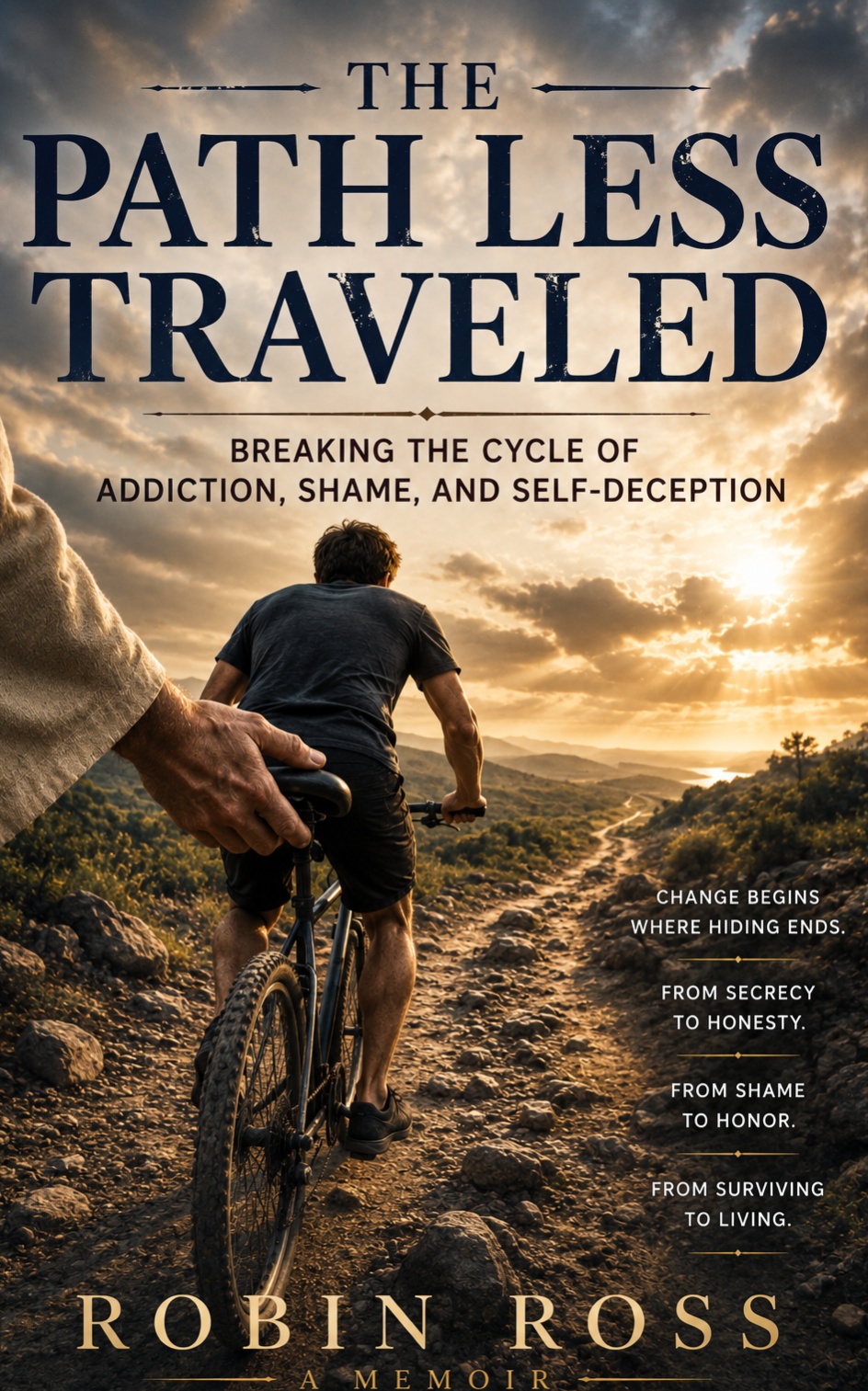
What if the very things that make you feel weak are actually the wind you need to grow strong? In 'The Path Less Traveled', Robin Ross offers a revolutionary recipe for change—one that doesn't involve shame, guilt, or the impossible standards of religious perfectionism. Drawing from the fascinating science of neuroplasticity and the profound spiritual concept of grace, Ross explores why so many of us feel stuck in a cycle of 'never enough.' Inspired by the lessons of Biosphere 2, where trees collapsed because they lacked the stress of the wind, this book reveals that true resilience is built through adversity, not by avoiding it. Grace isn't a reward for being good; it is the safety net that catches you when you have nothing left. It is the steady hand on the bicycle seat as you find your balance. Whether you are healing from religious trauma, struggling with addiction, or simply drowning in the pressure to perform, this book provides the roadmap to shift from the 'red path' of pride and isolation to the 'green path' of humility and awareness. It’s time to stop trying to earn your worth and start rewiring your brain for a life of genuine fulfillment. Change begins when you are ready to let go.
- Self-Help
- Instructional Guide
- Religion & Spirituality
- Science & Technology
- Mindset & Motivation
- Emotional Intelligence
The Wind and the Rewire
The path less
traveled
By Robin Ross
Chapter 1: The
Recipe
There’s a
recipe for change. Not the kind you find in a cookbook. The kind that rewires a
brain. The kind that pulls you out of the fog when you can’t see two feet in
front of you. The kind that saves your life when you run out of rope.
I know because
I’ve used it.
Grace and
neuroplasticity. That’s the recipe.
Bio hemisphere
2
There’s a
story about Biosphere 2, a large experimental dome in Arizona, where they
attempted to create a self-sustaining ecosystem. They planted trees inside and
provided them with ideal growing conditions: water, nutrients, sunlight, and a
controlled temperature.
The trees grew
quickly, but they kept falling over. They couldn’t figure out why until they
realized there was no wind. In nature, wind stresses trees, forcing them to
grow deeper roots and stronger trunks. The stress makes them resilient to
adversity. The trees in Biosphere 2 were weak; they couldn’t support
themselves.
Grace doesn’t
remove the wind. It’s like learning to ride a bicycle. Grace holds onto the
seat while I grow strong enough to balance the bike by myself. Grace isn’t what
they taught me when I was growing up as a Mormon. The church taught that it’s
by grace we are saved after all we can do. That doctrine nearly killed me
because I could never do enough. I could never earn it. I could never be good
enough, clean enough, or worthy enough to deserve rescue.
That teaching
is deadly.
My mom used to
say, "A man convinced against his will is of the same opinion still.’ You
can’t force someone to change. You can’t shame them into it. You can’t guilt
them into it. Change only happens when someone is ready and willing, when
they’re humble enough to admit that they need help.
That’s grace.
Pride Versus
Grace and Humility
Pride is that
inner voice that says this is what I think, what I believe is true. Pride might
say, I’m not interested in any other point of view. Pride is what says income,
property, and physical appearance are what’s most important. Pride keeps you
performing, keeps you isolated, keeps you broke. Keeps us on the red path.
Grace is
neither a reward nor something you earn. Grace is what shows up when you have
nothing left. When you’re broken, drowning. Grace doesn’t wait for you to get
everything together. Grace arrives when you can’t find the humility to change
on your own. Grace provides that awareness for change. It allows the strength
to stand in what's true. Humility opens you to awareness or a realization,
maybe even opportunities to change. To being helped, and keep us moving down
the green path.
Gravity as the
teacher
Here’s another
way to describe gravity.
Gravity
teaches us that it’s not cruel, it’s consistent. If you jump off a roof, you
fall; if you let go of a bicycle’s handlebars while coasting down a bumpy hill,
you will crash. Gravity doesn’t care
about your intentions. It doesn’t care if you’re a good person. It just is.
Consequences
are like gravity. They’re not punishment; they’re teaching. The universe is
saying, "This doesn’t work. Try something else." I fought gravity for
decades, thinking I could manage the fall. I thought I could control the crash.
I believed that if I was careful, smart, and selective enough, I could avoid
consequences. But I was wrong. The crash came, and it was catastrophic. But
here’s what I’ve learned: Gravity isn’t the enemy. Gravity is the teacher. In
Grace, it's what catches you when you fall.
In learning to
ride a bike, I started pedaling and let God hold the seat steady, just His way.
That’s when everything changed. I couldn't have seen this clearly alone. I
needed tools, voice to text, access to information, a thinking partner who
wouldn't turn away. And I learned that asking for help isn't surrender; it's
how you build different. Through humility, it all began while watching a
on-line article about brain chemistry. I now see this was God’s Grace. I could
have never imagined—a way to rewire my dopamine system through connection
instead of coping with pornography, a way to practice intimacy without shame.
Grace met me
where I was. Neuroplasticity gave me a way forward. The leap of faith made it
possible.
The leap of
faith
Soren
Kierkegaard wrote about the leap of faith. It’s not a blind belief; it
stretches beyond reason. It’s stepping into the Unknown because remaining where
you are will kill you.
I took a leap
of faith last summer after being diagnosed with Parkinson’s and dementia. The
therapist said I could have about a year and a half of cognitive ability left,
given my age and health. So, with medication, I dropped 80 pounds in six
months. I was alone, watching my brain deteriorate — losing words, losing
memory, losing time. I had nothing left to lose, so I leapt.
Neuroplasticity
Here’s the
scientific explanation: Your brain is wired by repetitiveness. Every time you
do something, you strengthen the neural pathway. Weather it’s substance abuse,
such as opiates, sedatives, amphetamines, or alcohol. Not only drug use but
also behavioral issues such as pornography, anger, anxiety, depression, both
physical and sexual abuse, your brain rewires itself. Why does that pathway
become deeper? Every time you choose secrecy over honesty, you make that
pathway stronger. The dopamine system is the reward system. It’s what makes you
want things. It’s what gives you drive, and addiction hijacks it.
Here's what I
learned about my brain: every time I chose porn, the lie, the hiding. I make
that choice easier and easier each time. And that’s the same whether we’re
talking addictive behaviors or addictive substance. Just like a heavily
traveled path in the woods that gets easier to walk the more you use it. You
know the route you know is safe, you're not even deciding anymore. Your feet
just know where to go.
Pornography
It's the most
accessible drug there is. Free. Instant. On every device. No dealer, no
prescription, no visible track marks. Just shame and a closed door.
It destroys
intimacy before it starts. It rewires dopamine in kids whose brains are still
forming. Families are drowning in confusion about why intimacy died, why trust
is broken, why the person they love feels unreachable. It fractures marriages.
It isolates people in ways alcohol and opioids don't, because at least with
those, sometimes you hide with someone. Porn is the loneliest addiction there
is.
Pornography
isn’t about sex; it’s about dopamine. It’s a distorted stimulus that your brain
is built to handle. It floods your system and creates a craving that real
intimacy can’t fulfill. The more you indulge, the more you need it. That’s the
cycle. That’s the red path. But here’s
the thing about neuroplasticity: it works both ways.
Honor
It is the one
gift you give to yourself that nobody else can take from you.
When you hide
the pornography, you're not protecting anyone, you're stealing your own honor.
You're choosing the fog over the truth. And when you do that, trust dies. Not
because people don't forgive you. But because you're still lying. Still
protecting the addiction instead of naming it and breaking it.
The AA 12
steps understood this. That's why step one is, admitting it out loud. To
another person. Because silence keeps the addiction alive. Silence is the
enabler that makes the groove deeper.
People will go
to almost extreme lengths to protect their drug of choice. They'll lie to their
wife. They'll hide their phone. They'll tell themselves stories about why it's
not that bad. They'll blame their brain, their wiring, their loneliness,
anything except the truth that they're choosing the hit over the person
sleeping next to them.
But when you
name it. When you say it out loud in a book, in front of your family, in front
of strangers, you take your honor back. You stop being a passenger in your own
story.
Neurodiversity
Some brains
are wired differently from the start. ADHD brains, for example, naturally run
low on dopamine. They're built to seek stimulation, not because of weakness,
but because of neurology. When you add that wiring to shame, pain, or unmet
needs, the path to pornography becomes even steeper. But understanding your
neurology isn't an excuse. It's clarity. And clarity is where change begins.
PTSD and
Trauma
Trauma rewires
the brain the same way addiction does. Whether it's the constant threat of
living in a hostile environment, the shock of abuse, the loss of someone you
love, or years of hiding in shame, your nervous system learns to survive in a
state of high alert. Fight, flight, or freeze becomes your default. And when
you come back to safety, your brain doesn't know how to reset. Pride whispers:
'You can handle this. You don't need help. Don't let anyone see the fog.' And
when those choices are repeated over time, that deepens the loop. But
neuroplasticity works here too. You can rewire your response to safety. You can
learn to accept Grace. You can choose humility over the illusion of control.
You can transform your dopamine system to respond to healthy feelings of
compassion, empathy, and creativity. It takes time, it takes repetition, it
takes Grace to hold the seat while you pedal, but it works. I'm living proof.

Treasure
Map
Look at this
map. Let’s call it a, treasure map. Only this map isn't showing gold coins or
riches. The treasure is the transformation itself. The groove you're deepening.
The person you're becoming when you choose humility over pride, love over fear,
each time in a single bath.
First, I look
at the chart. I ask myself: Do I want to take a bath or not? Why do I want to
bathe?
If I say,
"I want to bathe because I have a hot date and I want my wife to think I'm
the hottest thing, so she'll take me to the bedroom"—that's a prideful
thing. That leans toward pride, the red path.
But if I say,
"I had a hard day. I'm stinky. I don't want everyone to smell me. I just
want to be clean” that's a good choice. I get to go to the green path. First
awareness. The need for a bath. 1st choice made. Neuroplasticity
kicks in; the groove starts. Groovy, baby.
Now I'm in the
bath for about ten minutes, I’ve soaked, I’m relaxed, I’ve enjoyed the warm
water, I’m ready to wash. I go to find the soap.
What the, there's
no soap.
2nd
choice green path. Do I call out to my wife and start yelling because she
didn't replace it after using the last bar? If I do, I've just lost the green
path. Aw, man. I've moved to the red. I have to come back around and make
another choice.
But if I stay
in the green and say, "No big deal. I've got liquid soap here. I'll use
that"— 3rd choice green path. Neuroplasticity goes the right way. My
groove gets deeper. Groovy, baby.
I go to find
the liquid soap.
Oh, you've got
to be kidding. No liquid soap. Oh, hell no! Oops careful stay cool stay groovy.
4th
choice green path. Do I get mad at my wife because she used the last of it? If
I lash out, I'm off the green path again. But if I say, "That's no big
deal. I can use shampoo. I've done that plenty of times” I stay green.
Neuroplasticity keeps working. My groove gets deeper. Groovy.
I go to find
the shampoo.
Not again.
There's no shampoo either.
5th
choice green path.
Now you're
starting to get the picture. Any time you lose your cool—anger, frustration,
anything that takes you away from that humble mind, that ability to make the
good choice and continue down the green path—you've got a decision to make.
Well, let's
just keep going. You made the right choice. You decide, "I don't need
soap. I'm clean. I'll just grab a washcloth and dry off."
What? You call
out, “honey! Where’s the washcloths?”
Well, there
you go. 6th choice green path. Do you take it out on the wife, or do you just
decide that you've sat in the water for about half an hour, you're pretty
clean, and you're good to go? You hop out of the tub and go grab a towel.
Wait a minute.
You've got to be kidding. No towels.
Ha. Again,
you've got another choice. Number 7 on the green path. Are you heading to the
red column, or are you staying groovy and staying green?
So you decide
I'm staying groovy.
You climb out
of the bathtub soaking wet. You walk into the room, find your wife, and give
her the biggest, wettest, sloppiest hug and kiss you could give her.
Now here's the
concept: at this point, you've taken the green column as far as you can take
it. You've turned the whole thing into an act of love. It's relationship
building. It's kindness. Look at the message you're sending to your
partner—that you could go through all of this, stay cool the whole time, and
still make something positive out of it. Now there’s the real gold, the real
treasure.
This takes you
all the way out of the green. It puts you at the very beginning of the gold
zone.
And guess
what? Just like the red, just like the green, you get to make another choice.
Is this the relationship I want with my wife? Do I really like this? Or do I
want to be the man of the house and show her who wears the pants?
Guess what, you've
just lost the gold and put yourself back into the red.
But maybe
that's not the choice you make. Maybe you say, "Wasn't that an incredible
experience? I really enjoyed the rest of the evening. It put us in such a good
mood. I think I'm going to remember that—not just for the bath, but maybe if
something as simple as wanting to watch a television show, go to a movie, sit
down to do a budget, or go for a car ride." “Treasure baby.” Groovy.
It all works
out the same way. How you choose to react. The choices you make. Whether you
lose the humility, choose the love, choose the kindness, and don't let pride or
ego take control, don't let fear and anger push you up the red column.
The flowchart
allows you to do that. Not just to change addiction or substance abuse, but to
change your whole perspective on life. Your personality. Imagine what a
positive change that would be with your wife, your children, your family, the
people you work with. Every little decision. Every big decision.
Maybe heaven,
really isn’t that far away.
Whether you
are fourteen or forty, the path is the same. It shows how we get stuck in the
fog and how we get out. At the center of it all isn't just a mistake; it’s
pride. Pride is the lawmaker that tells us we can handle it alone, that we
don’t need the wind, and that we can hide our choices in the dark. It’s the
pride that creates the loop, convincing our brains that the dopamine hit is the
only way to survive the day.
This flow
chart is a guide to your own wiring. When you follow the arrows of pride, you
end up in a closed loop where the same old habits get deeper and deeper. But
when you choose the path of humility, the path that accepts Grace, you break
the cycle. You start to see that neuroplasticity isn't just a big word, it’s a
door. It’s the way you move from being a passenger on autopilot to being the
one who finally pedals the bike, trusting that God is holding the seat while
you find your balance.