

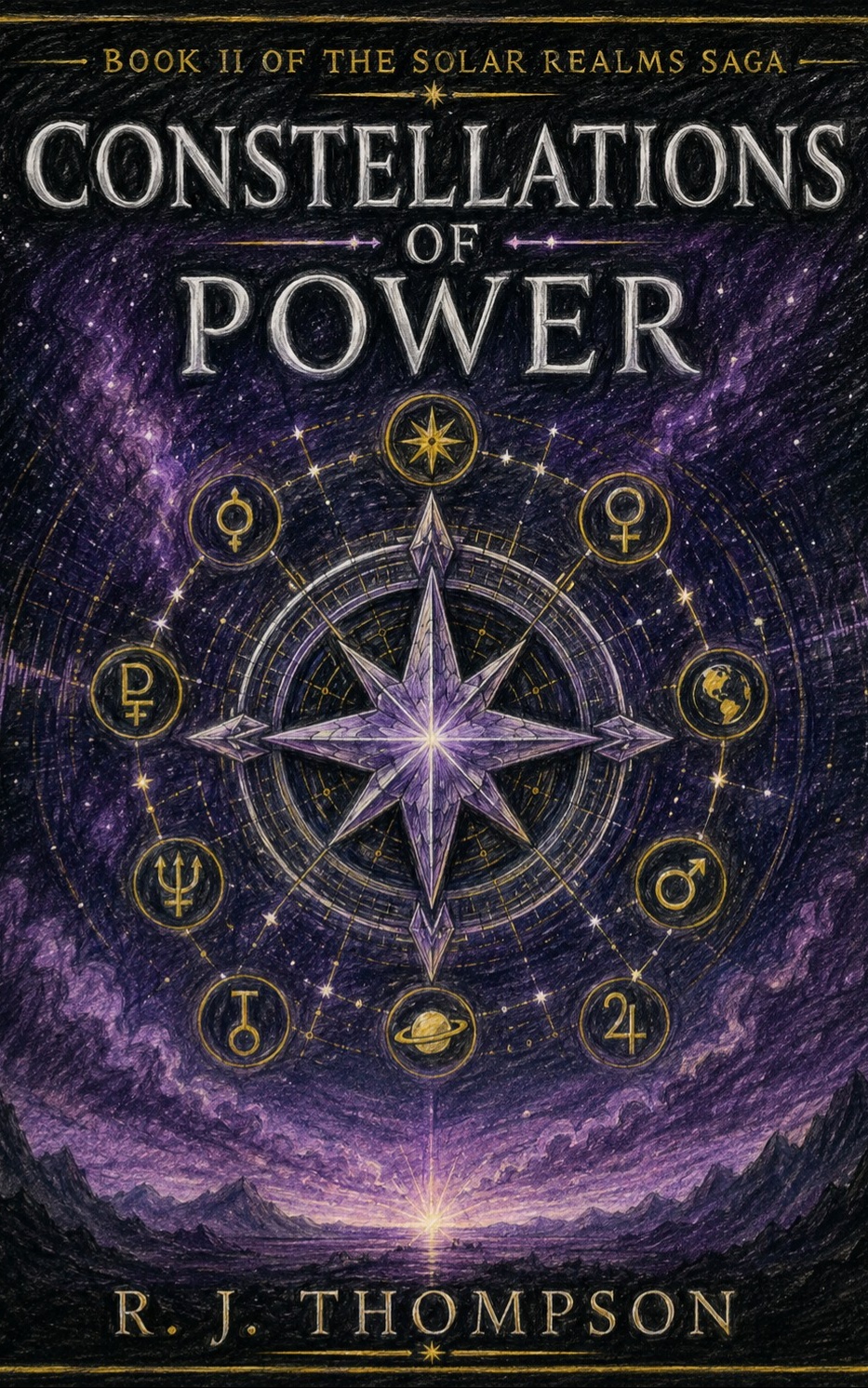
Constellations of Power
Book 2 of the Solar Realms Saga
by Rocky Thompson
The Solar Realms are falling silent. When the SolarNet abruptly collapses and ancient Precursor gates awaken across the system, entire human colonies vanish without a trace of destruction. As panic spreads across interplanetary settlements, authoritarian opportunists exploit the chaos to seize absolute control under the guise of security. Commander Kaelen Voss and the Vanguard are dispatched to confront the unknown beyond the Obscura Gate. But when their lead systems analyst Mira Solane is pulled into an enigmatic alien consciousness, the crew realizes they are not fighting a standard military invasion. They face an incomprehensible intelligence testing the very nature of human meaning and persistence. With political conspiracy festering within their own high command, Kaelen and his allies must abandon traditional military dogma. To survive an existential pressure that predicts every centralized move, humanity must forge decentralized networks of mutual trust and radical resilience. Constellations of Power is a gripping, high-stakes space opera where the greatest weapon against total annihilation is our irreducible capacity for choice.
- Science Fiction
- Thriller
- Mystery
- Adventure
- Space Opera
- Dystopian
FRACTURE
Kaelen Voss walked the length of the Stalwart’s observation deck while the ship hummed beneath his feet. The vibration, a lingering strain of old damage hidden beneath expensive repairs, traveled through the metal floor in uneven pulses.
Somewhere deeper within the cruiser, coolant lines clicked against reinforced bulkheads as maintenance crews worked another endless shift. Since Helios, no ship that saw active service remained fully repaired for long. There was always another fracture waiting beneath the plating.
Twenty-six months had passed since the Ascendance.
Seven months since Geneva.
The Solar Realms still described themselves as functional because no one had found a less alarming word.
Beyond the broad observation windows, Geneva Station drifted against the darkness like something history had failed to bury. Its shattered docking arms reached into space, twisted ribs of alloy curling away from the station’s broken heart.
Once, diplomats had crossed those polished corridors believing careful language could preserve peace indefinitely. Now emergency beacons blinked faintly through abandoned sectors while repair drones crawled over the wreckage, their cutting torches flashing briefly before vanishing into the darkness.
It was a monument to survival.
Or a warning, depending on who needed the story.
Kaelen slowed near the viewport. The station turned with patient indifference beneath scattered repair crews, each drone salvaging another fragment from a structure too important to abandon and too damaged to restore completely.
He understood the impulse.
People rebuilt around their wounds long before deciding whether they had stopped bleeding.
The recycled air carried the familiar metallic scent of ozone.
His shoulders tensed before he could stop them.
For an instant, Helios surfaced through sensation rather than memory. Overheated circuitry. Recycled oxygen. Corridor lights flickering before instinct demanded an escape route.
Kaelen drew a measured breath.
Twenty-six months had been enough for memorials to become ceremonies and official histories to call Helios a turning point.
It had not been enough for forgetting.
The investigations had stalled more than a year earlier, not because the evidence had vanished, but because permission had. Questions remained buried beneath sealed reports and classified archives while those with the authority to pursue them found increasingly convenient reasons not to.
Outside, Geneva Station continued its slow orbit, scarred but still moving.
Behind him, the Stalwart carried on with the quiet rhythm unique to military vessels. Somewhere farther down the deck, someone laughed before the sound disappeared. A cargo cart rattled across reinforced seams in the flooring. Voices filtered through bulkhead speakers as duty rotations changed.
A soft chime sounded behind him.
“Sir?”
Kaelen turned.
Lieutenant Marin stood near the hatch with a datapad tucked tightly against her chest. She couldn’t have been more than twenty-three. The crisp lines of her uniform still carried traces of academy discipline, but the exhaustion in her eyes belonged to someone who had already learned that emergencies moved faster than institutions.
“The latest requests from the Belt just came in,” she said. “Ceres reports they’re down to three days of emergency oxygen.”
Kaelen straightened.
“How many critical shortages?”
She glanced at the display.
“Four this week. Two more are expected before tomorrow.”
He accepted the datapad and scanned the reports.
Ceres.
Europa Transfer Ring.
Two independent settlements beyond Callisto.
The numbers weren’t surprising anymore.
That was the part he hated most.
“Route priority shipments immediately.”
Marin hesitated.
“From Earth’s reserve?”
“Yes.”
“That will trigger allocation disputes.”
“It usually does.”
She shifted her weight.
“SolarNet’s recovery models still classify the transfer as destabilizing.”
Kaelen looked down at the figures again.
“The recovery model is averaging shortages across the whole network.”
He handed the datapad back.
“Ceres doesn’t breathe in averages.”
For the first time since she had entered, Marin’s rigid posture softened.
“I’ll authorize the transfer.”
“Quietly.”
She nodded.
“Yes, sir.”
She turned toward the hatch, then paused.
“Thank you.”
The words came so quietly he almost missed them.
Before he could answer, she was gone.
Kaelen looked back through the observation window. Cargo tugs drifted beneath Geneva’s shattered framework, hauling emergency plating stripped from sectors no one intended to rebuild.
Reconstruction had become selective. Recovery resources clustered where infrastructure was strongest and political pressure greatest, while settlements farther from the Core absorbed delays they had less capacity to survive. No single decision created the imbalance. Allocation rules, damaged routes, competing emergencies, and institutional inertia reinforced one another until geography itself began determining who recovered first.
Kaelen crossed onto the bridge, where the lighting shifted from the subdued glow of the observation deck to the cool blue of tactical displays. Officers moved between consoles with practiced efficiency, but beneath the routine he sensed the same strain he had seen across every command vessel since Geneva.
No one wasted movement anymore.
A navigation officer acknowledged him with a nod before returning to a holo-display crowded with blinking cargo routes.
Kaelen stopped at the central logistics console and called up the latest allocation matrix.
Red markers spread across the Solar Realms like bruises.
Ceres.
Callisto.
Tycho.
Peripheral settlements near Europa were already operating life-support recycling beyond safe tolerances. Fresh reports shifted the matrix almost as quickly as he could read them. Another oxygen shortage. A delayed medical convoy. A warp-gate recalibration request pushed back another twelve hours.
The Council continued calling it transitional instability.
No one struggling to fill an oxygen tank bothered with language that polite.
SolarNet had once coordinated communications, freight movement, navigation, and warp-gate harmonics so efficiently that most citizens had never needed to think about it. Now ships reached gates carrying outdated calibration data, critical supplies followed obsolete routes, and governors made decisions from projections already useless by the time they arrived.
Civilization hadn’t stopped.
It had fallen out of rhythm.
Kaelen manually overrode two priority routes, one for a medical convoy and one for the oxygen transfer.
Earth’s delegates would protest.
Venus would demand an emergency review.
Luna would insist on procedural oversight before authorizing permanent changes.
He authorized the transfers.
The console acknowledged the override with a quiet tone before routing the requests into the growing queue of emergency traffic.
Council sessions had become harder for him to endure than supply reports. Not because people argued, but because too many of them had learned to turn argument into profession.
A meeting from two days earlier surfaced unbidden.
The Jovian delegate had risen halfway from his chair, anger flushing across a face untouched by the mines he claimed to represent.
“Your speeches are stirring, Voss, but words won’t refill oxygen tanks.”
Kaelen had answered without raising his voice.
“No. But they might stop you from suffocating each other long enough to fix the tanks.”
Embarrassment had flickered across a handful of faces.
Annoyance spread across many more.
What Kaelen had wanted to say remained unspoken.
Instead, his thoughts had gone to Kehl.
He could still picture the miner’s broad hands resting quietly on a negotiation table, traces of Callistan dust permanently embedded in the cracks of his weathered skin while wealthier delegates debated oxygen quotas as though discussing trade tariffs.
Kehl rarely needed to speak first.
He understood consequences better than theory, and that had always made people who lived by theory uncomfortable.
Kaelen closed the Council records before irritation hardened into something less useful.
There was still too much work to do.
Outside the bridge windows, Geneva continued its slow orbit, reminding everyone aboard the Stalwart that history had a habit of returning before anyone was ready for it.
Night aboard the ship had become a matter of lighting rather than time.
The cruiser moved through transfer lanes above Geneva while emergency traffic crowded civilian channels, each priority request competing with another somewhere else in the system.
When his shift finally ended, Kaelen found himself back on the observation deck without remembering the walk there.
Geneva drifted beneath the ship.
From a distance, it almost looked peaceful.
Distance had always been a convincing liar.
Kaelen knew how many bodies remained sealed inside collapsed sectors awaiting recovery. He knew how many families still lived with unanswered questions because identification teams had been forced to prioritize the living over the dead.
Some losses never received conclusions.
Only paperwork.
The observation deck lights dimmed into night cycle, and his reflection became clearer against the glass. The face looking back was leaner now, the lines around his eyes sharper than they had been before Helios. The scar along his jaw caught the faint overhead light.
People still saw a hero.
The Council saw a political complication.
Somewhere along the way, he had stopped seeing either.
His hands settled on the observation rail.
The metal was cold beneath his palms.
A faint metallic bite lingered in the recycled air.
For half a second, the deck vanished.
Alarms.
Smoke.
Emergency bulkheads slamming shut.
Boots striking metal.
Kaelen focused on the cold rail until Geneva returned beyond the glass.
Not Helios.
Not anymore.
His communicator vibrated softly against his wrist.
Another encrypted logistics update.
Three more supply requests had arrived while he stood at the window.
He dismissed the alert without opening it.
There would always be another shortage waiting by the time he finished solving the last one.
He was about to leave when a flicker crossed the corner of the observation display.
A routine maintenance notification appeared and disappeared before he could read it.
Another followed.
Kaelen stopped.
The frequency was wrong.
Maintenance traffic should have been isolated from civilian observation systems. Whatever was transmitting wasn’t using standard fleet architecture.
He stepped toward the inactive console mounted against the far wall.
The screen remained dark.
No active communications.
No scheduled diagnostics.
Nothing that should have produced a maintenance alert.
A quiet tone sounded through the empty observation deck.
Kaelen stared at the console.
The tone came again.
Not an alarm.
A summons.
The console pulsed faintly.
No sender identification.
No routing authorization.
Only encrypted carrier traffic bleeding through channels that should have remained silent.
Recognition came before explanation.
He had heard that frequency before.
Years ago, beneath collapsing systems and emergency broadcasts.
Helios.
Kaelen crossed the deck in measured strides. The observation console resisted his first touch. Its display remained black, save for faint ripples of static crawling beneath the surface.
Impossible.
The Helios network had collapsed more than two years ago. What remained had been buried beneath sealed archives, quarantined servers, and Council security protocols that officially no longer existed.
Another tone sounded.
The static intensified.
Pale text appeared.
THE GAME IS NOT OVER.
The words remained for only a heartbeat before dissolving back into interference.
A second later, they returned.
THE GAME IS NOT OVER.
Kaelen stared at the screen.
Something about the repetition was wrong.
Identical at first glance, but not beneath the surface.
Tiny variations moved through the carrier pattern with each iteration.
Information hidden inside rhythm.
His attention narrowed.
He had seen techniques like it before.
Jax built elegant architectures that concealed meaning beneath efficiency. Nox approached the same problem from the opposite direction, disguising the architecture until the pattern became visible only to someone who knew where to look.
Different methods.
Same principle.
Kaelen’s fingers settled against the console.
Old instincts overrode caution.
He bypassed the primary interface and opened the diagnostic layer manually.
Static peeled away in uneven sheets.
Fragments of abandoned protocols scrolled across the display.
Dead communication pathways.
Observer loops.
Authentication routines marked obsolete years earlier.
Then another line assembled beneath the repeating message.
BEGINNING SUBROUTINE: TRIAL_WAKE_07
Kaelen’s breath caught.
“No.”
He expanded the diagnostic record.
The signature matched archived Helios architecture closely enough to make his stomach tighten.
Challenge-system identifiers.
Observer routines.
Relay structures associated with infrastructure he had believed permanently decommissioned.
But recognition was not proof.
The code could be Helios.
That did not mean whoever sent it was.
“I know this.”
The words sounded strangely distant on the empty observation deck.
The console pulsed again.
Suppressed communication pathways unfolded across the diagnostic display. Relay structures marked inactive acknowledged one another through channels that should no longer have been in use. Archived handshake protocols appeared in the traffic record beside timestamps Kaelen did not immediately trust.
He leaned closer.
If the diagnostic history was genuine, parts of the architecture had been active before tonight.
If.
That distinction mattered.
Decommissioned systems rarely vanished cleanly. Code survived in archives. Relays were repurposed. Old protocols remained buried beneath newer ones. None of that meant Helios itself had somehow survived intact.
The display flickered.
The repeating message disappeared.
A single new line appeared in its place.
YOU OPENED THE DOOR.
Kaelen went still.
The Council chamber returned to him.
Not the accusations.
The older voice.
The admission no one on that panel had seemed comfortable making.
Some of them began after your contact event.
His hand remained against the console.
The Council had called it correlation.
Seven months ago, that distinction had been easy to defend.
Now coincidence felt harder to dismiss.
Harder.
Not impossible.
Kaelen forced himself to look back at the diagnostics instead of the message.
“What are you?”
No answer came.
The display shifted one last time.
TRIAL ONE WILL COMMENCE.
A countdown appeared beneath it.
09:59
Kaelen stared for one heartbeat.
09:58
Then training displaced shock.
He touched his communicator.
“Bridge, lock down external routing. Isolate this deck from the ship network.”
The response came immediately.
“Sir?”
“Now.”
The lights along the observation deck shifted as isolation protocols engaged.
Kaelen kept his eyes on the display.
09:57
“And get me everything we have on Helios architecture. Archived protocols, relay histories, diagnostic records. Everything.”
“Yes, sir.”
Somewhere inside the Stalwart, machinery continued to hum. Officers changed shifts. Cargo vessels crossed Geneva’s broken silhouette. Emergency shipments moved toward settlements that needed them.
The Solar Realms carried on, unaware that a signal using architecture associated with Helios had appeared aboard the Stalwart.
Kaelen did not know who had sent it.
He did not know whether the diagnostic history was genuine.
He did not know whether the Council’s anomalies and the message in front of him were connected.
He knew only what the screen was telling him.
09:56
The countdown continued.
SILENCE
The alarms changed tone on the bridge. What followed bore no resemblance to peace. Peace carried the quiet rhythm of life: breathing, conversation, machinery settling into routine. This was something else. It felt as though an immense voice had stopped speaking in the middle of a sentence. Kaelen stood at the Stalwart’s command rail as SolarNet die…