

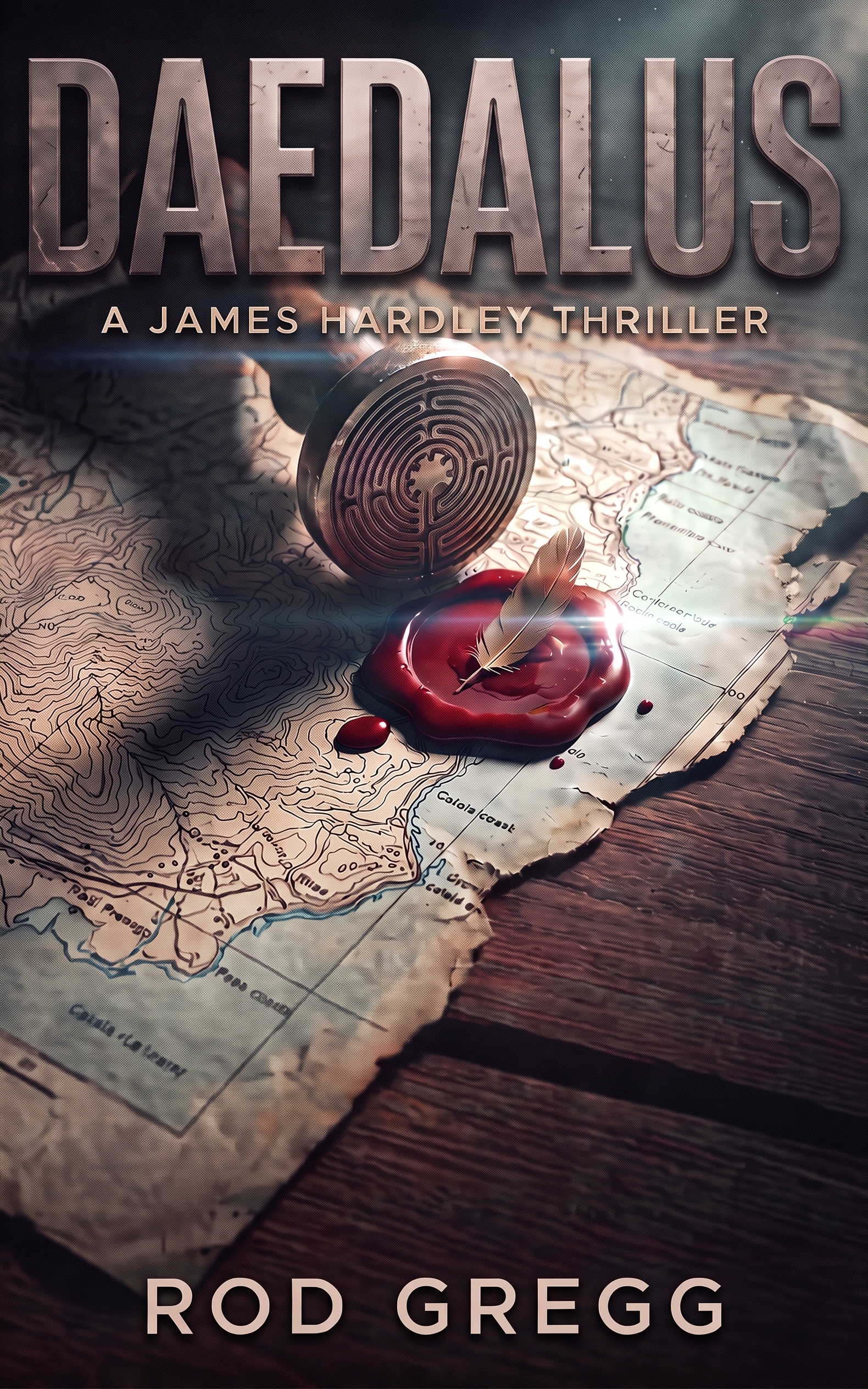
Daedalus
A James Hardley Thriller
by Rod Gregg
Before he was the master of mission planning, John Weatherby was a boy from a coastal English town with a drive for something greater. Known by the callsign Daedalus, his career through the elite 22 SAS and MI6 defined the standard for covert direct action. He was the man who made the impossible look easy, the handler who forged the world’s deadliest operatives. Now, Daedalus is dead. In the wake of his kidnapping and ultimate sacrifice, his proteges—the lethal James 'Rock' Hardley and the operative known as Mongoose—are left to navigate a world without their North Star. But Weatherby didn't leave them empty-handed. From beyond the grave, a final directive arrives, introducing them to Thomas Lockwood, callsign Orion. A veteran planner with a god-of-war namesake, Orion must prove he can fill the vacuum left by a legend. The team’s first test: a high-stakes conspiracy within Italy’s internal security agency. A shadow official is selling out the state to the Cosa Nostra, and the agency needs an outside scalpel to cut out the rot. As Orion struggles to master the delicate art of the handler, the team must evolve or die. From the rugged Dinaric Alps to the ancient streets of Rome, the Icarus legacy continues, proving that while legends may fall, their plans never fail.
- Thriller
- Suspense
- Espionage
- Romantic Suspense
- Action
Chapter 1: Salt and Dying Dreams
He was eighteen and already lean from the docks. His hands were thick with callus and small white scars from ropes and gaffs. The work suited him. It rewarded silence and observation. He learned the geometry of the place without meaning to: where the ice trucks parked, which alleys stayed dark after last call, how the older deckhands moved when they had money in their pockets and drink in their blood. He filed all of it away the way other boys filed football scores.
The pubs along the seafront were breeding grounds for trouble. The Crown and Anchor was the worst of them, all sticky floors and men who had already decided the world owed them something. Weatherby drank there rarely, and when he did he sat with his back to a wall and watched. He had no interest in proving himself to anyone. That changed on a Thursday night when three of the regulars decided a barmaid named Ellie needed lessons in manners.
They were older, heavier, the kind who had spent years mistaking bulk for strength. One of them put a hand on her wrist hard enough to leave marks. She tried to pull free and the others laughed. Weatherby set his half-finished pint down carefully. He had been waiting for something like this without admitting it. The fight was not about gallantry. It was a test.
He stood and crossed the short distance with the unhurried economy he used on the docks. The first man turned, already talking, and Weatherby broke his nose with a short, straight jab that drove cartilage back into sinus. Blood sprayed across the bar top. The man dropped to one knee, hands clamped to his face, making wet noises. The second came in swinging wild. Weatherby stepped inside the arc, took the man’s wrist, and folded the elbow the wrong way. The joint went with a dry, splintering crack like green wood snapping, cutting through the music. The third tried for a bottle. Weatherby kicked his supporting knee sideways and put him on the floor, then finished it with a heel stomp to the temple that left the man still and leaking from one ear.
It took less than thirty seconds. He stood over them breathing evenly while the pub went quiet. Ellie stared at him with something between gratitude and fear. Weatherby looked at the blood on his knuckles, then at the three men who would not get up without help. The calculation had been simple. Three bodies, controlled space, no weapons drawn by the opposition. He had wanted to know if the cold thing inside him could be pointed and switched off. It could.
He walked out before the police arrived. The night air smelled cleaner after the sticky heat of the bar. His hands stung where the skin had split. He did not go home. He went instead to the small recruitment office two streets back from the docks, the one with the faded Union Jack in the window and the fluorescent lights that never quite reached the corners. The sergeant behind the desk was thick through the chest and had the permanent sun damage of a man who had spent years under harder skies. He looked up from a form, took in the blood, the age, the stillness of the boy in front of him.
“Busy night?” the sergeant asked.
Weatherby did not smile. “I need to leave this place.”
The sergeant studied him for a long count of ten. Whatever he saw in Weatherby’s eyes was not the usual mixture of bravado and fear. It was colder, already distant, the look of a young man who had just measured himself against violence and found the result favorable. The sergeant slid a set of papers across the desk.
“Sign there. Medical tomorrow. You ship out Monday if you clear.”
Weatherby signed with the same hand that still had blood drying in the creases. He traded the gray North Sea for the promise of a uniform and a structure that would not care what he had done in a Lowestoft pub.
Basic training was effortless in the ways that broke most of the others. The isolation of the barracks, the endless physical toll, the deliberate stripping of civilian softness—none of it touched him. He discarded his civilian habits without a second thought, dropping the habit of looking people in the eye when they spoke, replacing it with the blank, unreadable stare of a soldier who saw only targets and terrain. He thrived on the structure. While the rest of the intake counted hours until lights-out and complained in whispers, Weatherby slept hard, woke early, and ran the circuits until the instructors stopped looking for excuses to drop him. His observation skills sharpened further. He noted every instructor’s tells, the weak points in the camp perimeter, the way certain corporals favored one shoulder after long days. He filed it all away.
He finished at the top of the class without ceremony. The parade ground accolades meant nothing. The certificates went into a drawer he never opened again. What interested him were the quiet conversations in the mess, the older men who spoke in short sentences about selection, about the Regiment, about the ones who operated so far in the shadows that their names never appeared on any list the public would ever see. Weatherby listened. He realized the Army was not a career. It was a method of disappearing while remaining the most dangerous man in any room he chose to enter.
At night he lay on the thin mattress and stared at the underside of the bunk above him. The three men in Lowestoft were already fading into data points—vectors of approach, kinetic energy transfer, temporal discipline under stress. The cold thing inside him was quiet, satisfied for the moment. There would be higher ceilings to break. He could already feel them waiting.
The wind off the training grounds carried no salt and no diesel, but the dreams of the boy who had stood on the harbor wall still died a little further each day. In their place something harder took root, something that understood violence as a language and silence as its grammar. John Weatherby was no longer measuring himself against fishermen and pub thugs. He was measuring the distance to the next locked door, and he already knew he would find a way through it.
```Chapter 2: The Brecon Beacons
The Brecon Beacons waited like a patient predator. Wet rock and grass that turned to grease under boot soles, fog that dropped without warning and swallowed the ridgelines whole. Selection was not a test of muscle. It was a slow-motion car crash for the soul, designed to grind men down until the weak ones simply stopped existing. John Weatherby arr…