
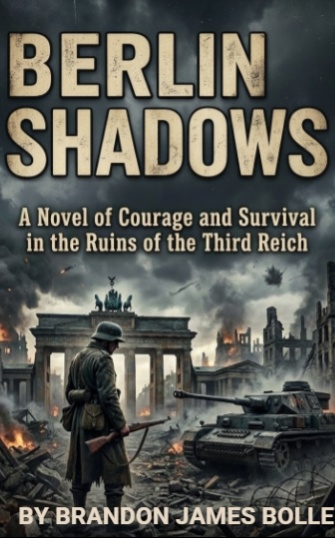
BERLIN SHADOWS
A NOVEL OF COURAGE AND ESPIONAGE IN THE RUINS OF WW2 BERLIN
by RON BOLLE
Berlin is a funeral pyre. As the Red Army’s artillery levels what remains of the Third Reich, physicist Elsa Meyer is running out of time. For years, she lived a double life as a lab assistant, harvesting the secrets of Germany’s atomic program for the Allies. Now, with Hitler’s bunker in chaos and her handler dead, she is the only one left who knows where the heavy water data is hidden. But Elsa isn't just fleeing the Soviets. SS Obersturmführer Kurt Hauser is purging every witness to the program, and Elsa is at the top of his list. To survive the gauntlet of ruined subways and sniper-filled streets, she must form an uneasy alliance with a guilt-ridden chemist and a rugged OSS operative. From the claustrophobic darkness of U-Bahn tunnels to the blood-soaked banks of the Elbe, Berlin Shadows is a high-octane race against total annihilation. Elsa carries the ledger that will define the post-war world, but in a city where every shadow hides a killer, the price of the future may be her own soul. Can she escape the collapsing heart of evil before the atomic dawn breaks over the wrong side?
- Thriller
- Historical Fiction
- WORLD WAR 2
- Spy Thriller
- Action Thriller
Berlin Nightmare
Berlin was a graveyard of stone and smoke. In the basement of the Kaiser Wilhelm Institute, the air tasted of wet concrete and burnt insulation. Elsa Meyer worked by the light of a single shielded bulb, her fingers steady as she fed the final sheets of isotope separation data through the microfilm camera. The numbers swam in neat columns: enrichment ratios, cascade efficiencies, the precise thermal neutron capture cross-sections that could turn ordinary uranium into something the world had never seen. Outside, the roar of Soviet Katyusha rockets shook the foundations hard enough to rattle dust from the ceiling beams.
She did not look up when the door scraped open. Major Sterling Vance stepped through in a tattered civilian coat that still smelled of cordite. His face was gray with brick dust, the scar along his jaw catching the light.
"Three blocks," he said without greeting. "Trophy brigades. They have lists. Scientists first, then the paper trail. Your name is on one of them."
Elsa advanced the film one frame. "Confirmed?"
"Intercepted an hour ago. They want the heavy-water calculations and every hand that touched them. We move now or not at all."
She sealed the cassette, slit the lining of her heavy leather satchel with a penknife, and stitched the microfilm into the seam with three precise stitches. The upper floors took a direct hit. Plaster exploded downward. The bulb swung wildly, throwing their shadows across crates of unfinished graphite moderators and half-empty canisters labeled D2O.
Vance pressed a scrap of paper into her palm. "Mitte district. Cellar beneath the ruined bakery on Oranienburger. Scholl has the procurement ledgers—every shipment from Norway, every failed electrolysis run. Without those files the cascade data is only half a weapon."
Elsa memorized the address and burned the paper over a spirit lamp. "Extraction?"
"I get you to the Elbe if I can. After that you're American property." His voice stayed flat. "Don't die for the math, Meyer. Die for the delivery."
They climbed the service stairs as a squad of terrified German soldiers poured through the lobby, rifles clattering, eyes white with panic. Vance melted into the opposite corridor. Elsa slipped out the side exit into a courtyard choked with broken masonry. The sky over the Spree glowed the color of old blood. Somewhere to the east another salvo of rockets howled in.
A Hitler Youth patrol rounded the corner—boys in oversized tunics, faces smeared with soot, bayonets fixed. One of them shouted about defeatists. Elsa kept her head down, satchel tight against her hip, and walked past them as if she still belonged to the Institute, still wore the white coat of a loyal assistant. The lie held for twenty steps. Then the lead boy turned, eyes narrowing at her civilian coat and the Institute pass still pinned to it.
She cut left into a gap between collapsed walls before he could raise the rifle. Bricks skittered under her boots. A shell landed two streets over and the concussion slapped her sideways into a cratered fountain. Cold water soaked her stockings. She crawled free, lungs burning, and did not stop until the patrol's shouts faded behind the next row of gutters.
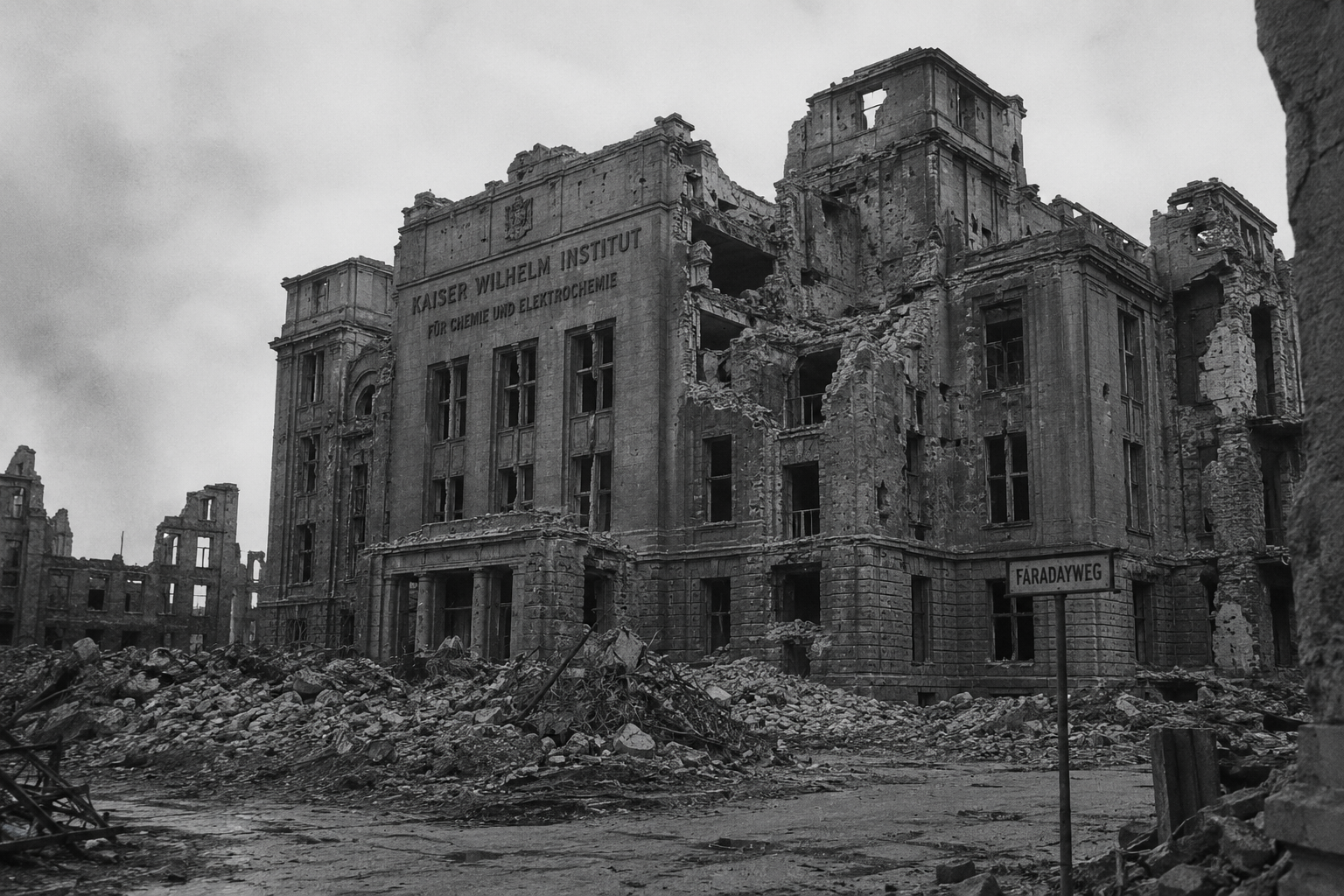
Her cover was ash. The Kaiser Wilhelm Institute was already a smoking husk, its last secrets riding against her ribs. She was a woman alone in a dying city, carrying the architecture of the atom in a few strips of film and a coded address. Every doorway could hide Hauser's men or Sokolov's trophy hunters. The isotope numbers kept scrolling behind her eyes—critical mass estimates, neutron multiplication factors—as if the equations themselves were trying to outrun the fire.
She checked the satchel once more, fingers finding the hidden seam. Intact. Scholl waited in Mitte with the heavy-water ledgers. After that, the long crawl west. Elsa Meyer straightened her collar, tasted blood where she had bitten her tongue, and stepped into the smoke-choked street.
The rockets came again, closer this time, turning the night into a continuous metallic scream. She calculated the odds the way she always had—distance, cover, ammunition she did not possess—and kept walking. The final formula was no longer on paper. It was moving through the ruins on two legs, and the city itself was trying to erase it before dawn.
The Scarred Inquisitor
Obersturmführer Kurt Hauser stood amid the gutted shell of the Kaiser Wilhelm Institute and breathed in the reek of scorched paper and wet brick. Soviet shells still hammered the eastern districts, each concussion sending fresh showers of plaster from the cracked ceilings. His black leather trench coat was powdered white with dust. Behind him, two …