

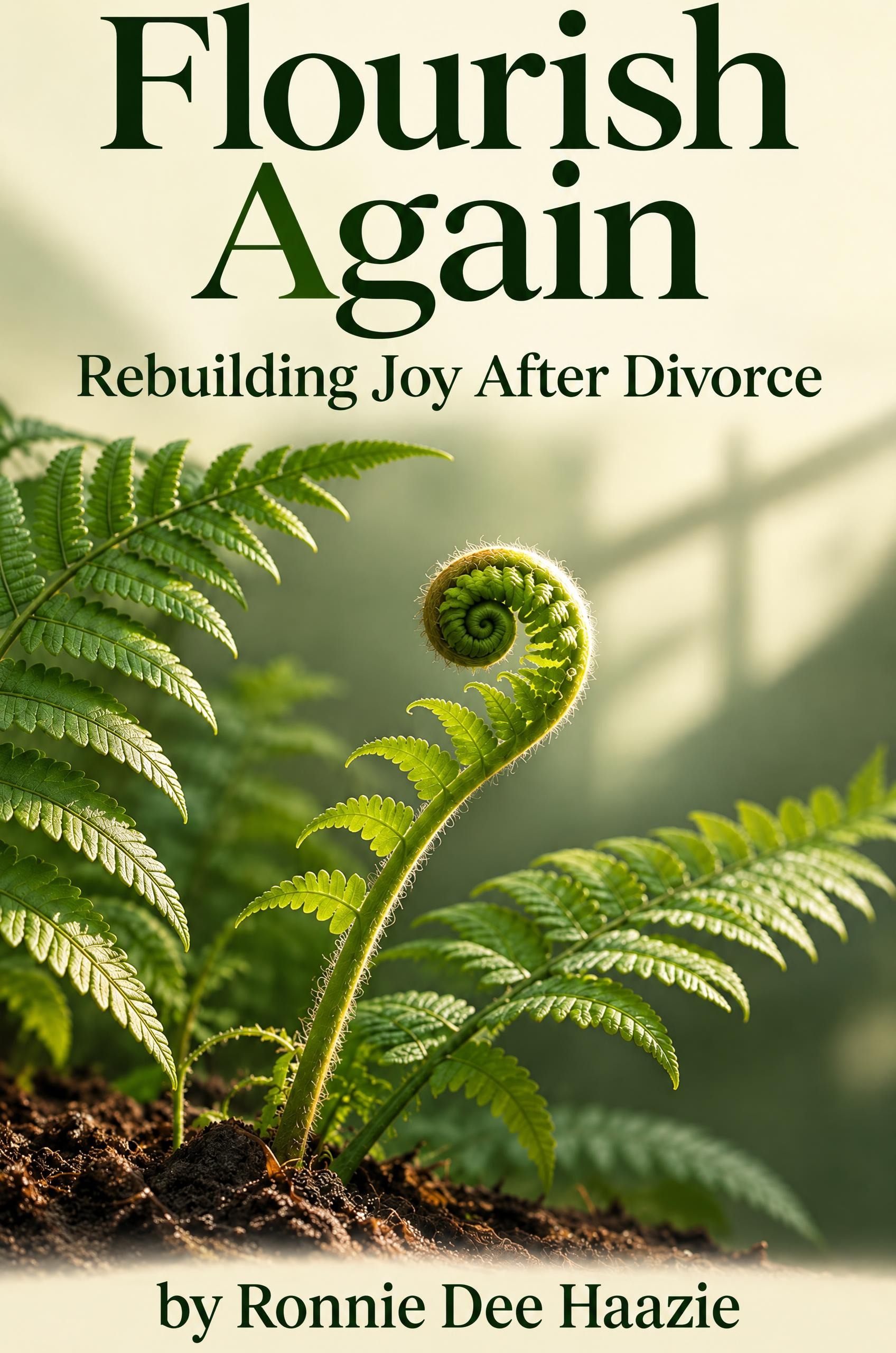
Flourish Again
A Compassionate Guide to Rebuilding Joy After Divorce
by Ron Ron
You are not broken, and you do not have to rebuild your life overnight. Flourish Again is a gentle guide for women 40 and beyond who are healing after divorce. Coach Ronnie, a certified transformational wellness coach, offers plain words and small steps in place of rigid timelines and empty comfort. Each chapter opens with a scene you will recognize. Then you get a short practice, a Faith Note with a verse for hard days, and journal prompts to help you hear your voice again. Inside, you will find: Calming tools for the nights when your heart races and sleep will not come Scripts for asking for help, setting boundaries, and saying no with kindness A calm first look at your money, with clear steps for getting organized Guidance for your children, for holidays and anniversaries, and for dating when you feel ready A four-week rebuilding plan with daily checklists, so you always know your next step Open to any chapter. Give it ten minutes. Take one step.
- Self-Help
- Wellness & Fitness
- Religion & Spirituality
- Life Transitions
- Boundaries & Self-Care
- Healing & Trauma
Embracing the New Beginning
Dawn is barely breaking, and the air in the house feels different. Still, almost echoing. The coffee smells familiar, but the second mug sits cold and unused beside the sink. Your phone buzzes with a calendar reminder, and your chest tightens as you think, "This is my life now." You take one breath and whisper, "Okay... one step."
A quiet that feels too loud
You wake up, and for a split second you forget. Then it lands again.
Maybe it's the silence in the house. Maybe it's the empty side of the bed. Maybe it's the fact that you no longer "check in" with anyone, and instead of feeling free, you feel untethered.
If this new season feels disorienting, you're not failing. You're adjusting to a shift that touches everything: your daily routines, your identity, your nervous system, and the future you pictured.
Divorce isn't just the end of a relationship. It's the end of a shared story, and grieving that story makes sense.
What nobody tells you clearly
Divorce hits like a wave, even when you saw it coming.
You might be grieving the relationship itself, even if it wasn't healthy. You might be grieving:
- The dreams you built inside it
- The version of yourself you were while you were married
- The family rhythm you expected to have
- The security you thought would last
And you are a woman with history. At 40, 50, or 60, you carry layers of experience. You are rebuilding with wisdom, scars, responsibilities, and a heart that's carried a lot.
Some days life feels oddly flat. You go through the motions of work, errands, and appointments, but the color is turned down. Music, cooking, holidays, and even getting dressed might feel strangely distant.
That doesn't mean joy is gone forever. It means your heart is healing.
Your emotions are not a problem to solve.
If you're feeling a messy mix of grief, anger, relief, shame, fear, numbness, peace, and loneliness, welcome to being human after a major transition.
You don't need to pick the "right" emotion. You don't need to rush into "being strong." You don't need to talk yourself out of what you feel. You need to tell the truth.
When you stop fighting your emotions, they soften. When you name what hurts, you begin to lead yourself out.
Try saying (out loud if you can):
"This is hard."
"I'm grieving what I hoped for."
"I'm allowed to feel both relief and sadness."
"I don't have to be okay today to be healing."
When judgment makes everything heavier
Sometimes what hurts isn't just the divorce. It's what people imply about it.
The sideways looks. The awkward silence. The well-meaning but sharp advice. The feeling that you've become "less than," "too much," "a cautionary tale," or "a problem to be fixed."
If you've felt judged by family, friends, church circles, coworkers, or even yourself, hear this clearly: other people's assumptions don't get to define your life.
Your divorce is not your identity. It's an experience you're walking through, and you get to write what comes next.
Your nervous system needs safety first.
After divorce, your body often behaves as if you're in danger, even when you're not. You might notice:
- Trouble sleeping, or sleeping too much
- Racing thoughts at night
- Anxiety spikes when the phone buzzes
- Tears that arrive "out of nowhere"
- Irritability with people you love
- Brain fog and decision fatigue
- Feeling numb, disconnected, or on autopilot
None of this is weakness. It's a stress response.
So the first stage of rebuilding joy is creating safety, inside your body and inside your days. Positive thinking comes later.
Small steps to start rebuilding joy
Joy doesn't usually come back as fireworks.
It returns like a candle.
Here are three gentle ways to light it.
1. Give your day two anchors. Pick two steady points you hit every day:
- Morning tea or coffee with 5 slow breaths
- A 10-minute walk after dinner
- One song you play while you get ready
- A short devotional or journal check-in before bed
Anchors calm your nervous system. They tell your brain: we are okay enough to keep going.
2. Reclaim one small choice. Divorce leaves many women feeling powerless, so we rebuild power through small choices. Pick one thing this week that is yours again:
- Rearrange a room
- Buy yourself flowers
- Sign up for a class
- Go somewhere you always compromised on
- Update your playlist
- Wear what makes you feel like you
Small choices restore identity.
3. Find your safe people. You don't need a crowd. You need two or three people who hold your truth without trying to rush you. If you don't have them yet, that is a starting point, not a life sentence. Chapter 5 shows you where to look and how to ask.
Faith Note
"God is our refuge and strength, a very present help in trouble." (Psalm 46:1, KJV)
If your faith is part of your life, this season will likely test it. That's normal too.
You might feel angry at God, ashamed to show up at church, tired of "everything happens for a reason," or desperate for comfort and unsure where to find it.
Here is a softer invitation. You don't have to perform faith. Bring your real heart, and God can handle your honesty.
Sometimes the most spiritual thing you do all day is whisper:
"Help me today."
Try This Today (5 minutes)
Put one hand on your chest. Breathe in slowly for 4 counts, then out for 6. Repeat five times.
Then ask yourself: "What do I need right now: comfort, clarity, rest, or support?"
Choose one tiny step. Text a friend, drink water, step outside, or write one honest sentence.
Journal Prompts
- What part of my life feels most unfamiliar right now?
- What am I relieved to be free from, and what do I quietly miss?
- If I gave myself one kindness today, what would it be?
- What small thing still brings me peace?
TAKEAWAY from this chapter: You are not behind. You are rebuilding, and you don't have to do it perfectly. Rebuilding faithfully, one day at a time, is enough.

Understanding the Grief
You're doing fine, right up until you're in the grocery store under bright lights and a song you didn't choose starts playing overhead. The smell of laundry detergent on someone's coat sends you back, and grief rises fast. Your phone lights up with a co-parenting text, and you think, "I thought I was past this." You steady your cart, breathe, and r…