

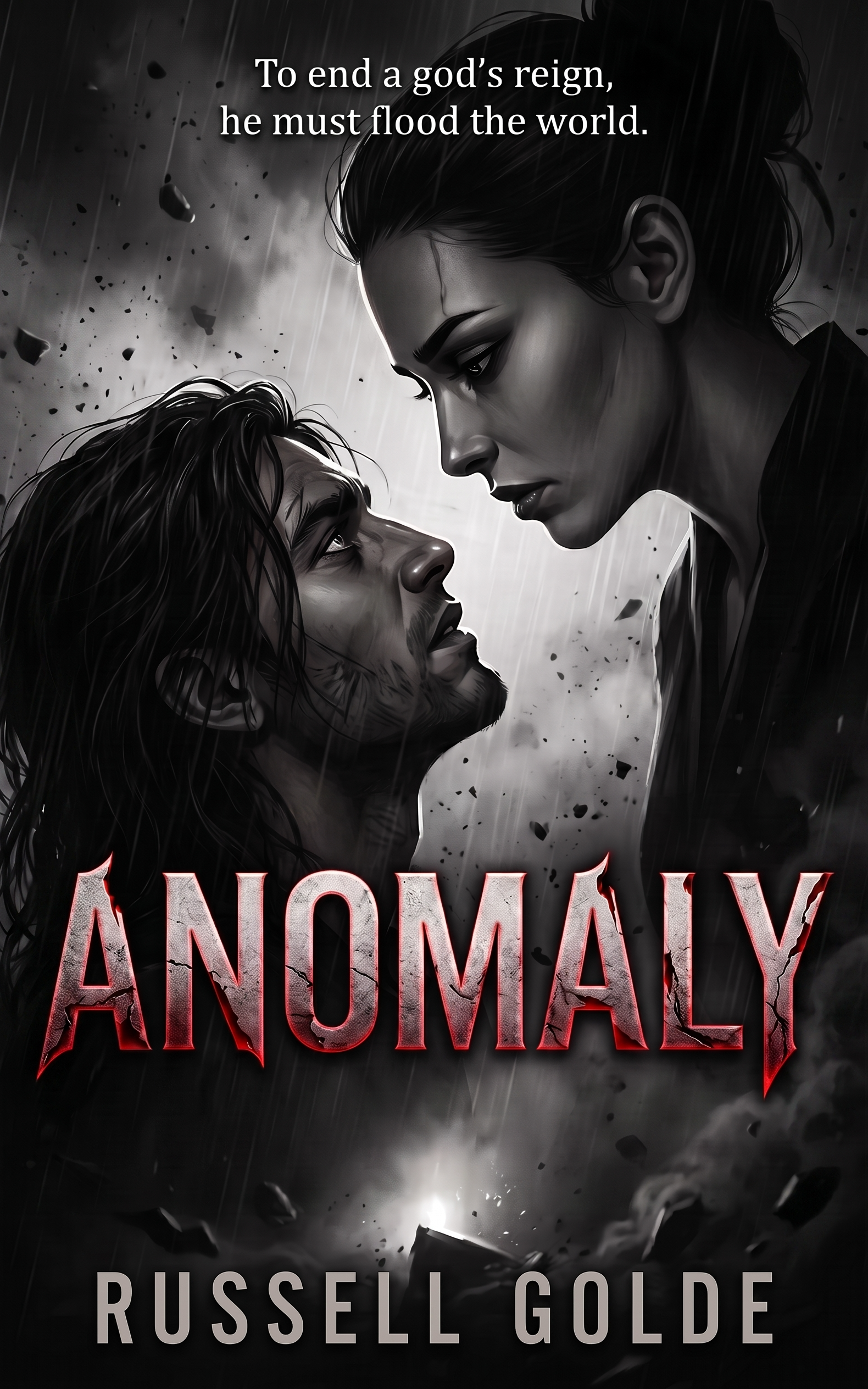
Anomaly
To end a god's reign, he must flood the world.
by Russell Golde
For generations, humanity has labored under the crushing hum of divine frequencies, controlled by the autocratic Anunnaki royalty. Zisudra Kaveh is just a broad-shouldered dockworker trying to survive in the shadow of the ruling elite. But Zisudra harbors a dangerous secret buried deep in his blood: he is a forbidden hybrid, born of a human mother and an Anunnaki scholar. Unlike ordinary mortals whose minds shatter under divine influence, Zisudra possesses the impossible ability to absorb and channel raw, godlike energy. Adorned with bismuth-tantalum bracelets and intricate gold-salt tattoos to contain his surging power, he is drawn into a perilous, electric bond with the goddess Nin-Me-Shar. When the warlord who slaughtered his parents returns to hunt him, Zisudra unleashes his hidden lethal capabilities. Targeted by a deadly assassin and hunted by the Anunnaki Council, Zisudra realizes that freedom cannot be requested—it must be forged in total destruction. To save humanity and the goddess carrying his unborn child, Zisudra plans the ultimate reset: hack the subterranean energy grid, melt the ice caps, and wash away the old gods in a catastrophic global deluge.
- Science Fiction
- Fantasy
- Adventure
- Space Opera
- Dark Fantasy
- Mythological
Chapter 1
The Uncle, Elias Thorne
The Nephew Zisudra Kaveh
“Dinner’s ready, Zisudra!” Elias called from the kitchen.
He came in tracking mud, clothes dark with the day’s work on the small farm. “Shoes off. Go wash up,” Elias said without looking up.
“Bone broth soup again.” Zisudra dropped into his chair.
“Can we go into town tomorrow?” He tried a smile.
“Work is slow. No money for town.”
“I could unload freight at the docks. The Anunnaki ships are always coming in.”
His uncle looked at him then. “Eat your food. And stay away from the Anunnaki.”
Zisudra was gone before the roosters woke, his uncle’s warning a weight in his gut. The port smelled of salt and industry, a world away from their farm. He watched men hauling crates from a towering Anunnaki vessel, their movements sluggish, defeated. When a foreman bellowed for more hands, Zisudra stepped from the crowd. He returned that afternoon, muscles aching and boots caked in harbor mud, but with a work chit in his pocket. “They need help,” he said simply. “I start tomorrow.”
Elias set down his cup. “I told you to stay away from the Anunnaki.”
“We have no money.” Zisudra met his eyes. “I’m of age. I’ll help support this house.” He didn’t wait for an answer.
Elias sat alone at the table after the boy’s door closed. He’d known this day was coming. That hadn’t made it easier to watch arrive. The docks would be full of Anunnaki, and Zisudra was not like other men. If they ever learned what he was, it would be the same as a death sentence.
The seasons turned. Elias would find himself staring out at the path leading to the farmhouse, wondering how the boy was managing in a man’s world. Ama would appear every few weeks, Zisudra’s childhood friend grown into a serious young woman, her dark braid over one shoulder, a small cloth purse set on the table without ceremony. Elias would feed her whatever he had. She would tell him what she knew.
In the village, he heard it too, the way rumors move through a market—stall to stall, mouth to ear— of a young man at the port who could shoulder a crate that took three men to load, who worked through the noon heat without water, without rest, without any of the ordinary limitations of the body.
Then one evening, months after he’d left , a man filled the doorway, broader and harder than Elias remembered, shoulders straining against the seams of his shirt, face weathered by wind and sun.
He’d left with a farmhand’s slouch and returned with the hard edges of a man who carried barrels and won arguments.
Even from across the room, Elias could see the new lines drawn at Zisudra’s jaw, the sun at the port burned into his skin.
The boy was gone, a man in his place. “Foreman,” Zisudra said, the word holding all the explanation needed for his absence. “The men still move like cattle. I’m working on that.”
“There is a reason for that,” Elias said, “you will find out in time.”
There is also a reason why you don’t, he thought to himself.
Zisudra’s hands, calloused and rope-burned, set down meat, red and thick. The dock master procured these for me when I told him I was going to see my uncle. The Anunnaki won't miss two steaks.
Elias stared at the beef for a long second with wide eyes. The steaks were dark and marbled, their edges rimmed with fat that would crisp and smoke in the pan. “I will start the fire” Elias said as he hurried to the wood stove.
The cuts left bloodstains on the scarred wood where sometimes Elias’s own meals had been thin broth and day-old bread. “Tonight we eat like the gods”, Zisudra said with a grin. “The gods”, Elias repeated with a touch of sarcasm. The steaks didn’t last long. What followed was the kind of night that moves through laughter and long pauses and old grievances and older memories, each one surfaced, held briefly in their conversations, then allowed to fade away. Before the sun crested over the hills, Zisudra was gone again. Elias woke to the smell of cold fat in the iron pan and two more steaks wrapped in banana leaves with a note that read Thank you for everything, Uncle. The chair across from him was empty, pushed back at an angle, as if Zisudra had only just stood up. He poured himself a cup and sat with the things he could not say. Another time, perhaps, he thought.
Chapter 2
The early morning fog was burning off at the pier, but the gulls’ harsh cries were drowned out by an unnatural, low-frequency hum that vibrated through the dockworkers’ bones. It was the sound of the Anunnaki control frequency. Into this came Nin-Me-Shar, Anunnaki royalty, a goddess by the agreement of anyone who had ever looked at her, her royal g…