

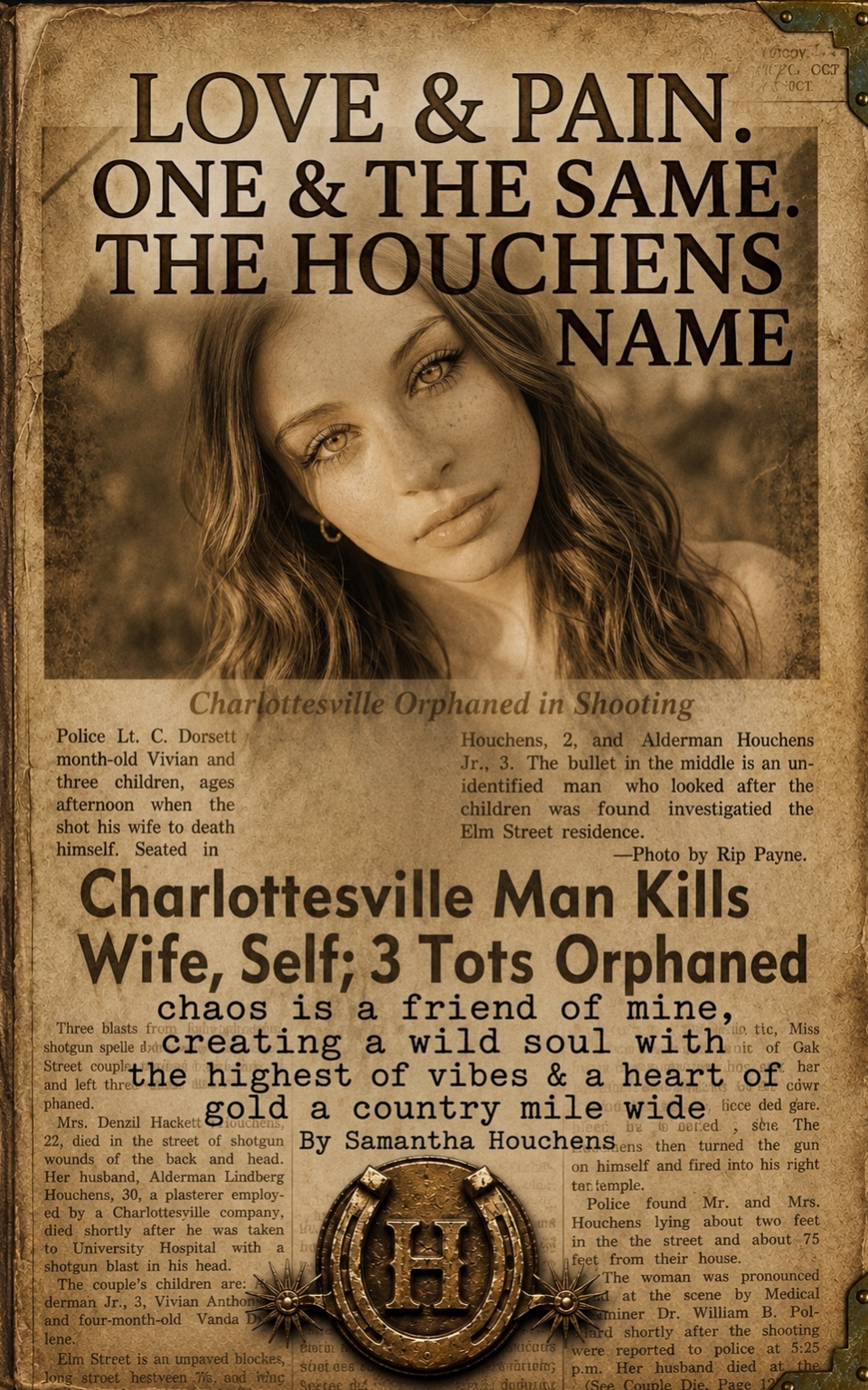
Love & pain , the houchens name. One & the same
Unearthing a legacy of silence and the violent truth behind a family name
When Samantha Houchens was a child, her father handed her an old newspaper clipping and spoke five words that would haunt her forever: "My dad killed my mom." In that moment, the boy in the photograph—one of three children orphaned by a 1962 murder-suicide on Elm Street in Charlottesville—became more than a headline. He was her father, and the tragedy was her inheritance. For decades, the Houchens name has been synonymous with whispered warnings and a shadow of violence that refused to dissipate. "Love & Pain. One & the Same. The Houchens Name" is a gut-wrenching investigative memoir that digs into the red clay of Virginia to unearth secrets buried for over sixty years. Through a meticulous trail of court records, death certificates, and forgotten archives, Samantha explores a family tree scarred by unexplained fires, suicides, and systemic silence. Is the bloodline cursed, or were they simply human beings broken by a community that chose to look away? This is not just a true-crime documentary in prose; it is a daughter’s journey to break the cycle of generational trauma. Raw, haunting, and deeply courageous, Samantha Houchens confronts the ghosts of her past to ensure her children inherit a legacy of truth rather than a legacy of pain.
The Box in the Cabinet
There is a particular way people lower their voice when they say certain names. Not a whisper exactly. More like the volume drops automatically, the way your body pulls back from something hot before your brain has finished deciding it's dangerous. I noticed that sound long before I understood what it meant. I was just a kid, small enough that adult conversations happened somewhere above my head, and I would catch fragments the way you catch rain in your hands. A word here. A pause there. A name that made the air in a room go tight.
That name was Houchens.
Red was everywhere in my childhood, and I mean that in the most literal sense. The dirt of Orange County, Virginia has a reddish clay to it, the kind that stains the knees of your jeans and packs under your fingernails and stays there no matter how hard you scrub. I grew up with that dirt on me constantly. Red dirt roads that led to places most people on the outside never thought to look. Red mud that clung to truck tires and boot soles and the backs of dogs. And the roses my father kept in the yard, stubborn old climbing roses along the fence line, red as anything you have ever seen. He never talked much about why he planted them. He was not a man who explained his softer choices. But they were there every summer, bloody bright against the green, beautiful and thorny in equal measure.
He warned me about the thorns. That was the thing about my father. He would hand you something beautiful and immediately tell you how it could hurt you. I thought that was just his way of being careful. It took me most of my adult life to understand that was actually the most honest thing he ever taught me. Beauty and danger sharing the same stem. Love and warning wearing the same face. He knew that long before I did.
I was seven the afternoon he decided the warning needed words. The kitchen smelled like it always did in those years, a mix of fry grease and the cold metallic bite of Budweiser from the can he kept within reach. His tattoos showed dark against his forearms where the flannel sleeves were rolled. He moved like a man made of granite and old timber, quiet even when he walked. I sat at the table with my legs swinging, watching him open the cabinet above the stove, the one that held the things we never used for regular days.
He reached all the way to the back and pulled out a weathered box. The cardboard had gone soft at the corners. He set it down between us and lifted the lid like he was handling something that could still cut. Inside were folded papers, a few photographs gone yellow at the edges, and one newspaper clipping that crackled when he smoothed it flat with his palm.
Three small children stood in front of a house. The print under the picture named the street. Elm Street. Charlottesville. The year across the top of the page was 1962. My father put one thick finger on the middle child, a boy with a face that looked too serious for the size of him.
"That's me," he said.
I looked at the boy. I looked at my father. The kitchen light made everything ordinary and wrong at the same time.
"My dad killed my mom," he said. "Then he took his own life."
There was no buildup. No soft landing. Just the words sitting there in the red-tinted afternoon like something that had finally been allowed out of the dark. I remember the way my stomach dropped, the same drop you feel on a bridge when the boards give a little under your feet. I was seven. I did not have language for murder-suicide or orphan or generational anything. I only knew that the man who planted roses and fixed broken things with his hands had just handed me a story that made the air leave the room.
He watched my face. He did not rush to fill the silence. That was his way. He gave you the hard thing and then he waited to see if you would bleed from it.
"Those other two are my brother and sister," he said after a while. "We were left after. People talked. They still do, some of them."
I stared at the clipping until the newsprint blurred. The little boy in the photograph had my father's eyes. Or my father had his. The house behind them looked plain, the kind of place that should have held ordinary days, not the end of them. I wanted to ask how. I wanted to ask why. The questions sat heavy behind my teeth and never quite made it out. Instead I nodded like I understood, because that felt like the only safe thing to do.
After that day the name we carried changed weight. Before, Houchens was just what people called us at school and at the feed store. After, I started hearing the way voices dropped around it. Careful. Like people saying the name of a place where something bad had happened. Not because the place itself was evil, but because the memory still had weight. I began collecting those lowered voices the way other kids collected baseball cards. Fragments at church parking lots. Half-sentences over back fences. The specific body language of people who remembered things they were never quite sure how to talk about.
My childhood turned into what I would later call silk-dressed suffering. We wrapped the hard parts in beauty because the naked version was too much to look at straight on. My father kept planting those roses. He kept warning me about the thorns. He fixed what broke in the house and stayed quiet about what had broken long before I was born. Love and pain grew on the same stem in that yard, and I learned early that you could not separate them without cutting yourself.
I carried the clipping in my mind for years after he put the box away again. The image of those three children. The blunt sentence that rewrote the map of who we were. I grew up inside both the reality of what happened and the mythology that gathered around it like silt in a riverbed. Some people called it a curse. Some called it bad luck. Some just stepped back when the name came up and let the silence do the talking.
Now I am grown, and the box is open on my own table. The same clipping lies under the lamp, the newsprint thinner, the edges more fragile. The boy in the middle still looks out at me with my father's eyes. I know more names now. Alderman Lindberg Houchens. Denzil Douveries Hackett Houchens. I know the street. I know the year. I know that one violent day on Elm Street sent something moving through the bloodline that never fully settled.
The search is no longer optional. The red clay holds what happened on it and does not offer explanations. Places keep memory even when people try to forget. I used to ride those back roads as a teenager and feel something I could not name, something between sadness and pride. The Houchens name was attached to this county, to its soil, to specific addresses and specific moments recorded in courthouse papers and the long memory of old people who watched it all happen.
I am done dressing the pain in silk and calling the wrapping enough. Beauty and danger still share the stem. That part has not changed. But I need the truth of what grew there, the ordinary human breaking that no one stopped and no one fully named. The little boy in the photograph deserved more than a lowered voice. So did the woman who died in that house. So do the ones who came after and carried the weight without a map.
I touch the edge of the clipping the way my father once did. The paper still crackles. Outside, the roses along the fence are coming into their first hard bloom of the season, red as anything, thorns waiting for whoever reaches without care. I know better now. I reach anyway.
The Geography of Silence
I started at the feed store because that is where Orange County still tells the truth sideways. Men in work boots stand around bags of sweet feed and talk about weather and cattle prices and whose tractor broke down, and if you wait long enough the talk slides toward people. I parked on the gravel lot off Main Street, felt the red dust rise around …